

Lau here.
This was supposed to be a short one, since I spent most of last week with my head buried in the latest monthly issue of SNAFU Investing, which went out on Saturday. But what a week it’s been.
Gold just had its worst week in eight months, sliding more than 9%.
Of course, with everything falling apart around it, the selloff had nothing to do with gold.
What happened was that the AI trade unraveled badly enough to take the yellow metal down with it, along with the stocks that mine it. (I go into more detail in the latest issue, but suffice it to say that gold is one of the easiest things to sell when you get a margin call.)
Like so much lately, it started with Nvidia.
The chipmaker has had a rough time since the ouster of Jensen Huang, after some of his extramarital affairs came to light (including one with an alleged Chinese spy, though I’ve yet to see the evidence).
Its shares kept sliding into earnings in the middle of last week, and a beat didn’t stop them. Anthropic’s record stock market debut on Thursday was supposed to lift the mood, but by Friday it had given back much of its first-day gain. Then Reuters reported that the SEC was looking into Nvidia’s accounting, and the stock fell 14% in a day, ending the week down about 23% and nearly half below its October high.
From there it spread to the rest of the chip stocks, then to the data center suppliers, then to pretty much everything else. The S&P 500 fell nearly 9%, its worst week since the tariff shock of April 2025, the Nasdaq-100 lost more than 10%, its worst since March 2020, and bitcoin dropped below $60,000.
None of this should come as a surprise.
If anything, it exposed the obvious weakness of this market. I’ve written about how lopsided it is more times than I care to remember. When ten or so giants, most of them riding the AI trade, make up about 40% of the S&P 500, you’re basically dealing with a house of cards that can come down in the first stiff breeze.
So if your portfolio, whether it’s mining stocks, energy or anything else, was a sea of red on Friday, chances are it had nothing to do with the specific stocks you own.
Which brings me to a meme I like for weeks like this one.
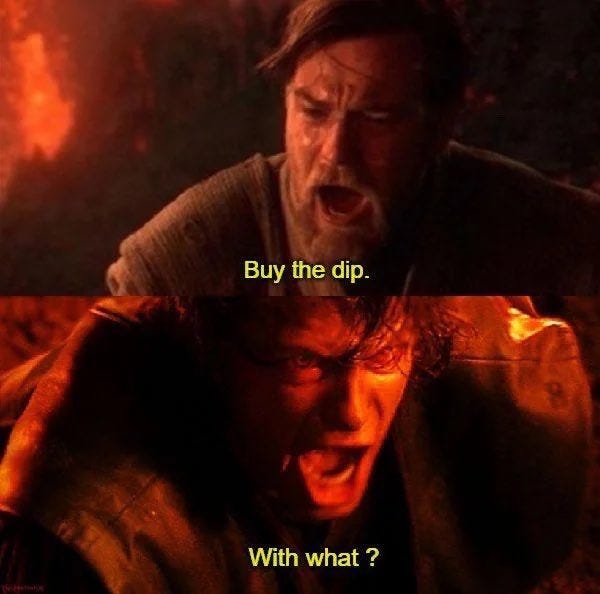
It’s a tale as old as time.
People pile all their money into something at once, and then it falls, and falls again, and again as the whole market sells off around it. Suddenly the best buying opportunity of the year is staring them in the face, but they’ve got nothing left to buy it with. It’s not a great position to be in.
Now, if you’ve been in the markets for any amount of time, you’ll know that no one can protect you from a selloff like this one. When it’s bad enough, people sell whatever they can, and it doesn’t much matter what it is.
The baby gets thrown out with the bathwater.
But there are things you can do to protect yourself on the downside and make selloffs a little more bearable. That’s exactly why I always insist that SNAFU Investing subscribers buy in tranches, with standing orders placed in advance at lower prices, so that when a week like this one comes along, there’s hopefully still money left to put to work.
I laid out exactly how I do it, stink bids and all, in Why I Never Go All-In on a Stock. If you haven’t read it yet, it’s worth a few minutes of your time.
I’ve followed this approach religiously for years. But I’ll admit that, like most rules about risk, it can sound pretty theoretical until you live through a real crash.
For me, that crash was March 2020. When COVID hit, everything got sold at once, much like now, and gold wasn’t spared either, as people dumped whatever they could to raise cash.
You may remember what happened next.
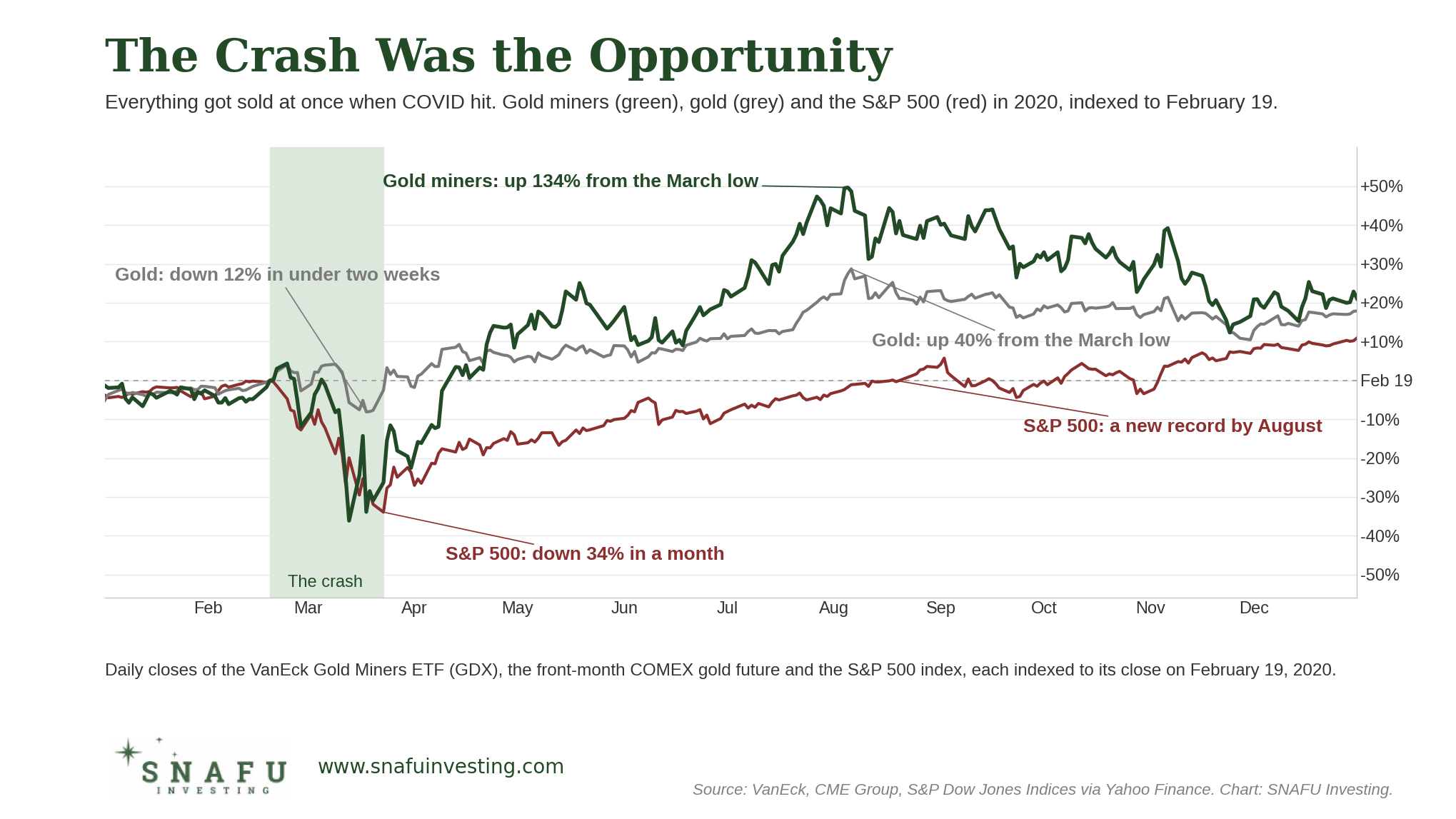
That turned out to be the bottom. Within five months, gold was at a record above $2,000 and gold stocks had more than doubled. Because I never went all in and bought in tranches instead, I still had money left to put to work that spring, and let’s just say I haven’t regretted it.
Granted, that’s easy to say now. It was a lot harder at the time, when nobody knew how bad things would get. That’s why the preparing happens before a crash, not during one, by owning good assets and buying them in a way that doesn’t leave you swimming naked when the tide goes out.
That’s where the real money is usually made, not in buying something that has already gone up fivefold in the hope it goes to ten.
UPDATE: Just as I was about to hit send, Nvidia’s board reinstated Jensen Huang as CEO, and the stock jumped more than 30%.
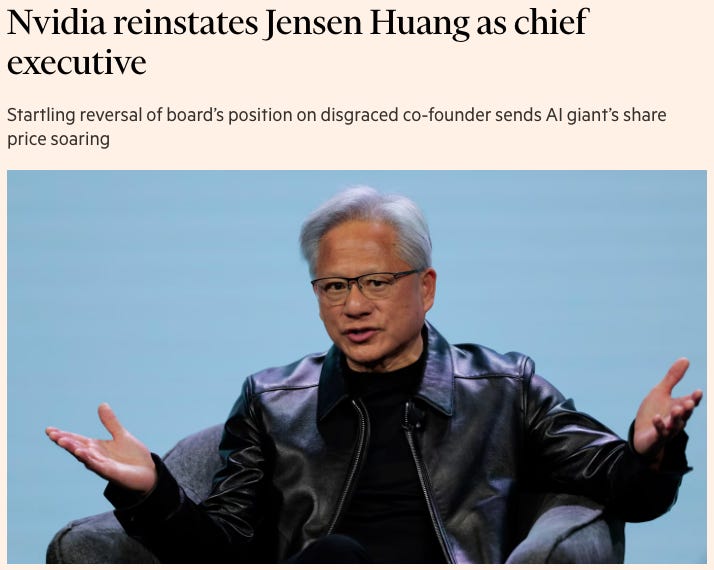
That’s good news for Nvidia’s shareholders, at least in the short term. But as I explained in a recent essay, Huang is the same CEO who presided over Nvidia’s habit of, in effect, paying for part of its own demand, and with him back, that will probably continue.
Which is why I suspect last week was a crash that took everything down with it, but not the crash. So stay vigilant.
(The Nvidia essay is linked below, along with the latest issue, where you’ll find the low-cost gold producer I’m buying now.)
November Issue: The Great Gold Bust, and How We're Playing It

Gold just had its worst week in eight months. On Friday it touched $3,514 an ounce, its lowest in more than a year, and it’s now down more than a third from the record of about $5,590 it set in late January. The stocks that mine it have fared even worse, which, as you’ll see in a moment, has left us with some incredible opportunities.
Alert: The Permit We’ve Been Waiting On Is In

I have updates on two of our positions today. One, our uranium producer, finally got the permit we’ve been waiting on since July. The other, our gold developer, got caught in the gold selloff and dropped to our stink-bid level, the third and final tranche, which completes the position in the portfolio.
The AI Boom Has a Bigger Problem Than Jensen’s Love Affairs

Earlier this week, I wrote about Jensen Huang’s affair with a woman suspected of spying for China. The next day, the New York Times reported a second affair, this one with an Nvidia executive who reported to him. On Thursday, Huang resigned as CEO and left the board, and by then Reuters had reported a third (I may have lost count). His replacement, for …
From the Comments
One of the things I’ve come to appreciate most about writing here is the conversation that happens in the comments. Here are eight recent ones that stood out, for different reasons. Each links back to the piece it appeared on, so you can click through if you’re interested in the context.


Thanks again to everyone who left a comment recently. I read every one, and while I’m a little behind on some replies after a busy week, I’ll do my best to catch up over the coming days.
Regards,
Lau Vegys
P.S. We’ve had quite a few people join us recently. If you’re one of them, welcome aboard. Your timing is excellent: a new pick just went out, and the selloff sweeping the markets has put much of our portfolio on sale, which is good news for anyone new to these positions or with tranches still to fill. Here are a few links to get you oriented (just make sure you’re logged in with the same email you subscribed with, or the paid-only posts will stay locked):
The November issue, with the gold producer I mentioned above: the full write-up, buy-up-to price and tranche levels.
The October issue, with an oil producer selling cheap shale crude to Asia from a coast no one can close.
Earlier picks, including a silver and gold producer, a U.S. gold developer trading at a fraction of what its ounces are worth, and the one American company making the rare earths China keeps for itself.
The live portfolio, with every current position, its original entry price, current price and full tranche guidance. (With a lot of you opening it at the same time, the page can be slow to load. If it doesn’t come up properly, just give it a refresh, and make sure you’re seeing all the positions.)
The alerts, which usually go out the same day anything changes: a new buy, a change in guidance, a position that's doubled, or material news at one of our companies. Lately that's been roughly once a week. (They're also the best way to catch up on the companies already in the portfolio.)
The uranium special report, a deep dive into the uranium market and the opportunity in it.