

A word before we start. This is the second of the SNAFU Investing monthly issues, which come at the end of each month. This one carries a new recommendation, below the paywall.
“China and the United States must hold the line of no conflict and no confrontation between us. The Thucydides Trap can be overcome.”
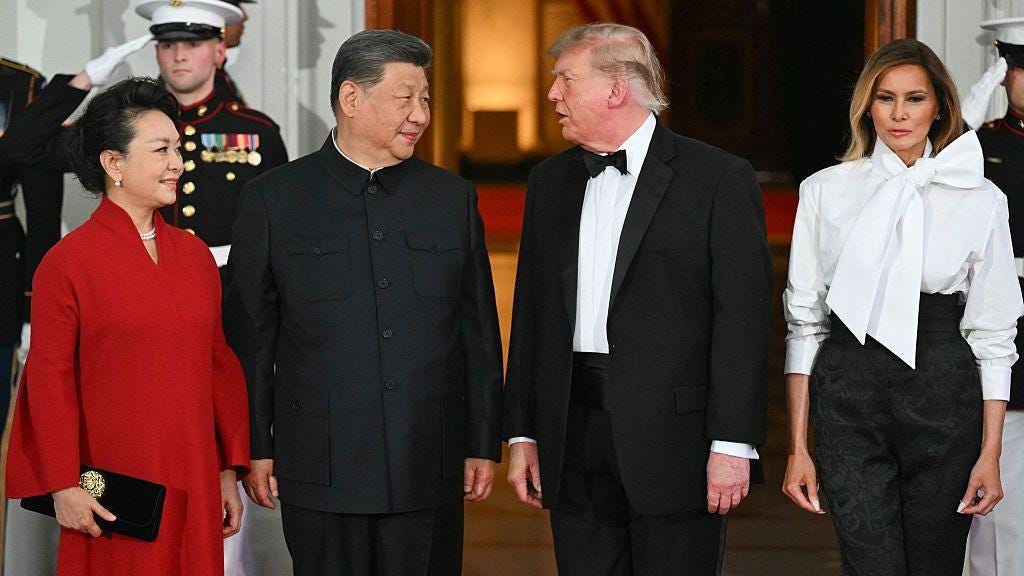
Xi Jinping said that earlier this week, on the South Lawn of the White House, at the welcome ceremony for his state visit, with Trump beside him and a military band behind them. Most of the coverage gave the line a sentence and moved on to the trade numbers. I think it was the most important thing anyone said all week. I’ll explain why in a moment.
But first, some background, in case you’ve been living under a rock for the past eight years. The United States and China have been locked in an on-again, off-again trade war since 2018: tariffs, counter-tariffs, export bans, a truce, the collapse of the truce, another truce. The latest of those came last November, when the two sides agreed to put their newest round of tariffs and export controls on ice for a year and talk instead.
This week’s state visit was the latest round of that talking. Xi came to Washington, stayed three days, and the two sides agreed to extend the November truce by another two months, to January 10, and to meet twice more before then, in Shenzhen and in Miami.
If you followed the coverage, especially in the more president-friendly outlets, you probably came away with the impression that a deal is just around the corner, and that once it’s signed, everything goes back to business as usual.
I don’t think so. The trade war between the U.S. and China was always a sideshow of a much bigger issue: who will be the world’s dominant power?
It will either be China, or it will be the United States. It can’t be both.
China’s economy is already larger than America’s on a purchasing-power basis. Its navy has more ships. And it controls about 90% of the world’s rare earths, which, as it happens, is what this issue is about.
Meanwhile, the U.S. finds itself in the same position previous established powers did when a rising one came up behind them: more than US$40 trillion in debt, running wartime deficits in peacetime, paying more in interest than it spends on its military, and stretched across commitments on three continents it can no longer comfortably afford.
This dynamic has a name, and it’s the one Xi reached for on the South Lawn: Thucydides’ Trap, after the ancient Greek historian who wrote the history of the Peloponnesian War between Athens and Sparta. Sparta was the established power. Athens was the one rising fast. And the trap, as Thucydides described it, was that the rise of one and the fear it produced in the other made war inevitable.
Now, I’m not saying war between the U.S. and China is inevitable. But if history is any guide, the odds are not comforting.
A guy called Graham Allison, a professor at Harvard, has studied sixteen cases of Thucydides’ Trap over the past five hundred years. In twelve of them, 75% of the time, the result was war. Not a trade dispute. War.
The clearest modern example is the one everyone learns in school: World War I. Britain was in decline. Germany was rising fast. War became inevitable. But it’s not the only one from living memory. Japan was the rising power in the Pacific in the 1930s, the United States the established one, and we all know how that ended. Go back further and you get England and the Dutch in the 1600s, Britain and France in the 1700s, and the same story each time.
Now, it’s true that China might be fine with being number two globally as long as it’s number one in its own neighborhood. It might even be fine with the dollar staying the world’s reserve currency, given what that job costs the country that holds it (economists call it the Triffin dilemma: to supply the world with dollars, America has to run the trade deficits that hollow out its industrial base), as long as the yuan is what its neighbors and its oil suppliers settle in.
My fear is that the U.S. couldn’t swallow even that. Losing Asia and watching the yuan gradually take over its own backyard would be challenge enough, and a power that feels itself being cornered tends to do what any cornered animal does. It lashes out.
I may well be wrong. But I remember enough physics to know that objects in motion tend to stay in motion, and U.S.-China relations have been moving in one direction (not a good one) for eight years. Nothing about this week reversed that, by the way.
That’s why I think that even if some sort of deal gets worked out, in Shenzhen or in Miami or wherever the next handshake happens, it will do nothing to resolve the larger problem.
Trump understands that. So does Xi. Which is why, standing on the South Lawn, he reached for Thucydides.
Now, before I get to this month’s pick, which I think is the best way to profit from all of this right now, and which has the kind of multi-bagger potential I look for, let me lay out the case for it. It starts with those rare earths I mentioned, and why China’s grip on them is a much bigger problem for America than most people realize.