


Do you remember the oil shock that never materialized? The one China quietly canceled a couple of months ago?
Well, it looks like we may not have escaped it after all.
Now, I’ve already written to you this week about the diesel problem, and why President Trump’s recent deal with Russia isn’t going to do anything to solve it.
But today I want to step back and look at the big picture, because it has changed significantly since I last covered it in depth. The oil market is now being squeezed from three directions at once.
The first comes from the Iran war, where the fighting has spread from the oil fields to the things that carry the oil: pipelines, ships, and sea lanes. The second comes from Saudi Arabia’s war against a bunch of guys in sandals, who have been threatening shipping routes on the other side of the Arabian Peninsula. And then there’s China. The country that canceled the oil apocalypse in the spring has started buying again.
You don’t need me to tell you that things have been, to put it mildly, volatile across the board.
But I think we’re looking at something more than that now. Oil is getting harder to move just as the world’s biggest buyer starts competing for it again. Those pressures are starting to feed one another, and the result could be a much bigger oil shock than most people expect.
Which is why I think this whole situation warrants a closer look.
Note: This is a long one. I’ll get to a way to profit from all of this at the end, but even if you never buy a share, I think understanding how these pieces fit together will be worth your time.
So grab a coffee. Let’s dig in.
How China Bought the World Time
First, a quick recap, because it will make everything that follows easier to understand.
In February 2026, Benjamin Netanyahu convinces Donald Trump to launch a war against Iran. We get plenty of conflicting explanations along the way: preventing attacks on U.S. bases, protecting Israel from an imminent strike, stopping a bomb, regime change.
But the regime doesn’t just survive. It does the one thing everyone said it would never dare to do: it shuts the Strait of Hormuz, cutting the world off from roughly 15 million barrels of crude a day.
Now, oil trades in one global market. The world consumes roughly 100 million barrels of oil a day, and there is very little slack in the system. Take away the 15 million barrels of crude that used to come through Hormuz, and the whole world has a problem.
There were workarounds, though.
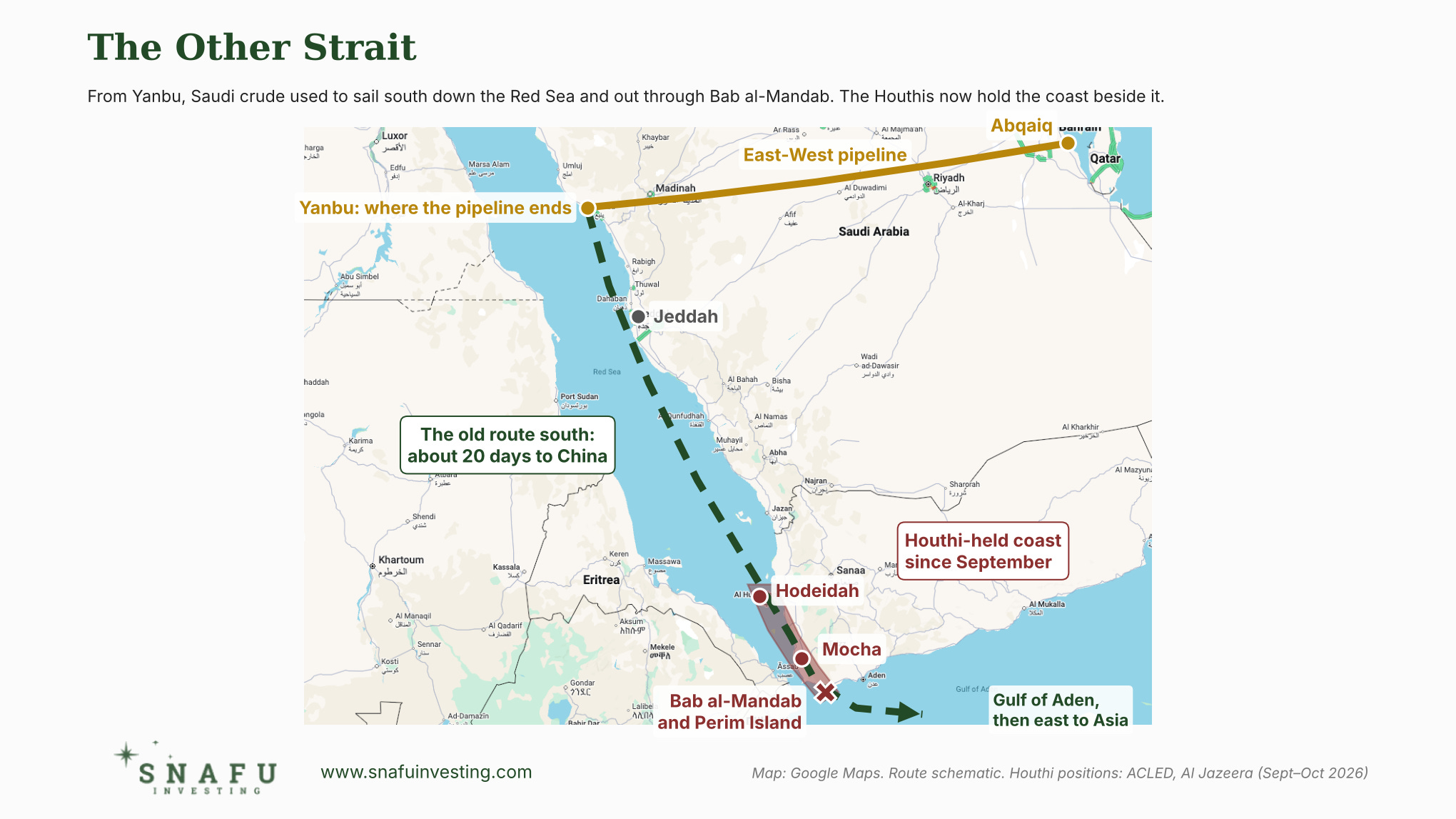
First, Saudi Arabia cranked up the mother of all oil pipelines: the East-West Pipeline. It runs, as the name suggests, from the oil fields in the east to the port of Yanbu on the Red Sea, crossing 750 miles of mostly desert along the way. It can carry about 5 million barrels a day (since expanded to 7 million). From Yanbu, the oil goes north toward Suez and Europe, or south down the Red Sea and out to Asia.
Then the UAE’s Habshan-Fujairah line added another 1.5 million barrels a day. It pops out on the Gulf of Oman, beyond Iran’s blockade. The map below shows how the two routes work.
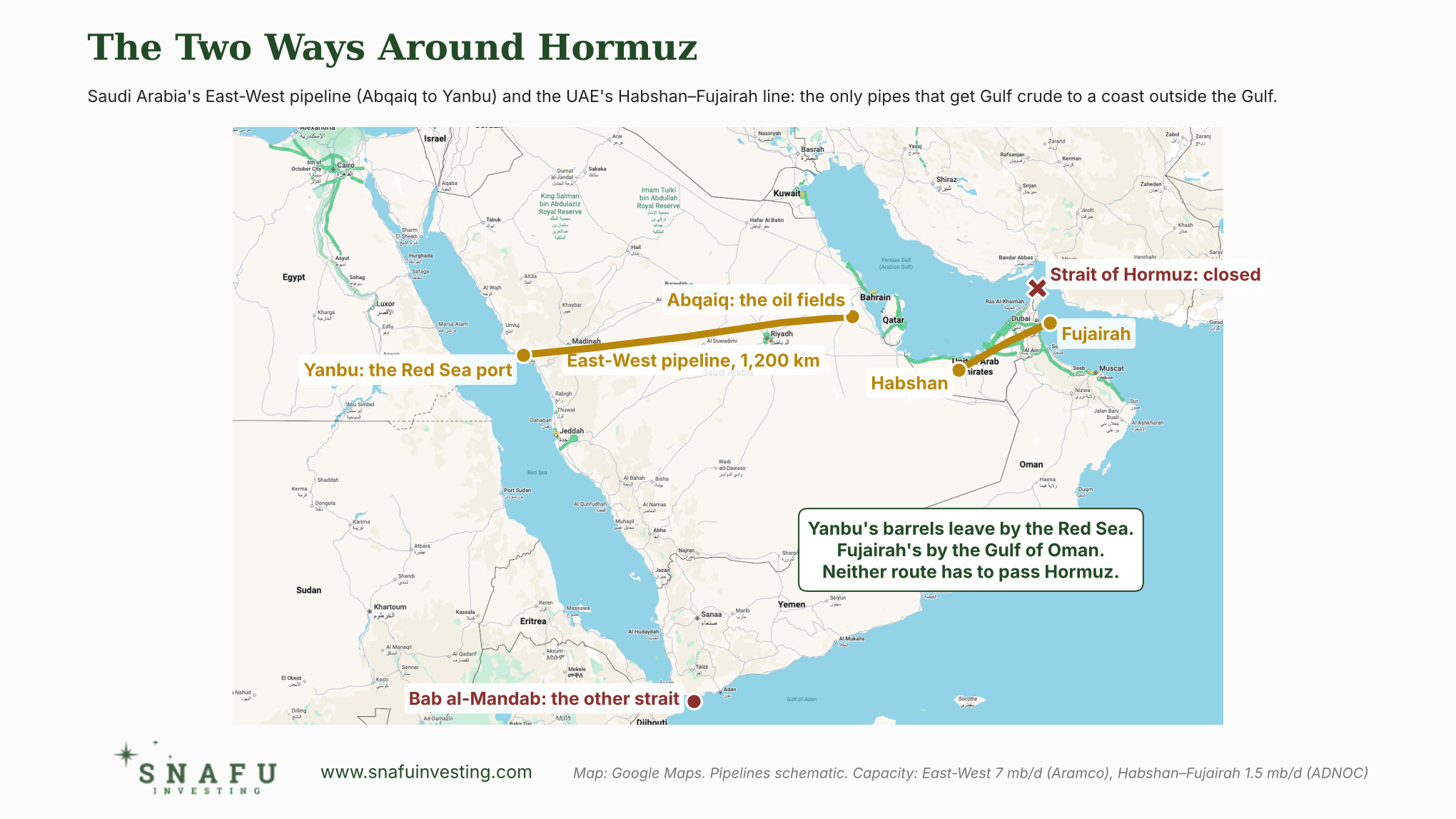
That gave us about 6.5 million barrels a day of bypass capacity.
Then came the IEA’s emergency release of 400 million barrels from strategic reserves, the biggest in history. Spread over months, that worked out to roughly 2 million barrels a day actually reaching the market. Add perhaps another million from shadow-fleet tankers willing to run Hormuz with their transponders off, for a fat premium, and the total came to about 9.5 million.
Against the 15 million that used to flow through Hormuz, that still left the world 5.5 million barrels short. Every day.
Which is where China came in.
The world’s biggest oil importer quietly cut its purchases by 4.9 million barrels a day. Coal, fewer fuel exports, and a decade of EV subsidies helped it get by on less imported crude. But the real backstop was its immense oil reserves. Here’s the chart I showed you then.
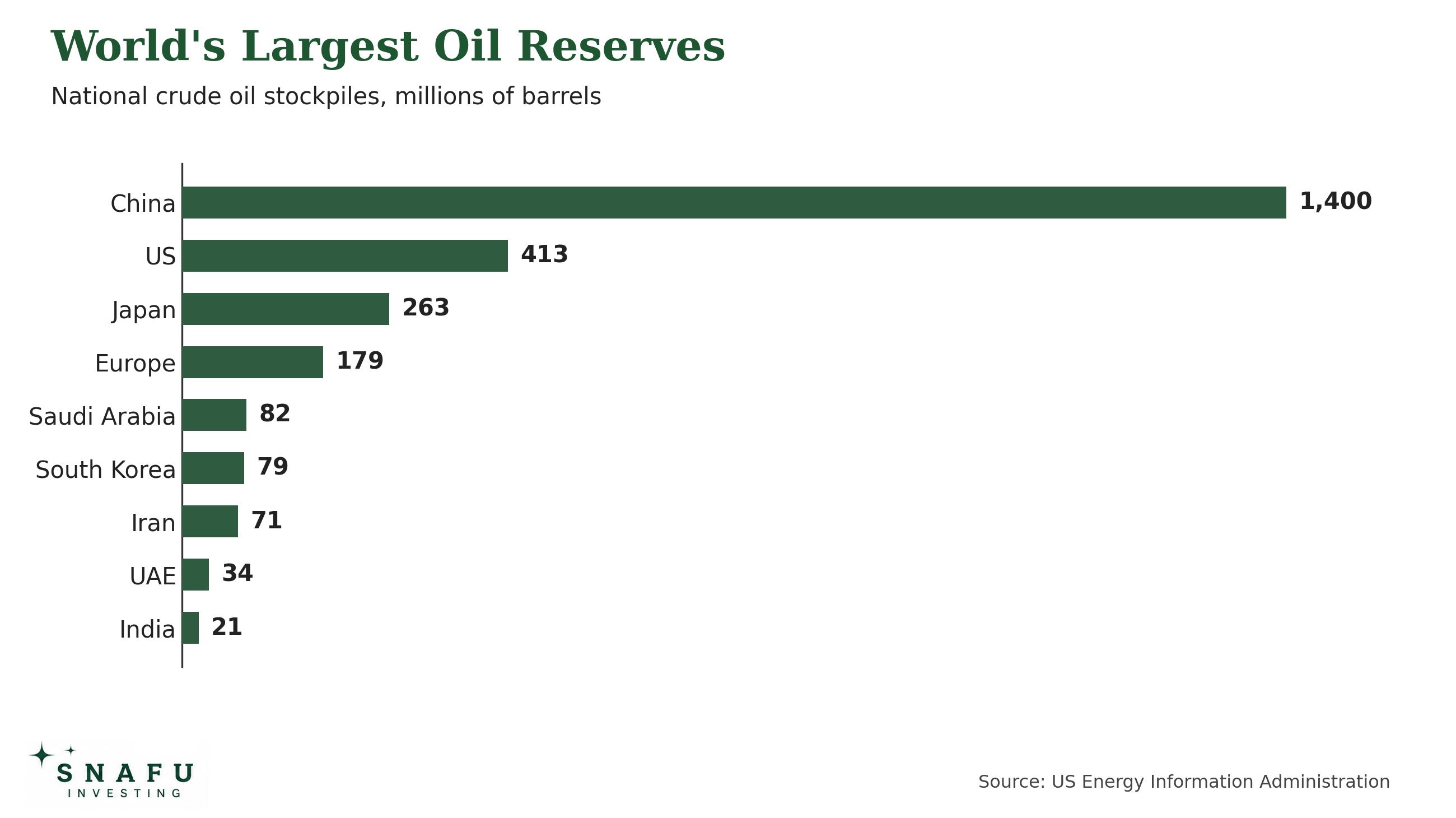
China’s cut covered almost the entire shortfall. The oil apocalypse was postponed.
Sure, it wasn’t pleasant. You probably noticed it in canceled flights, your energy bills, or at the pump. But it was bearable.
That was the picture in July. It is not the picture now.
The Guys in Sandals
A lot of what changed comes down to the guys in sandals. They call themselves Ansar Allah, or “Helpers of God,” but they’re better known as the Houthis, after the family that leads them.
Here’s how they fit into this story.
Yemen, Saudi Arabia’s southern neighbor, has been in a civil war for over a decade. Saudi Arabia intervened on one side back in 2015; the Houthis, allied with its archenemy Iran, fight on the other. For years, it was the same tit for tat: the Houthis lobbed missiles and drones at Saudi cities and oil facilities, the Saudis bombed Yemen, and the front lines barely moved.
Then, this summer, the war began to change. In July, the Houthis declared a blockade on any ship linked to Saudi Arabia. By late August, they had attacked ten commercial vessels, most of them tankers, hit six, and sunk one, killing four crew members.
September brought the real breakthrough. In the space of a week, the Houthis pushed 150 kilometers down the coast, took the port of Mocha, and overran Perim Island. By September 13, they held Yemen’s entire Red Sea coastline.
Including the spot you can see on the map below: Bab al-Mandab. Like Hormuz, it’s a strait and one of the world’s important oil chokepoints. This one is the southern door of the Red Sea, about twenty miles wide. At its narrowest point, the Houthis now sit just twelve miles from Africa.
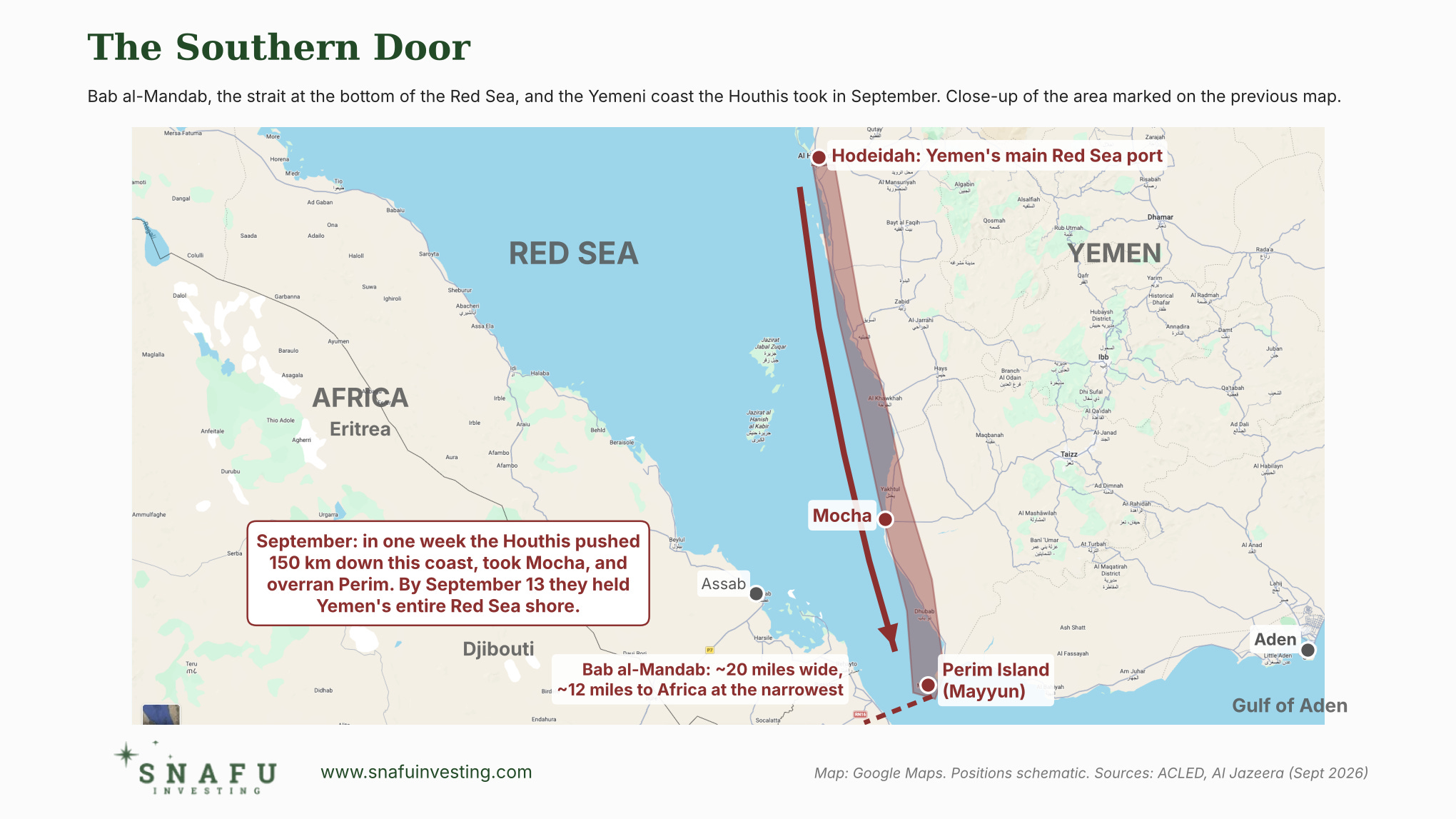
Keep that geography in mind. We’ll come back to what it means for getting oil to Asia.
Meanwhile, the pipeline itself came under attack.
On September 11, drones launched from Iraq hit the East-West Pipeline’s pumping stations, the structures that push oil across those 750 miles of desert. By the time they were done, the stations were rubble.
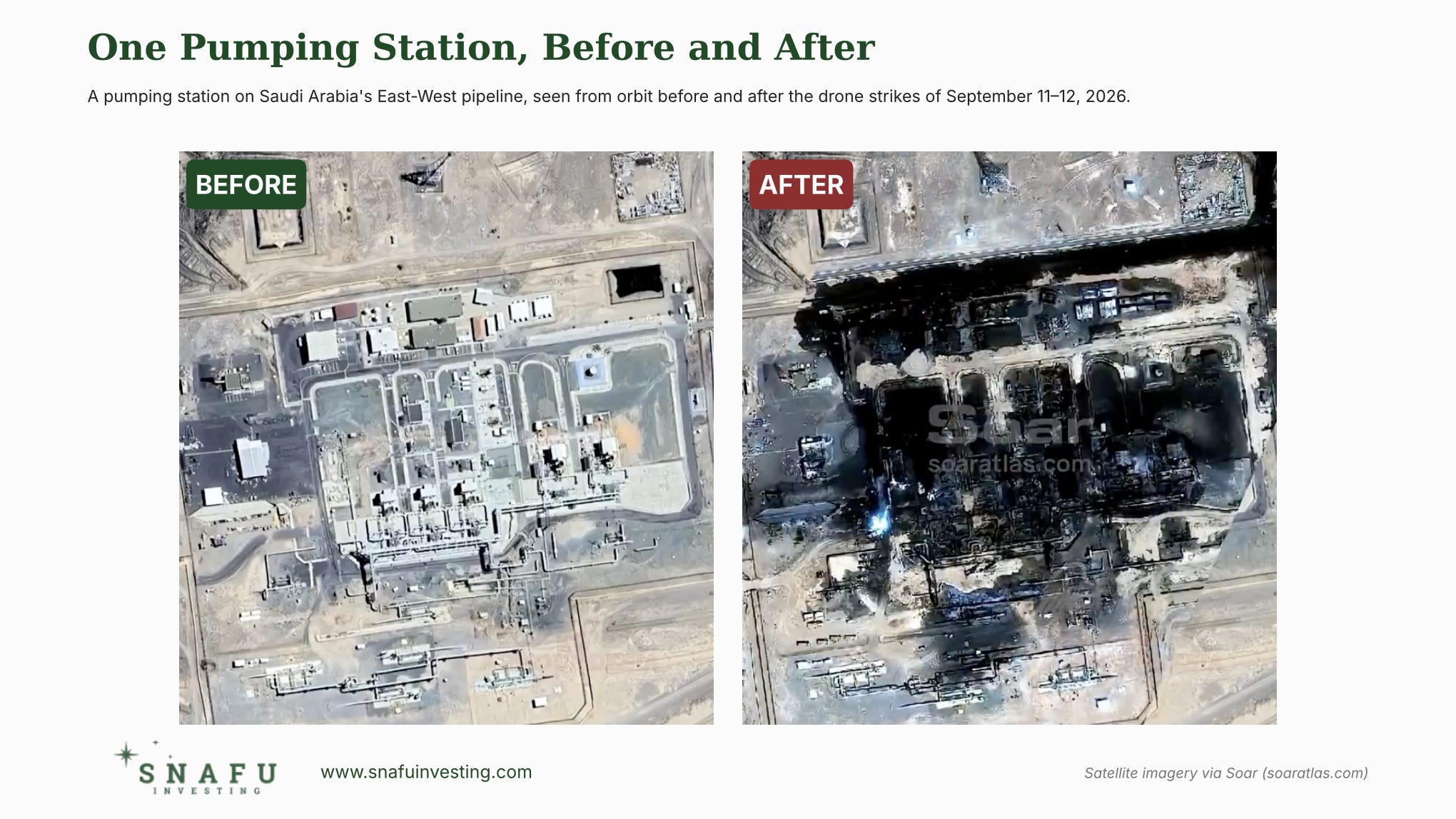
The line went out of commission for eleven days.
How big a hit was that to the pipeline?
Well, before the drones, Kpler, the Paris firm that tracks tanker movements by satellite, had the line running at about 5.5 million barrels a day. Afterward, nothing loaded at Yanbu for days, and Kpler didn’t expect it to get back to even half that within a month. So, with the line dark for a third of the month and limping for the rest, September’s flow can’t have come to much more than 2 million barrels a day. Less than half the 5 million we used in our earlier arithmetic.
Not great. But it gets worse.
The Beast Is Eating Again
OK, let’s get back to China.
Ever since putting together those first two essays, I’ve kept a close eye on China’s crude imports. I noticed them picking up in July and August. Now September’s numbers are out, and we have three consecutive monthly increases. The change in direction is clear. Take a look.
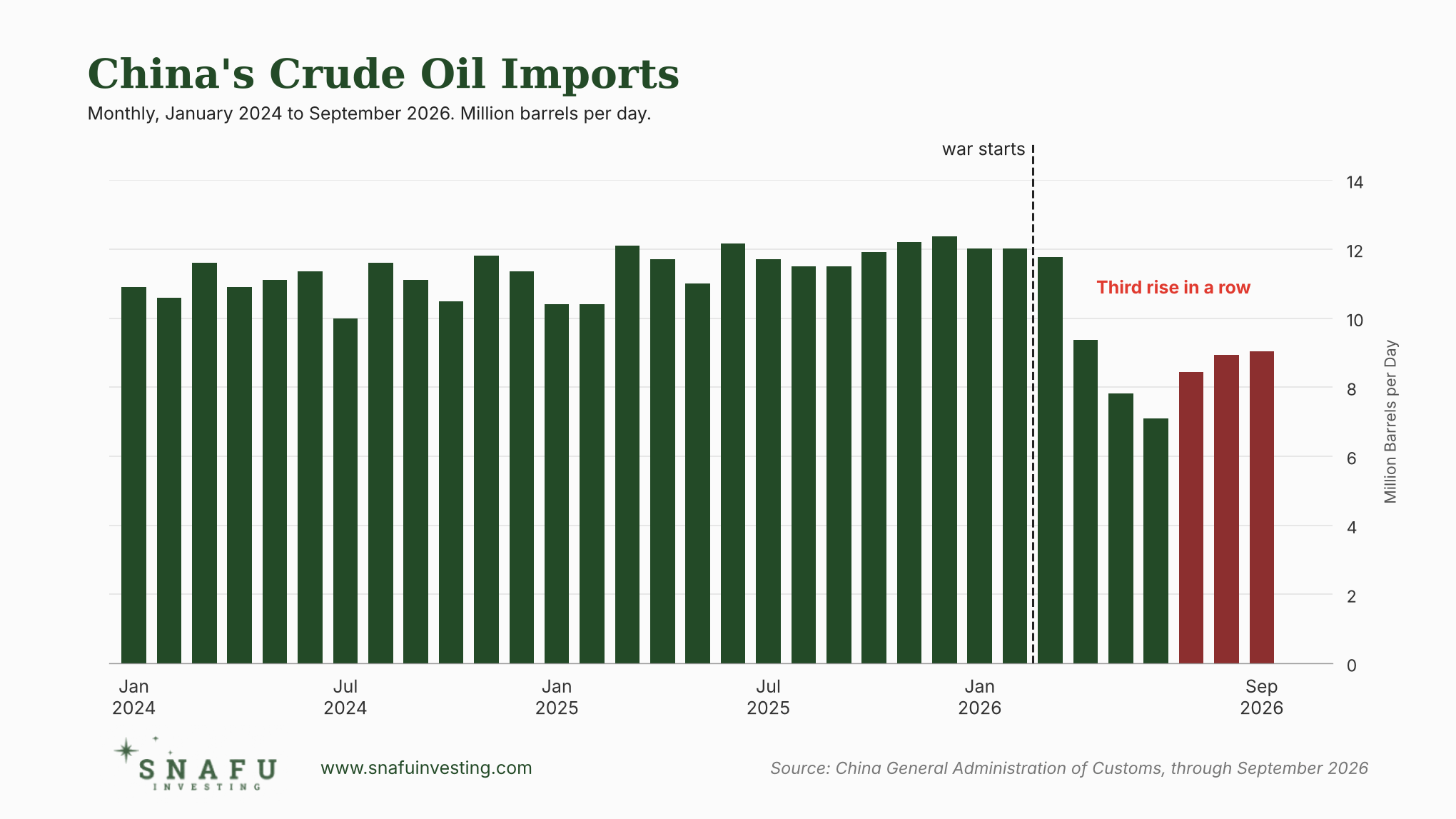
As you can see, imports climbed from roughly 7.1 million barrels a day in June to 8.45 million in July, 8.93 million in August, and 9.03 million in September.
Granted, that’s still about 21% below a year earlier. But remember our July arithmetic: by buying less, China was freeing up 4.9 million barrels a day for the rest of the world. Today, that cushion is down to about 2.5 million.
The point is, after a few months of holding back on purchases to keep the world supplied, the beast is eating again. More than that, it seems to want those barrels now, whatever they cost.
Here’s what I mean. The chart below compares Brent crude futures, the global benchmark, in green, with Shanghai crude futures in red. The Shanghai contract is priced in yuan; here it’s converted to dollars so we can compare the two.
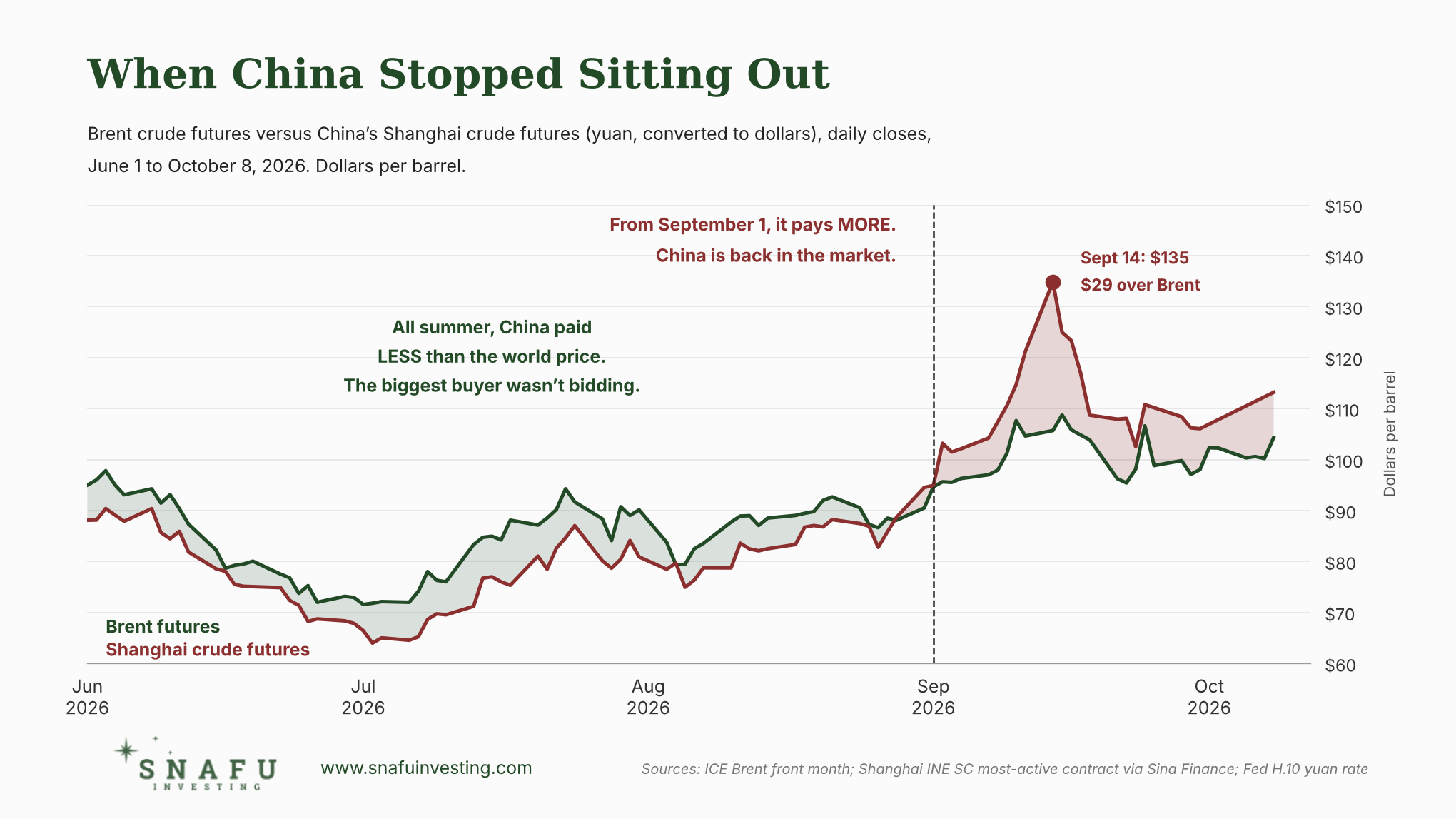
For most of the summer, the Chinese price tracked Brent and generally traded below it. That’s the green shading. The world’s biggest buyer was holding back, and barrels delivered into China were cheaper than the global benchmark.
On September 1, the lines crossed. China began paying a premium, shown in red.
By mid-September, Shanghai crude had reached $135 a barrel while Brent was at $106. Quite a gap. The premium has narrowed since, but it hasn’t disappeared.
Why is China doing this? As usual, they’re not saying. My guess is that Beijing sees a lot of trouble coming down the pipe and would rather stock up while it still can.
That would also explain what China just did with its fuel exports.
As I told you earlier this week, on October 1, less than a week after Trump asked Xi Jinping for help with fuel supplies, China halted all fuel exports. Gasoline, diesel, jet fuel. Every destination except Hong Kong and Macau. It has since let some shipments go out again, but at a reduced level, and only with Beijing’s sign-off, month by month.
That is exactly what you’d do if you expected the war to drag on and oil to get harder to find.
Follow the Ships
There’s another part of this story I’ve only touched on in passing. To understand why the shortage is getting harder to manage, you have to follow the ships.
Every day, the oceans are crisscrossed by some of the largest machines human beings have ever built: supertankers over a thousand feet long, each carrying two million barrels, moving at roughly the speed of a bicycle.
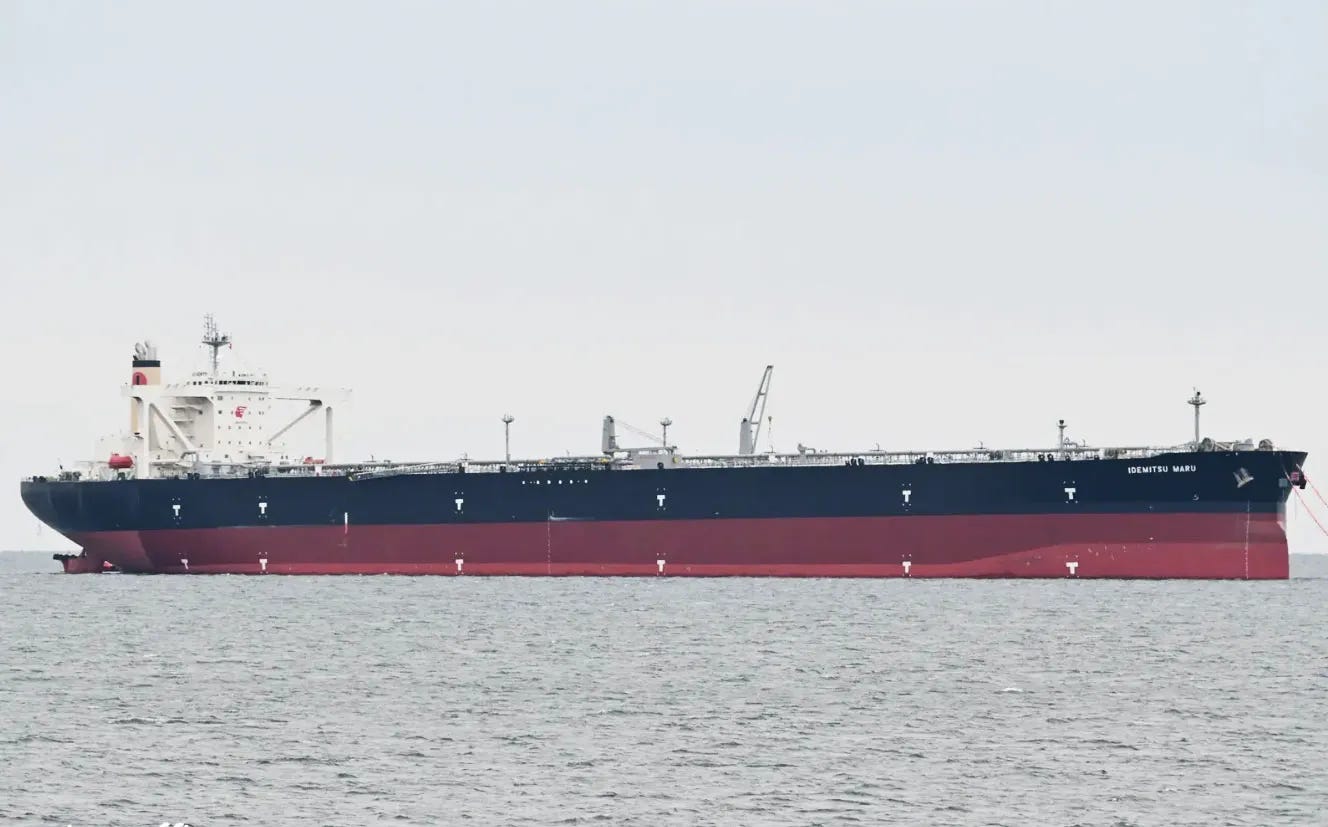
The world’s oil runs on them. Keeping enough of them in the right places is a small miracle of logistics most of us never think about.
And until recently, it was remarkably cheap. On many routes, moving a barrel cost only a few dollars. The Persian Gulf-to-China run, for example, took about 20 days each way, or 40 to 45 days round trip. Before the war, hiring a supertanker cost about $30,000 a day.
Multiply that by 45 days and you get roughly $1.3 million in ship hire. Spread it over two million barrels, and the hire cost alone comes to about 65 cents a barrel. You still have fuel, insurance, and other costs, but you get the idea.
All of that depends on being able to sail the usual routes. Close a strait, or make the passage uninsurable, and a round trip that took four to six weeks can suddenly take two to three months. The same number of ships can now move a lot less oil.
That’s what happened when Hormuz closed.
But the people running the tankers aren’t dummies. They’re savvy businessmen, and they’ve figured out how to get more oil through a closed strait.
The supertankers are too big, too slow, and too expensive to risk running the strait. So they wait in the Gulf of Oman, outside the blockade. Smaller tankers load inside the Gulf, hug Oman’s coast on the way out with their transponders off, then pump their cargo into the waiting supertankers at sea. After a few deliveries, a supertanker is full and sails off to Asia.
Traders began working this out around July. By August, the shuttle was moving just under a million barrels a day. In September, it reached 3.6 million.
The problem is that it’s now close to its limit. Each transfer takes days, the area off Oman can only accommodate so many ships, and there are only so many owners willing to make the dangerous run.
The backlog alone tells the story. Tankers International, which runs the world’s largest supertanker pool, estimates that waiting adds about ten vessel-days to each cargo, tying up the equivalent of fifteen supertankers.
But consider where those barrels were going.
Four out of every five that passed through Hormuz were headed for Asia. So Asia, and China in particular, has the biggest problem finding replacements.
Which brings us back to our friends in sandals.
Until recently, the alternative route for Saudi oil was straightforward: pump it across the desert to Yanbu, the Red Sea port, load it onto tankers, then sail south through Bab al-Mandab, the strait at the bottom of the Red Sea, and east toward Asia.
It looks like a detour on the map, west across Arabia and then back around it. But the voyage from Yanbu to China still took about 20 days, roughly the same as the old run out through Hormuz.
Not anymore.
That red X at the bottom of the map is Bab al-Mandab. The Houthis hold the coast beside it and still attack Saudi-linked tankers, despite an offensive launched earlier this month by Saudi-backed Yemeni forces to push them back. For Saudi oil, the southern exit is effectively closed.
That leaves the northern exit: the Suez Canal. Fine if the oil is headed for Europe. But to reach Asia, you now have to send it on a voyage the old spice traders would recognize: across the Mediterranean, past Gibraltar, down the coast of Africa, around the Cape of Good Hope, and back across the Indian Ocean.
Here’s what that looks like.
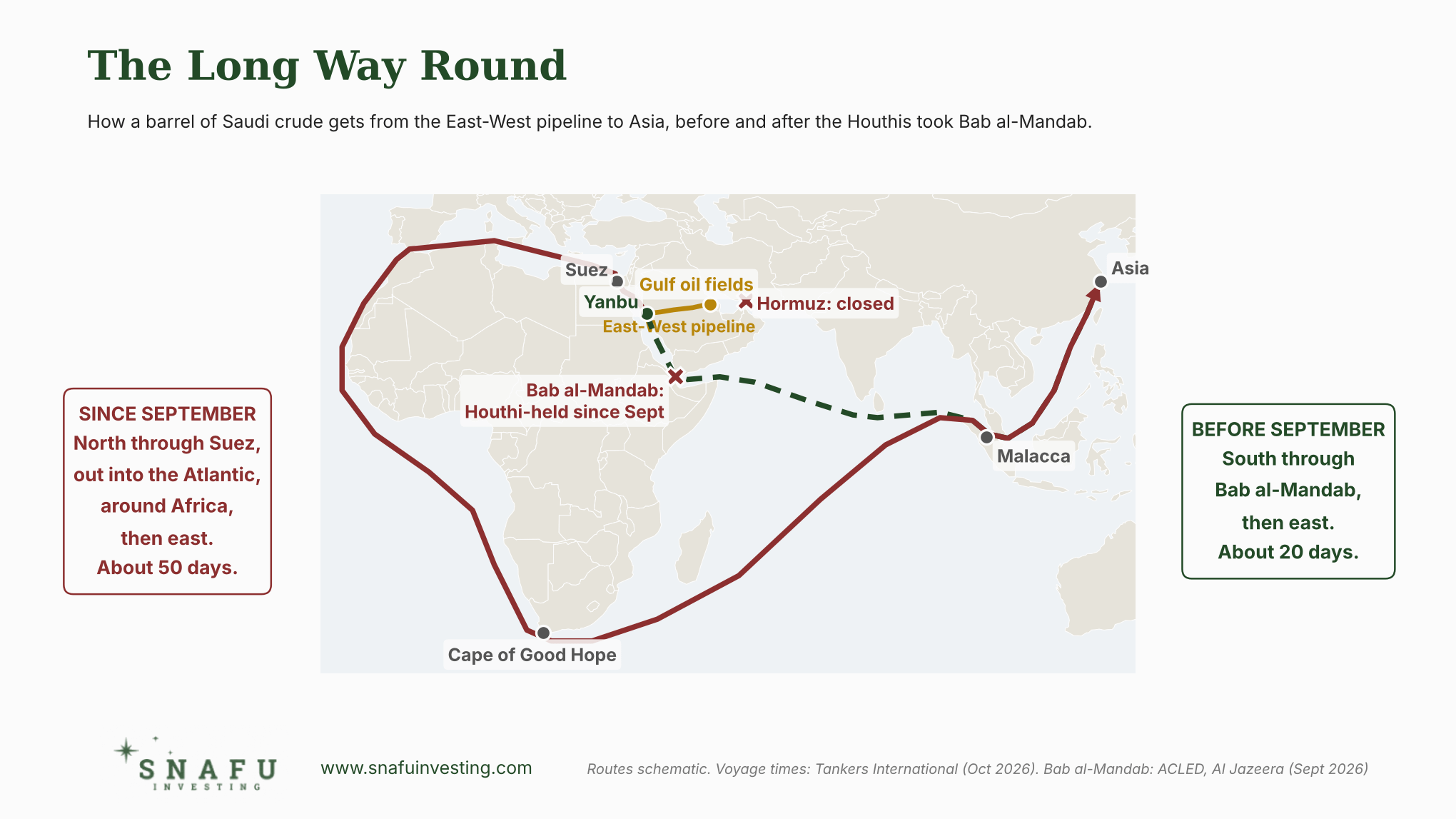
Again, the old route, shown by the dotted line, took about 20 days. The new one takes about 50. An extra month, each way.
This also means a ship now takes two and a half times as long to complete a round trip. On that route, it’s effectively as though more than half the tanker fleet disappeared.
Now look at what all this has done to the daily cost of hiring a supertanker.
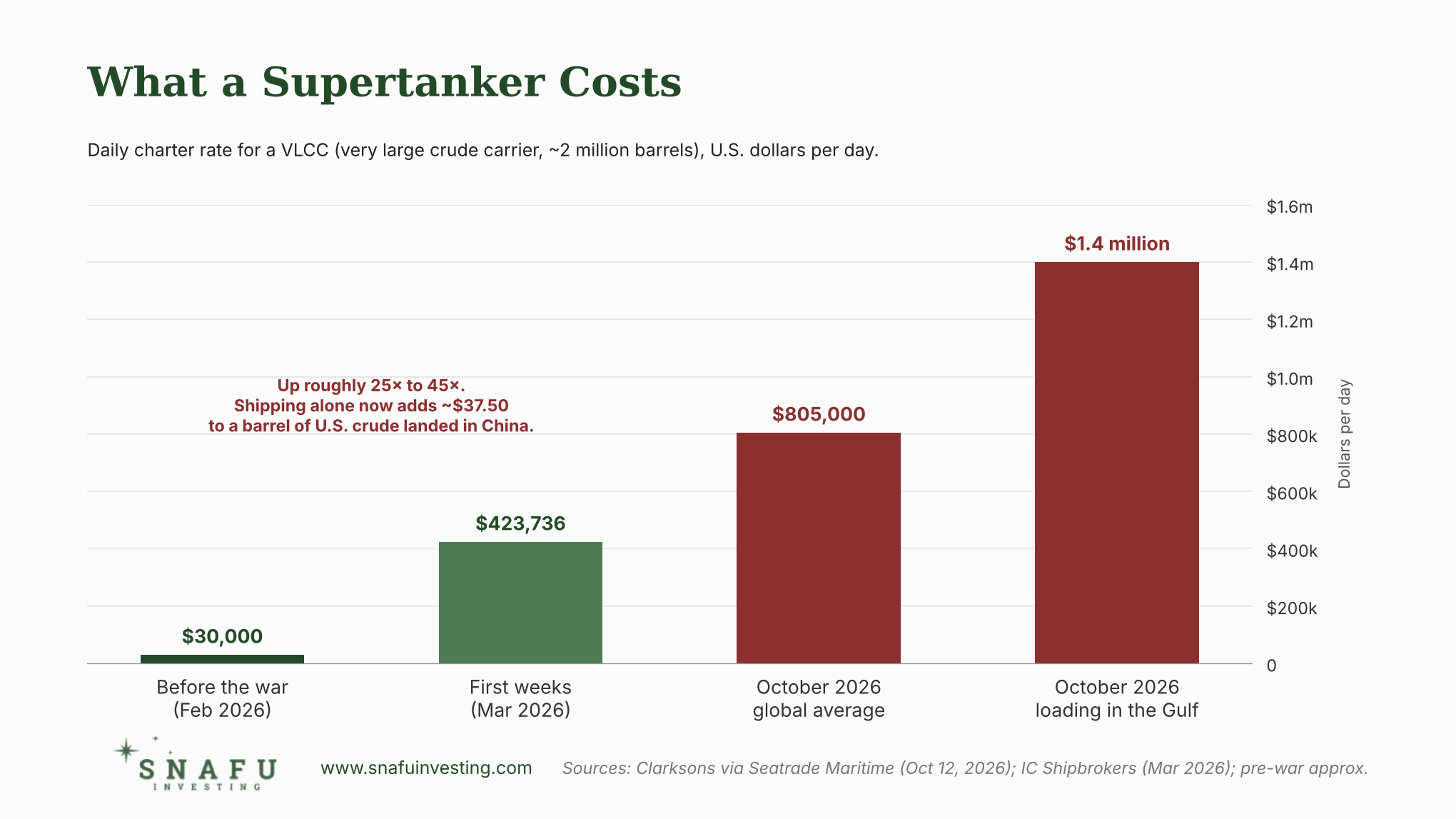
Again, before the Iran war, it was about $30,000 a day. On one of the worst days of the pandemic, it spiked to around $250,000, which people at the time thought was Armageddon.
Today, the global average is around $800,000 a day. Ships loading in the Gulf are fetching $1.4 million.
And remember, a longer voyage means paying those rates for more days.
But the impact doesn’t stop with the ships taking the detour. Every tanker tied up on a longer trip is one less available for another cargo. That puts pressure on shipping costs elsewhere, too.
Take the U.S. Gulf-to-China route. It doesn’t pass through Hormuz, but it still depends on finding an available tanker. Freight on that route has risen from about $8.60 a barrel before the war to $37.50 today. That’s an extra $29 a barrel just to move the stuff.
That’s a lot. Remember, Brent was around $65 a year ago and is around $100 now. In other words, the increase in freight on that route is almost as large as the price shock from the Iran war itself.
Bottom Line
Take everything we’ve covered so far, add the diesel and refinery problems I wrote about earlier this week, and I think we could be at the start of a major oil shock whose full impact has yet to be felt.
To recap. In September, the bypass pipelines moved about 3.5 million barrels a day, with the East-West line dark for a third of the month and limping for the rest. The IEA’s stock release is down to about half a million barrels a day, from roughly two million in the spring. Yes, the shadow fleet shuttle off Oman is up to 3.6 million, but most of that gain is canceled out by China, which is now holding back 2.5 million barrels a day instead of 4.9.
Add it all up, subtract it from the 15 million that used to come through Hormuz, and September’s shortfall comes to about 4.9 million barrels a day. That’s up from about 0.6 million back in July, when China was still covering most of the gap.
Here’s a visual to put those numbers in perspective.
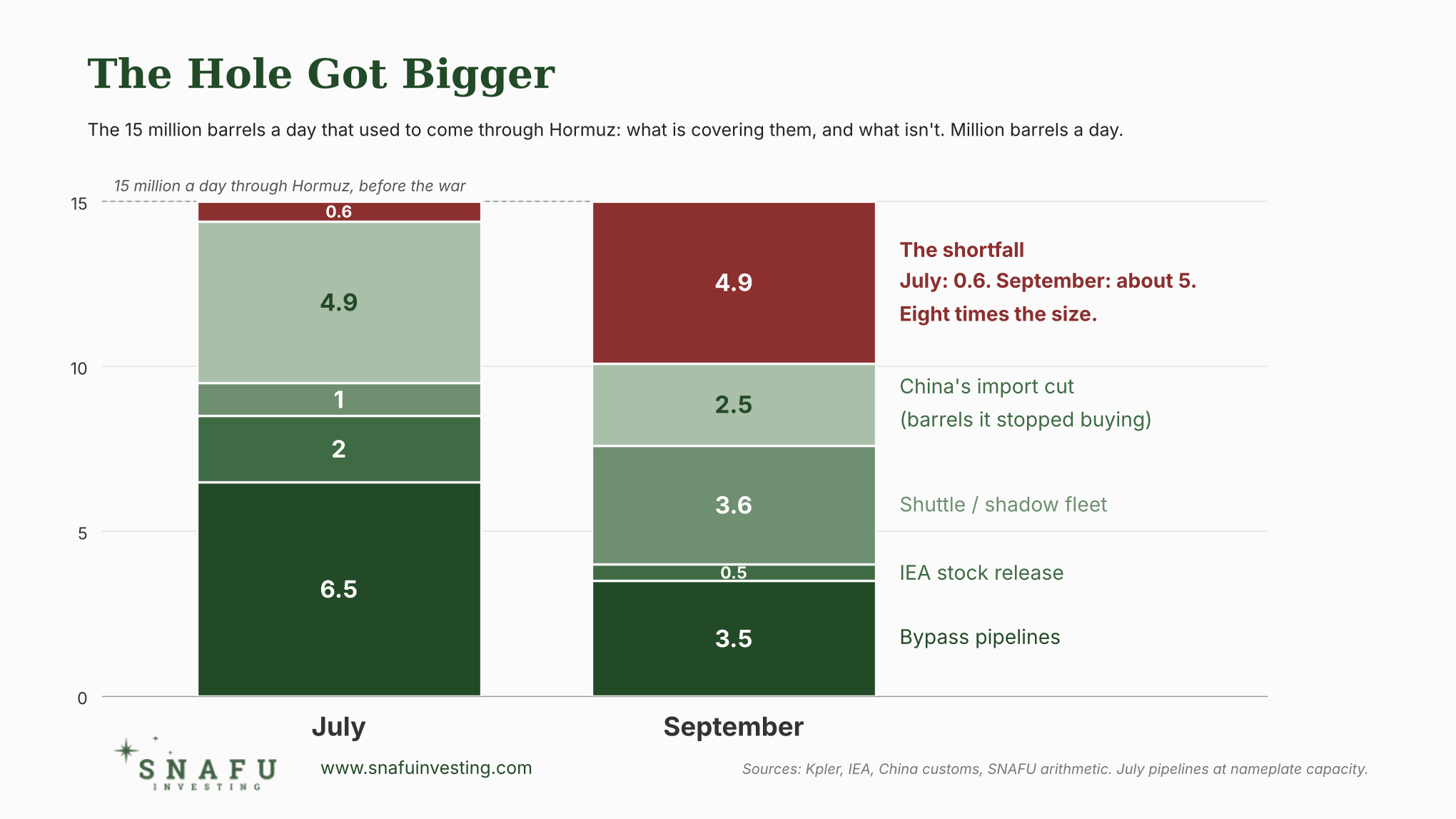
And how is that hole getting filled?
Stockpiles.
Again, oil is a global commodity, so when supply falls short, the barrels have to come from somewhere. And now they’re coming out of storage. Governments are drawing down strategic reserves, and companies are tapping commercial inventories. The price pushes everyone to use the cushion they have.
The problem is, most countries don’t have anything like China’s. And in September alone, the world pulled 113 million barrels out of storage, the most in any month since the war began.
We also recently learned that oil inventories across the OECD, the 38-country club of rich economies, have reached their lowest level since 1990.
And it’s even worse in the U.S. Take a look at this chart of the Strategic Petroleum Reserve.
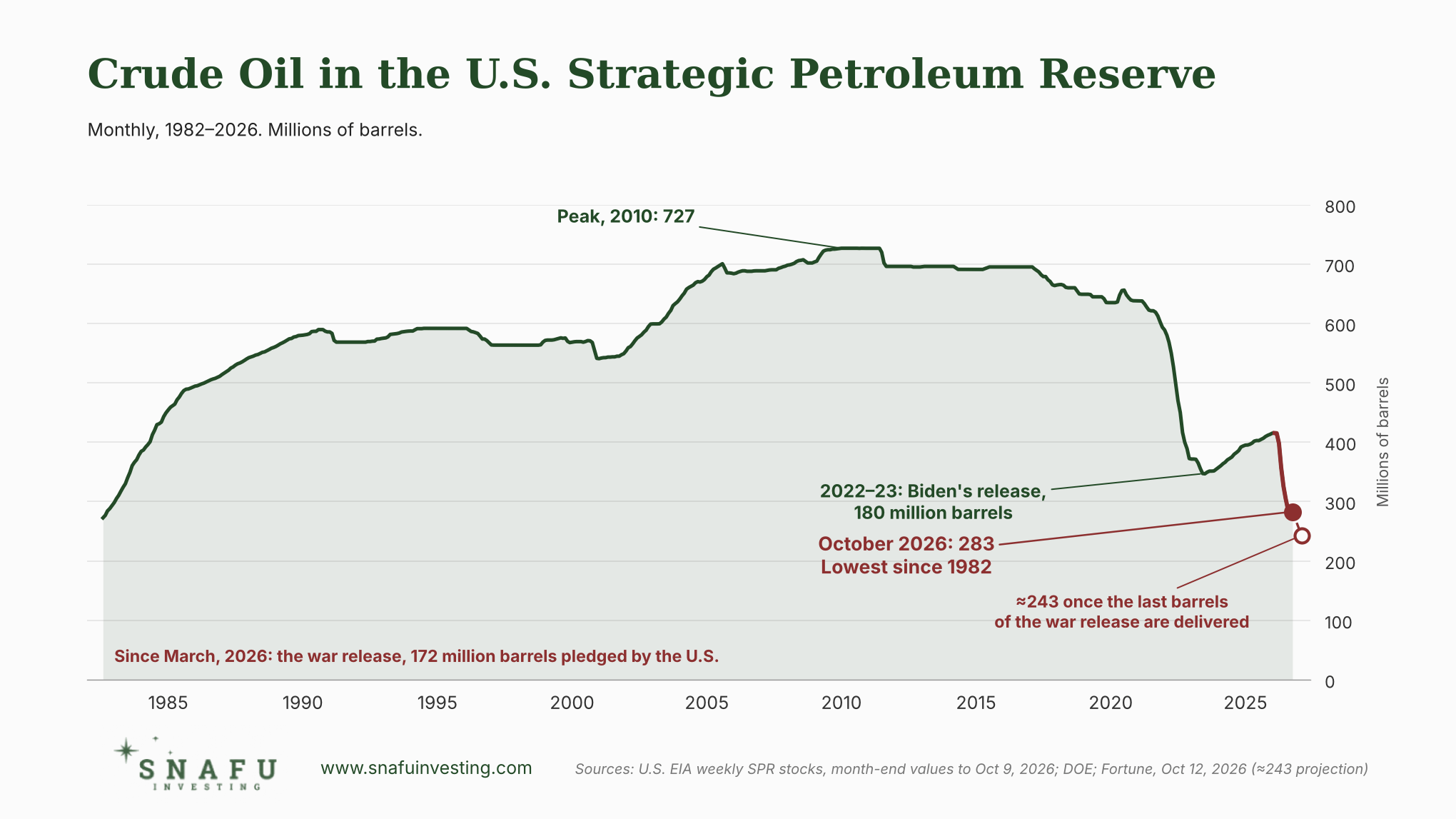
At 283 million barrels, the U.S. reserve is at its lowest since 1982. And the last of the war release hasn’t even been delivered. Once it is, that figure will be down around 243 million.
Keep in mind that all of this is happening while the fighting around the world’s most important oil chokepoint shows no sign of ending. Quite the contrary. Look at how it has spread: the U.S. and Israel are fighting Iran, and Saudi Arabia is fighting the Houthis. Even the pipeline bypassing Hormuz has been hit by drones.
The war keeps widening, not winding down.
My bet is that if it isn’t resolved before the November 3 midterms, a prompt resolution becomes less likely afterward. (And I doubt Iran has much interest in handing Trump a pre-election win it can withhold.)
Think about it. Before the election, every cent at the pump is a vote. A deal is worth a lot to Trump. Afterward, with two years until the next election, much of that urgency disappears. The deal becomes a legacy question, and legacy questions have a way of dragging on.
But even an end to hostilities tomorrow and a reopened strait wouldn’t refill the reserves, rebuild the refineries, send the Houthis home, or undo the dozen other problems this war has created.
And nowhere are those problems more acute than in the oil-starved countries of Asia. Remember, they used to take most of the 15 million barrels a day that flowed through Hormuz. Their replacement barrels now come the long way around.
As I write this, buyers in India, Japan, Korea, and, of course, China are scrambling to diversify away from the Gulf. They’re paying premiums to do it. And I expect them to keep paying after a ceasefire, because they’ve just learned what dependence on Gulf oil means when the shooting starts.
That’s a huge challenge for those countries. It’s also a big opportunity for the countries and companies that can sell them oil from a coast where no one is shooting, without depending on Hormuz or the Red Sea.
Which brings us to this month’s recommendation. There’s a place, and a company, that started doing exactly that this year.
And the stock has barely noticed.