


A word before we start. This is the first of the SNAFU Investing monthly issues, and they’ll come at the end of each month. This one carries a new gold recommendation, below the paywall.
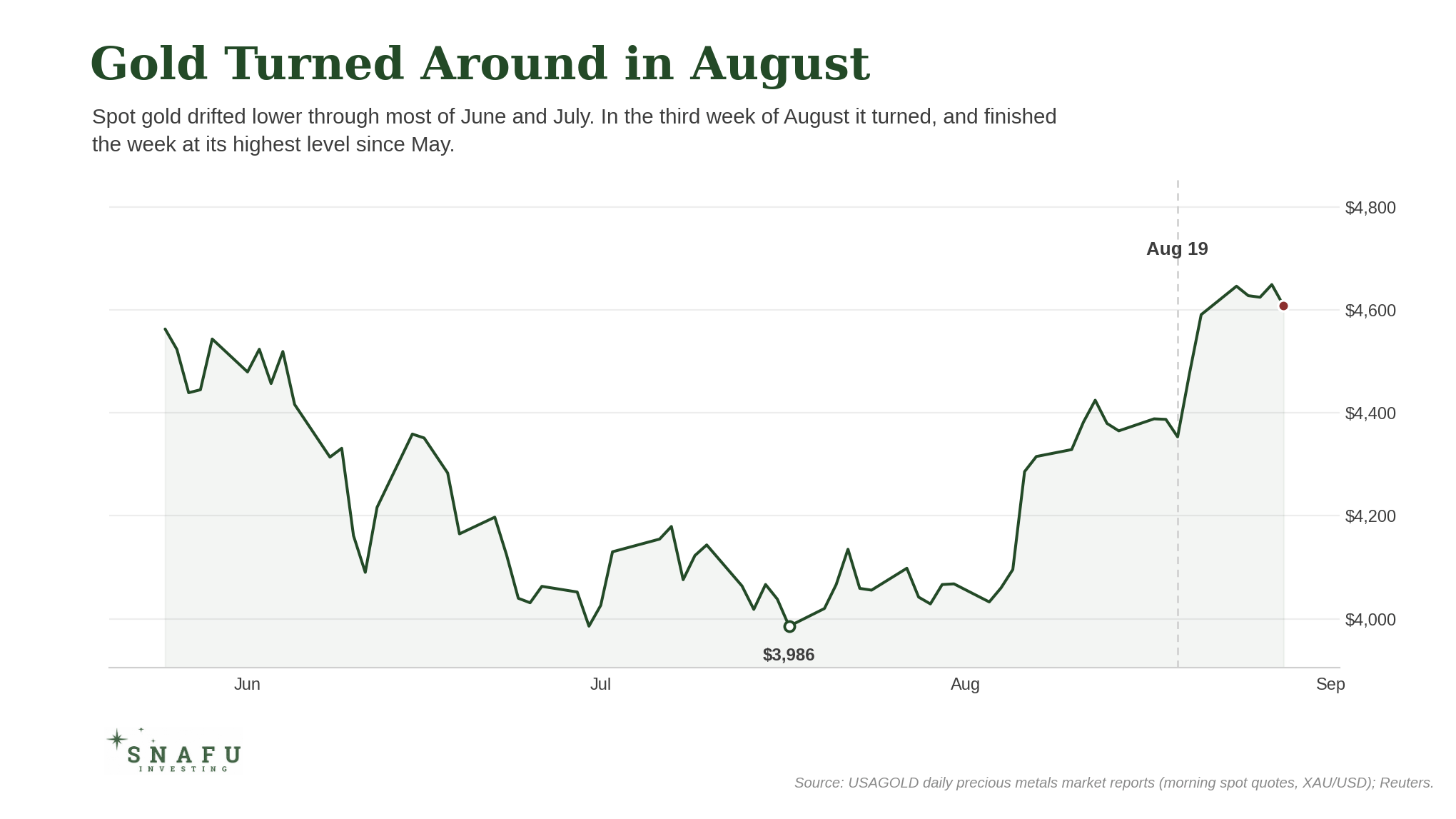
You may not have noticed it amid the ongoing Iran war and everything else happening right now, but gold has been on quite a run lately. Last week alone, it jumped more than 5%, reaching its highest level since May. Take a look at the chart below.
So what happened?
Well, several things actually.
If you look closer at the chart you’ll see the move started on Wednesday the 19th. But it didn’t start in the gold market.
What happened was that that afternoon the Treasury announced it would at least double the size of its long-end buyback operations, from $2 billion apiece to $4 billion, running from September 9 through November 4.
Now, a buyback here means exactly what it sounds like. The government goes into the market and buys back bonds it has already sold. This is not new borrowing. It’s the Treasury taking its own paper off dealers’ hands with cash.
In case you’re wondering why the Treasury would do such a thing, look at the position it’s in.
It has to sell $739 billion of new debt this quarter. It also has close to $10 trillion of old debt to roll over this year.
Meanwhile, the people who used to buy that paper without blinking are backing away. In June, foreign investors were net sellers of U.S. government debt. And as I showed you on Wednesday, that wasn’t a one-month blip. Their share of the market has been sliding for fifteen years, from close to half back in 2011 to about 30% today, the lowest in two decades.
The problem is that when fewer buyers show up for your debt, the yield goes up. And when the yield goes up, every dollar you borrow costs more, which means you borrow more.
Unless of course you buy the bonds yourself.
That’s the reason a program like this exists at all.
This isn’t a new idea, by the way. The Fed spent the first half of this year doing its own version of it, buying short-term Treasury bills by the tens of billions and calling it reserve management. I called it what it was back in December. Money printing in anything but name.
Now, you may be thinking, but wait Lau, $4 billion isn’t all that impressive. After all, against the $739 billion the Treasury has to borrow this quarter, $4 billion an operation barely registers.
So why did gold care at all?
The reason is simple, actually. The market wasn’t pricing the amount of money. It was pricing the precedent, and the willingness to go further. In fact, the day after the announcement, Treasury Secretary Bessent signaled the operations could run bigger than $4 billion if needed.
Remember, this is the same Bessent who, earlier this month, publicly asked the Federal Reserve to “upsize” an emergency lending facility (currently capped at $60 billion per country) so Japan could get the dollars it needs without dumping a single Treasury on the market.
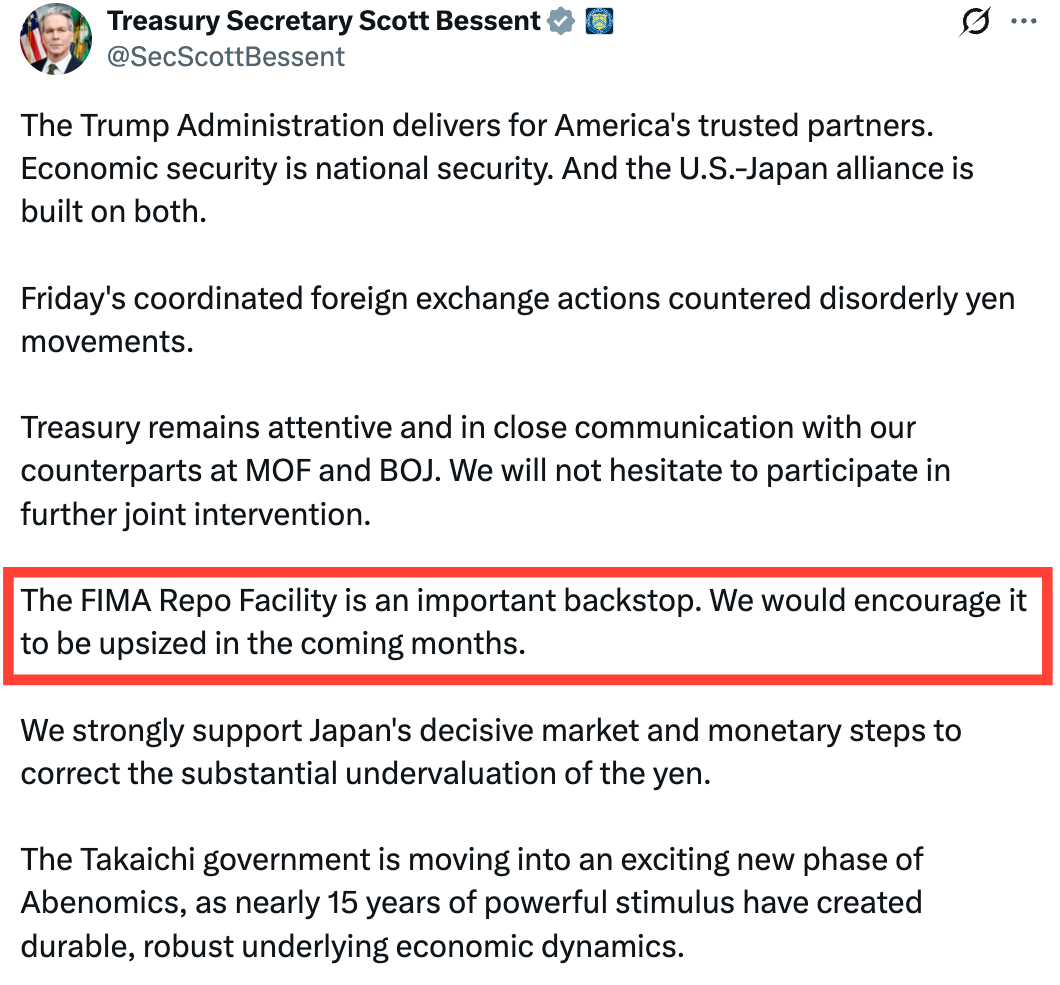
Those dollars, of course, wouldn't come out of a drawer. The Fed would create them. Print them, if you will. I wrote about it last week.
Put it all together, and it seems the Treasury is working around the clock to hold the bond market up.
Which is why gold is where it is even after Fed Chairman Kevin Warsh got up at Jackson Hole yesterday, called inflation at 3.7% concerning, and hinted that rates may have to go up rather than down.
And my guess is that’s how it trades from here. Higher, and not especially bothered by talk of rate hikes. (Which is why this month’s issue adds a gold position to the portfolio.)
The Only Way Out
None of this is happening in isolation, of course. The U.S. national debt crossed $40 trillion this month, which I wrote to you about earlier this week.
And as I mentioned there, the headline number is bad enough on its own. But the bigger problem is the acceleration, which is to say how quickly it keeps getting worse. Take a look at the chart below if you missed it.
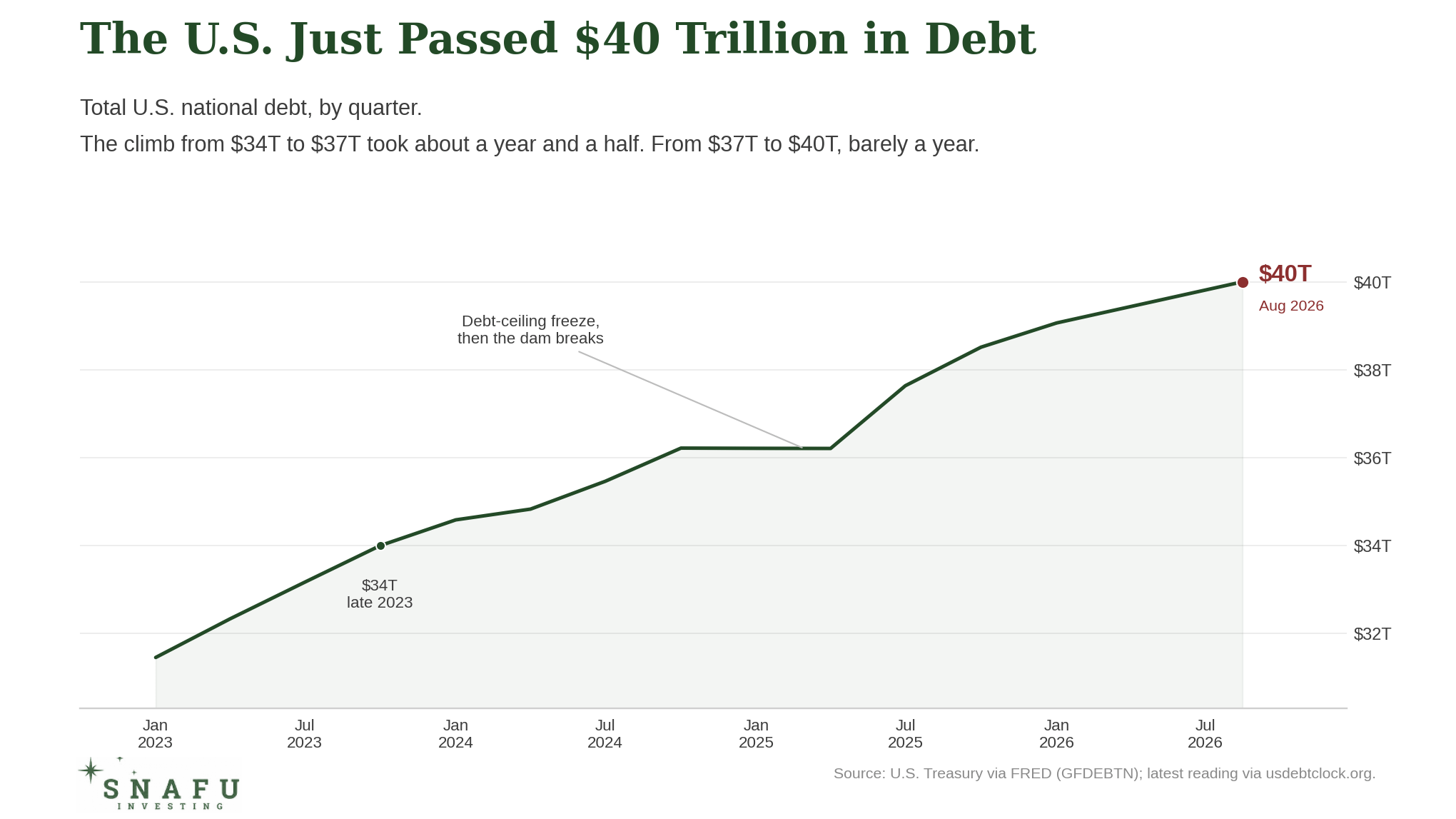
I ended that piece by saying there’s only one realistic way out of this, and that’s devaluing the dollar. So let’s talk about that, because this is the big picture that really matters.
The easiest way to see why this is the obvious way out is with a simple illustration that hits closer to home.
Say your family has a fixed $500,000 mortgage. Then high inflation hits and prices across the economy rise dramatically. Over time, your salary and your partner’s salary double or triple along with most prices, while that $500,000 mortgage stays exactly where it is. Suddenly, the debt feels a whole lot lighter. Your mortgage payments haven’t changed, but they now eat up a much smaller portion of your income.
Just as importantly, the politically connected elites (the only people who really matter) tend to do just fine out of it too. During inflation, asset prices rise. Stocks, real estate, private equity, all of it goes up in nominal terms. Which is precisely why devaluation is such a convenient path of least resistance for those in power. For the majority of Americans watching their savings and purchasing power disappear, not so much.
Now, you might reasonably ask why they don’t simply cut spending instead.
Well, aside from the fact that we recently watched Musk’s DOGE try (and fail) to make a meaningful dent in federal spending, balancing the budget today would require roughly $2 trillion in cuts every single year. For context, the entire Social Security program costs about $1.5 trillion annually, while the military budget is roughly $900 billion. Even eliminating either one completely wouldn’t be enough.
Put yourself in a politician’s shoes. Imagine stepping up to the microphone: “My fellow Americans, we need to slash government spending by $2 trillion a year. We’ll start by cutting Social Security payments…” You wouldn’t finish that sentence before being booed off stage, assuming you made it past your campaign donors.
History shows that when governments face choices like these, they almost always take the path of least resistance. Cutting spending is politically toxic. Default is off the table. But gradual devaluation? That’s always the preferred stealth option.
But don’t let the word “gradual” fool you. America’s own history shows that devaluation can happen a lot faster than those in power would have you believe.
Consider this. When Nixon took the dollar off gold in 1971, it took less than ten years for the dollar to lose more than half its purchasing power. Think about that. More than half, gone inside a decade. And it didn’t stop there. Today, that same dollar buys roughly 90% less than it did in the early 1970s.
And before anyone tells me this couldn’t happen in America, it already has in a country very much like America. In 1976, the United Kingdom, then one of the world’s leading economies, went hat in hand to the IMF for the largest loan package the fund had ever arranged. The pound had collapsed, inflation had hit 27% the year before, and the government was struggling to finance itself. Being a rich, developed nation didn’t protect it.
And guess what. None of this is lost on the people sitting on trillions of those dollars.
Follow the Money
I’m talking about central banks, of course. And judging by their actions, they answered the devaluation question a long time ago. Take a look at the chart below. It shows central bank gold buying over the past eight years, with the last four set against the four before them.
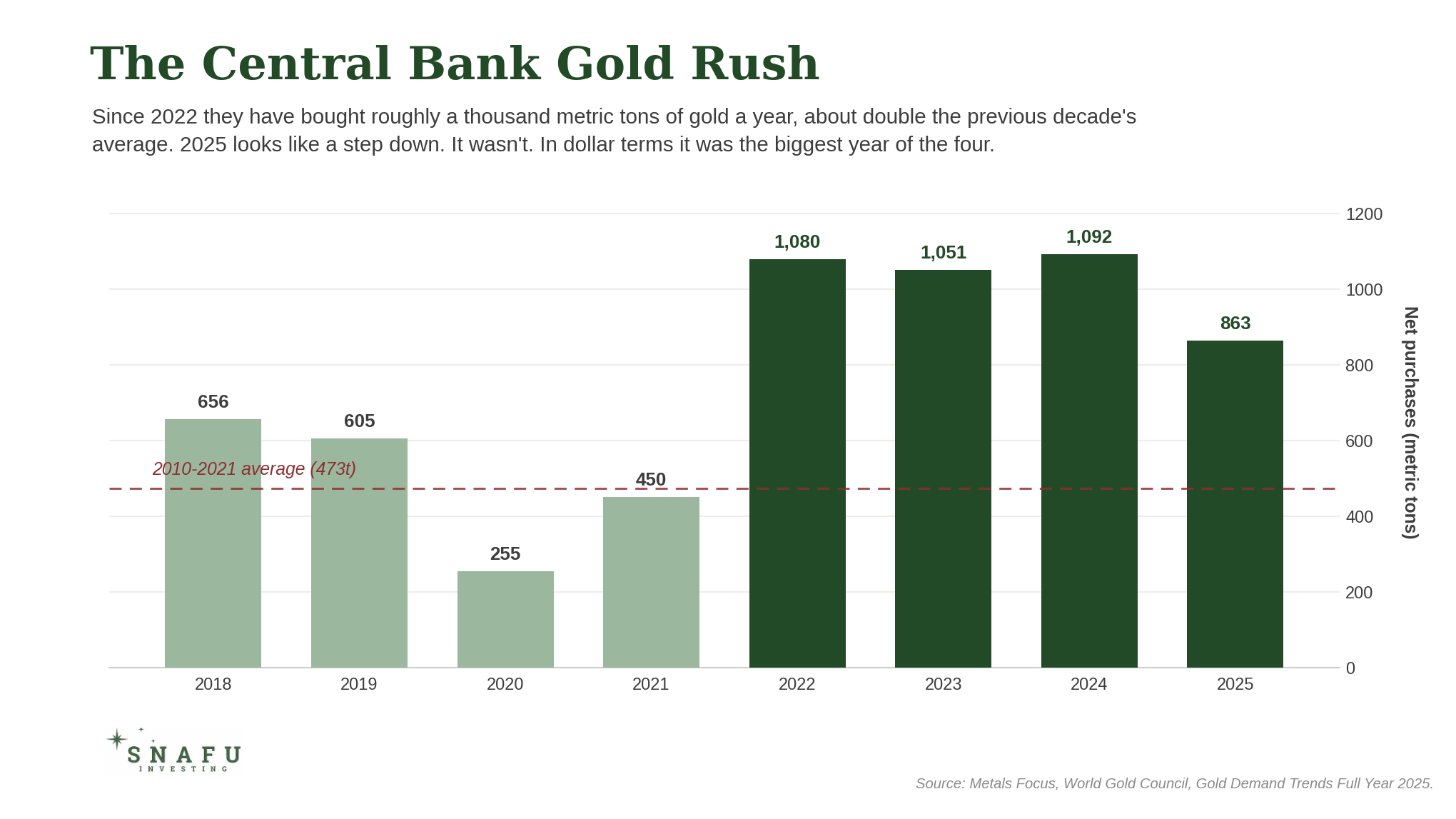
As you can see, since 2022 central banks as a group have bought roughly 1,000 tons of gold a year. That’s about double what they averaged over the previous decade. And it’s probably the most underappreciated reason gold has done what it’s done.
Now, in case you’re wondering why 2022 was the turning point, that was the year the West froze roughly $300 billion of Russia’s foreign reserves following the invasion of Ukraine. The U.S. also effectively cut Russia’s central bank and some of its biggest banks off from the dollar system. As the rest of the world watched, every reserve manager on earth suddenly had to reckon with the fact that the world’s dominant reserve currency could be weaponized against them.
Now, if you take another look at the chart, you’ll notice central banks bought less gold in 2025 than in the previous three years. In tons, that’s true. But not in dollars. Gold cost 44% more that year, so they actually spent about $95 billion, compared with roughly $84 billion the year before.
Now, before someone in the comments section points out that gold buying was tepid in the first quarter this year, yes, according to revised World Gold Council (WGC) figures, buying dropped to double digits as gold spiked toward $5,600.
But here’s the thing. We also know it came back with a vengeance, jumping to 289 tons in the second quarter after the price had fallen about 30%.
Which tells you central banks are more than willing to buy the dip, because they still want the ounces. Badly.
Recent surveys of the people actually making these decisions confirm it.
Earlier this year, OMFIF, a London-based think tank, published its annual survey of some of the world’s largest public investors, collectively managing more than $10 trillion. Among the central banks surveyed, a net 30% said they intend to add more gold to their holdings over the next year or two.
Interestingly, they’re not expecting to get it cheaply, either. Some 61% expect gold to be trading between $5,000 and $6,000 an ounce by June 2027. And only 28% said the current price was discouraging them from buying.
Note: A separate WGC survey found much the same thing, with a record 45% of central banks planning to increase their gold holdings over the next twelve months.
Which leaves one obvious question.
Where’s the Gold?
Now, before I get to this month’s pick, there’s one more piece of this story we need to talk about. It’s the part few people seem to mention. And it’s also the reason this month’s recommendation is what it is.