


Earlier this week, I wrote about Jensen Huang’s affair with a woman suspected of spying for China. The next day, the New York Times reported a second affair, this one with an Nvidia executive who reported to him. On Thursday, Huang resigned as CEO and left the board, and by then Reuters had reported a third (I may have lost count). His replacement, for now, is Colette Kress, the company’s longtime CFO, whom Huang, funnily enough, reportedly called “a deer in the headlights” in a meeting this summer.
The stock plunged as much as 14% after the announcement on Thursday and finished the week down almost 13%, its worst week since the tariff crash of April 2025. That wiped out about $570 billion of market value in five trading days, and closer to $1.7 trillion since the record Nvidia set in early October.
Today I want to explain why I think this is a much bigger moment than a CEO scandal, and why it should matter to people who have never owned a share of Nvidia. But first, it’s worth explaining why someone who mostly invests in things that come out of the ground keeps writing about a chipmaker.
The first reason is size. Most of us have heard the name so often that we hardly stop to think how big Nvidia actually is. Until a few weeks ago it was the most valuable company in the world, and even after this week it’s second, behind only Apple. The chart below compares Nvidia’s stock market value at Friday’s close with the entire stock markets of Europe’s biggest economies.
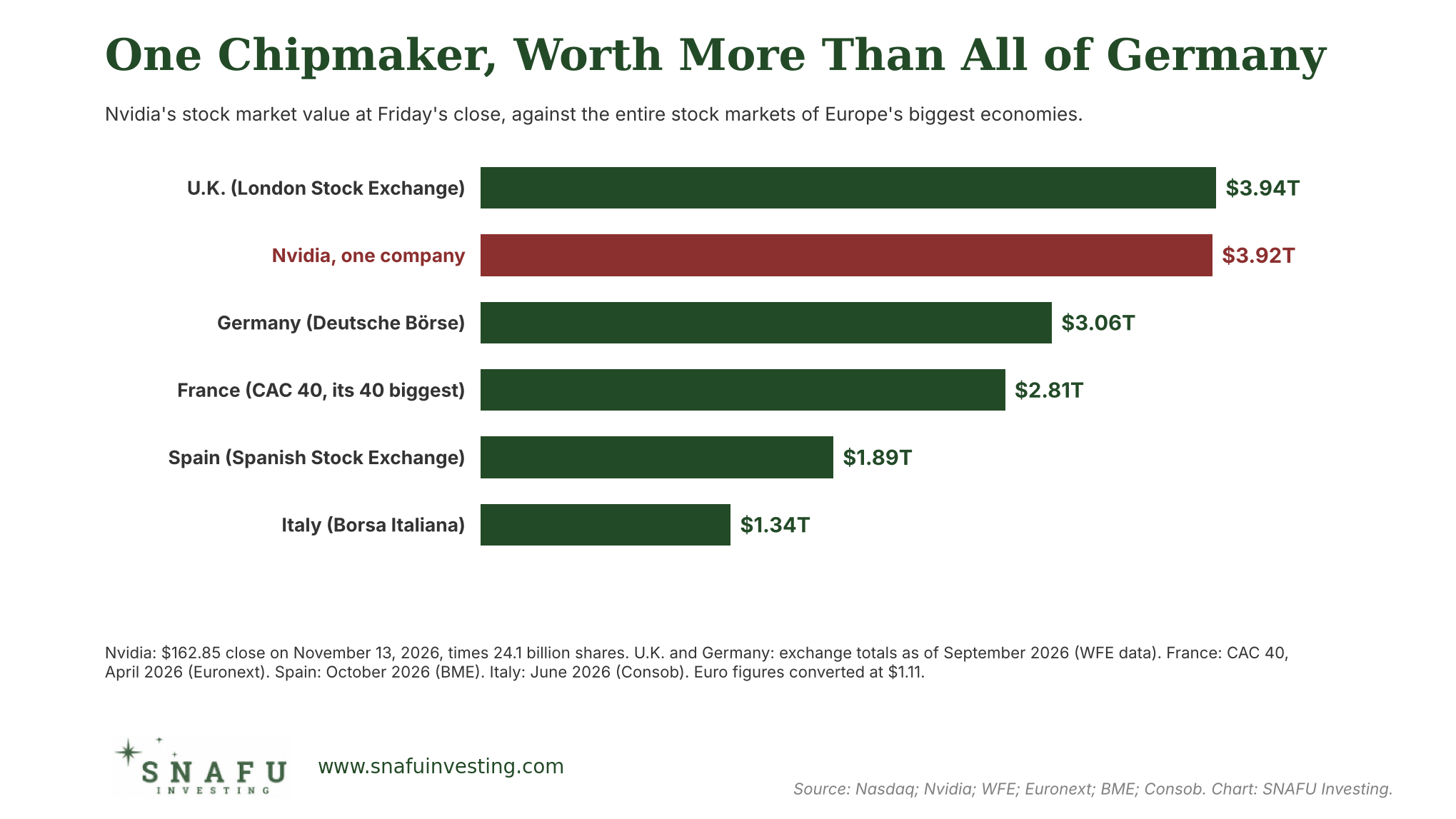
As you can see, one company is worth about as much as everything listed in London, and more than all of Germany, France, Spain or Italy.
Even Japan’s stock market, home to Toyota, Sony and every other listed company in one of the world’s biggest economies, is worth only about twice as much as Nvidia alone.
When you’re that big, you don’t move on your own. You move the market, and when you fall, every index fund in America falls with you.
But that’s not the whole story. Nvidia is one of the ten biggest stocks in the S&P 500, which together account for roughly 40% of the index, and most of them are part of the AI trade. It doesn’t take a genius to see that, by sheer size alone, the AI trade is what the whole market now sits on.
All of which brings up the bubble question, and that’s the second reason. When people hear that AI may be a bubble, a lot of them assume you’re saying there’s something wrong with the technology. But AI can be every bit as revolutionary as promised and still be a bubble. The internet was real too, and the Nasdaq lost more than three-quarters of its value between 2000 and 2002 anyway.
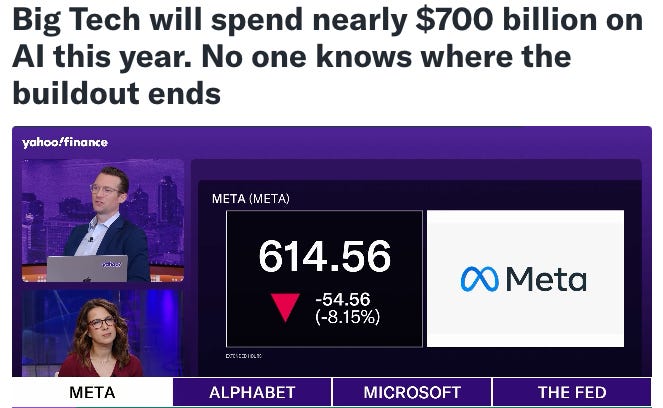
And there are good reasons to think this one is a bubble. Going through all of them is beyond the scope of this piece, but consider that the companies building AI plan to spend more than $700 billion on it this year, while consumers around the world spend about $40 billion a year on AI products.
Now, I don’t want to harp on the bubble thing too much, but I also think it’s interesting that back in May, Nvidia reached about 8.4% of the S&P 500.
That’s more than any single stock has carried since at least 1981. It’s more than IBM at its height in the 1980s, and more than Microsoft or Cisco at the peak of the dot-com bubble. You can see it in the chart below.
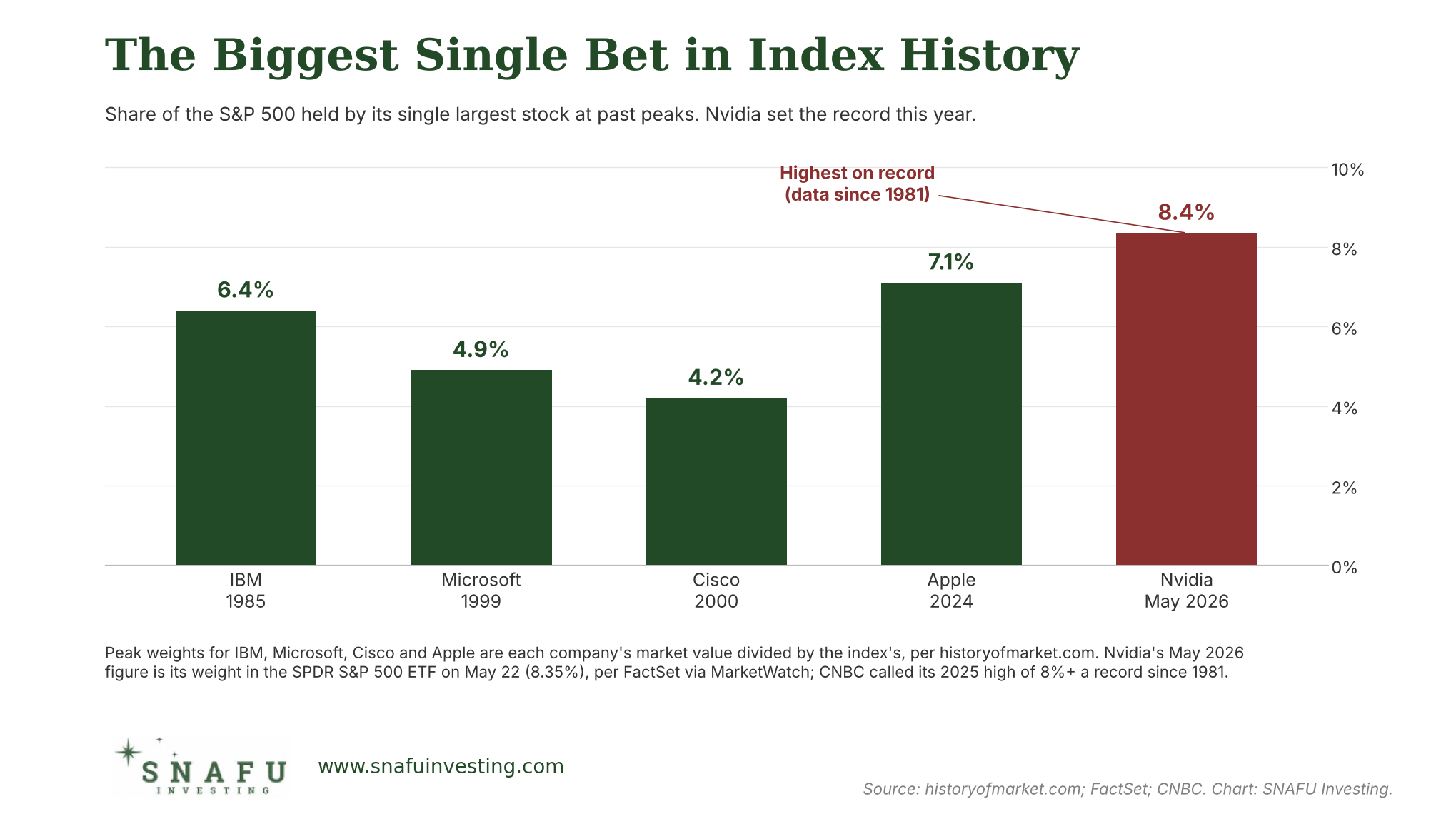
It’s no longer at 8.4%, of course, thanks in part to the market’s reaction to its former CEO’s escapades. The slide has taken Nvidia’s weight down to about 6%.
You might think none of this is your problem if you’ve never owned a share of Nvidia. But if you have a 401(k) or an index fund, you were along for the whole ride, whether you meant to be or not. After all, for every dollar that goes into an S&P 500 fund, roughly 40 cents ends up in those ten stocks, and about 6 cents in Nvidia alone.
All that aside, the third reason I keep coming back to AI is that if you invest in hard assets or resource stocks, as I do, you’re on the other side of the same trade. Every data center runs on enormous amounts of electricity, which takes natural gas or uranium to generate, plus copper to carry it and silver and rare earths in the hardware. A good chunk of the companies on my watch list, whether it’s a copper miner or something else, seem to be priced on the assumption that the build-out keeps going. So if the money behind it turns out to be shakier than it looks, I want to know before the market does.
With all that in mind, when the biggest company in the AI trade, the one the whole market leans on, loses its founder in a week, it’s worth asking what else is going on underneath.
So let’s dig in.
Follow the (Circular) Money
Most of the internet spent the week making fun of Huang’s inability to keep it in his pants. Fair enough. But I think the real story ran in the Wall Street Journal the day after he resigned.

According to the Journal, Nvidia had been negotiating billions of dollars of financial guarantees for companies that couldn’t afford to buy its chips. In the spring, Huang’s son-in-law, Nico Caprez, a vice president at the company, and another vice president were telling prospective partners that Nvidia could arrange credit support for them within a couple of weeks.
Interesting, no?
Nvidia supposedly has the best business on earth right now. Its chips are the ones everybody wants, and it has been selling them as fast as it can make them. So why would a company like that need to help its customers borrow the money to pay for them?
You may remember that back in October I wrote that eight of the ten biggest stocks in the S&P 500 were engaged in what you might politely call a circular arrangement. Four of them, Nvidia, Broadcom, Micron and AMD, sell AI chips. The other four, Microsoft, Alphabet, Amazon and Meta, buy them.
That’s how you end up with record revenues on one side of the index that are really just record spending on the other.
Well, it turns out the circle goes further than that, and the part that goes further runs through Nvidia.
Nvidia’s business is simple to describe. It designs the chips that train and run AI models, and sells them to whoever is building data centers. Some of those buyers are giants like Microsoft and Amazon, which can pay from their own pockets. But a lot of them are younger companies, the so-called neoclouds like CoreWeave and Nscale, that buy the chips, fill buildings with them and rent out the computing power by the hour to AI developers like OpenAI and Anthropic. It’s a bit like a car rental company, except the cars cost tens of thousands of dollars each and the company buys hundreds of thousands of them.
Those younger companies don’t have that kind of money. So Nvidia has been... well, helping them find it, and the way it works is something most people holding Nvidia in their retirement accounts have probably never heard about.
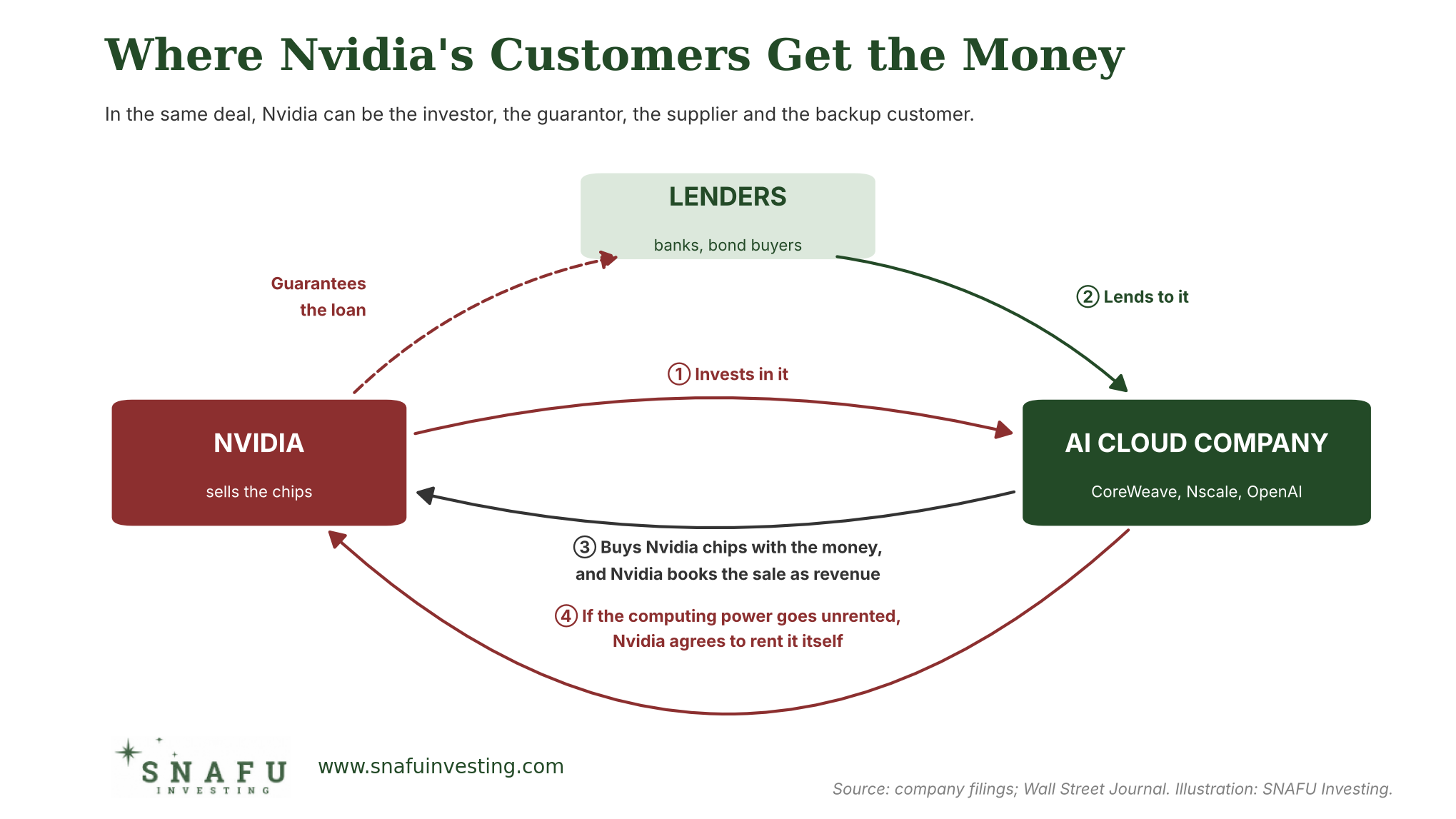
It works more or less like this:
Nvidia invests in an AI company, or guarantees the loans it takes out.
The company uses that money to build a data center and fills it with Nvidia chips.
Nvidia books the sale as revenue.
And if the company can’t find enough customers to rent all of its computing power, Nvidia agrees to rent the leftover itself.
In the same deal, Nvidia is the investor, the guarantor, the supplier and the backup customer.
If that still sounds confusing, the diagram below may help.
OpenAI is probably the biggest example. In July, Nvidia was weighing a $250 billion guarantee for a data center campus in Ohio that OpenAI will lease. The deal eventually got cut roughly in half, and in August Nvidia signed guarantees of up to $105 billion with SB Energy, the company building it.
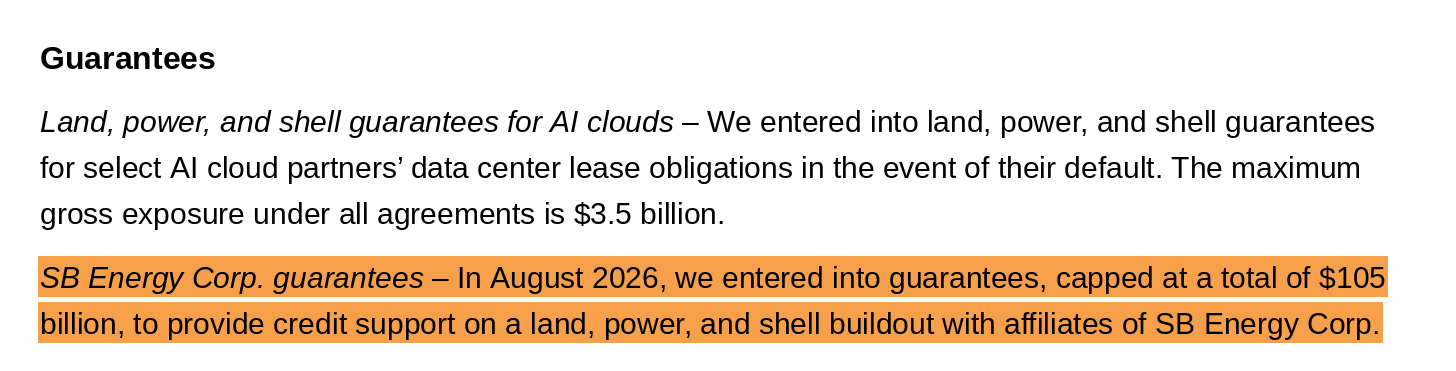
That’s quite a change from a year ago, when critics accused Nvidia of propping up its own sales and the company sent Wall Street analysts a memo saying it didn’t rely on vendor financing. So much for that.
And that’s just one example. There’s an even easier one to understand. CoreWeave, one of those neoclouds, buys Nvidia’s chips and rents out the computing power. Nvidia owns more than 10% of it, sells it the chips, and has agreed to buy any computing power CoreWeave can’t rent out to someone else, all the way to April 2032. Nvidia even agreed to pay another neocloud, Lambda, about $1.5 billion to rent back thousands of its own chips.
The scale of all this shows up in Nvidia’s own quarterly filing, for the three months to July 26, buried in the notes. The commitments and guarantees listed there add up to $530.5 billion. Three months earlier, the comparable items in its filing came to roughly $220 billion. In other words, in a single quarter they more than doubled.
To be fair, a commitment isn’t a loss. A guarantee only costs Nvidia anything if a customer can’t pay. And a good chunk of that money is Nvidia buying memory and other parts for its own products anyway.
But here’s the thing. It’s hard to look at the rest of that $530.5 billion, the cloud agreements, the data center leases signed on behalf of partners and the guarantees, and conclude that it exists for any reason other than to keep customers buying. Those pieces alone add up to about $165 billion.
That’s actually more than everything Nvidia owes on its balance sheet, which comes to about $91 billion.
So what happens if some of them stop paying? After all, these are mostly young, heavily indebted companies whose main business is renting out Nvidia chips.
If, say, a third of those obligations went bad, that’s about $55 billion, or roughly a quarter of the book value of Nvidia’s equity.
And the hit to equity is the smaller problem. The bigger one is what a default would do to everyone else in the loop. If one neocloud goes under and Nvidia has to make good on its guarantee, lenders start asking what’s behind all the others. Borrowing gets more expensive for every company like it, more of them struggle to pay, and the ones that can’t borrow stop buying chips. So Nvidia’s revenue would shrink just as it had to start paying on the guarantees and leases it signed for those same customers.
Which brings me to one more thing that’s easy to miss. After this week, Nvidia trades at about 14 times the earnings analysts expect from it.
That sounds cheap for the company at the center of the biggest technology boom in a generation. But that multiple is only cheap if the earnings are real, and we now know at least part of them is being paid for with money Nvidia helped its own customers borrow.
Lucent Did It First
Lest you think I’m reading tea leaves here, there’s actually a historical precedent for how arrangements like this play out, and it isn’t even that old. It happened during the dot-com bubble.
In the late 1990s, the hottest stocks in America weren’t just the Pets.com kind. They were the companies selling the equipment that built the internet. These telecom equipment makers couldn’t make routers and switches fast enough for the hundreds of new carriers racing to lay fiber, much as Nvidia can’t make chips fast enough today. And ordinary Americans owned them by the millions.
The big three were Lucent, Nortel and Cisco. Lucent is the interesting one, because much like Nvidia today, it was owned by pretty much everyone. AT&T spun it off in 1996, along with Bell Labs, the lab behind the transistor and the laser, and because AT&T shareholders got Lucent shares, it became the most widely held stock in the country, with 5.3 million shareholders. If you were investing back then, there’s a good chance you owned it, or your parents did. At its peak it was worth $258 billion.
And this was no sock-puppet dot-com. Lucent made real things, and most of America’s phone lines ran through its switches.
But there was one problem. A lot of Lucent’s customers, the new carriers, had no money. So Lucent lent it to them.
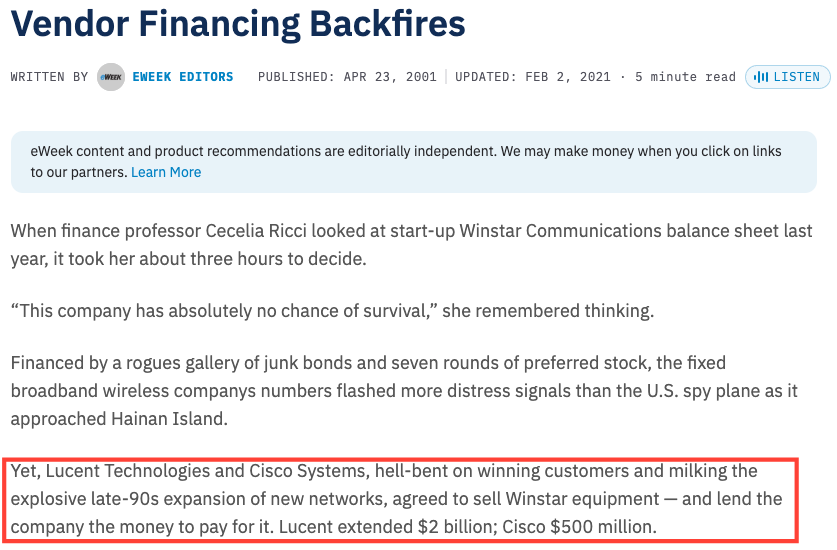
Lucent explained it plainly in its own annual report for 2000. Its customers were “requiring their suppliers to arrange or provide long-term financing for them as a condition of obtaining or bidding on infrastructure projects.”
By September of that year, Lucent had committed about $6.7 billion in credit to customers and another $1.4 billion in guarantees of their debt, $8.1 billion in all, much of it to startups. Nortel and Cisco were doing the same. It’s the same arrangement Nvidia has with CoreWeave and Nscale today, minus one thing. Lucent never promised to become its own customers’ customer, the way Nvidia did when it agreed to rent whatever computing power CoreWeave can’t sell.
As long as the loans kept flowing, the carriers kept buying, and the equipment makers kept reporting record sales, which kept their stocks flying and helped inflate the whole bubble.
But trouble was soon afoot.
The money ran out first at the weakest customers, and it spread from there. One of them was Winstar, a wireless carrier that got a $2 billion financing deal from Lucent. When Lucent stopped funding it in 2001, Winstar filed for bankruptcy and sued Lucent for $10 billion. A long line of other upstart carriers went under the same way, and the equipment makers holding their loans took the losses. Nortel, which had about $4.1 billion of customer financing out at the end of 2000, lost $19.4 billion in a single quarter the following year, most of it writing down the companies it had bought at the top.
Soon enough, the customers stopped buying and started defaulting at the same time. The revenue and the loans disappeared together, because they had been the same money all along.
Lucent fell hardest of all. In October 2000, with the numbers already slipping, the board fired its CEO. Two months later the company said it had overstated its revenue for the latest quarter by nearly $700 million. America’s most widely held stock, which had peaked at $84, bottomed at 55 cents in October 2002.
Back then, Lucent’s $8.1 billion of customer financing was considered reckless. In today’s money it would be about $16 billion. To see how that compares with what Nvidia is doing now, the chart below puts it next to the roughly $165 billion Nvidia has committed to keeping its own customers buying.
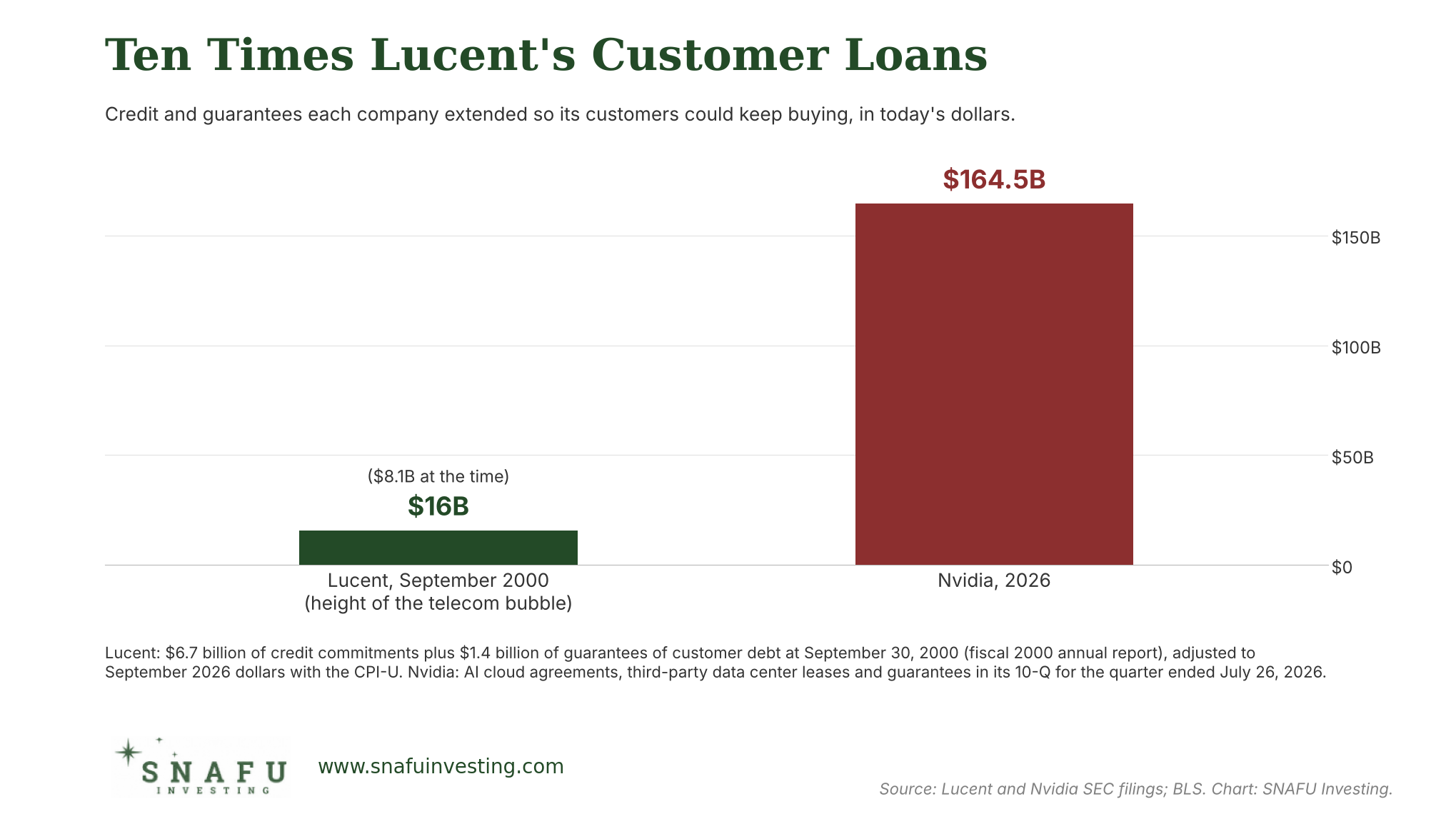
Nvidia’s figure is about ten times as large, at a company that carries several times Lucent’s weight in the market.
And there’s another clear parallel here. As I mentioned, Lucent was the most widely held stock in America, and its collapse hurt millions of people who thought they owned something safe. And, of course, Nvidia is in practically every retirement account in the country (because it’s in every fund that tracks the S&P 500).
The Cracks Are Showing
Which brings us back to Nvidia’s new interim CEO, who may now have to decide whether the loop keeps spinning.
My guess, and it’s only a guess, is that for now things will carry on more or less as they are. It’s always easier to keep doing what you were doing, and a company in the middle of the biggest boom in its history doesn’t slam on the brakes in its first week under new management.
The trouble is that cracks are already appearing. The clearest example landed on Thursday, the same day Huang resigned.
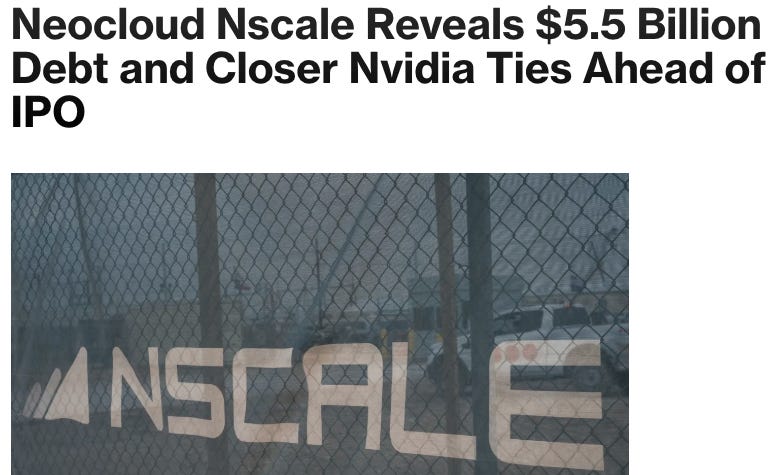
Nscale, a British neocloud preparing to go public, updated its IPO filing. It had placed a big order for Nvidia chips to serve a $44.6 billion contract with Anthropic, and it now says it will need more money to meet its obligations next year, some of which “cannot be contractually deferred, reduced or cancelled.” Its debt went from $137 million at the end of June to $5.5 billion at the end of September, and it lost $1.69 billion in the first nine months of the year on $307 million of revenue. Nvidia, meanwhile, has committed another $1 billion of financing on top of the $1 billion it had already put in.
In other words, Nvidia lends Nscale the money, Nscale uses it to buy Nvidia’s chips, Nvidia records the sale, and Nscale rents the chips out to Anthropic. And Nscale already says it can’t pay for next year without more help. Oops.
So what happens if Nvidia looks at that and starts pulling back? It isn’t a crazy idea, because Kress was never exactly sold on the program. That “deer in the headlights” remark I mentioned earlier reportedly came in an August meeting about this very program, after Kress kept asking how Nvidia should decide which deals to do, how to value the guarantees, and what the company was actually getting back. She was also the one who reworked the OpenAI deal in Ohio and cut Nvidia’s initial commitment roughly in half.
But it’s also true that she has publicly called the deals savvy investments, and that she’s only the interim CEO.
If she does pull back, however, companies like Nscale will have to borrow from someone else.
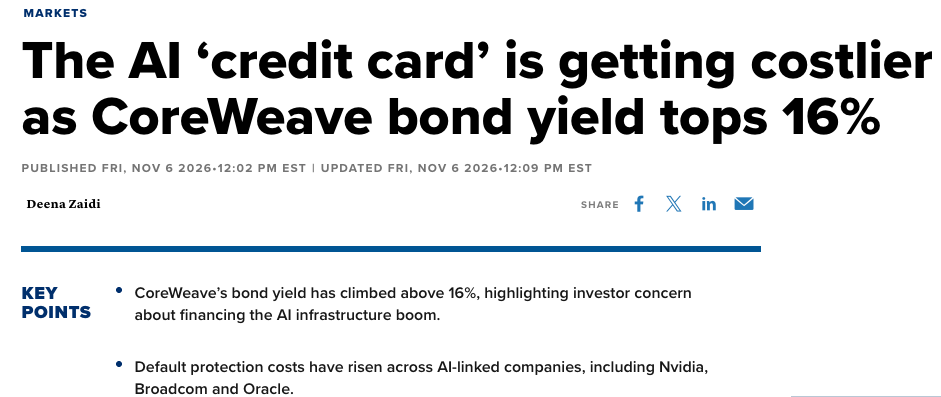
The problem is, that’s getting harder by the week. Hedge funds have been dumping AI-related debt in what one RBC fund manager called “a massive hedge fund capitulation.” CoreWeave, the company I mentioned earlier, saw its bonds yield more than 16% earlier this month, the kind of rate usually reserved for companies investors think might not make it, and the cost of insuring Nvidia’s own debt against default rose 76% in a month. Earlier this week, Wells Fargo’s head of high-grade bond syndication said the market is reaching “maximum market capacity” for this kind of borrowing.
It shouldn’t come as a surprise that a company that can’t borrow can’t build data centers, and a company that can’t build data centers doesn’t buy chips. In other words, if Nvidia stops lending, its customers stop buying, and the revenue the whole AI trade is priced on starts to shrink, and fast.
Of course, if Nvidia doesn’t pull back, the commitments keep growing. And if the cracks are real, which they seem to be, the loop doesn’t have to break this year to do damage. The bigger it gets in the meantime, the bigger the mess when it goes.
Now, I’m not saying Nvidia is Lucent. It’s far more profitable, its customers include some of the biggest companies on earth, and so far nothing like Lucent’s accounting has turned up at Nvidia. But the lesson from 2001 isn’t that the technology was fake. The internet turned out to be every bit as big as promised. The lesson is that the seller was paying for part of its own demand, and it didn’t end well.
Nvidia reports its next quarter on Tuesday. Everyone will be watching revenue and profits. I, for one, will be watching the notes.
Regards,
Lau Vegys
Thanks for explicating the circle jerk of finance at play here Lau. Very instructive and does seem destined for trouble. You mentioned the relevance of all this to resource investors and specifically for natural gas and uranium. How does this vulnerability effect your strategy going forward?
Excellent piece. Thank you!