

Lau here.
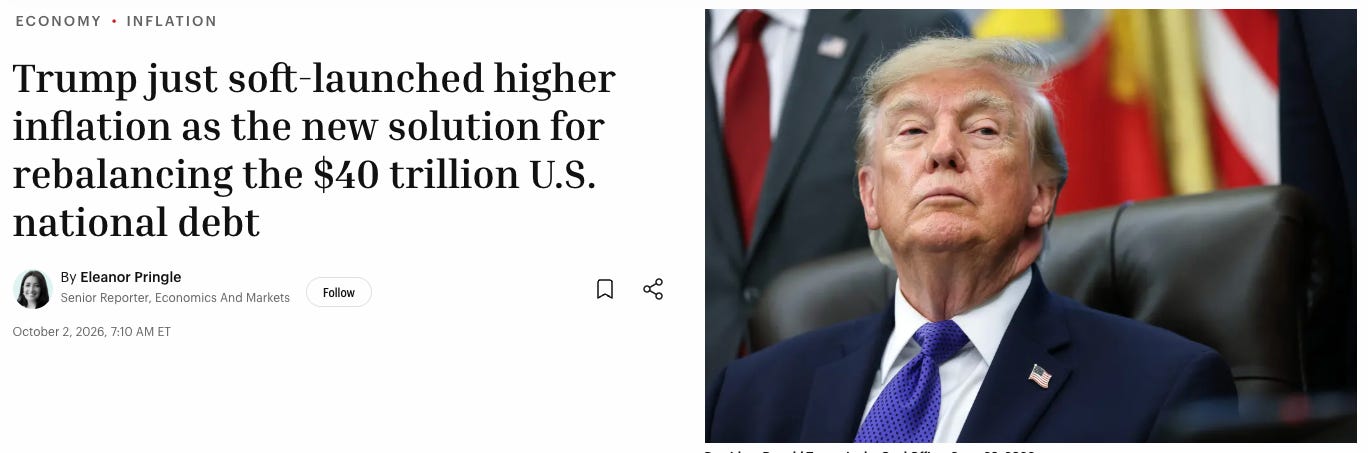
Last week the president said something out loud that presidents are not supposed to say out loud. A journalist asked him about the debt crossing $40 trillion, and this is how he answered.
You know, inflation, certain levels of inflation will also pay off that debt very rapidly. Very rapidly.
I wrote the whole thing up on Saturday, and judging by the response it got, I wasn’t the only one who thought this was a remarkable thing for a sitting president to say.
It also brought a joke to mind. Not a Soviet one this time. Soviet prices were set by decree, so where I grew up inflation showed up as empty shelves rather than price tags, and most of our jokes were about standing in line. For the classic example of what inflation can become, you have to go to Germany, to the Weimar Republic in the early 1920s.
Here’s the joke:
A man pushes a wheelbarrow piled high with German marks to the market to buy a loaf of bread. He sets it down for a moment and turns away. When he looks back, the wheelbarrow is gone.
The money is still there.
Now, as you may suspect, there’s a very good reason they told that one.
Take a look at the chart below. It’s the price of one ounce of gold, in German marks, from 1919 to 1923.
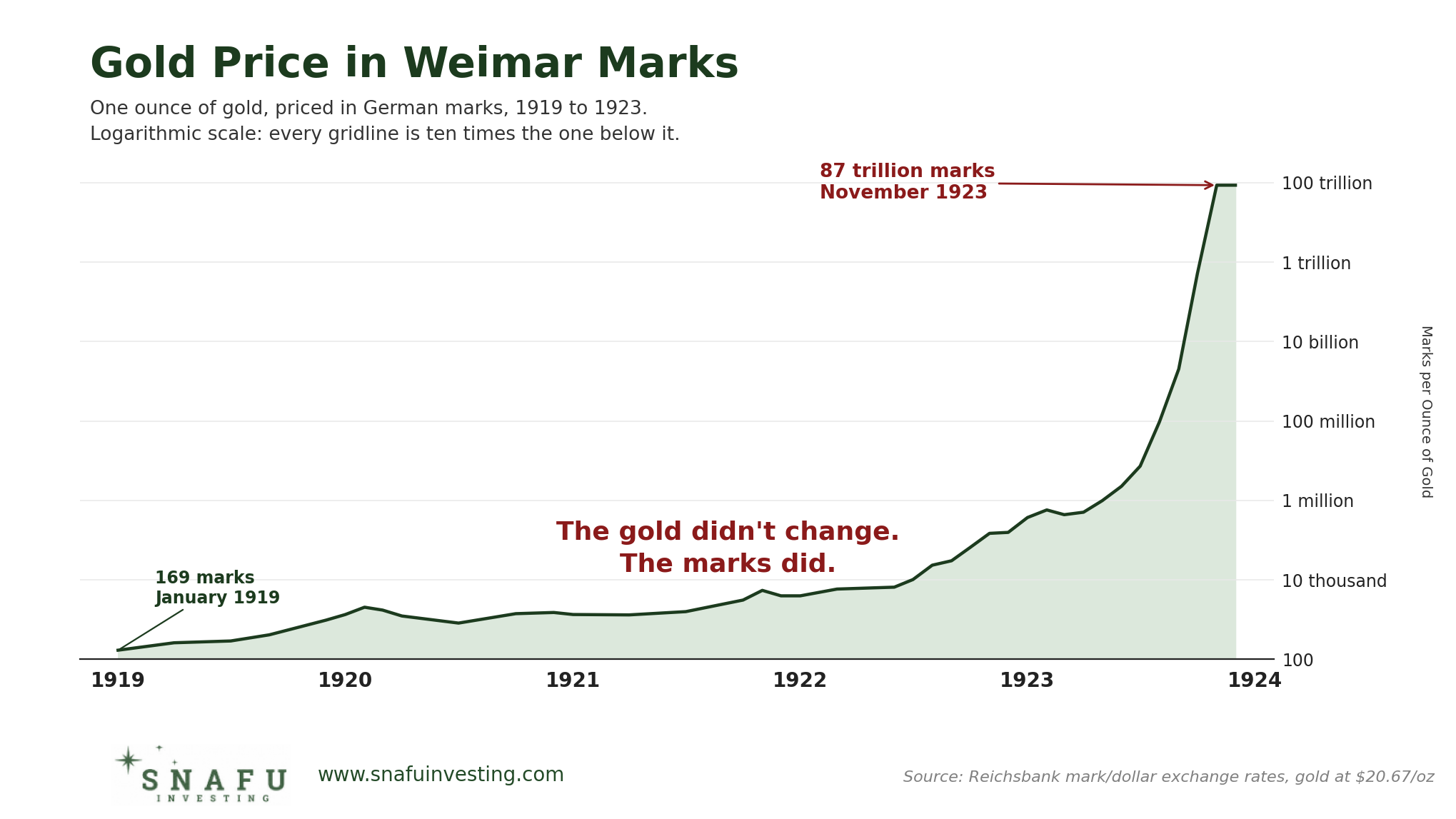
As you can see, an ounce of gold went from about 170 marks in January 1919 to 87 trillion marks by November 1923. That’s less than five years.
What happened was that Germany came out of the war owing reparations it had no realistic hope of paying. Different name, but debt all the same, and far more of it than the country could comfortably meet.
So the government printed.
For a while, that looked manageable. Then, in 1923, it stopped being manageable altogether. The gold price was rising anywhere from 400% to 2,000% a month, and during some stretches almost that fast in a single week. A loaf of bread in Berlin that cost around 160 marks at the end of 1922 cost 200 billion by late 1923.
No wonder the joke has the wheelbarrow getting stolen and not the money in it.
Now, I’m not saying America is Weimar. And, of course, Trump was talking about inflation rather than outright currency collapse. But it’s worth remembering what happened the last time the U.S. went through a major monetary reset.
The basket of goods that cost 41 cents in August 1971, when Nixon severed the dollar’s last link to gold, cost 92 cents by August 1981. In other words, more than half the dollar’s purchasing power disappeared inside a decade, and at no point did it look anything like Weimar.
The catch is that this kind of relatively orderly devaluation, without wheelbarrows and riots, only works as long as people are still willing to lend to you while you do it.
And that’s the hard part today. It’s what I spent most of Saturday’s piece on (including the four mechanisms already taking shape to keep Treasury demand alive), linked below along with the rest of last week’s pieces.
Trump Just Told You How He'll Pay Off the Debt

I’ve written before that there’s only one way out from under US$40 trillion of debt that keeps the elites happy and the public none the wiser: devalue the dollar. Not default. Not cut spending. Inflate the debt away, hopefully quietly enough that nobody riots.
China Got Trump's Red Carpet. It Kept the Rare Earths.

Whatever you think of China, and there’s a lot one can think about it, one thing is beyond dispute: its rise is the biggest story of our time.

From the Comments
One of the things I’ve come to appreciate most about writing here is the conversation that happens in the comments. Here are nine that stood out last week, for different reasons. Each one links back to the piece it appeared on, so you can click through if you’re interested in the context.


Thanks again to everyone who left a comment last week. I read all of them, even the ones I don’t get a chance to reply to individually. Over the coming days, I’ll try to catch up on the questions and the longer threads.
Regards,
Lau Vegys
P.S. If you joined as a paid member last week, welcome aboard. A few links to help you find your way around:
The latest (September) issue, with our newest recommendation, an American rare earth company.
The first recommendation: a uranium play, with the full thesis, buy-up-to price, and tranche levels.
The second recommendation: a silver pick, same treatment.
The third recommendation: a U.S. gold developer trading at a fraction of what its ounces are worth.
The live portfolio: the scorecard of every open position and where each one stands.
The first Special Report: a deep dive into uranium and the opportunity behind it.