


I’ve written before that there’s only one way out from under US$40 trillion of debt that keeps the elites happy and the public none the wiser: devalue the dollar. Not default. Not cut spending. Inflate the debt away, hopefully quietly enough that nobody riots.
This week, the president said it out loud.
Asked by Time magazine about the debt crossing US$40 trillion, Trump answered: “You know, inflation, certain levels of inflation will also pay off that debt very rapidly. Very rapidly.”
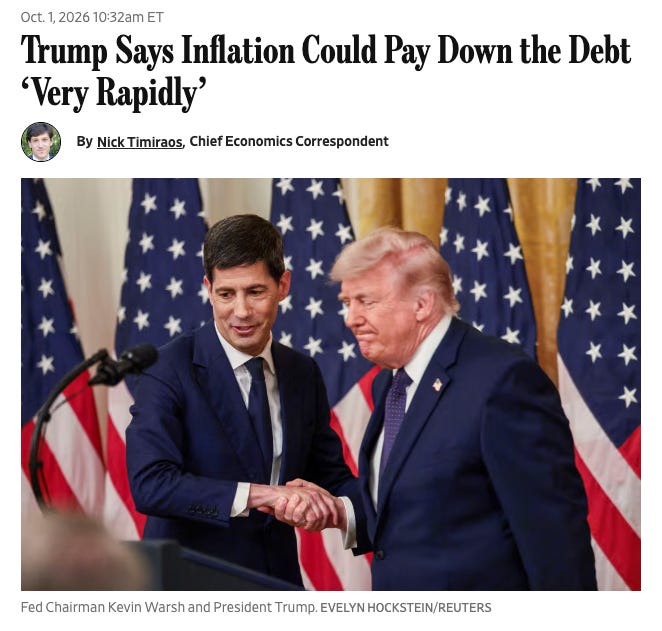
Oh, how times change. Not so long ago, Trump was standing on the Capitol steps promising to “marshal the vast powers” of his cabinet to “defeat what was record inflation and rapidly bring down costs and prices.”
In the same interview, he also added, somewhat mysteriously, that there are “other means” of dealing with the debt, without saying what they were. We’ll come back to that, because I have a pretty good idea what he meant. But first, a little on why a sitting president would say something like this right now.
Why There’s No Other Way
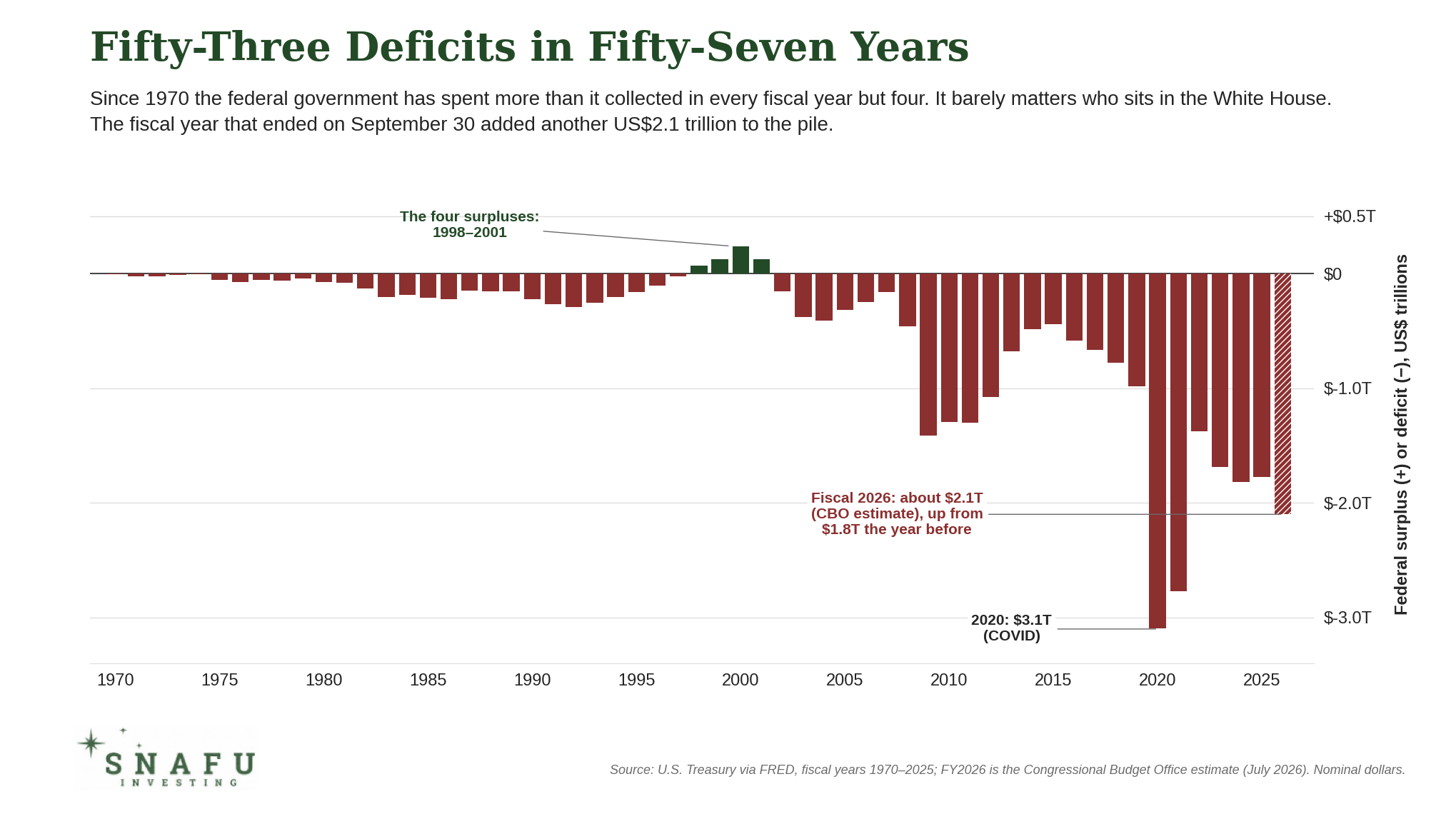
The reason Trump is talking about this now has a lot to do with timing. The fiscal year ended on Wednesday, and the numbers are about what you’d expect from a year with a war in the Gulf, oil above US$100, and an interest bill that passed a trillion dollars. By the Congressional Budget Office’s count, the government ran a deficit of about US$2.1 trillion. That’s up from US$1.8 trillion the year before, and the biggest shortfall since the pandemic. Take a look at the chart below.
Now, if we’re being completely honest, we can’t pin all of this on Trump, not because I feel any need to defend him, but because doing so would imply that the next guy might fix it.
Not going to happen.
Take another look at the chart above. As you can see, since 1970 the federal government has spent more than it collected in 53 of 57 fiscal years. In other words, it really doesn’t matter who sits in the White House. Bush, Obama, Trump, Biden, Trump again: each one has pushed the debt pile significantly higher than he found it.
It’s just the nature of the beast.
The problem the powers that be face now, if they see it as a problem at all, is that the hole has gotten too big to fill the honest way. Balancing the budget would take more than US$2 trillion in cuts every single year. For context, all of Social Security costs about US$1.6 trillion, and the military close to a trillion. Eliminate either one entirely and you still wouldn’t get there.
So cutting is off the table. Default is off the table too, since it would wipe out the very people who fund political careers in this country (along with those careers themselves, of course).
That leaves inflation. Politically, it has two great virtues. It never requires a vote. And it’s kind to the people who matter. When money gets printed, asset prices rise, and the people who own the assets get richer. The pandemic years proved this about as clearly as anything could: between March 2020 and March 2024, the number of U.S. billionaires went from 614 to 737, and their combined wealth rose about 90%, to some US$5.5 trillion.
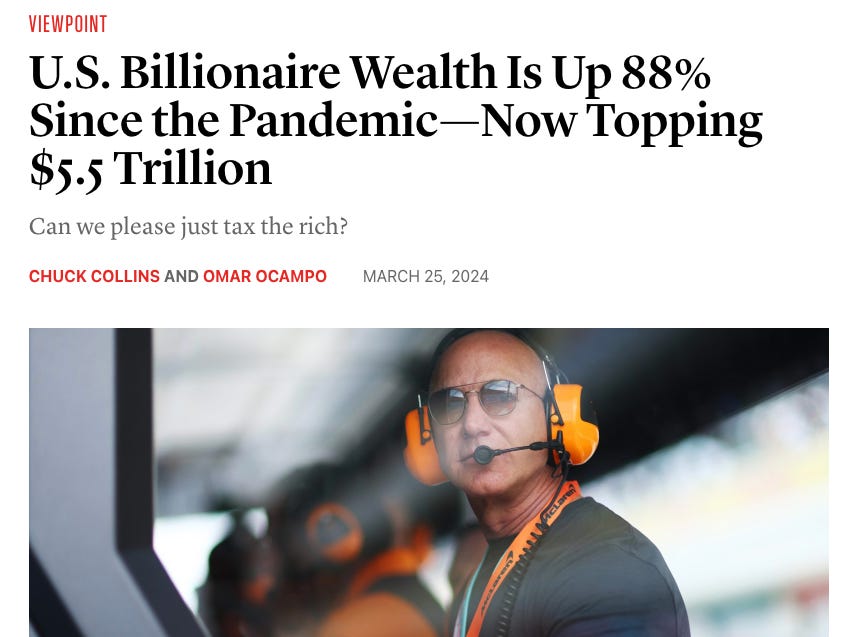
Not coincidentally, that was when the Fed was printing at a pace never seen before. For everyone else, the ones watching their savings buy less every year, not so much.
So Trump isn’t the first leader to work out that inflation is the path of least resistance. He’s just the first in a long while to say it on the record.
What he didn’t say is how it works. So let’s talk about that, because it’s worth understanding.
How Inflation Pays a Debt
The general idea is simple, and it hits close to home. Say your family has a fixed US$400,000 mortgage, roughly the price of an average American house. Now say inflation takes off and, over a few years, prices across the economy double, and so, more or less, do your and your partner’s salaries. Your mortgage payment hasn’t changed by a cent. But it now takes half the share of your income it used to. The debt didn’t shrink. Your dollars did, and the debt was written in dollars.
The government’s position is exactly the same, with one important caveat. Inflation only shrinks a debt if the interest rate on that debt stays below the inflation rate. Say the government borrows at 3% and prices rise at 5%. The real value of what it owes melts by 2% a year, and after a decade or so, a mountain has become a hill. If it has to pay 7% to borrow while prices rise 5%, the trick stops working.
Now, if you look at the historical record, this wouldn’t be the first time the U.S. government has pulled it off.
Let’s go back to 1946. America had just won a world war and paid for much of it on credit. Federal debt held by the public stood at 106% of GDP, slightly higher than it is today. Everyone agreed it had to come down. But nobody wanted to slash the programs millions of returning soldiers now depended on.
So they didn’t.
What they did instead was lean on the Fed. Remember, since 1942 the Fed had already been pegging Treasury yields at the Treasury’s request, long bonds at 2.5%, so the war could be financed on the cheap.
But guess what: when the war ended, the peg stayed.
And here’s the thing about a peg like that. To hold yields at 2.5%, the Fed has to buy every bond the market won’t take at that price, and it pays with money it creates on the spot.
Now, during a war, rationing and price controls can keep all that new money bottled up, and that’s exactly what happened in America between 1942 and 1945. But in 1946 the controls came off, and prices took off: up a third between the end of 1945 and the end of 1948.
Net result: by 1950 the debt was down to 73% of GDP. By 1960, 44%. And not because anyone paid it back: in dollars, the debt was about the same size in 1960 as in 1946. The dollars themselves just bought a lot less, and everyone holding them covered the difference.
Economists have a polite name for this: financial repression. The honest name is a tax on you.
And it wasn’t the only time it worked. The details change, but the trick is always the same: keep what the government pays on its debt below inflation. Take a look at the chart below. It shows the yield on the 10-year Treasury minus inflation, going back to 1945.
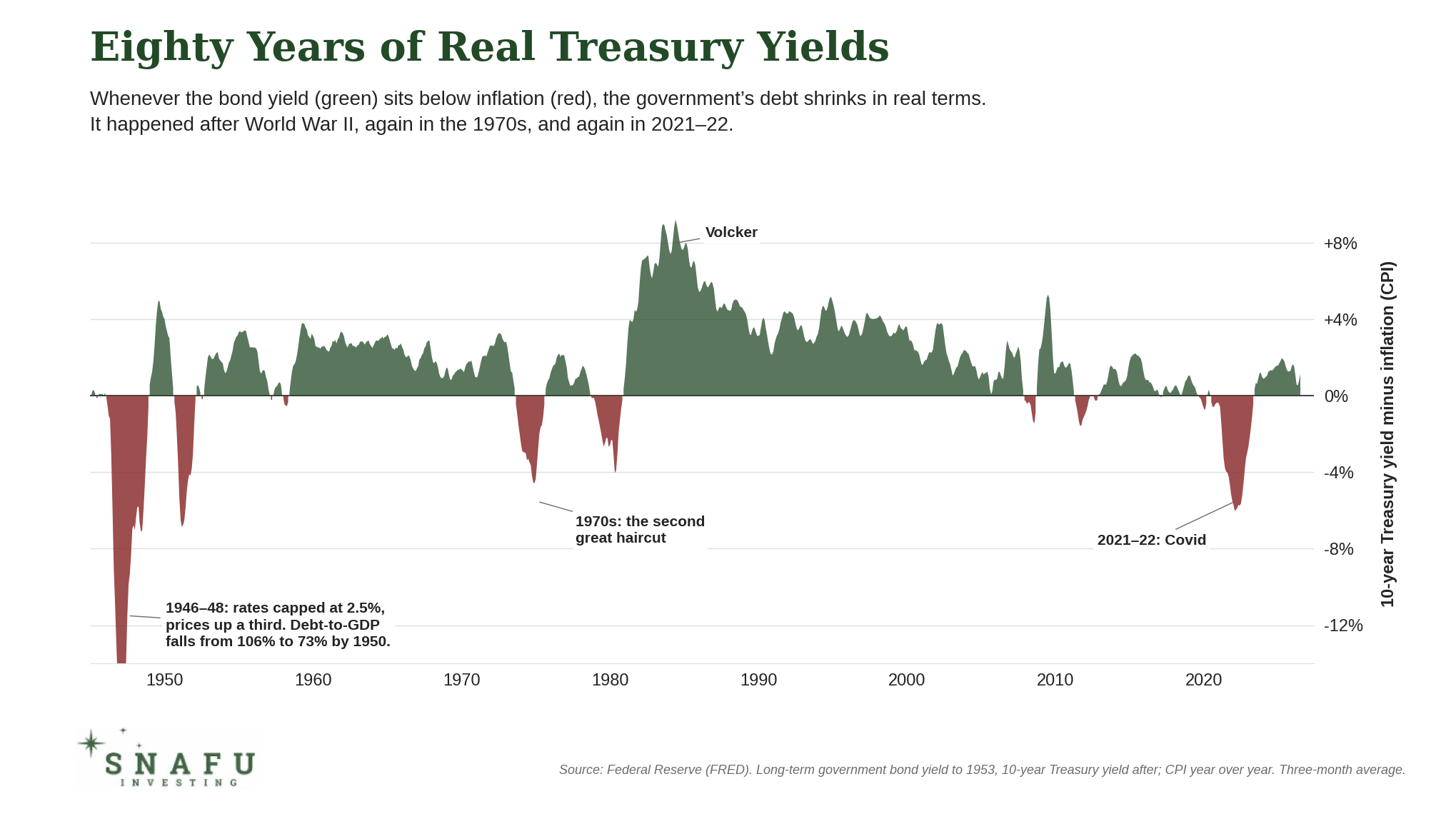
Here’s how to read it. Every time the line dips into the red, inflation is running ahead of what the government pays to borrow. In other words, those are the years the trick works and the debt burden quietly melts away.
We’ve already discussed the 1940s, the big red patch on the left. The same thing happened again in the 1970s. The government ran a deficit every single year, yet the debt ratio barely budged from around 25%. If you’re wondering how, consider that consumer prices more than doubled over the decade.
Now look all the way to the right, at 2021 and 2022. The U.S. government ran deficits of US$2.8 trillion and US$1.4 trillion, yet debt-to-GDP fell anyway, from 98% to 93%. How? Well, prices rose about 14% in just two years.
Lenders Who Can't Say No
If you’ve been reading carefully, you probably already suspect there’s a catch.
Free investors, meaning anyone who can walk away, won’t lend you money at 3% when inflation is 5%. They demand 6, 7, 8%, which of course just makes the interest bill bigger. (Keep in mind, at a trillion dollars a year right now, it’s already the second-largest line in the budget.)
So here’s the thing. For inflation to work as a debt-reduction tool, you need lenders who keep buying your paper at a loss. Not because they want to, but because they have to. Let’s call them captive lenders. Think banks that hold Treasuries to satisfy regulators, money market funds that can hold little else, foreign central banks with dollars to park. America has always had some of those. The question is whether it has enough of them right now.
Let me explain.
See, in 1946, finding captive lenders was the easy part. Americans had nowhere else to put their money (owning gold had been illegal since 1933), and the rest of the world was broke.
But today it’s a lot harder. As I told you recently, the foreign governments and central banks that financed America for decades have stopped keeping pace. At the end of 2014, they held a little over US$4.1 trillion of Treasuries. A decade and change later, they hold about US$3.9 trillion. Meanwhile, the debt went from US$18 trillion to US$40 trillion. In other words, the people who used to bankroll America sat out the last US$22 trillion of it.
So if inflation is going to do the job the president says it will, the U.S. government needs lenders who can’t say no. And since Trump took office, the pieces of a system that could do exactly that have been falling into place.
I count four big ones. Let’s take them one at a time. Then I’ll give you the blueprint for how they all fit together.
1. Build a new sponge.
For fifty years, the U.S. government never had to think about who would buy its debt, because the rest of the world did it automatically. America bought the world’s stuff, above all its oil, and paid in dollars. The world ended up holding mountains of dollars it had to park somewhere, and the obvious place was U.S. Treasuries. The oil exporters were the clearest case (that’s the petrodollar system I’ve written about before), but Japan, China, Germany and everyone else with a trade surplus did the same. In effect, they were forced buyers. Think of it as a sponge that soaked up whatever the U.S. government wanted to borrow, at whatever rate it offered.
Well, the problem now is that the sponge is drying up. China has spent the past few years building a way to buy its oil without dollars, as I showed you in my series on the Hormuz crisis, and foreign holders in general have been backing away: their share of the Treasury market has slid from close to half in 2011 to about 30% today, the lowest in two decades.
Which raises the question: how do you get people to keep buying your debt when the people who used to don’t want to anymore? One answer is to build a new sponge. And the U.S. government is doing exactly that, out of stablecoins of all things.
If you’re not familiar with them, stablecoins are digital tokens designed to trade one-for-one with the dollar, and in much of the world they’ve become the easiest way for ordinary people to hold “dollars” without a U.S. bank account. Last year Congress passed a law to regulate them, the GENIUS Act. Among other things, it requires every dollar stablecoin to be backed one-for-one by a narrow set of assets, and the main one on the list is short-term Treasuries. So every time someone in Lagos or Buenos Aires buys a digital dollar, somebody in the chain buys a Treasury bill. Treasury Secretary Bessent said at the time that the law would produce a “surge in demand” for government debt, and he wasn’t exaggerating. The stablecoin market is now around US$300 billion. Tether, the biggest issuer, reported about US$141 billion of Treasury bill exposure as of March, which by its own count makes it the seventeenth-largest holder of U.S. government debt on earth, ahead of most countries.
Of course, it doesn’t stop at crypto. Banks, money-market funds, insurers and pension funds can all be nudged into Treasuries through regulation, and they are. What every one of these buyers has in common is that none of them is really free to walk away. They hold Treasuries because the rules say so. And when you trace it all the way back, the new buyer is you and me.
2. Run a pawn shop.
The second piece deals with the old buyers, the foreign governments that already hold trillions of this paper. If the U.S. government can’t make them buy more, it can at least try to stop them from selling.
For that, the Fed has a tool almost nobody has heard of, called the FIMA repo facility. In plain English, it’s a pawn shop for governments. A foreign central bank that needs dollars hands the Fed some of its Treasuries as collateral, the Fed hands back freshly created dollars, and later the country buys its bonds back. The Fed’s own description says the facility exists to give foreign governments “an alternative temporary source of U.S. dollars other than sales of securities in the open market.” In other words, it was built so that a government that needs cash doesn’t have to dump Treasuries to get it.
Why does that matter right now? Because of Japan. Japan is the biggest foreign holder of U.S. debt, about US$1.14 trillion of it, and it has spent this year fighting a collapsing yen. Defending a currency takes dollars, lots of them, and Japan’s two interventions this year cost US$73 billion and US$75 billion. The obvious place to get that money would be to sell some Treasuries. Which is exactly what the U.S. government cannot allow. Which is why it has been steering Japan toward the pawn shop instead. (You may remember that right after this summer’s joint intervention, Japan’s Ministry of Finance announced it plans to use the facility, and Bessent publicly asked the Fed to raise its US$60 billion per-country cap.)
3. Move the debt to where the Fed sets the price.
The third piece is about which kind of debt the government issues. As you may recall, the Fed can’t dictate what investors demand to lend for 30 years; that rate is set in the market. But it has a great deal of say over what they get for lending for three months. So if you’re the Treasury and you want to keep your borrowing costs down, you issue more short-term bills and fewer long bonds.
That’s what’s been happening. In 2014, bills made up 13% of marketable debt. Where are they now? About 22%. Interestingly, that’s above the 20% ceiling the Treasury’s own advisers consider “prudent.”
Now, conveniently, the stablecoin rules I just mentioned also create demand for exactly this paper. That’s because under the GENIUS Act, Treasuries used as reserves generally have to mature within 93 days. So the newest captive buyer is being steered straight into the one corner of the market where the Fed sets the price.
4. Print, but don’t call it that.
And finally, there’s one buyer that can never run out of dollars: the Fed. If the economy weakens, if the bond market seizes up, if long rates get uncomfortable, the Fed can simply create reserves and buy government debt itself. Call it QE. Call it liquidity support. The mechanics are the same: the buyer with the deepest pockets in the room owns the printing press.
And you don’t have to wait for a crisis to see it. The Fed spent the first half of this year buying short-term bills by the tens of billions and calling it reserve management.
That’s printing in everything but name.
The Treasury, meanwhile, has started buying its own bonds. In August it doubled its long-end buyback operations, from US$2 billion apiece to US$4 billion, through early November. A week later came reports that Bessent could tap the government’s cash balance, close to a trillion dollars, to fund more of them.
None of that is QE on paper. All of it is the government holding its own bond market up.
Now, here’s the blueprint I promised, with all four pieces in one picture.
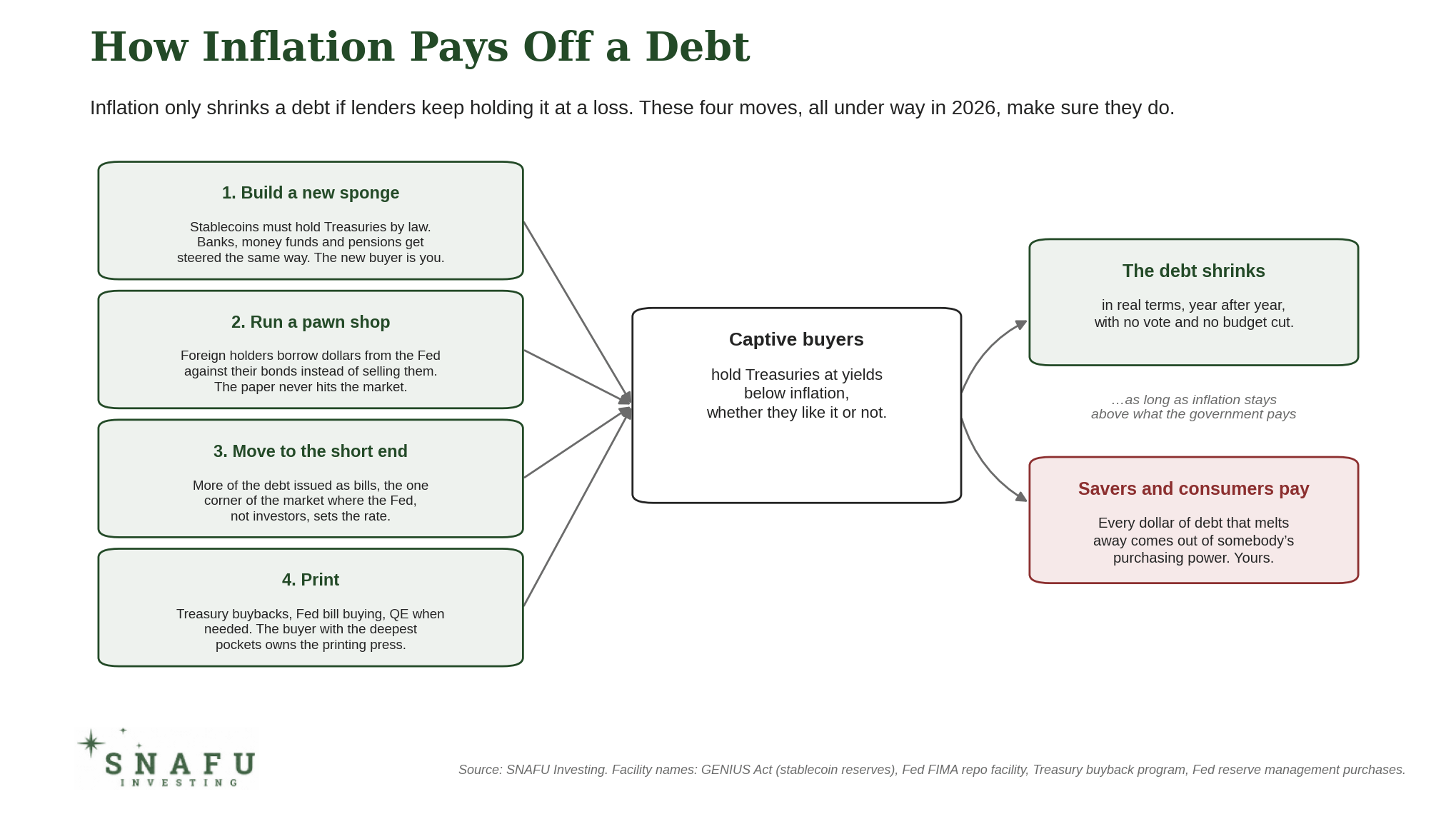
If you study it for a moment, you’ll notice the four pieces have one thing in common. Not one of them depends on the interest rate to work. Or on inflation staying low.
I’d bet this is exactly what Trump had in mind when he talked about “other means.”
Enjoy the rest of your weekend,
Lau Vegys
P.S. As I mentioned, owning gold was illegal for Americans from 1933 until the end of 1974, so when the dollars in the bank started buying less in the late 1940s, there was nowhere to go. That isn’t your situation. You can still swap government currency for the one thing the government can’t print: precious metals. Physical metal comes first. After that, for potentially greater profits, mining stocks, which give you leverage to the metal price. That’s why a good part of the SNAFU Investing portfolio is in gold and silver names. And last week, the latest monthly issue went out with a brand-new recommendation. If you’re a paid subscriber, it’s all waiting for you in the portfolio. If you’re not, now might be a good time to see what you’ve been missing.
Great article on how the hidden tax of inflation sticks it to those that cannot afford it and most do not realize what is happening.
They will blame the greedy corporations and anyone else but the government which caused it all to begin with.
Thanks so much! Real education like this is VERY difficult to come by.