

Today’s the day.
The publication I promised when I left my old shop is live — you’re reading it. (The backstory’s here, if you missed it.) I called it SNAFU Investing. Odd name, I know — but it’s personal. Behind it is the biggest tank battle in history, two days in cold water, and a man I knew well. I want to tell that one properly before we get down to business — because it sets the stage for everything else we’ll be talking about today. But it’s far from everything you’re getting.
Here’s the plan. The story first. Then the word itself, and why it’s the single most useful word for understanding the world right now — by the time you see what it actually means, you’ll know why I built a whole publication around it. From there, the biggest SNAFU in the markets today, plus what you’ll actually get around here, free and paid. And at the bottom, my first recommendation: the full writeup on a company sitting right in the middle of that SNAFU.
Let’s get into it.
Two Days in the Water
Longtime readers know I grew up in the USSR, in the Soviet republic of Lithuania, and know roughly what I think of the system that ran it. I’ve written about that world plenty. Nobody in my family had any love for communism.
But there’s a story from that world I haven’t told here. It’s about my grandfather, on my father’s side, and it’s where this publication’s name — and the star on its masthead — come from.
When the Germans invaded, my grandfather — Juozas, the Lithuanian version of Joseph — was evacuated from Lithuania deep into Russia. He was no communist, but he was young, idealistic, and, might I add, fiercely anti-Nazi, having witnessed some of their atrocities. So when the Red Army formed the 16th “Lithuanian” Rifle Division at Balakhna, near Gorky, largely from evacuees like him, he ended up in its ranks.
Now, for all the genuine bravery of the men in that division, my grandfather’s stories about it always carried a second theme: the staggering amount of nonsense that came down from above.
The division was poorly supplied and short on combat experience. And from the day it was formed, the Soviet leadership looked at it with suspicion. Moscow simply never trusted it.
So its first battle — against fortified German positions near Oryol in February 1943, undertrained and half-starved — went about the way you’d expect. Historians call it the catastrophe at Alekseyevka: more than a thousand men dead and three thousand wounded in roughly a month. Even the Soviet command admitted the division had been sent in unprepared.
Its response? It stamped the survivors politically unreliable.
You can guess what a label like that meant in the Soviet Union. It was no badge of honor; a man wearing it stood about two steps from prison.
Whether my grandfather was in that February fight himself, he never said — and the men who were there mostly didn’t.
By the summer of 1943, the division — refilled with fresh replacements after that February — was fighting around Oryol, on the northern side of the Kursk salient.
History remembers Kursk as the largest tank battle ever fought. But most of the men who fought there weren’t in tanks. All told, some two million men took part — roughly the population of a decent-sized European capital — spread out across hundreds of miles of farmland, trying to kill each other. Most were infantry.
My grandfather was one of them.
Long story short — and I don’t recall all the fine details; my grandfather, rest his soul, has been gone for more than twenty years — somewhere in that fighting, his unit collided with the Germans and got mauled. Men he’d trained with died around him. What was left of them went to ground in the only cover they could find: a marshy stream bottom — a pond, basically — with reeds and standing water.
And then, at some point, the rest of his unit fell back. Nobody told him.
That used to puzzle me. How does an army forget a man?
Years later, I did some digging into how the Red Army actually worked. Turns out, it wasn’t hard to see how something like that could happen.
Orders in a rifle company that summer traveled by field-telephone wire and by runner. There were no radios at that level. After a mauling, half the wire could be cut and some of the runners dead. The lists of who was still alive out front no longer necessarily matched anything real.
Somewhere up the chain, someone ordered a pullback. The order reached the men it reached.
It never reached my grandfather.
Maybe the runner was killed. Maybe whoever knew where he was lying was dead himself. Maybe someone decided the men in the low ground were lost anyway. Nobody ever knew, and nobody came.
As far as headquarters was concerned, the situation was normal.
So he sat in that water for two days, with German patrols close enough that he could hear them talk.
Now, look, the man was no coward — he’d go on to be decorated later in the war — but he wasn’t stupid either. A soldier separated from his unit was supposed to rejoin it without delay. For my grandfather, that meant climbing out in broad daylight and crossing open steppe crawling with German patrols. He probably wouldn’t have made it very far. The other option was to remain in the area and wait for orders. But Germans were everywhere, and the orders weren’t coming.
The point is, the official version of events had no survivable role in it for him. So he read the situation for what it actually was, rather than what it was supposed to be, and stayed in the water until he saw his chance to get out.
Thankfully, it was summer, or this story would have ended very differently. But even in summer, two days in water does ugly things to a body. And he couldn’t so much as splash around to keep the blood moving; he had to stay still while the mosquitoes found him long before the Germans left. The skin goes white and soft, the legs go numb, and when you finally try to move again, every step is excruciating.
My grandfather learned all of that on the way out.
When he finally pulled himself out of the water, he was lost, starving, and alone in enemy-held territory. He told me he was never much good at reading terrain. But he knew two things: roughly where his own lines were, and where to find the North Star.
Now, walking north was obviously out of the question. That would take him deeper into German-held territory, toward Oryol itself. His own lines lay somewhere to the east or southeast.
So that became the plan. Hide and sleep through the day so the patrols wouldn’t find him. Walk at night, using the North Star as a fixed point to keep his bearings.
He didn’t walk toward it. He kept it to his left and walked east.
The skies stayed clear.
And eventually, he made it back to his own lines.
It’s a shame the old man isn’t around anymore. Had he lived long enough for me to tell him, he’d have gotten a kick out of knowing there’s a perfect word for everything he went through in those fateful days of 1943:
SNAFU.
The water never entirely left him, by the way. For the rest of his life, his legs ached whenever rain was coming. He’d announce it, complaining, a day in advance — and he was usually right.
The Word
Soviet soldiers didn’t do acronyms. They had mat, the great Russian cursing tradition, and they wielded it the way painters wield paint. My grandfather’s full description of that, shall we say, pond experience, faithfully translated, would probably peel the pixels off this page.
Now, from what I know, American soldiers love swearing too. But they also love acronyms. And so the American GIs fighting that same war came up with five letters that couldn’t have described my grandfather’s situation any better.
As you may or may not know, the term came from the ranks, not the officers’ mess. It was the enlisted man’s cynical answer to the nonsense that came down from headquarters — and the difference between what command thought was happening and what was actually happening on the ground.
SNAFU. Situation Normal: All Fucked Up.
(Pardon the language — that was strictly for research purposes, as you can no doubt tell. From here on, we’re a respectable publication. Mostly.)
That’s the word this publication is named after. And now you know the story behind the North Star in the logo, too. One last point on that note, by the way. You may have noticed that my grandfather didn’t actually follow the star — had he done that, he would have walked due north, deeper into German-held territory. No, what he did was use it as a fixed point to find his own way back. And that’s an important distinction. In a SNAFU, you first need to see things as they really are. Only then can you figure out where you’re going.
That’s more or less the philosophy behind what we’ll be doing here.
Enough war stories, though. Let’s look at the world we live in today. Nothing works the way it’s supposed to — and everyone pretends it does.
It’s the SNAFU world.
You don’t have to look very far to see what I mean:
Take the debt. The U.S. owes $39.4 trillion, runs war-sized deficits in supposedly good times, and borrows new money just to pay interest on the old.
Or take the money itself. You saw what happened with the COVID trillions. The Fed’s balance sheet more than doubled, inflation hit 9.1%, and the people responsible called it “transitory.”
Then there are the markets. The economy weakens, so stocks rise because investors expect the central bank to make money cheaper. That’s a perfectly normal day in today’s SNAFU world.
And then there’s the empire. America is expected to police the world, defend its trade routes, and run the world’s reserve currency — all on borrowed and printed money — while depending on its rivals for critical minerals and supply chains.
But tune into the legacy media, and none of this is particularly alarming. The debt is high, yes, but manageable. Markets may be a little frothy, but fundamentally sound. Fiat money is simply how the modern world works. And the American empire may have its problems, but it remains indispensable.
You get the picture.
Situation normal.
Now, I can already hear some of you thinking: fine, but why not just call it a crisis?
Crisis. I know that word intimately. It was in the name on the door at my last job, and it’s the load-bearing word of half the financial newsletter industry. It taught me a lot. It also taught me its limits.
Here’s the difference.
A crisis is an event. Something breaks, everyone can see that it broke, the sirens go off — and buried inside the word is an assumption that the system will respond, the damage will be repaired, and things will eventually return to normal.
A crisis, by definition, ends. Or it’s not a crisis.
A SNAFU is different. The dysfunction is the normal state of affairs. Nothing is coming to the rescue because, as far as the system is concerned, the situation is normal.
The best you can do is recognize things for what they actually are rather than what they’re supposed to be, and act accordingly.
Which, come to think of it, is exactly what my grandfather did some eighty years ago.
And speaking of the USSR, do you think it had nearly seventy years of crisis?
No. It had nearly seventy years of SNAFU.
Sure, it spilled over into proper crises now and then — shortages, Afghanistan, Chernobyl, the “monetary reforms” that ate people’s savings overnight. But those were events. The SNAFU was the system standing behind them all.
And guess what? Most people didn’t see it. They lived their lives. They married, worked, raised children, and told jokes in their communal kitchens. The Soviet Union had existed for their entire lives and, for all its dysfunction, looked permanent. So when the whole thing came crashing down, millions were left scratching their heads.
But some saw it coming from miles away. They understood that the USSR wasn’t collapsing because of Afghanistan, or the ruble, or any single disaster. Those were crises, and crises pass. The real problem was that the entire country had become one big ball of SNAFU.
The people who understood that early enough didn’t just survive what came next. Some of them came out of it very wealthy.
And before you assume it all must have been obvious, remember: you have the benefit of hindsight. They were living inside a totalitarian state that had looked permanent their entire lives.
Now, I’m not saying America or Europe is the Soviet Union, or that either will necessarily end up like it. I’m saying people are remarkably good at accepting dysfunction as normal once they’ve lived with it long enough — and then being completely gobsmacked when things finally change.
You, of course, are different. You read SNAFU Investing.
I kid, but only a little. The truth is, it’s no more obvious today to most people knee-deep in the SNAFU world of the West — Europeans and Americans alike. Most will only recognize the crisis when it finally arrives, far too late to prepare. And even then, they won’t understand what actually hit them.
And it won’t be the crisis per se. It’ll be what stood behind it all along.
So What’s the Biggest “Situation Normal” Right Now?
I could point you to a dozen more SNAFUs, and one of these days I’ll lay the whole thing out properly. Maybe I’ll even turn it into a SNAFU manifesto of sorts.
But the question that matters right now is the one in the title: what’s the biggest SNAFU going on today?
First, though, here’s the thing to understand about SNAFUs as an investor’s tool. A SNAFU creates the mispricing: assets get valued as if the official story were true. On the other side of the equation sits reality — and it’s reality that creates the catalyst, because sooner or later, it forces the issue.
Learn to see both clearly, and you win. Simple as that.
And one of the clearest examples of SNAFU in the world right now — one I deliberately left off the list above — is energy.
Just look at the genuinely destructive energy policies the West has talked itself into. The Paris Accords. Net Zero. Entire national grids staked on the idea that the wind will blow and the sun will shine when we need them to. Spain — the country I’m writing this from — got a taste of where that can lead last year, when a massive blackout brought much of the country to a standstill.
Meanwhile, nuclear — the one source of clean, always-on power — spent those same years wearing a scarlet letter.
And nothing did more to cement that reputation than the 2011 Fukushima disaster. Nuclear progress was set back by years, as governments and environmentalists spent the next decade bashing the cleanest, densest fuel humanity has ever had while their own grids became shakier by the year.
But electricity has to come from somewhere. And sooner or later, reality wins.
The turn came, of all places, at a climate conference. At COP28 in Dubai in December 2023, the U.S., UK, France, Japan, South Korea, the UAE, and more than a dozen other countries pledged to triple global nuclear capacity by 2050.
As big a deal as that was, remember: it happened before two things made the case for nuclear considerably more urgent.
The first was AI. The world piled into the data-center craze, and suddenly everyone needed vastly more reliable, around-the-clock electricity to power it.
The second was Hormuz.
I’ve written extensively about this in the past, so I won’t beat a dead horse here. But the point is simple: the war with Iran and the subsequent closure of the most important energy chokepoint on earth gave every energy-importing country a hard lesson in what it means to depend on someone else’s strait for your energy needs.
Nowhere did that lesson land harder than in Japan and South Korea, two of the biggest and most energy-starved economies on earth. They produce little of their own energy, import most of what they use, and much of it arrives through Hormuz.
Both countries were already turning to nuclear before the missiles flew. Japan had been quietly restarting reactors shuttered after Fukushima, while South Korea was pushing ahead with its own nuclear build-out. But Hormuz gave the energy-security argument a whole new urgency.
And then, just this week, came another big step. Japan and South Korea signed an agreement with the United States to cooperate on deploying small modular reactors — SMRs — across Asia and beyond.
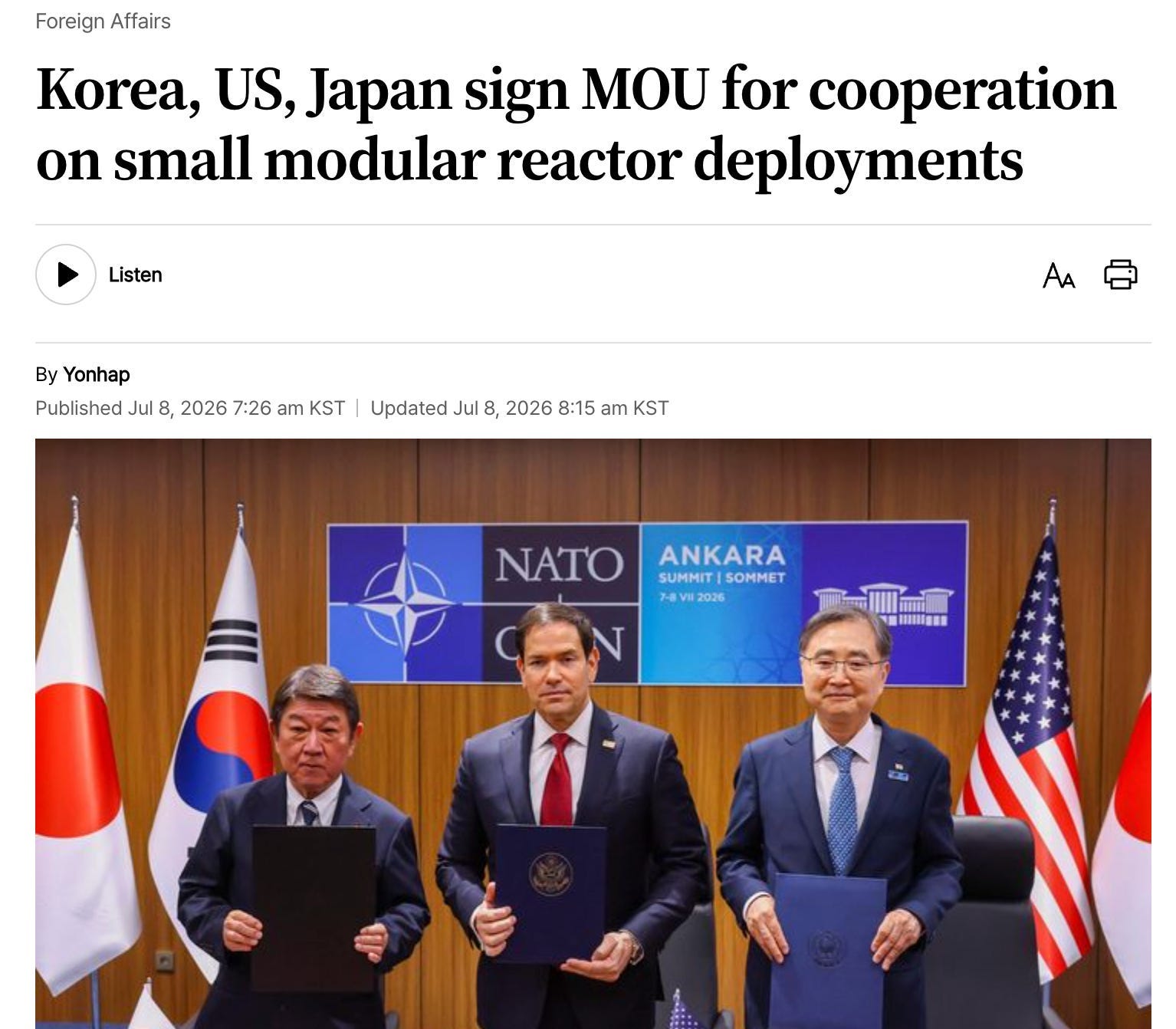
Unlike conventional nuclear plants, SMRs are designed to be smaller, easier to deploy, and potentially cheaper to build at scale. If the technology lives up to its promise, it could bring nuclear power to far more places, far faster.
And all those reactors — big or small — need fuel.
That’s where uranium comes in.
The world’s nuclear plants already generate roughly 10% of its electricity. And every new reactor means more uranium demand — not for a year or two, but for decades. Remember, the commitment is to triple nuclear capacity by 2050. And that pledge came before AI, before Hormuz, and before Asia got its latest brutal lesson in energy security.
The problem — especially for the data-center-crazed United States — is that much of the world’s uranium supply is increasingly spoken for, tied up, or simply off-limits.
For investors positioned in uranium, of course, that’s the opportunity.
The U.S. banned Russian uranium imports in 2024. Kazakhstan — the Saudi Arabia of uranium — produces roughly 40% of the world’s supply but has deep ties to Moscow. And China, busy building reactors of its own, has been locking up Kazakh output years in advance.
That leaves America, Europe, Japan, and Korea competing for the same limited pool of Western supply.
Somewhere in the middle of all this mess sits a Western uranium company — and no, not one of the usual suspects. Already producing — not promising to produce someday, but producing now.
And here’s the kicker on timing. The stock sits about a fifth below where it traded a month ago — mostly because the whole sector gets dragged down every time Hormuz flares up, and lately it’s been flaring more often than not.
Now, plenty of smart people will tell you uranium shouldn’t sell off on Hormuz at all, since not a pound of it passes through the strait. They’re only partly right.
Something else does pass through: sulfur — close to half the world’s seaborne supply — and sulfuric acid is what Kazakhstan’s uranium mines run on. So the shooting is a real uranium problem after all. Just not for everyone.
It threatens the world’s biggest supplier. But some Western producers don’t touch the stuff at all — including the one I’m recommending today.
A Quick Word About Me
Before I show you the company, you’re entitled to ask who’s asking for your trust.
I’m Lau Vegys. I’ve spent nearly two decades in the investing world — though who am I kidding: if you’re reading this, you probably know me already. And if you don’t, Google works fine.
So I’ll just say this. For the past two and a half years, I wrote every stock recommendation published by Doug Casey’s Crisis Investing right here on Substack. Last year, those recommendations averaged +53% by the December review. The precious-metals positions averaged around +140%. Eleven times, a position doubled and subscribers got the alert: original capital off the table, ride the rest for free. One pick — a rare-earths company — ran to five times the entry price; I walked through that whole trade recently, start to finish, right here.
Now, normally I would never cite results from behind another publication’s paywall — that research belongs to the people who paid for it. But my former shop has been quoting these particular numbers in its own public marketing. And since I’m the one who built them, I figure I’m entitled to mention them here too. The rest of the wins stay where they are — out of respect for the subscribers who paid for them, not because there’s nothing to tell.
But none of that matters much from where you’re sitting. Because as of today, the record restarts — in public. Every recommendation I make here goes into the SNAFU portfolio — its own page, every entry and exit on the record, prices updating automatically. It starts small. That’s what a track record looks like on the day it’s born.
And I’ll be in it with you. Every stock I recommend here, I buy with my own money — never before you get it. My standing rule: no buying until at least three trading days after a recommendation goes out, so every subscriber has had their chance first.
For what it’s worth, I also live the SNAFU world the way I write about it: a wife, three kids, passports from more than one country among us — and no single government holding all our keys.
What You’re Signing Up For
Free subscribers get the essays — at least twice a week, on making sense of the SNAFU world we all live in: money, markets, and everything the official story leaves out. Free, and free to share.
Paid subscribers get what follows from the seeing:
Live now: the SNAFU portfolio on its own page — every entry and exit on the record, prices always current (give or take — they update on a small delay), one click away. No digging through back issues.
Today: my first recommendation — the full writeup below: thesis, numbers, risks, buy-up-to price, position sizing.
Next week: recommendation #2, from a different corner of the resource market.
Before the month is out: two special reports, going deeper — one on today’s theme, one on the second recommendation’s.
From August: monthly issues.
Twice a year: a full review of every position in the portfolio — on top of the real-time alerts.
As they trigger: real-time alerts — new picks, material developments on our positions, and profit-taking. When a position roughly doubles, I’ll usually tell you to sell enough to recover your original capital and let the rest run free.
And for those who want a direct line: Founding Members get their questions answered first, plus a heads-up whenever one of our buy levels trades. (Sell alerts are identical for everyone, always.)
To everyone who pledged during the quiet weeks — and there were many of you — thank you. Your pledge converts automatically today, at the price you pledged, regardless of anything happening with pricing this week. You were in before anyone, and your deal reflects it.
Now, the price. SNAFU Investing costs $349 a year — that’s the standing rate, and it’s what subscriptions will cost from next Saturday onward. But this is launch week, and launch week gets launch terms: $199 for the first year. That’s 43% off — everything above, the picks, the portfolio, the alerts, the reports, for about 55 cents a day. Get your first year for $199: www.snafuinvesting.com/launchweek
(Substack asks for your email first — the $199 appears on the next screen. Outside the U.S., you may see the equivalent in your local currency.)
The offer closes Friday, July 17, at midnight New York time. When it closes, it’s gone. No extensions, no “back by popular demand.”
The comments on my essays are open to everyone — I read everything, and I answer. The essays keep coming regardless. But the picks, the portfolio, and the alerts live below this line.
And the first one is waiting: a producing Western uranium company, recently sold off with the rest of the sector — and on the right side of the energy SNAFU I just laid out.
Situation normal. Plan accordingly.