


Whatever you think of China, and there’s a lot one can think about it, one thing is beyond dispute: its rise is the biggest story of our time.
Lee Kuan Yew, the man who built modern Singapore and spent fifty years watching China from next door, put it like this:
The size of China’s displacement of the world balance is such that the world must find a new balance. It is not possible to pretend that this is just another big player. This is the biggest player in the history of the world.
He was spot on. China is not just another big player. (If you read my two-part series on how China saved the world from US$200 oil, I suspect you’ll agree.) It’s the biggest one yet, and the challenge it poses to the U.S.-led order is just as big.
Case in point: rare earths.
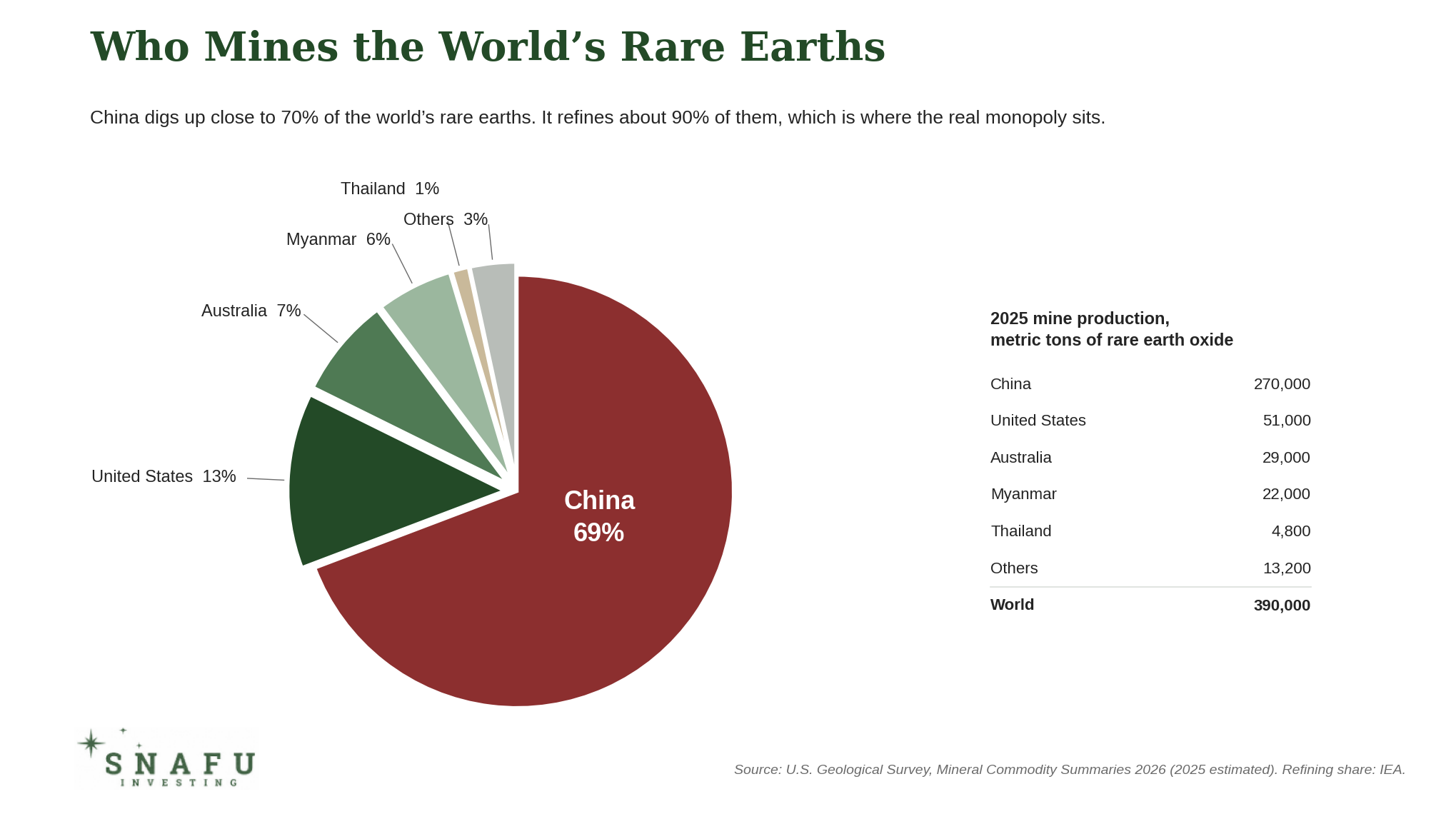
China processes around 90% of the world’s supply of rare earth elements (REEs). It also produces nearly all of the more valuable heavy rare earths, which we’ll get to below. And if you look at the chart below, you’ll see where the raw material comes from in the first place: China mines close to 70% of it.
Most people have never heard of these obscure elements, but modern life doesn’t work without them. They go into the crucial components of advanced electronics: iPhones, electric cars, flat-screen TVs, computers, and the sophisticated end of military equipment, like guidance systems, drones, anti-missile systems, radars, and fighter jets. The screen you’re reading this on relies on them.
There is no substitute for rare earths in advanced electronics. The U.S. military and the U.S. consumer are wholly dependent on them, and the country that supplies nearly all of them has a virtual monopoly on the trade.
Former Chinese leader Deng Xiaoping is said to have remarked, back in 1992, that “the Middle East has oil, China has rare earths.” He wasn’t wrong.
So how did China end up sitting on the rocky equivalent of the Persian Gulf?
Well, rare earths are a bit of a misnomer. They’re not rare at all. They turn up in ordinary ore all over the world, in the sands you mine for titanium, in the rock you mine for phosphate, in the United States, Australia, Brazil, Vietnam, Greenland. Digging them up is the easy part.
The hard part is what comes after. Separating rare earths from ore is toxic, expensive, and dangerous to the workers, and it’s the processing, not the mining, that decides who controls the trade. China has fewer environmental regulations and frankly disregards environmental and labor safety concerns in a way other countries cannot. That lets it produce rare earths at a much lower cost than anyone else. And that, in turn, is what let it undercut everyone else out of the business, one plant at a time.
The other part is, of course, subsidies. The Chinese government pours money into the industry. Nobody knows exactly how much, since it’s notoriously opaque, but it’s clear the Chinese Communist Party considers rare earths a national priority and will spend whatever it takes.
What the Trade War Became
Once you know all that, it’s kind of crazy that the world’s largest economy and its most powerful military are utterly dependent on these materials. But that’s exactly the situation the United States is in.
To give you an idea, an F-35 fighter contains about 920 pounds of rare earth materials. A Virginia-class submarine, about 9,200 pounds. An Arleigh Burke destroyer, around 5,200. They’re in the guidance fins on a Javelin missile, the sonar on a submarine and the motors that steer a drone. And for most of the past decade, about 70% of the rare earths America imported came from China.
Which is exactly why rare earths are what the trade war has become about. It might have started with tariffs on steel and washing machines, but it ended up being fought over the minerals inside a fighter jet. Below is a timeline of how that happened.
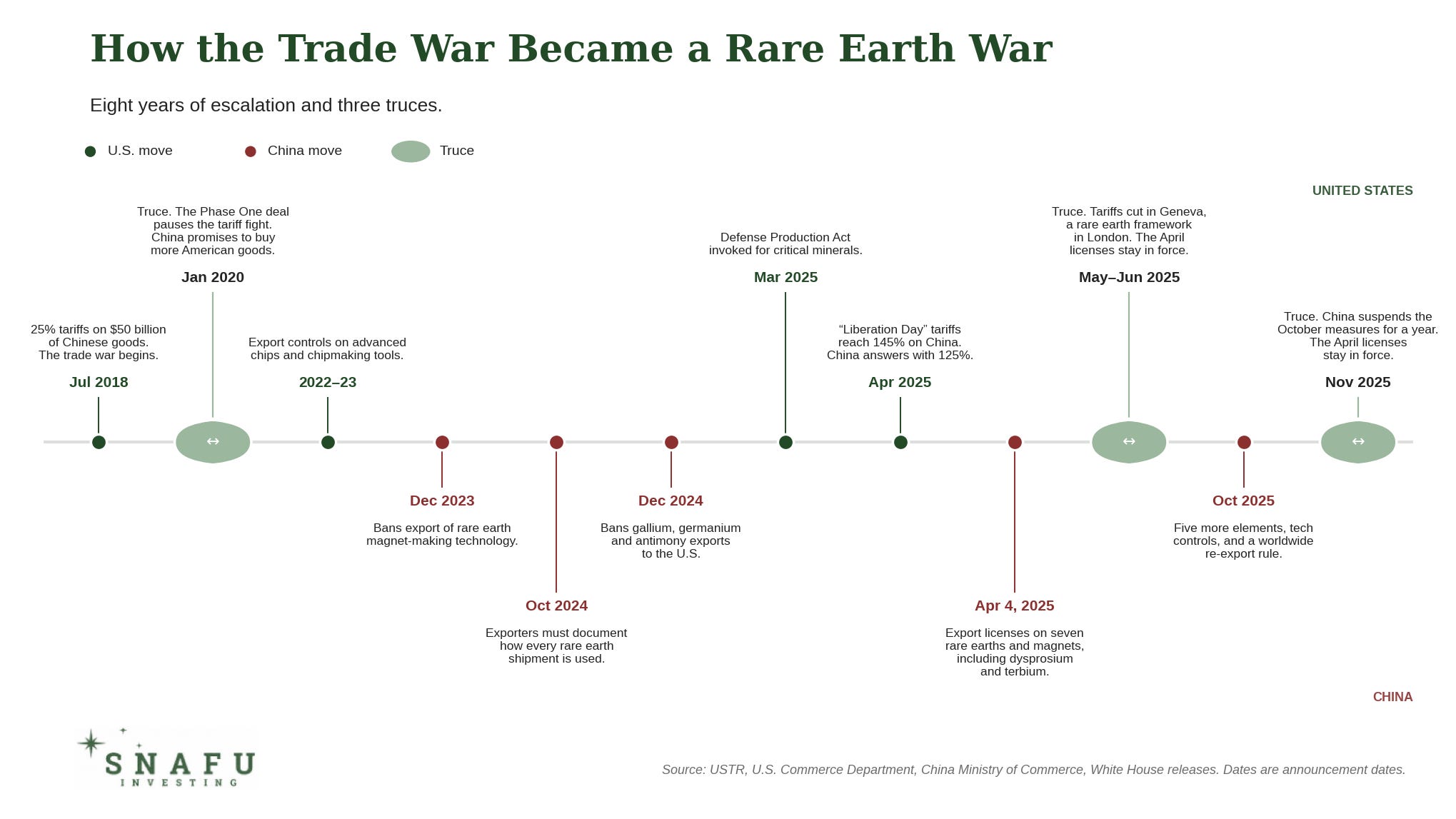
Now, if you look closer at the chart, two things jump out.
First, each side plays the cards it actually holds. America’s are tariffs, chip bans and an executive order. China’s, every one since the end of 2023, are minerals: export bans, traceability rules, and licenses on the rare earths that matter most. The U.S. has never answered a mineral move with a mineral move, for the simple reason that it has no minerals to answer with.
Second, look at the tempo. In the first five years, two moves and a truce. In the two years since, seven moves and two truces, including two moves in the same week. In other words, the trade war has been intensifying, not winding down (and the side setting the pace is the one holding the minerals).
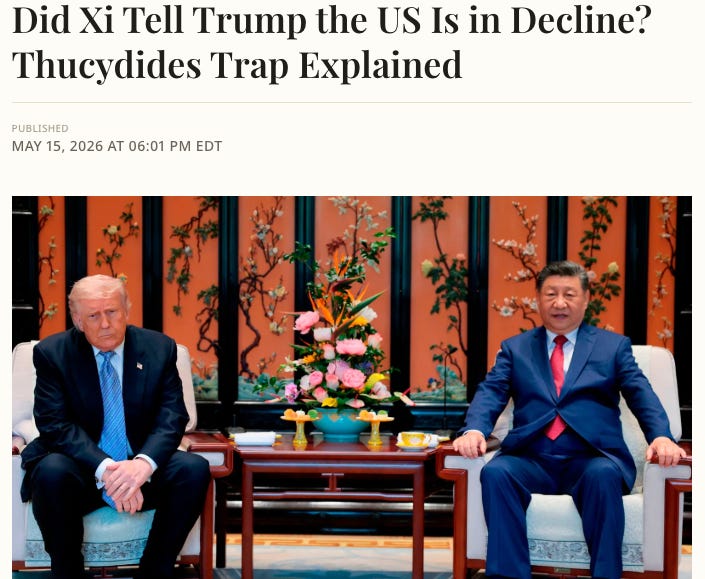
All of which brings us to Xi Jinping’s state visit to Washington last week. He stayed for three days, a good part of them talking with Trump, formally and otherwise. The two were picking up where their governments left off last November, when they agreed to put the latest round of tariffs and export controls on ice for a year and talk instead.
And the result of all that talking? A two-month extension of the November truce, through January 10, and a promise to meet twice more before then, in Shenzhen and Miami.
Light on substance would be the kindest way to put it.
It was not light on spectacle, though, and I think that speaks volumes in itself.
For starters, Trump didn’t wait for Xi at the White House. He went to Joint Base Andrews and greeted him personally on the tarmac, something U.S. presidents almost never do for foreign leaders. In fact, with the exception of popes, no president had met a foreign leader on the tarmac since JFK did it in 1962.
Then came the military band, the B-1 flyover, the 21-gun salute, fighter jets lined up on the tarmac, the formal White House ceremony and the state dinner.
That is not your usual treatment.
It’s clear the U.S. government is treating China as the other heavyweight in the room. And when historians go looking for the exact moment the multipolar world stopped being a theory, this visit may well be it.
What to Expect From Shenzhen and Miami
Watching all that, though, what struck me was what wasn’t being discussed. Not a word about rare earths, the one thing American industry arguably needed most out of the visit. Not from Trump, not from Xi. It was almost as if the subject were too hot to touch.
And yet the problem hasn’t gone away. Wire reports continue to describe Chinese deliveries as “falling short” of what was promised under the last truce. The numbers bear that out: Chinese shipments of rare earth magnets to the U.S. totaled 512 tons in August, down 20% from July and 13% from a year earlier.
More importantly, the restrictions themselves are still in place. Dysprosium, terbium and five other rare earths still need a license from the Chinese government before they can leave the country. Each application is considered case by case.
And if the buyer has anything to do with a foreign military, there isn’t even a case to consider. China’s rules bar licenses for defense end-users outright. That includes Pentagon suppliers, which means they can’t legally buy these materials from China at any price.
This is a problem because what turns an ordinary rare earth magnet into one that keeps working at the temperatures inside a jet engine, a missile or a submarine’s sonar (the very military hardware I mentioned earlier) is exactly that: a small dose of dysprosium and terbium.
How likely is all that to get reversed at the two remaining meetings this year?
Not bloody likely, as my good English friend Ian likes to say.
Just look at the timeline again. The licenses on dysprosium and terbium date back to April 2025, and they haven’t gone anywhere. That’s because they’re exactly what any negotiator wants: real leverage. China isn’t about to give that up, no matter how warmly Xi and Trump shake hands.
I say that because I’ve watched what China has actually traded away in every truce since. And if you’re wondering what that was, the answer is: not much.
In November of last year, for instance, China suspended the October package, the last Chinese move on the timeline above and one it had never actually enforced, for a year. In return, it got the fentanyl tariff halved and the U.S. affiliates rule suspended. The April licenses weren’t touched.
Last week, China extended that same arrangement by another two months. And again, the April licenses weren’t touched.
I’m sure you see the pattern. Each time, the thing China puts on the table is the threat it hasn’t used. The thing it keeps is the one that’s been working since April.
So that’s pretty much what I expect from Shenzhen and Miami. We may well see a longer suspension of the October measures, maybe out to 2028, plus a few more licenses for civilian customers, an aircraft order, maybe also a promise to buy more American soybeans. The headline will say “breakthrough.” And dysprosium and terbium will still need a Chinese permit to leave the country, because that permit is the whole reason the U.S. government keeps coming to the table.
Which is exactly how a smart rising power would play Thucydides’ Trap.
Regards,
Lau Vegys
P.S. This is exactly why the latest SNAFU Investing monthly issue, which went out a few days ago, features an American company on the right side of those licenses: one that can make what China is withholding, that has the government’s money behind it rather than in front of it, and that doesn’t need the next summit to go badly in order to work. The full write-up is available to paid members, with the thesis, the risks, the buy-up-to price and the tranche levels. As I write this, the stock is still trading below our buy-up-to, so if you’ve been on the fence, this is a good moment to come inside.
The book called the rare earth metals war dives into this topic is detail. There is a dark side though. China has polluted close to 60% of its ground water and a massive chunk of agricultural land to a point where it’s unusable. That will take centuries of not millennia to fix itself. Many communities who live close by these refineries suffer the most horrific heath issues. In the end you still need to produce food.
All so/exactly right ... I got the rec and bought it when you sent the post earlier ...