

A little over a week ago, I showed you how China quietly absorbed the biggest oil shock in history and saved the world, the United States very much included, from $200 oil.
It turned out to be one of my most popular essays yet, so clearly many of you had been wondering who "Canceled the Oil Apocalypse," and just as importantly, how. But if you missed it, here’s the short version. When the Strait of Hormuz closed and the world came up 5.5 million barrels a day short, China all but stopped buying oil. As I explained then, it could afford to do that thanks to three things:
Coal. China never bought into the crusade against “dirty” coal, so when the crisis hit, it could shift real demand away from oil and onto coal at a scale no Western country could dream of.
A quiet fuel export ban. In March, Beijing ordered its refiners, some of Asia’s largest fuel exporters, to stop shipping gasoline, diesel, and jet fuel abroad. Less fuel exported meant less crude imported.
A decade of EV subsidies. Tens of millions of electric cars were already on the road when gasoline prices surged.
But none of it would have been possible without the real backstop: China’s immense oil reserves. Here’s the chart I showed you:
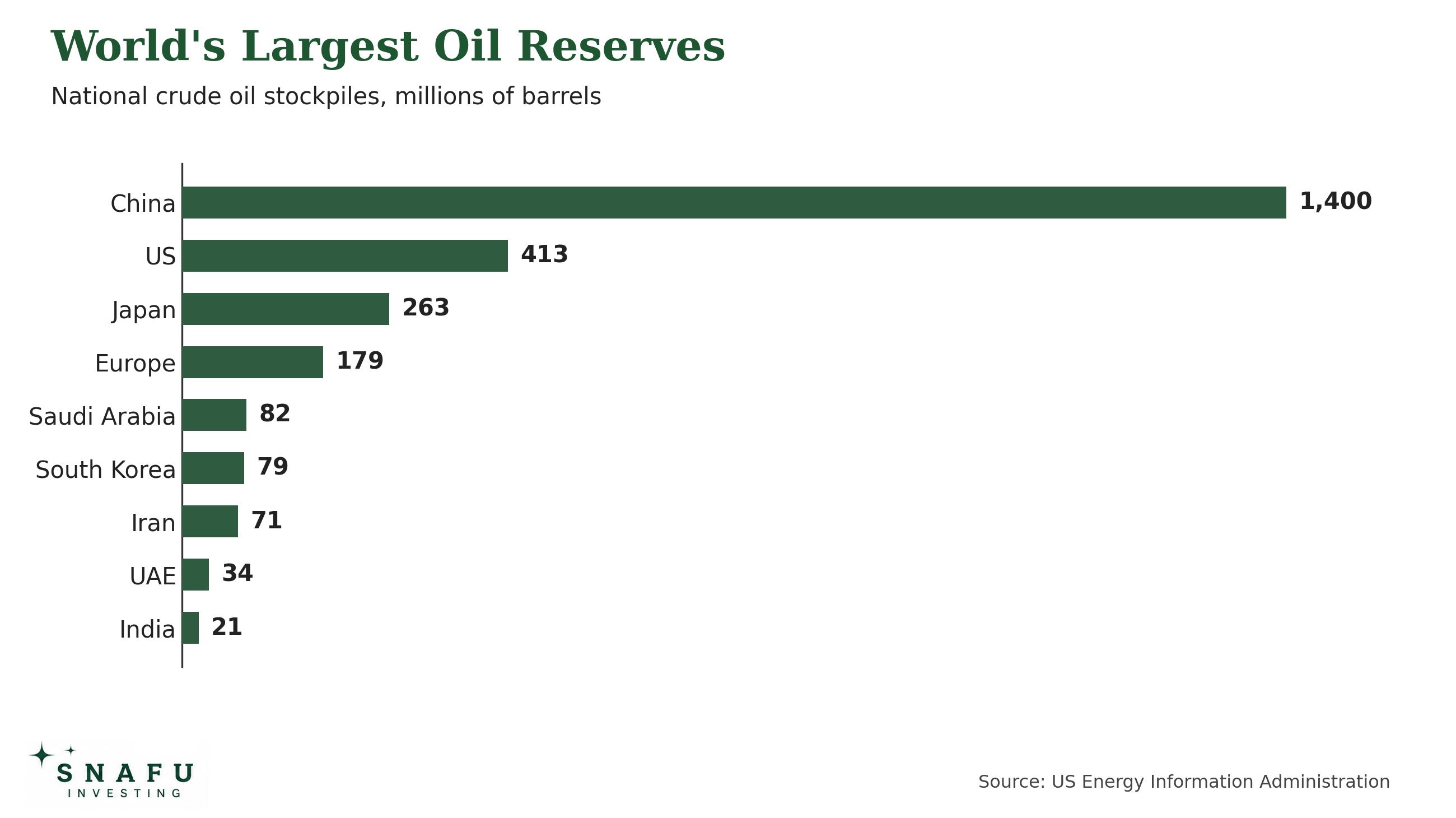
More crude than every other country on Earth was holding, combined. Around 1.4 billion barrels.
In that essay, I also promised I’d explain why China did all this. Today is that day.
But to get to the why, we first have to answer a different question: how? How does a single country quietly stockpile that much oil without the rest of the world noticing? Because you can’t really understand why China chose to spend its hoard the way it did until you understand how it built that hoard in the first place.
And here’s the strange part. The how and the why turn out to have the same answer.
The petrodollar.
So that’s precisely where we’ll start. Because once you understand how the petrodollar actually works, the whole picture snaps into focus: where China got the oil, and why Beijing would go to all this trouble in the first place.
How Oil Saved the Dollar
So what actually forces an oil trade to happen in dollars?
There’s no treaty. No law. No global rulebook saying a barrel of Saudi crude sold to a refinery in India has to be paid for in greenbacks. And yet, overwhelmingly, it is.
To understand why, and why it matters this much, we have to go back about eighty years.
You’ve probably heard the saying: he who has the gold makes the rules. That was America in 1944. It had won the war and held the largest gold reserves on Earth, and it used that position to rebuild the global money system around the dollar. The new system, created at the Bretton Woods Conference that year, tied almost every nation’s currency to the U.S. dollar at a fixed rate. It also pegged the U.S. dollar to gold at a fixed rate of $35 an ounce.
This arrangement made the U.S. dollar the world’s premier reserve currency, effectively forcing other countries to hold dollars for trade or redeem them with the U.S. for gold.
But by the late 1960s, America had printed far more dollars (for welfare, for Vietnam) than it had gold to back them. Other countries noticed and started cashing their dollars in for the real thing, draining America’s gold from 574 million ounces down to about 261 million. In 1971, to stop the bleeding, Nixon slammed the gold window shut. The dollar’s last tie to gold was gone.
That should have been the end of the dollar’s reign. A currency backed by nothing is just paper. Instead, Washington found something better than gold to back it with.
Oil.
In 1974, Saudi Arabia’s Prince Fahd came to Washington, and he and Henry Kissinger signed something titled the “Joint Commission on Economic Cooperation.” A bland, boring name. The deal underneath it was anything but. In short: America would give the House of Saud protection and a guarantee of its survival. In return, the Saudis would sell their oil — all of it — in dollars, and only dollars. And as the dominant force in OPEC, they’d make sure everyone else did the same.
It was, frankly, genius. Oil isn’t just another commodity. It’s the biggest one there is, bigger than any other commodity market on Earth, and every country needs it, constantly, forever.
Just to give you a sense of the scale we’re talking about, here’s how oil stacks up against the world’s ten biggest metal markets:
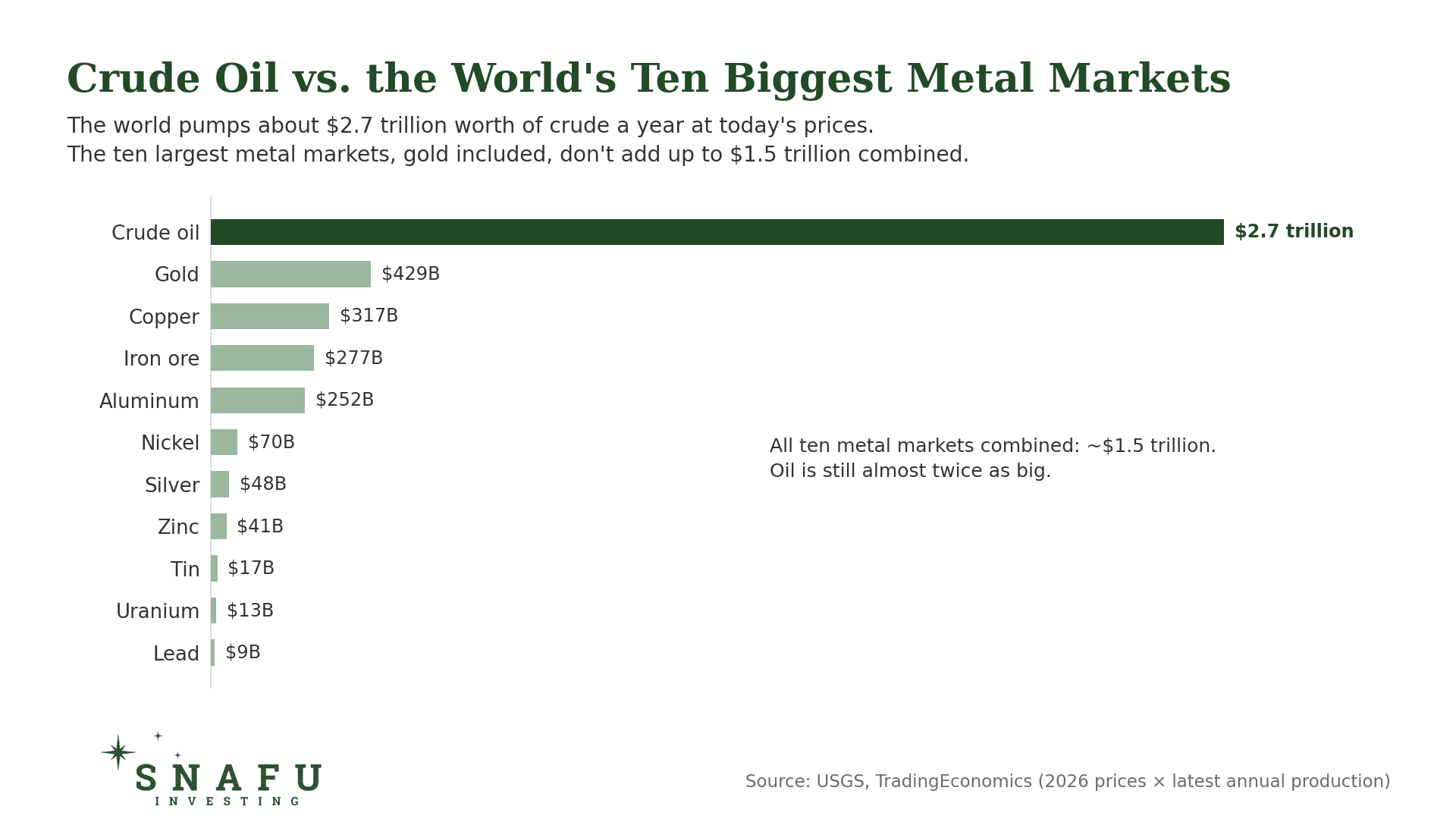
Tie the dollar to oil, and you’ve made the entire planet need dollars.
But the real masterstroke came about a month later. It dealt with the question of what would happen to all those dollars the Saudis were about to earn, and with it, the deeper question of how the whole arrangement stays durable. Because remember, there’s no law forcing anyone to obey it.
In July 1974, Treasury Secretary William Simon flew to Jeddah, the kingdom’s great port city on the Red Sea, on a hush-hush mission. There he cut the part of the deal that truly mattered: Saudi Arabia’s oil billions would be recycled into U.S. Treasuries through special off-the-books auctions, in exchange for military aid. Curiously, the arrangement was considered so sensitive that the Treasury hid Saudi Arabia’s holdings inside its published data for the next 41 years, until Bloomberg pried the records loose in 2016 with a Freedom of Information Act request.
And just like that, a perpetual loop was born. The world pays Saudi Arabia (and, in time, the other big oil exporters who followed its lead) dollars for oil. Those dollars get parked right back in America’s debt. Oil, in other words, became a permanent source of demand for U.S. paper.
The Only Buyer
Now, there’s one important aspect of all that plumbing that we live with to this day, and it works like this.
Say an Indian refinery buys $100 million worth of Saudi crude. It pays in dollars, and those $100 million move through the banking system, ultimately clearing through banks supervised by the United States.
This means the U.S. government can see any dollar oil trade on the planet. More importantly, it gives Washington the unique ability to block any one it doesn’t like.
This is what you’d call a sanction. A switch built right into the petrodollar’s plumbing, one America can flip to cut any bank, any company, any country out of the dollar system entirely.
That’s the true source of American power. And it also brings us, conveniently, back to China, and to that question I said we’d have to answer before we get to the why: how does a single country quietly stockpile 1.4 billion barrels of oil (and probably more) without the rest of the world noticing?
I’ll spare you the suspense and tell you outright. The answer comes down to two words: Iran and Russia.
Not coincidentally, these also happen to be the two most heavily U.S.-sanctioned countries on Earth.
Iran's sanctions go back decades: in 1996, President Bill Clinton signed a law that started cutting the world off from buying Iranian oil (the sanctions would come in waves and tighten for years afterward). Russia’s are more recent: in 2022, after the invasion of Ukraine, the U.S., joined by Europe and most other West-aligned economies, banned Russian oil in retaliation.
That left two of the world’s biggest producers largely locked out of the global oil market. Millions of barrels a day of crude sloshing around, stuck, with nowhere to go and almost nobody willing to buy.
Except one country. China.
Not only was China willing, it worked out how to do it without getting caught. The trade ran on an intricate system of workarounds: aging “dark fleet” tankers that switch off their transponders so no one can track them; cargoes relabeled as Malaysian; small, independent Chinese refineries known as “teapots”; and payments routed through obscure little banks with no business in America to lose, outfits with names like Bank of Kunlun.
Note: This is a fascinating rabbit hole. I might write a whole essay on it one day. But this piece is already running long, so for now all you need to know is that the dark fleet and the fake labels were the easy part.
But China's real secret weapon was the one thing the whole operation rested on. Without it, none of this would have been possible: the yuan. Because China wasn't paying in dollars. It was paying in its own currency.
And based on what we just discussed, you can probably see why that mattered so much. A dodgy-looking dollar payment would have lit up on Washington’s radar and been shut down in an afternoon. A yuan payment never touches an American bank. The sale simply happens, and there’s nothing Uncle Sam can do about it.
And of course, being the only willing buyer of Iranian and Russian oil meant China got a big, big discount.
Which is how, year after year, cargo after cargo, China quietly funneled over a billion barrels of deeply discounted crude into those silos in the desert, until it sat on more oil than the rest of the planet combined.
Why Save Your Rival?
OK, so we’ve finally arrived at the why. Why save the world, your fiercest rival included, from certain economic devastation in a $200-oil scenario?
There are three reasons. The third, arguably the most important of them all, deserves its own section, so I’ll get to it last.
But before I get to any of them, let me first rule out a couple of theories that kept popping up in the comments section of Part 1 and in readers' emails to me.
Theory number one: China did this simply to protect itself from high oil prices.
It makes sense on the surface. China is the world’s biggest oil importer, so $200 crude would hurt it more than almost anyone. Burning reserves instead of buying would simply be self-insurance.
The problem is that the theory falls apart once prices come back down.
In late June, when hopes of a ceasefire briefly pushed crude back to pre-war levels, a country that was merely protecting itself from a price spike would have jumped right back into the market. It would have been the perfect time to refill the reserves it had just drawn down.
China didn’t.
Its imports stayed at their lowest levels in a decade (that’s China’s own customs data, not satellite guesswork), and it just kept burning reserves.
Which tells us there had to be another reason.
Theory number two: China did it out of the goodness of its heart. A soft-power play for global goodwill, if you will.
Anyone who knows anything about China’s leadership can probably dismiss that one right away. The Communist Party has been remarkably pragmatic ever since Deng Xiaoping decided, back in the late 1970s, that markets would serve the Party better than Mao’s textbooks.
But there’s an even simpler problem with this theory: soft-power plays don’t happen in silence. And as I mentioned last time, China did all of this without saying a single word. If you’re saving the world to win friends, wouldn’t you mention it at least once?
OK, with that out of the way, let’s get to the real reasons.
First: protecting China’s export-based economy.
Some of you pointed this one out in the Part 1 comments too, and it’s kind of obvious when you think about it. China’s economy still revolves around making things and selling them to the rest of the world. Yes, its domestic consumer market has come a long way, but exports still account for roughly a fifth of China’s GDP. One dollar in every five the country earns comes from selling things abroad. That’s huge.
The chart below shows what that looks like in practice. Every box is one of China’s export markets, roughly scaled by value. The boxes with a line through them are the economies most likely to be hammered by a prolonged oil shock.
How do we know? Simple. They’re the big net oil importers, the countries that buy most or all of their crude abroad. For them, $200 oil is effectively a giant tax with no offsetting benefit from higher oil revenues.
And yes, that includes the United States. America produces plenty of oil, but crude trades in a global market at a global price. So even if every extra barrel came from Texas, American drivers and consumers would pay the shock all the same.
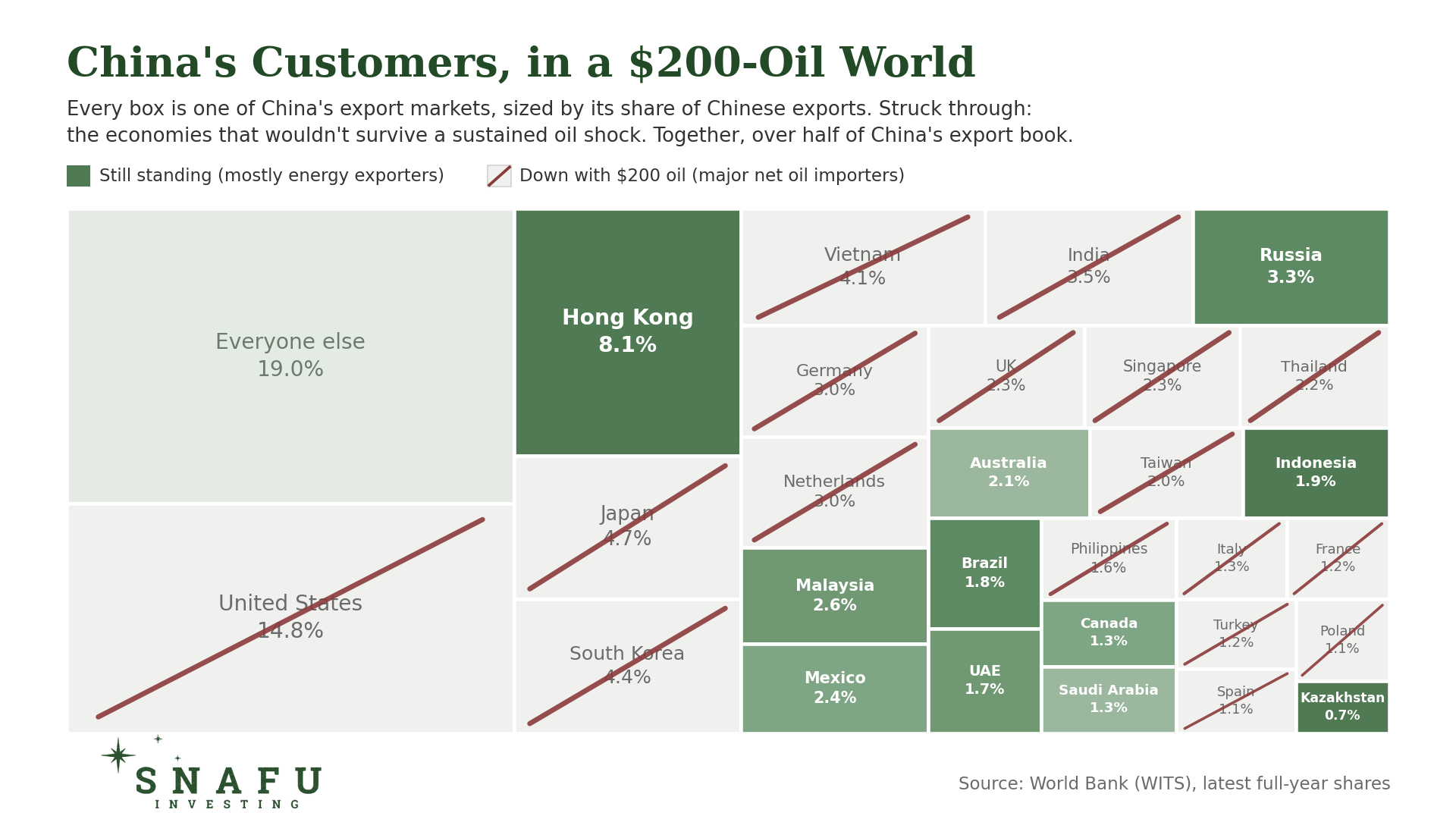
Add up the struck-through boxes and you get more than half of China’s export book. In dollar terms, that’s close to $2 trillion a year in sales suddenly walking toward a cliff. The U.S., Europe, much of Asia. China would have lost half its export market, and a good chunk of its economy with it.
Now the second reason: neutralizing the Malacca threat.
For all its economic might, China has one enormous vulnerability. And, curiously enough, it also comes down to a strait. Just a different chokepoint thousands of miles away: the Strait of Malacca.
Roughly 80% of China’s imported oil flows through this narrow shipping lane between Malaysia and Indonesia.
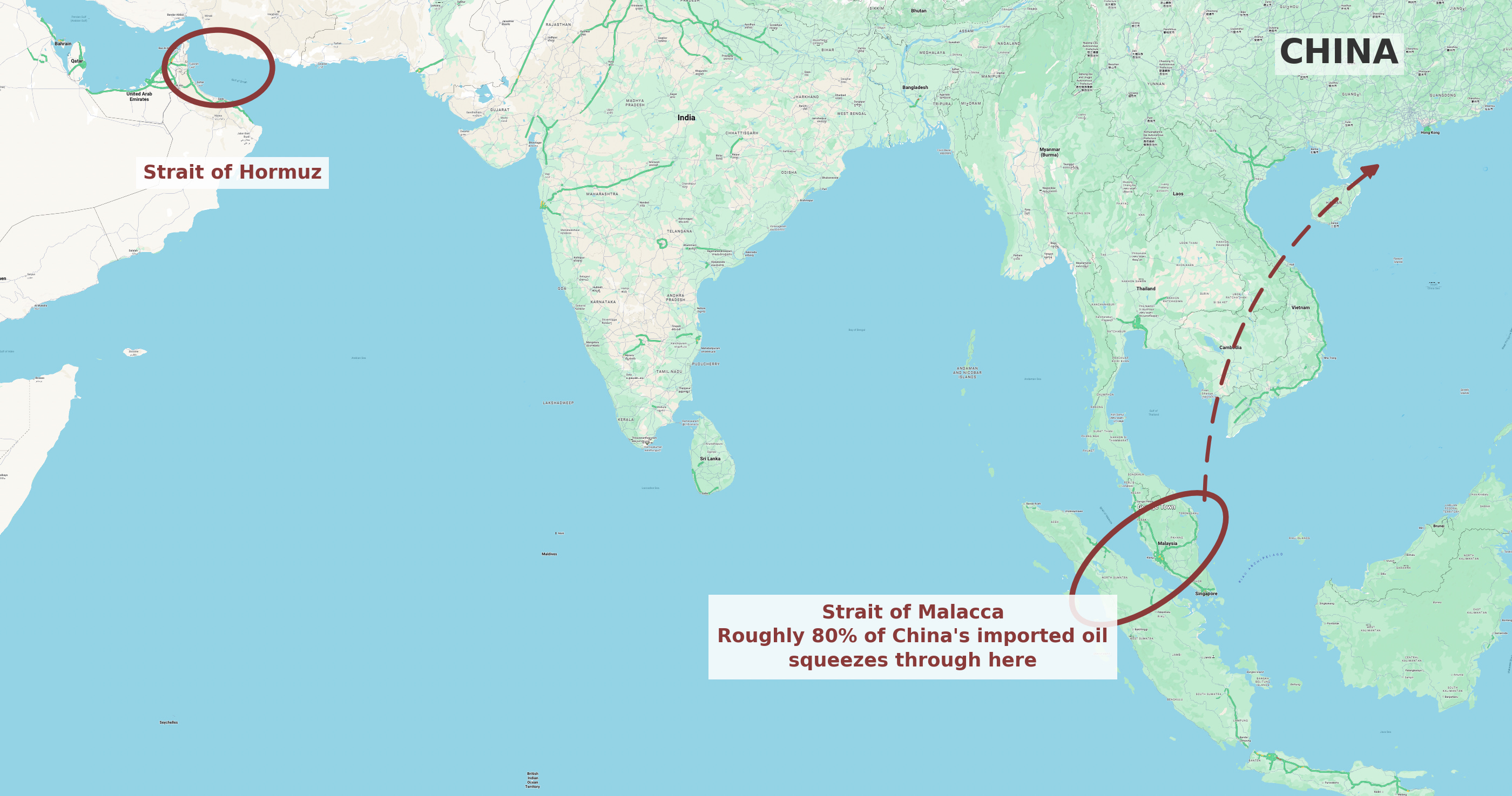
The U.S. government is, of course, well aware of this. The so-called “Malacca Dilemma” has featured in Pentagon planning for years, and the war plan it points to is brutally simple. In any serious conflict over Taiwan, don’t invade China. Don’t fire a shot at the mainland at all. Just park the U.S. Navy at Malacca, thousands of miles from Chinese shores, and choke off most of China’s imported oil. Starve the country into submission without ever setting foot on Chinese soil.
Needless to say, that scenario has kept Chinese strategists up at night for decades.
Now, in truth, China has done quite a bit over the years to blunt the threat, including two things that in the Western mind are diametrically opposed: expanding coal production while rapidly electrifying its economy with renewable power.
But if you’re China, there’s no better way to show the U.S. government that the Malacca card is dead than to go without imported oil, in public, for months on end. Which is exactly what China spent this spring doing.
The Stress Test
OK, so we've covered the first two reasons. Now for the third, and by far the most interesting one.
Remember how I said at the beginning of this piece that both questions, the how and the why, ultimately lead back to the petrodollar? This is where the two finally come together.
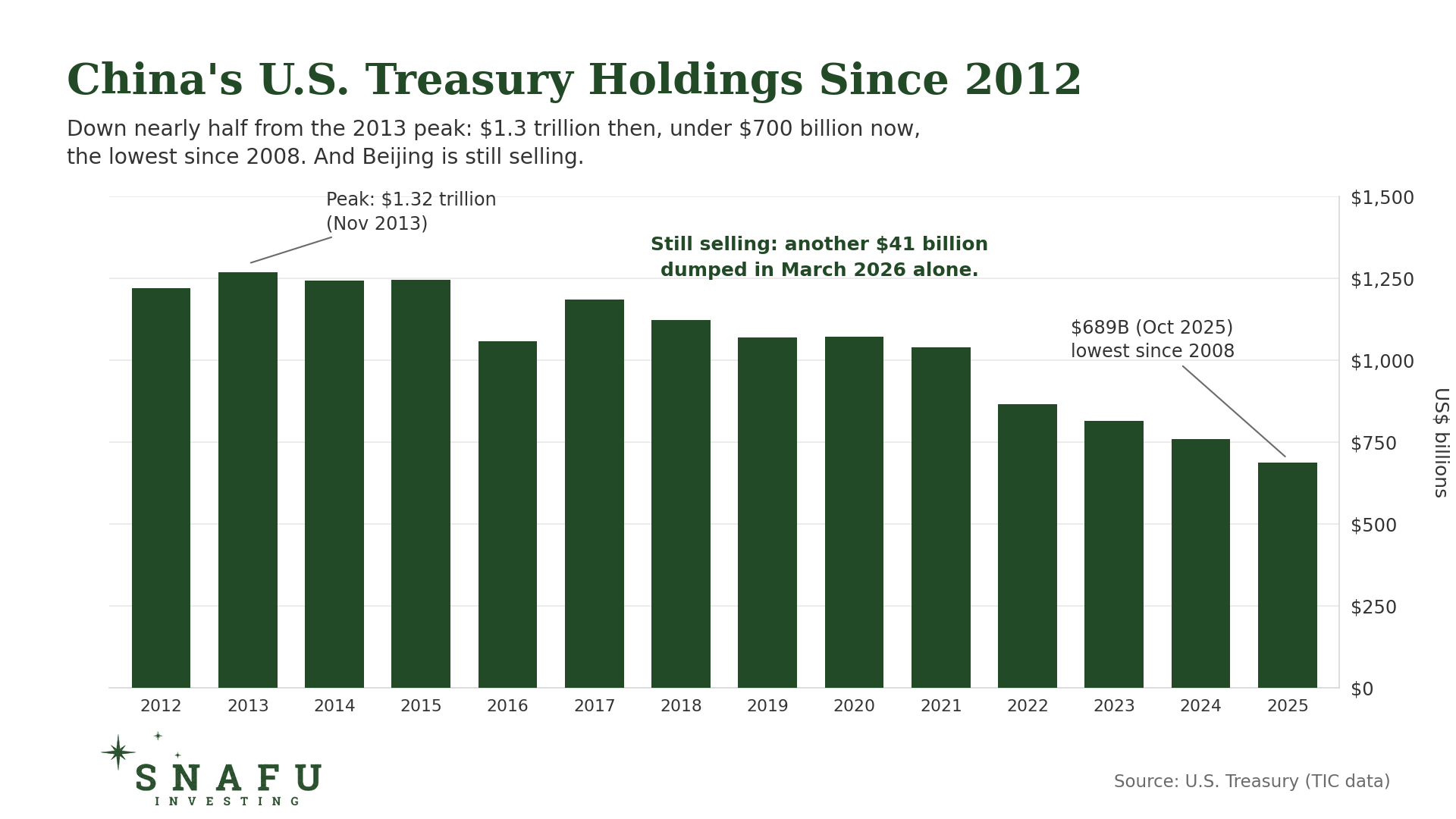
If you've been reading me for a while, you probably know China has been at the forefront of the de-dollarization movement for years. My research suggests the wake-up call came in 2014, when the U.S. weaponized the dollar against Russia over Crimea. Beijing drew the obvious lesson: holding dollar reserves means accepting potential financial subjugation. If Washington ever decides your foreign policy isn't aligned with theirs, your reserves can be frozen or seized. (Incidentally, a lesson Russia learned the hard way in 2022, when the West froze some $300 billion of its central bank reserves.)
You can actually see China acting on that lesson in the chart below. Its stash of U.S. Treasuries peaked at about $1.3 trillion in 2013, when China was America's largest foreign creditor. Ever since then, it's been steadily selling. Today it's below $700 billion, the lowest level in roughly 17 years.
But China wasn’t just walking away from the dollar system. Quietly, piece by piece, it was building a replacement, one designed to swap out every part of the dollar’s grip on oil.
The first serious move came in 2015 with CIPS, China’s answer to SWIFT: its own cross-border payments network. Think of it as a parallel set of banking pipes, ones the U.S. government doesn’t supervise and can’t switch off. Remember, two countries can agree to trade in yuan all they like, but the money still has to move between banks somehow. Until CIPS, nearly every major international payment ultimately relied on infrastructure controlled by the West.
Then, in 2018, Shanghai launched yuan-denominated crude oil futures, the first serious attempt at an international oil price that wasn't a dollar price. And to make sure the market actually worked, two of China's largest state-owned oil companies, PetroChina and Sinopec, stood ready as buyers, providing liquidity. Sell your oil in yuan, and there would always be someone on the other side of the trade. It worked. Within about a year, Shanghai's crude contract had become the world's third most traded crude benchmark, behind only Brent and WTI.
At that point, the blueprint was starting to emerge. I put it all on one page below because it’s much easier to grasp visually than in prose.
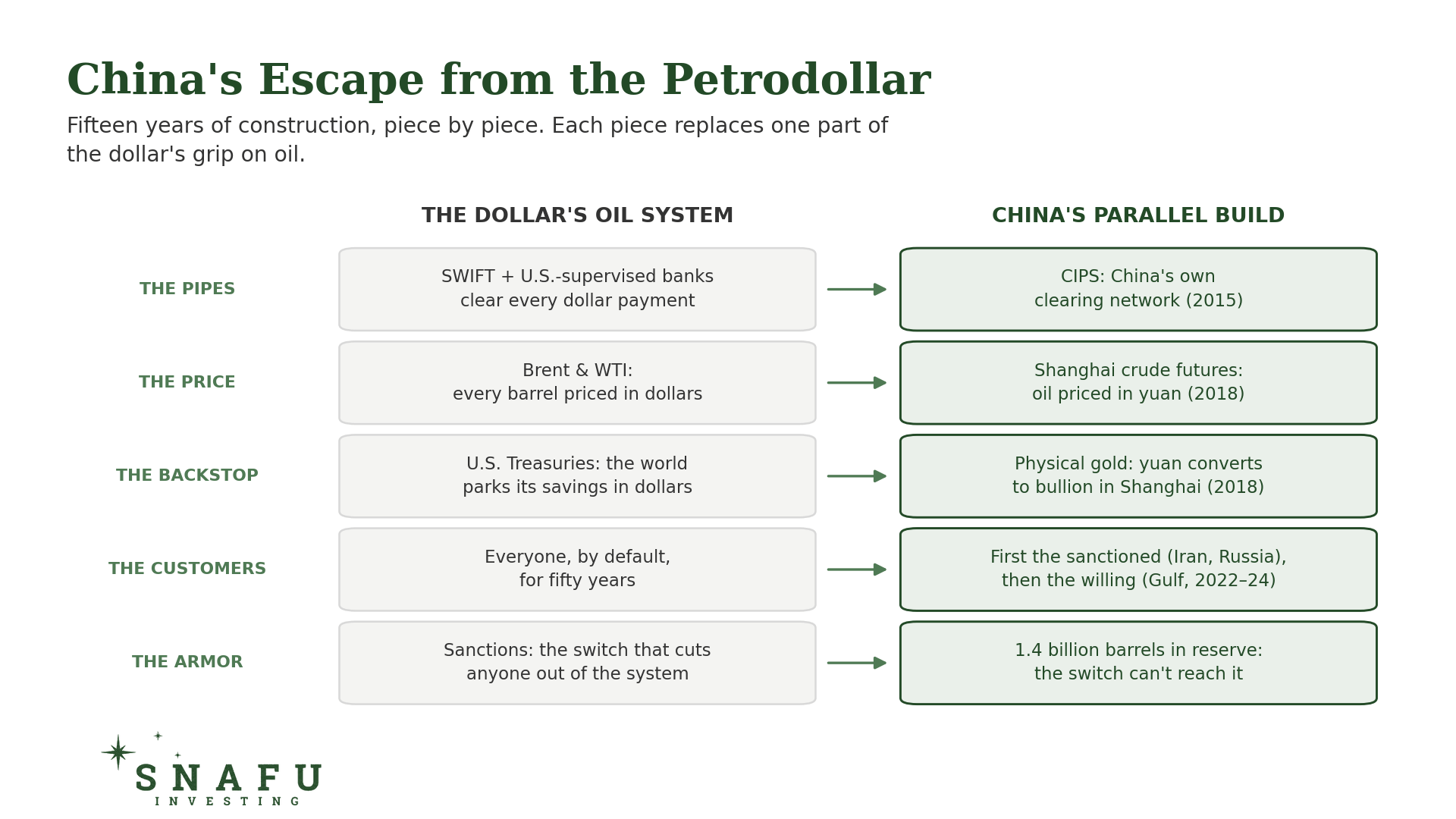
Now, if you look back at the blueprint above, we’ve already covered the first two blocks. It’s the third one, “The Backstop,” that’s worth a closer look, because that was the hard part.
Remember the arrangement William Simon negotiated with Saudi Arabia back in the 1970s? Oil exporters earned dollars, then parked those dollars in U.S. Treasuries. That wasn’t just good for the Saudis. It was good for Washington, too, because those oil dollars helped finance America’s deficits.
China couldn’t simply copy that model.
Yes, it has the world’s second-largest bond market. But Chinese government bonds yield far less than Treasuries. More importantly, the yuan isn’t freely convertible. Money can flow into China easily enough. And getting it back out often depends on Beijing’s permission, exactly the sort of uncertainty central banks and sovereign wealth funds try to avoid. Nobody parks their emergency fund behind a door someone else can lock.
So China came up with another solution.
Instead of backing its oil market with Treasuries, it backed it with gold.
From day one of the Shanghai oil contract in 2018, exporters accepting yuan could use those proceeds to buy physical bullion through the exchanges in Shanghai and Hong Kong. In other words, China solved the convertibility problem not with financial liberalization, but with the oldest monetary asset in history. You didn't have to trust the Chinese Communist Party. You just had to trust gold.
With that, the blueprint was complete.
There was just one problem.
Building a bypass is one thing. Knowing it actually works is another. Knowing it still works under the most extreme conditions imaginable is something else entirely.
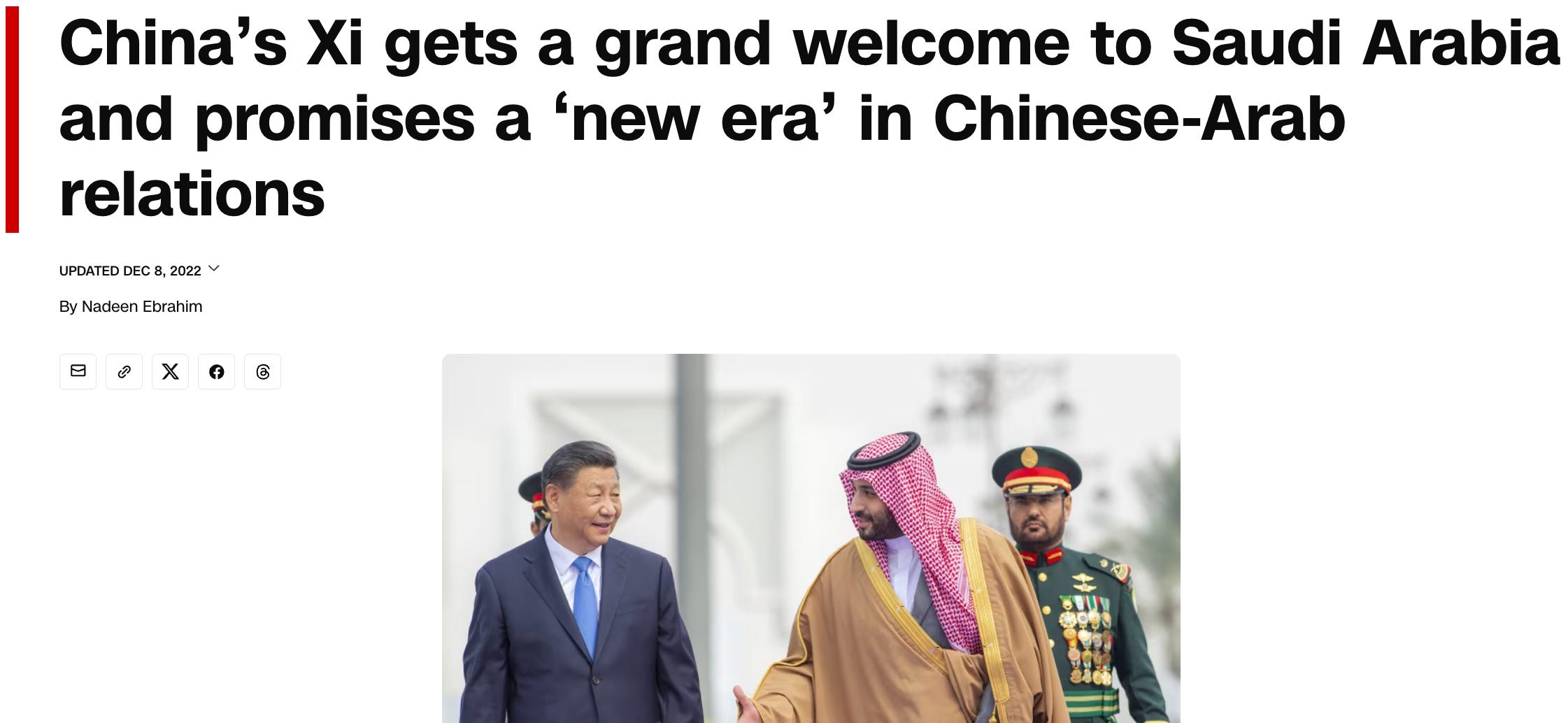
Yes, over the next few years, countries slowly started using pieces of the system. Pakistan bought Russian crude in yuan. Iraq approved yuan settlement for trade with China. Even Western oil major TotalEnergies completed the first LNG trade settled in yuan. And in 2024, following Xi Jinping’s famous trip to Riyadh, where he met King Salman and Crown Prince Mohammed bin Salman and openly urged the Gulf states to start selling their oil and gas in yuan, even Saudi Arabia, the original pillar of the petrodollar, joined China’s cross-border payments network.
But all of that happened on a relatively small scale.
Running millions of barrels of sanctioned oil through the system in normal times would have been tantamount to declaring monetary war on the United States. And Washington would almost certainly have responded.
But then the new Trump administration, fresh off its victory in Venezuela, handed China the opportunity itself. The U.S.- and Israel-led war with Iran pushed Tehran into shutting down the Strait of Hormuz, the single most important oil chokepoint on Earth.
And just like that, the very same actions that would have looked like monetary aggression a few months earlier suddenly looked like a public service. The world needed someone to absorb the oil shock. China did exactly that, while quietly putting every part of its alternative financial system through the biggest real-world stress test imaginable.
And that’s why I think this story matters.
Yes, China saved the world from $200 oil.
Yes, it protected its export economy.
Yes, it made the Strait of Malacca a much less effective weapon.
But it also accomplished something much bigger.
For the first time, China showed, to itself, to the U.S., and to anyone paying attention, that the petrodollar can be bypassed, not in theory, but in practice, and on a scale never before attempted.
If I’m right, and historians ever go looking for the day the multipolar world was born, this spring is going to be a very strong candidate.
Regards,
Lau Vegys
P.S. If today’s essay left you thinking about what happens to energy markets when the old rules quietly stop applying, that’s exactly what my new special report is about, just in a different corner of the market. Situation Normal: Uranium went out to paid subscribers a few days ago. Make sure you haven’t missed it. And if you’ve read it and want to act on it, remember there’s already a uranium play in the SNAFU portfolio. Read the report first, then go back to the recommendation.
this is an essay about why nations should never use their currency as a weapon, as the USA has since Brenton Woods, as it establishes counter-trends which are hard to predict. In the 1970's, Saudi had a resource that attracted reserve dollars; since 1990, China has a resource that has attracted reserve dollars. The only thing those nations could buy with that shitty paper was Treasuries, which only encourage profligate spending in swamp D.C. Anyone buying cheap oil with yuan is natural. The oil selling nation needs yuan to buy manufactured goods from China.
The petrodollar only works when America has something to sell. Back in the 1970's, America made stuff. Now? Only so many Teslas to sell. Weapon systems? Perhaps.
This all leads me back to a foundational reserve asset that America may lead the way if it can get its regulatory framework corrected - cheap energy, unconstrained by daily pumping of oil or gas. Uranium for modular nuclear reactors that get refueled every 18 months to 10 years. Such long-ish timeframes provide natural stability far better than an SPR.
As for "fascinating rabbit hole. I might write a whole essay on it one day." - perhaps a whole book would be appropriate. An Austrian perspective of what happens when you try to weaponize a fiat currency to secure dominance in a real reserve asset. It's going to generate unintended (bad) consequences, guaranteed.
I already wrote, but wanted to add that I almost always just write my comments spontaneously on finishing the articles. Ive always been interested in comments by folks who have similar interests and backgrounds enabling them to take pleasure in those substack posting I also appreciate, most of which are fairly esoteric. But generally I barely get the original reading done, because it's important to me to continue to expand my understanding, and then blast on to the next project. Recently I've started checking out comments more often and, as just now, I learn even more or am reassured that we're similarly stimulated. Makes sense, of course. I'm thankful for Lau's work in analyzing relavant material and for the community that responds with meaningful comments.