

I took this photo in Havana several years ago.
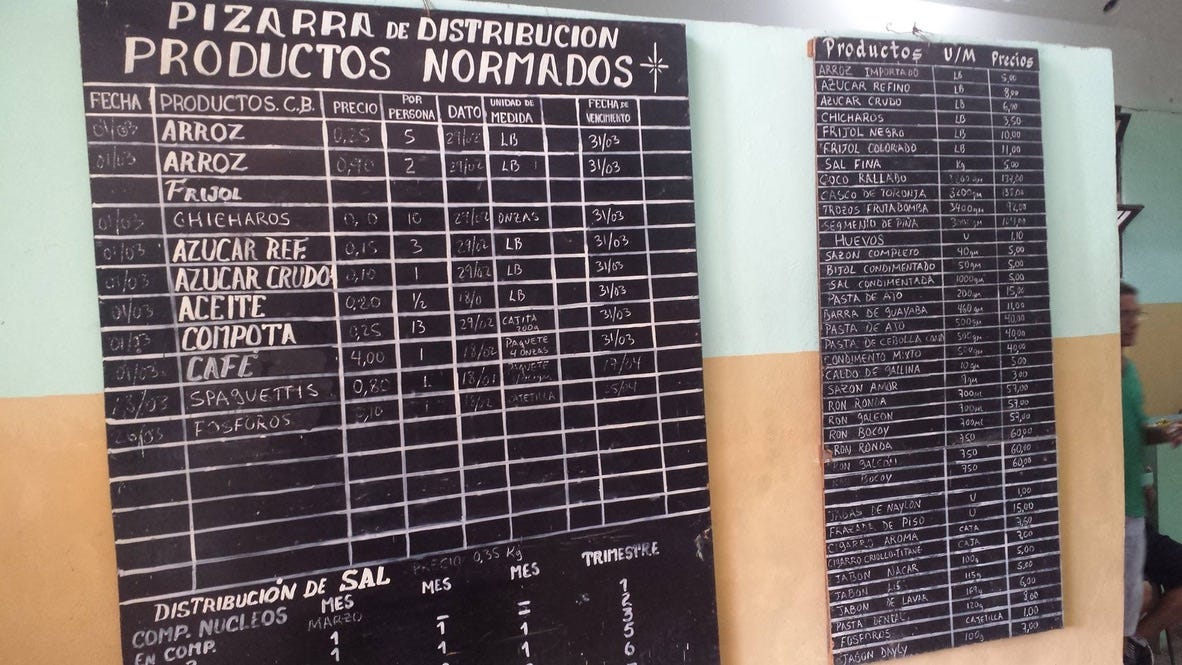
It’s a ration board, posted at the local bodega. Every Cuban neighborhood has one. It lists what’s available that week, how much each family can buy, and when. Rice, sugar, oil, coffee. All listed. All limited. All decided by the state. The families themselves carry a libreta, a small booklet that tracks their household’s entitlements. Think of it as a government-issued shopping list that someone else wrote for you.
I stood there staring at that board for a while, because I’d seen this before. Not in Cuba. In my childhood.
I grew up in the Soviet Union. We had our own version. Ration cards. Little booklets that told you what you were entitled to. Butter, sugar, vodka, meat, soap, cigarettes. Everything measured, everything tracked. You’d line up for hours, sometimes around the block, just to get what the state decided you deserved that week. If the shelves were empty when your turn came, and they often were, tough luck. Come back tomorrow.
The system was brutal. But it was also leaky. People found workarounds. Black markets. Trades. Favors. You’d swap your vodka ration for someone’s sugar. A factory worker would smuggle out a few meters of fabric and trade it for meat. The entire Soviet economy ran on these informal exchanges, because the official system couldn’t account for what people actually needed.
Looking at that board in Havana, I knew Cuba was no different. Cubans trade. They hustle. They find ways around the system. People always do when the rules are written on a chalkboard.
But what happens when the rules are written in code?
That question used to be theoretical. It’s not anymore.
The Chalkboard Goes Digital
Just weeks ago, in response to the energy crisis triggered by the closure of the Strait of Hormuz, Pakistan launched a digital fuel rationing app.
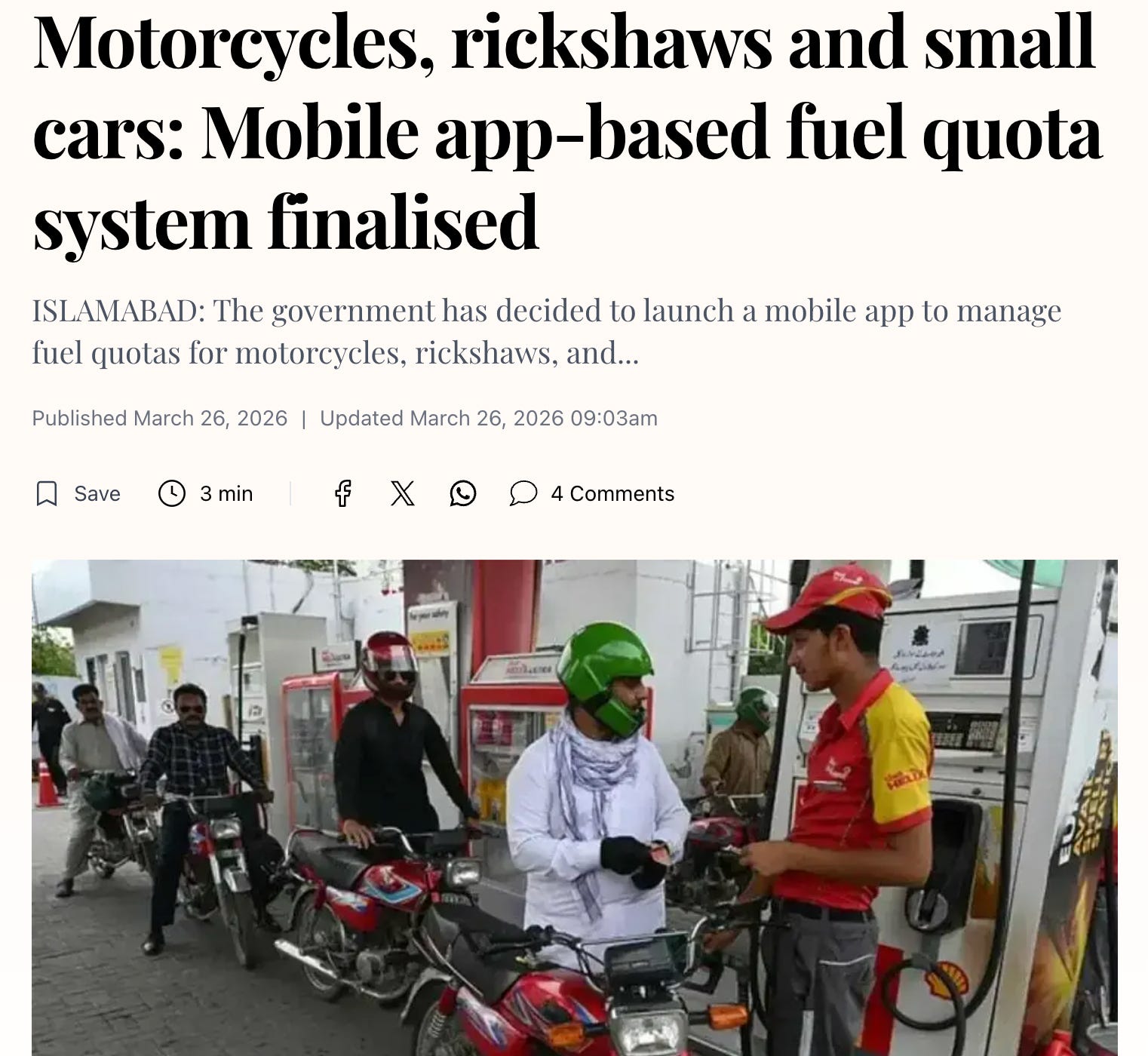
Here’s how it works: you register with your national ID and your vehicle registration number. You get a weekly fuel quota delivered via QR code. You scan it at the pump. If you’ve used your quota, you don’t get fuel. Unused balance doesn’t carry over to the next week.
Read that again. A government-issued digital system, tied to your national identity, that decides how much of a specific product you’re allowed to buy.
Pakistan isn't alone. Sri Lanka and Myanmar are running digital fuel quota systems. South Korea has introduced license plate rationing, banning cars from the road one weekday per week based on their plate number. Slovenia became the first EU country to impose fuel rationing in March. The Philippines, Thailand, Vietnam, and Indonesia are all contemplating emergency measures. Across the board, governments are rolling out digital ID-based fuel rationing, driving bans, air conditioning temperature caps, mandatory work-from-home days, all framed as temporary emergency measures. “Two weeks to flatten the fuel curve” is already a headline. I’m sure that phrase rings a bell.
During COVID, contact tracing apps weren’t surveillance systems. They were “public health tools.” Temporary. Necessary. Just until we get through this. But they normalized something enormous: the idea that the government could track your movements through your phone, in real time, and restrict your access to public life based on your compliance.
Most countries quietly kept the infrastructure long after the pandemic ended. The apps were shelved, but the frameworks, the databases, the digital ID systems, those stayed.
The Missing Piece
Now, tracking apps and fuel rationing are one thing. But the biggest piece of the puzzle, the one that ties the whole control grid together, is money itself. “Programmable money.” A currency the government can control at the transaction level. And most people have very little idea of what that might actually look like in practice. So let me walk you through it.
Imagine this. You earn 3% on your savings, but only on dollars held for less than a year. Hold them longer, and you start paying a negative interest rate. A penalty for saving too much.
Or this: you buy gas every week, like you always have. But one month you drive a little more, maybe you took a road trip, maybe you picked up extra shifts. You exceeded your yearly average. Now every gallon past that average is taxed at 20%. Not because gas got more expensive. Because you bought more than the algorithm thinks you should.
Or maybe a softer version: you get cashback every time you buy an electric vehicle, solar panels, or plant-based food. The government doesn’t ban beef. It doesn’t need to. It just makes beef slowly, quietly more expensive while making the alternative cheaper. You still have a “choice.” The menu just gets shorter every year. Exceeded your carbon quota? Transaction declined.
That’s not a ration board. It’s not a line around the block. It’s an algorithm running in the background of your bank account, adjusting incentives and penalties in real time based on what the people at the top have decided is good for you.
“Not Here”
Now, if you’re thinking, “They’d never get away with this. Especially not here in the good ol’ U.S. of A.” Well, that’s the whole point. They wouldn’t do it all at once. There would be riots.
But one small change at a time? Over years? That’s a different story.
Fuel rationing today. Energy credits next year. A carbon score the year after that. Each one introduced during a crisis, each one framed as temporary, each one just a little more intrusive than the last. And by the time you realize you’ve been on the system for three years, it doesn’t get rolled back. It just gets renamed.
Now, it’s true that in January 2025, President Trump signed an executive order banning central bank digital currencies. At the time, CBDCs were politically toxic. The crypto industry, one of Trump’s biggest donor bases, hated the idea. Banning it was easy points.
Whatever. Still a good thing.
Except six months later, he also signed the GENIUS Act into law.
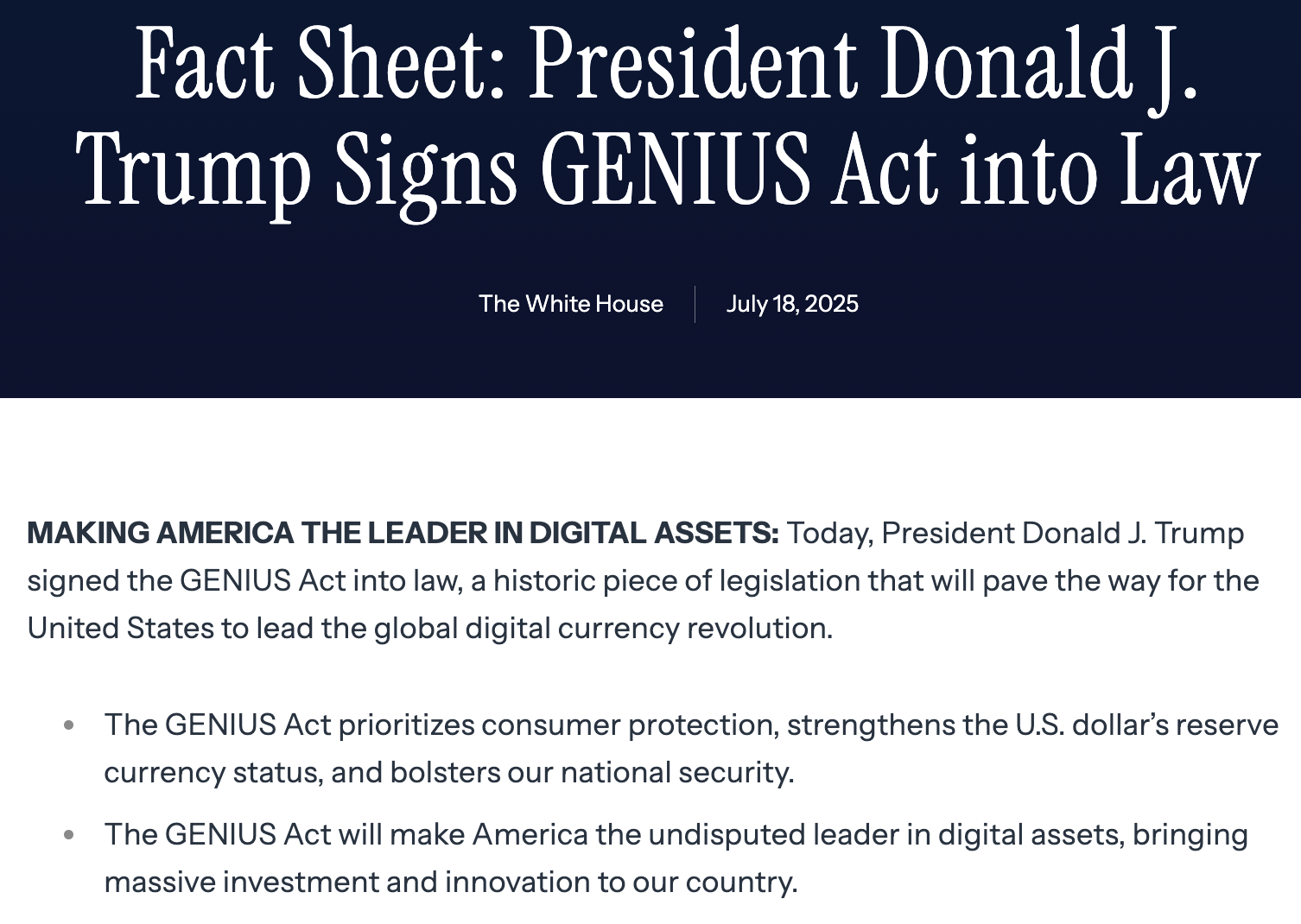
On the surface, the GENIUS Act regulates stablecoins, digital tokens pegged to the dollar, issued by private companies like Tether and Circle. It standardizes how they hold reserves, how they’re audited, and how they plug into the payments system.
But dig a little deeper, and you’ll see something else. The GENIUS Act requires every stablecoin to be fully backed by reserve assets approved by the Treasury, including, you guessed it, U.S. Treasuries. It also gives the Treasury Department oversight over how these companies operate, what transactions they can restrict, and so on. And it creates a global network of digital dollars that anyone with a smartphone can use, anywhere in the world.
In other words: CBDC-level control, without the CBDC label. Private companies do the (dirty) work. The government sets the rules. And the whole thing looks like just another tech product.
And it's not theoretical. Take Tether, the company behind the world's largest stablecoin. They now hold more U.S. government debt than South Korea or Germany.
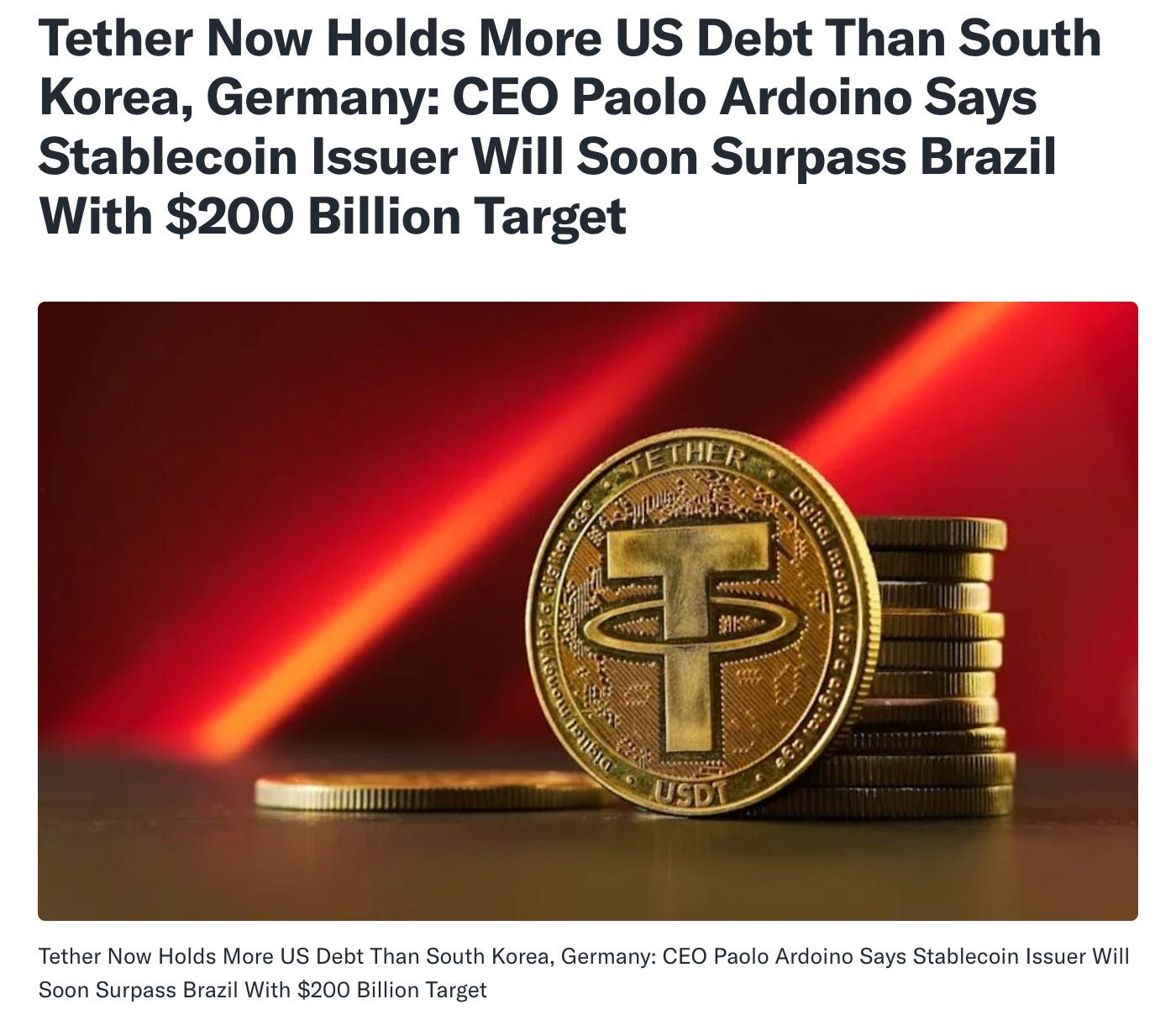
They didn't exist a decade ago. And this is the same company that, just weeks ago, froze $344 million with a single keystroke. At the request of OFAC, the U.S. Treasury’s sanctions enforcement arm, as part of the Iran sanctions.
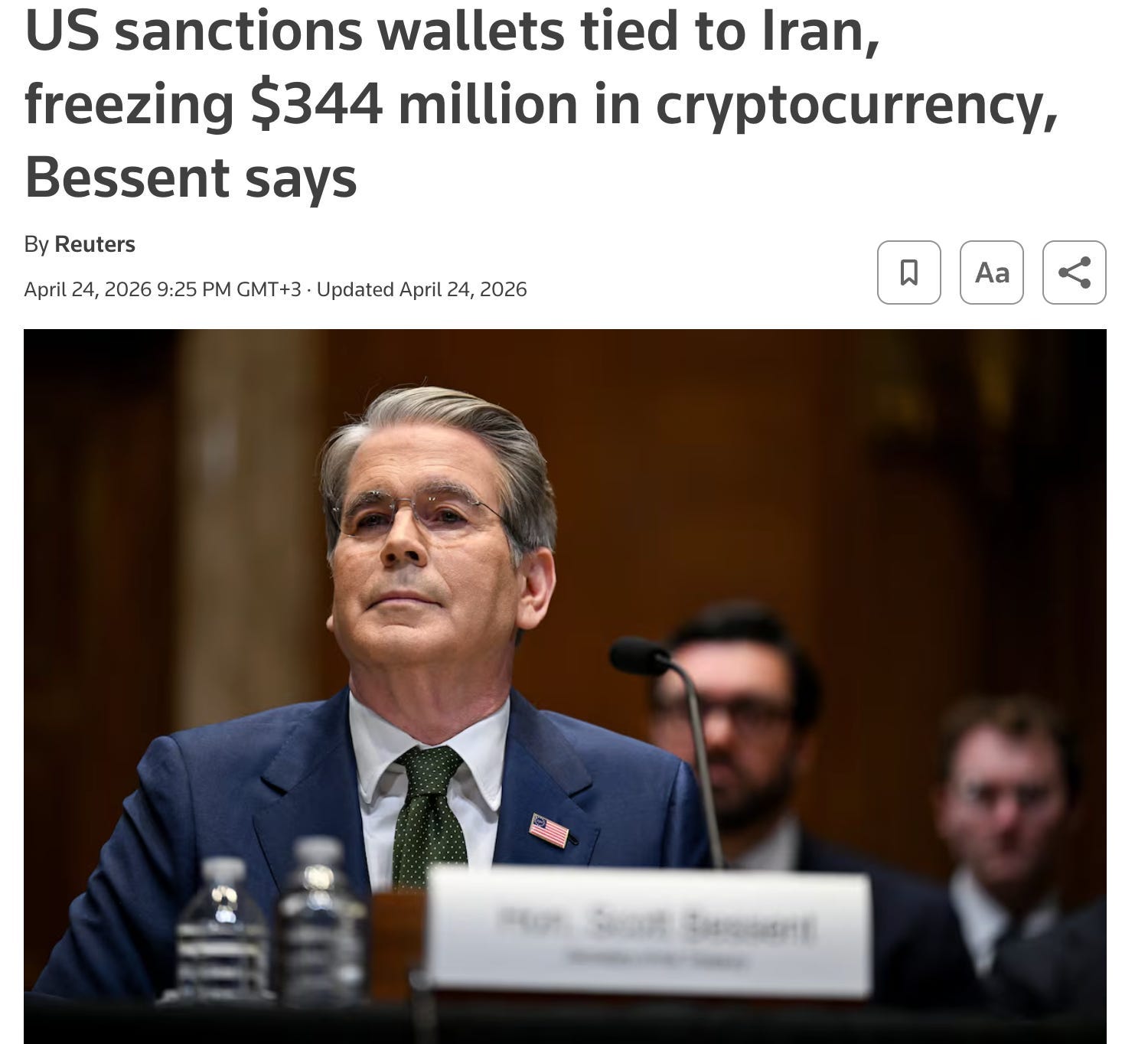
No court order. No trial. No due process. The government asked, and Tether clicked a button. Hundreds of millions of dollars, gone. Just like that.
The Digital Prison
So where does this leave us?
It leaves us with a digital prison being built around us. Slowly. Brick by brick. Ratcheting it up with every crisis that comes their way. COVID gave them the tracking apps. The energy crisis is giving them the rationing apps. And digital currencies, whether you call them CBDCs or stablecoins, will give them the most important piece of all: the “money.”
And they’re not even hiding the endgame. Several years back, at an IMF seminar, Agustín Carstens, the head of the Bank for International Settlements, the central bank of central banks, said this about digital currencies:
The central bank will have absolute control on the rules and regulations that will determine the use of that expression of central bank liability. And also, we will have the technology to enforce that.
"Absolute control."
It’s terrifying how quickly we’ve gone from a chalkboard in a Havana bodega to algorithms that can freeze your savings with a keystroke. At least in Cuba, you can trade your neighbor’s sugar ration for coffee. In the Soviet Union, you could swap vodka coupons for some canned meat. In Pakistan’s fuel app, you can’t even carry over unused quota to next week. And with programmable money? There’s nothing to trade, nothing to swap, and nowhere to hide. The algorithm knows who you are, what you bought, and whether you’ve exceeded your allowance.
The digital prison is being built. And the only weapon we have is refusing to buy the lie that it isn't. As long as we can see it, we can do something about it, at least at the individual level.
Regards,
Lau Vegys
For people to say, “It can’t happen here,” I will just remind them of what happened during the Chinese virus. Suddenly, your personal freedom was at the whim of who you allowed to be in office at the state and local level. Some places didn’t impinge upon your personal freedom, but others did to a drastic extent. And how many businesses were harmed in those demarcated regions of hell, like Michigan and New York? And who in California could forgot the attitude of Governor Gavin Gruesome, who made the whole state a shit-hole by saying, “My laws apply to you, while no one’s laws apply to me”? If any of you really think it can’t happen in the US, you are living in denial. And that isn’t a river in Egypt.
When I was at school, over half a century ago, I concluded that at some point, governments would become more tyrannical.
The pirates in charge are doing all they can to turn the world into a medieval serfdom where you get what they decide you deserve…
So, the question is, what is the work around / work arounds?
I am keen to get your feedback…
Thanks,
Mike