

Lau here.
The Fed meets on the 16th, and the market is now pricing in a two-in-three chance that it raises rates.
Which makes it all the more interesting that I spent last week writing almost entirely about gold. Higher rates are supposed to be poison for it. Why hold something that yields nothing when government paper pays you more than 4% just to sit there?
That’s what the textbook says, anyway.
The problem is, that same textbook assumes everything else carries on as usual. And while I don’t have a crystal ball, I think that assumption will be put to a real test this time around.
I mean, just look at what’s happening with that government paper.
Two days from now, on September 9, the Treasury begins buying back its own long-dated bonds at double the previous rate. It announced the increase back on August 19, lifting each operation from $2 billion to at least $4 billion, and it will carry on until November 4.
A buyback here means exactly what it sounds like. The government goes into the market and buys back bonds it has already sold. This isn’t new borrowing. It’s the Treasury taking its own paper off dealers’ hands with cash.
As crazy as it sounds, given the circumstances, it’s not hard to see why the government would resort to buying its own debt.
The Treasury has $739 billion of new debt to sell this quarter, on top of more than $9 trillion of old debt to roll over this year (with the national debt having recently crossed $40 trillion).
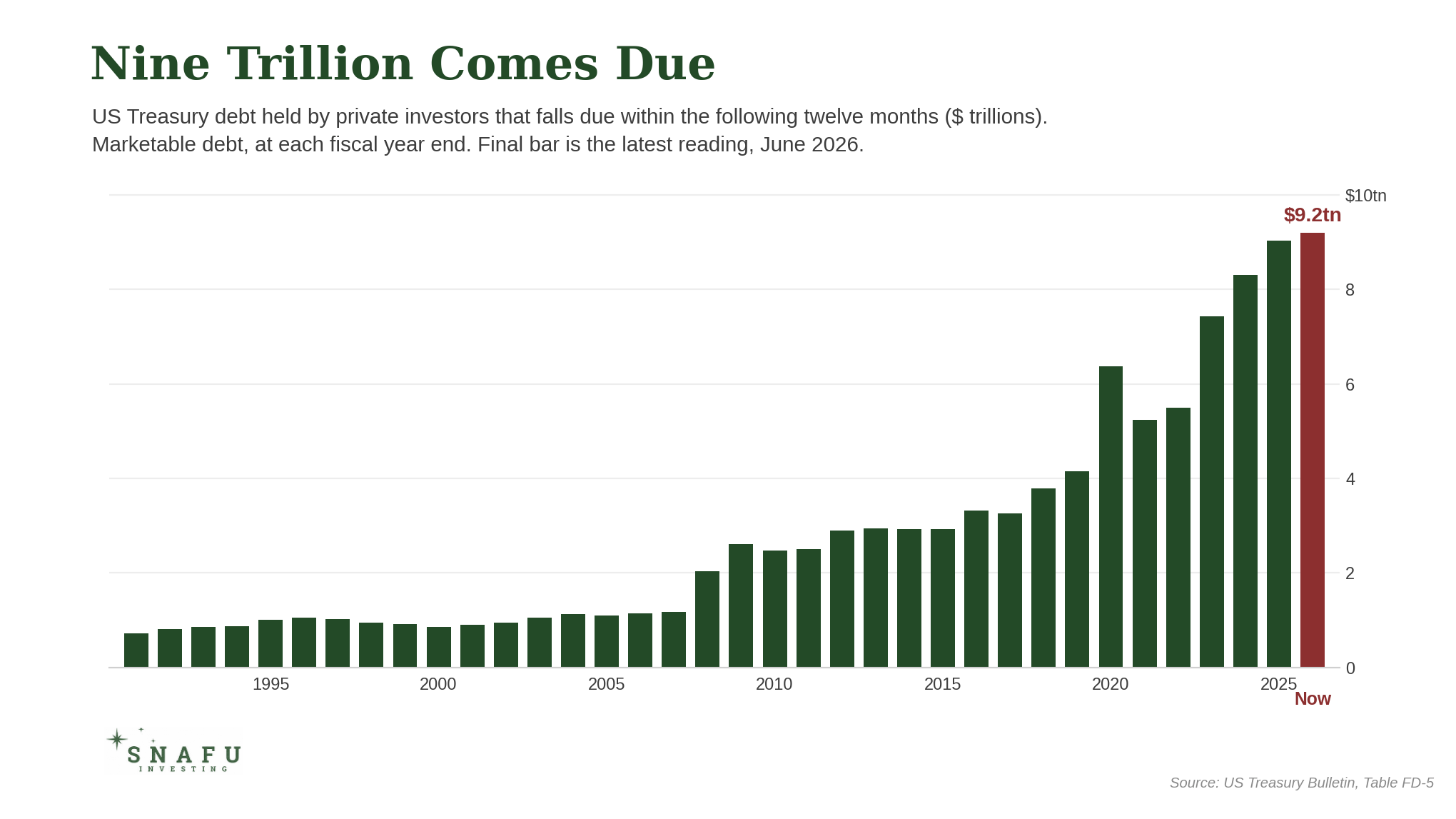
As you can see from the chart above, that $9.2 trillion is a big bill. For context, back in 2008, the same figure was about $2 trillion.
Meanwhile, the people who used to buy that paper without blinking are backing away. In June, foreign investors were net sellers of U.S. government debt. And as I showed you a couple of weeks ago, that wasn’t a one-month blip. Their share of the market has been sliding for fifteen years, from close to half in 2011 to about 30% today.
Which complicates that choice between gold and government paper. To put it mildly.
Setting all that aside, it’s worth remembering what usually happens when the Fed goes on the offensive. Historically, it tends to raise rates until something breaks. Then, of course, it cuts again.
You can see the pattern in the chart below. The dot-com bust in 2000, the financial crisis in 2008, COVID in 2020. Each time, rates eventually ended up back on the floor.
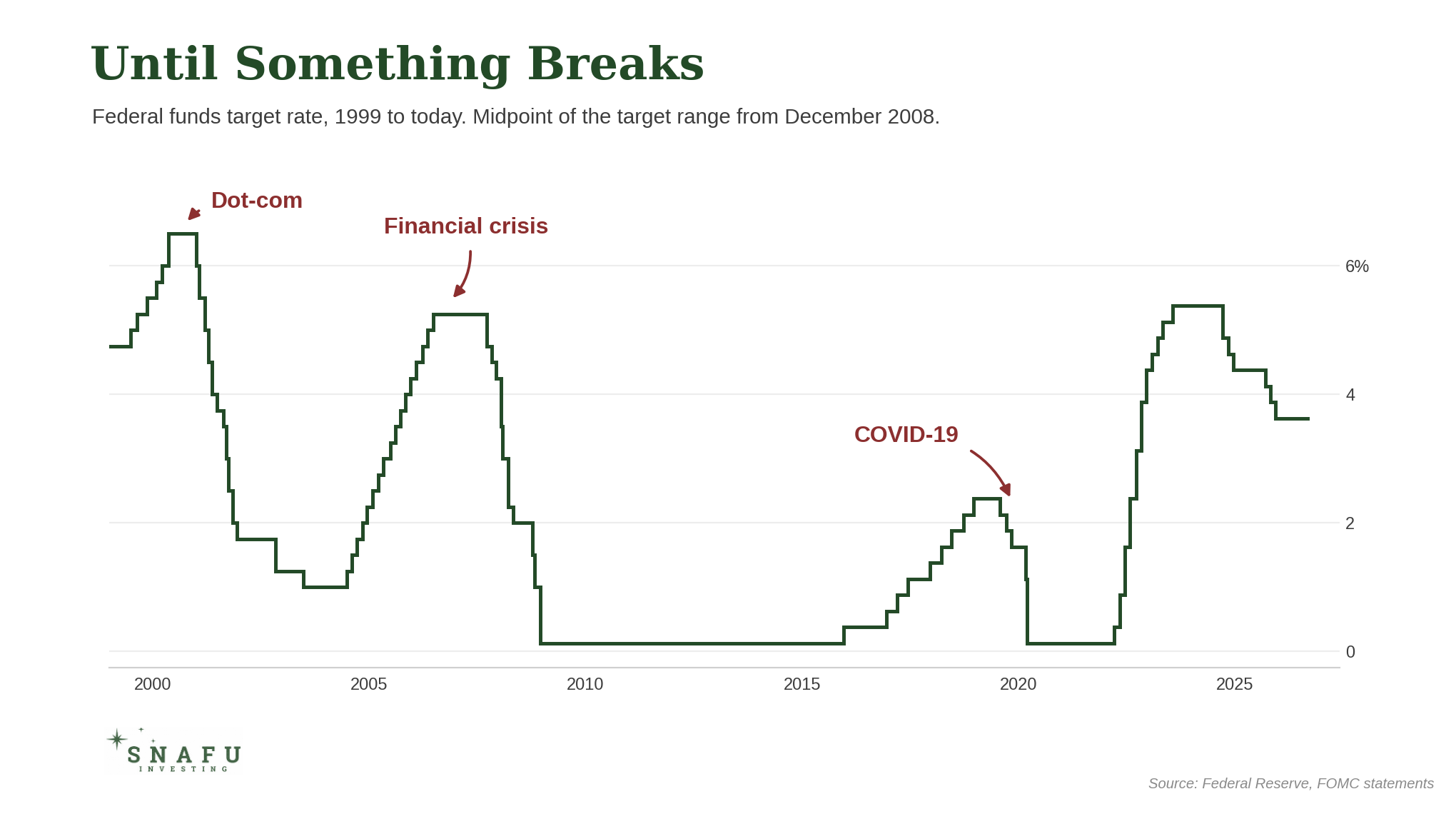
Of course, if the Fed really is serious about hiking rates, what’s different this time is the kind of crisis it might bring on. Any hike would land on rates that haven’t been this high since early 2008 (bar the three years from late 2022 to last December), while years of refinancing at higher coupons have already driven the government’s interest bill to the highest level in its history.
Keep in mind, interest is now the second-largest line in the federal budget, ahead of the military and Medicare. Only Social Security is bigger. In fact, the government now spends 22 cents of every dollar it collects just servicing the debt, against a fifty-year average of 12 cents. And every extra percentage point in rates will add roughly $3.2 trillion to the interest bill over the next decade.
So if rates go up again, the thing that breaks may not be a bubble or a bank.
It may be the budget.
Now, you’ll hear that this is all fine. That the Fed will do what it has to do to “squash inflation,” and that Volcker proved “it can be done.”
True. When Paul Volcker took over as Fed chairman in 1979, inflation was above 11% and climbing. It eventually peaked near 15%. He took the fed funds rate to 19%, broke inflation, and by 1983 it was down to 2.5%.
What conveniently gets left out is that federal debt was just 31% of GDP at the time. Today it’s more like 123%. And even with a fraction of today’s debt, Volcker’s cure came with two recessions and a great deal of pain.
The point is, Warsh doesn’t have Volcker’s room to maneuver. Not unless he’s willing to administer a cure that might kill the patient.
So, yeah, gold may not pay interest. But it’s also one of the few assets you can own that isn’t someone else’s liability. And as I showed you last week, there isn’t exactly a flood of new supply coming either. Even with the gold price nearly tripling since 2018, miners have managed to produce just nine extra tons a year.
But if, against your better judgment, you still don’t own any, don’t despair. Perhaps you have an old gold or silver certificate lying around. Apparently, you can just take it to the government and exchange it for the metal.
At least according to Treasury Secretary Scott Bessent.
You may have already seen the clip in the Fort Knox piece below. If not, here it is. Bessent rather proudly explains that those old certificates can still be redeemed for physical gold and silver:
There’s just one problem. It’s complete nonsense.
Silver certificates stopped being redeemable for silver in 1968. Gold certificates stopped being redeemable for gold in 1933.
Bear in mind, this is the same man assuring us that every ounce of gold at Fort Knox “is present and accounted for.” (More on that in the first piece below.)
Bessent’s little history lesson reminded me of a Soviet joke a reader sent me about a month ago. It seems rather fitting given how much faith we’re asked to place in the people running the show. Thanks for this one, Joe. And since you know I like ending these Monday notes on something a little more cheerful, I’ll leave you with it:

Last week's pieces are linked below in case you missed any of them, along with an alert on our silver miner breaking ground.
Bessent Says the Gold Is All There. I'm Not So Sure.

With gold rising above $4,600 in recent weeks, it feels like the perfect time to revisit a topic many of us haven’t forgotten: the gold at Fort Knox, and whether it’s actually still there.
Peak Gold Is Next Year

Gold is having a strange few weeks. First, it started climbing after the Treasury said it would double the size of its long-end buyback operations, which I wrote about in the first monthly issue of SNAFU Investing on Saturday. That pushed gold to its highest level since May.

From the Comments
One of the things I’ve come to appreciate most about writing here is the conversation that happens in the comments. Here are seven that stood out last week, for different reasons. Each one links back to the piece it appeared on, so you can click through if you’re interested in the context.


Thanks again to everyone who left a comment last week. I read all of them, even the ones I don’t get a chance to reply to individually.
See you in the comments this week.
Regards,
Lau Vegys
Our esteemed Secretary of the Treasury appears to be looking at those gold and silver certificates as if he's looking at a museum exhibit. The problem is that the notes on the wall don't tell the whole story. And since he was born after 1933, he may have never learned the whole story.
Can someone shuffle him off to the nearest data center? Or maybe I should use the term he may know: The library.