

With gold rising above $4,600 in recent weeks, it feels like the perfect time to revisit a topic many of us haven’t forgotten: the gold at Fort Knox, and whether it’s actually still there.
And as it happens, something caught my eye recently that makes for a perfect springboard into all of this.
Over a month ago, Treasury Secretary Scott Bessent went on Jesse Watters Primetime. The two were standing in front of a display of historic U.S. currency at the Treasury Department when the conversation turned to Fort Knox.
Take a listen below.
Here’s the transcript, if you’d rather read:
Jesse Watters: What are we looking at here? These look exquisite.
Scott Bessent: These are the displays of our currency over the years. Some of it, like, we used to have silver certificates. We used to be backed by silver, sometimes gold. And then in the ‘70s we just went to what was called fiat currency where you didn’t have to keep gold or silver in the vault. If any of these are still outstanding, the silver or gold is at Fort Knox waiting to be claimed if so needed.
Jesse Watters: Have you visited Fort Knox?
Scott Bessent: I haven’t. People on my staff have. We are going to the Treasurer’s office. The Treasurer has been to Fort Knox, and I’m happy to say all gold is present and accounted for. The U.S. has the largest pile of gold in the world. Over $1 trillion at current market value.
Jesse Watters: And we are getting more from Venezuela, I hear.
Scott Bessent: We are getting a lot from Venezuela.
Now, before we even get to how hard a sell it is to take Scott Bessent at his word that the gold is “present and accounted for” at Fort Knox (even though he admits he hasn’t seen it himself, and take note of Jesse’s reaction to that, by the way), I’m a little bothered that the current Secretary of the Treasury doesn’t seem to know that the U.S. ended the public’s right to redeem gold and silver certificates for metal decades ago.
I mean, is he actually saying I can snatch up some of the tons of these certificates for sale in coin shops and online, walk into the Treasury, and they’ll hand me my silver’s worth? I actually know people who still own them. Better let them know. What a fantastic arbitrage!
The Audit That Wasn’t
Of course, it’s not the first time Bessent has come off as clueless, which conveniently brings us back to the gold question. Last year, he gave an interview with Bloomberg where he confidently stated that there’s a report confirming the gold is indeed there. What’s more, Bessent also claimed they audit the gold every single year.
U.S. Treasury Secretary Scott Bessent: I don’t have any plans [to visit Kentucky]. I can tell you that we do an audit every year. I can tell the American people on camera right now that there was a report—September 30th, 2024—all the gold is there. Any U.S. senator who wants to come and visit can arrange a visit through our office.
And, similarly, he was dead wrong here too. This is the document he’s referring to.
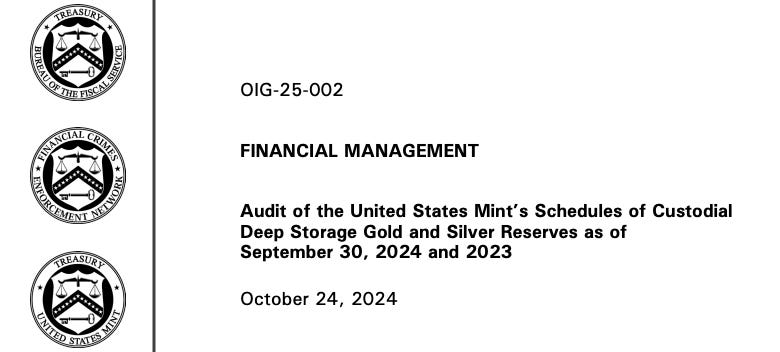
Here’s what the auditors actually wrote:
In our opinion, the Schedules present fairly, in all material respects, the balances of the United States’ Deep Storage Gold and Silver Reserves in the custody of the Mint as of September 30, 2024 and 2023, in accordance with U.S. generally accepted accounting principles.
Translation? They reviewed the schedules of gold reserves. Not the gold itself.
And a schedule, in accounting, is exactly what it sounds like. A list. A supporting table of balances that sits behind a line in a financial statement. The auditors’ job is to check that the list adds up, that it agrees with the underlying books, and that it’s presented the way the accounting rules require. All fine and well. It just has nothing whatsoever to do with whether there’s any metal in Kentucky.
So no, they didn't inspect, weigh, or test a single bar at Fort Knox. They reviewed a spreadsheet.
And that spreadsheet? It’s essentially this, from page 8 of the report:
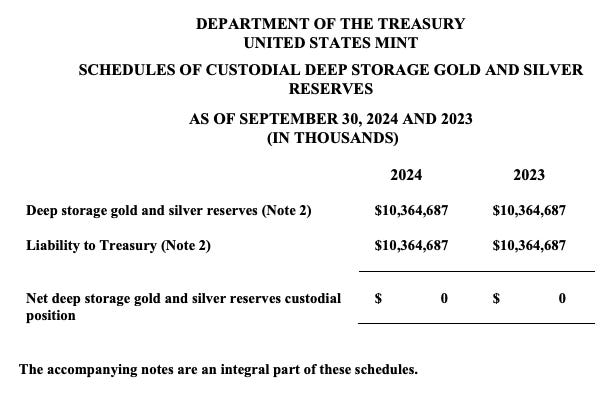
Those figures are in dollars, and in thousands. So that $10,364,687 is really $10.36 billion. (And “liability to Treasury” just means the Treasury owns the metal while the Mint holds it, which is why the two lines cancel out to zero.)
Now, $10.36 billion is a strange number for the largest pile of gold on Earth (Bessent himself put it at over $1 trillion in the video above). The reason for the gap, as you may know, is that the official “book value” of U.S. gold hasn’t changed since 1973. It’s still valued at $42.22 an ounce, the outdated statutory price the Treasury continues to use.
It’s easy enough to double-check.
Just divide that amount by $42.22 and you get roughly 245 million ounces, which is, of course, the amount of gold we’re told the U.S. government holds in deep storage (plus another roughly 16 million ounces held elsewhere, bringing the total to about 261.5 million ounces).
If you want to examine the report for yourself, here’s the link.
At any rate, the point I’m trying to make is that this isn’t an audit of the physical gold. It’s an accounting exercise, a restatement of what the Treasury already has on the books.
That’s not to say this was a demanding task. The entire report runs just 12 pages. Table of contents, a few summary tables, and some boilerplate language. That’s it. Nothing ChatGPT couldn’t crank out in a few minutes.
So if this is what the Treasury Secretary is passing off as a real audit, it’s just as well the U.S. government is getting all that Venezuelan gold he says it’s getting so much of.
So, Where’s the Audit?
Now, in case you’re wondering, the last time the entire Fort Knox holding was audited in a single exercise was back in 1953, under President Eisenhower. Even that was just a spot check.
There was also a notable photo-op in 1974, when the Treasury opened Fort Knox to about 100 journalists and members of Congress following rumors that the vault was empty. Cameras rolled, gold bars were displayed, and everyone left with a souvenir sound bite.
But nothing was weighed. Nothing was assayed. No serial numbers were matched.
One radio reporter summed it up best:
All I can say is that I saw gold in there.
That same year, the Treasury launched what they called a “continuing audit program.” Starting in 1975, they conducted annual reviews of small portions of the gold.
By 1982, about 80% of the gold had reportedly been verified. The program continued for several more years, and by 1986 that figure had (reportedly) reached roughly 92%.
After that? The continuing audit program was discontinued.
Note: There’s a reason many folks view 1953 as the last true inspection. Everything after it was done a compartment at a time. And once a compartment holding the gold was counted, it was closed with an Official Joint Seal, a numbered document with wax seals and tamperproof tape, and so long as that seal held, never opened again. From then on, auditing it meant checking the seal, not the gold behind it.
Now, the most recent effort to actually implement a real audit that I can think of came last year. Representative Thomas Massie introduced a bill called the Gold Reserve Transparency Act, and Senator Mike Lee introduced the Senate version on November 19.
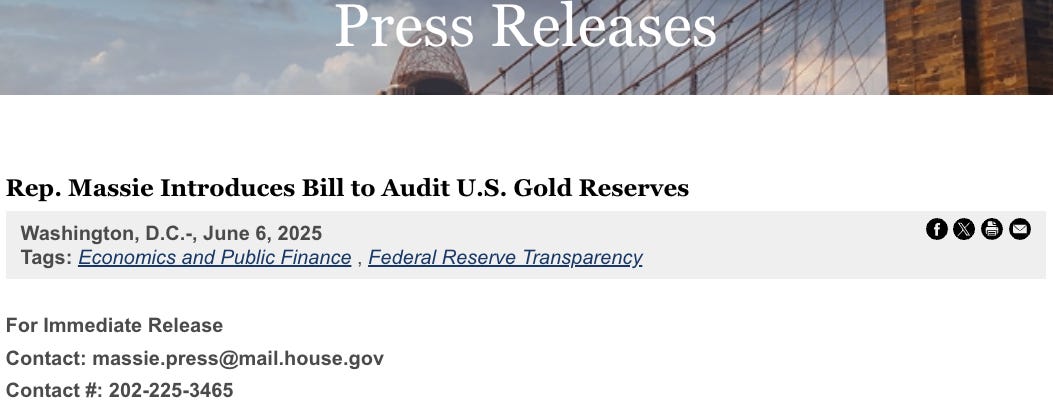
Between them, they’d require a full external audit and inventory within nine months, followed by another audit every five years, plus an assessment of the physical security around the reserves.
They’d also look into whether any of the gold in the vaults has been lent out, pledged, or swapped, and whether anybody else has a claim on it. Because I’m pretty sure there is gold in there. The question is how much of it still actually belongs to America.
At writing, both bills are sitting in committee. Neither has advanced.
Make of that what you will.
(In the meantime, the assurance on offer is the word of a man who hasn’t been to Fort Knox and thinks you can walk an old silver or gold certificate into the Treasury and come out with the metal.)
Enjoy the rest of your weekend,
Lau Vegys
P.S. None of this makes me want to own less gold. Which is roughly what SNAFU Investing’s first monthly issue is about. What I wanted was a company that already controls defined ounces somewhere a mine can actually get built, at a price that hasn’t caught up with the metal it’s sitting on. It went out to paid subscribers last weekend. If you’re a paid subscriber, make sure you haven’t missed it. And if you’re not, the intro is free to everyone.
Perhaps they can rewatch Goldfinger and guestimate the holdings from the movie set.
So, then, HOW is possible to get an OFFICIAL audit? What's going on? If Congress does NOT want it, then it seems we are stuck with B.S. Thus conspiracy theories galore!!
And why then do "they" not use the present value of gold, or a range of gold prices, so that we might be closer to the truth. I imagine we will never know unless there is a financial RESET, and maybe even then not know also. The Creature from Jekyll Island is about all we have, no? And what gives with JPMorgan and Jamie Diamond??? FIVE criminal CONVICTED cases and a slap on the wrist. See many articles on Wall Street on Parade. Maybe John Perkins, The Art of the STEAL will expose something. Not a DEAL but a STEAL!!!!! Love to see your comments about it as it comes out in a few days. Keep up the GREAT writings!!!, please. Kenneth Pollinger, Ph.D. (SUNY)(Sociology)