


Gold is having a strange few weeks.
First, it started climbing after the Treasury said it would double the size of its long-end buyback operations, which I wrote about in the first monthly issue of SNAFU Investing on Saturday. That pushed gold to its highest level since May.
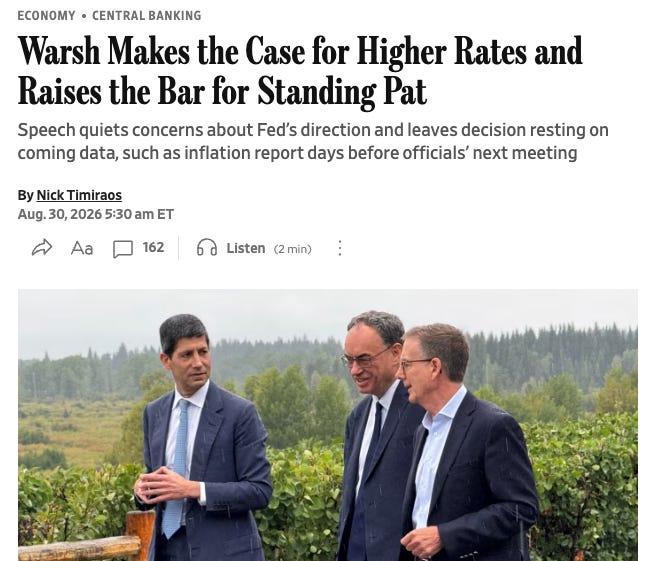
Then Fed Chairman Kevin Warsh rattled the market on Friday by calling inflation concerning and hinting that rates may go up rather than down.
As I write this, it changes hands around $4,330 an ounce. That’s about a quarter more than it was a year ago, but still well below where it was in January. So depending which chart you put in front of someone, you can make the bull case or the bear case. I’m firmly in the bull camp, and I’d find it hard to be anywhere else with everything that’s going on.
But I want to talk about something else today. Something that won’t have changed whatever the Fed decides later this month, and that very few people are discussing.
Earlier this year the World Gold Council published a forecast. It expects global gold mine production to peak as soon as next year, in 2027, and to decline gradually from 2028 onward.
In case it needs spelling out, peak means the most gold the world will ever pull out of the ground in a single year.
Nine Tons
It isn’t hard to see why they’d say it. Because if you look at the hard data, the mining industry simply isn’t finding enough new gold.
Take a look at the chart below. It shows what the world’s gold mines have produced over the past eight years, set against the price of the metal.
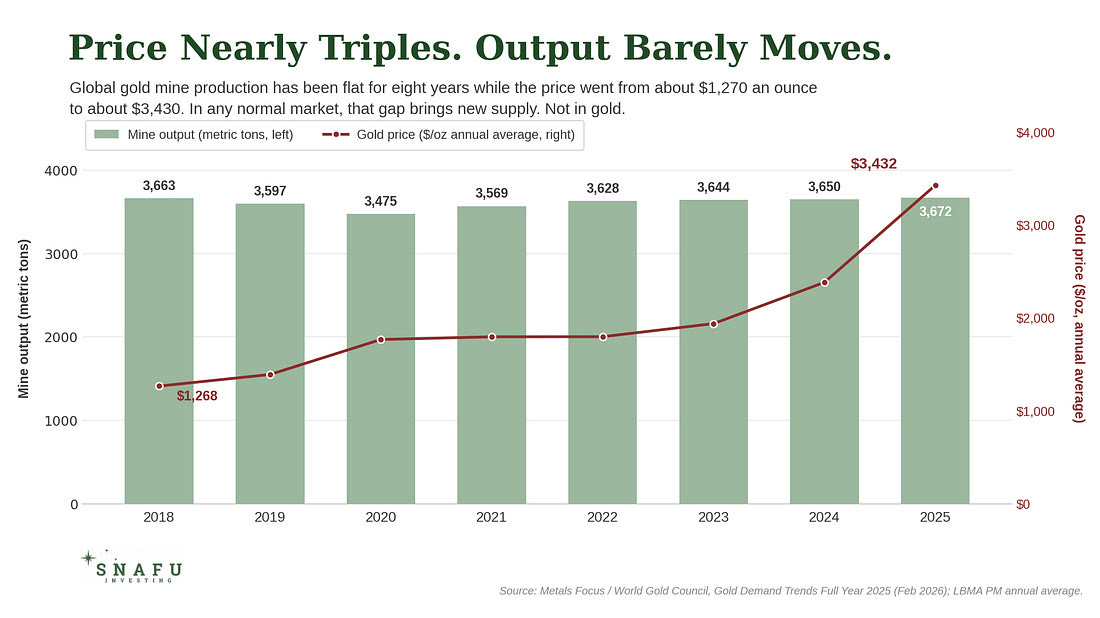
As you can see, global mine production hit 3,672 metric tons last year. That’s technically a record, but only barely. Back in 2018, miners produced 3,663 tons.
The gold price, meanwhile, went from an average of about $1,270 an ounce in 2018 to roughly $3,430 last year. It nearly tripled.
And what did all that extra money coax out of the ground?
Nine tons.
In other words, global gold production went essentially nowhere in seven years.
In almost any other market, a price signal like that would have brought a flood of new supply. In gold, it brought virtually nothing.
Fewer, and Smaller
So what’s going on?
Well, major producers have been depleting their reserves faster than they can replace them for more than a decade now.
And it’s not for lack of trying to find more. They’ve spent billions on exploration, scouring prospective belts all over the world for new deposits. Yet the discoveries keep getting fewer and smaller. Take a look at the chart below.
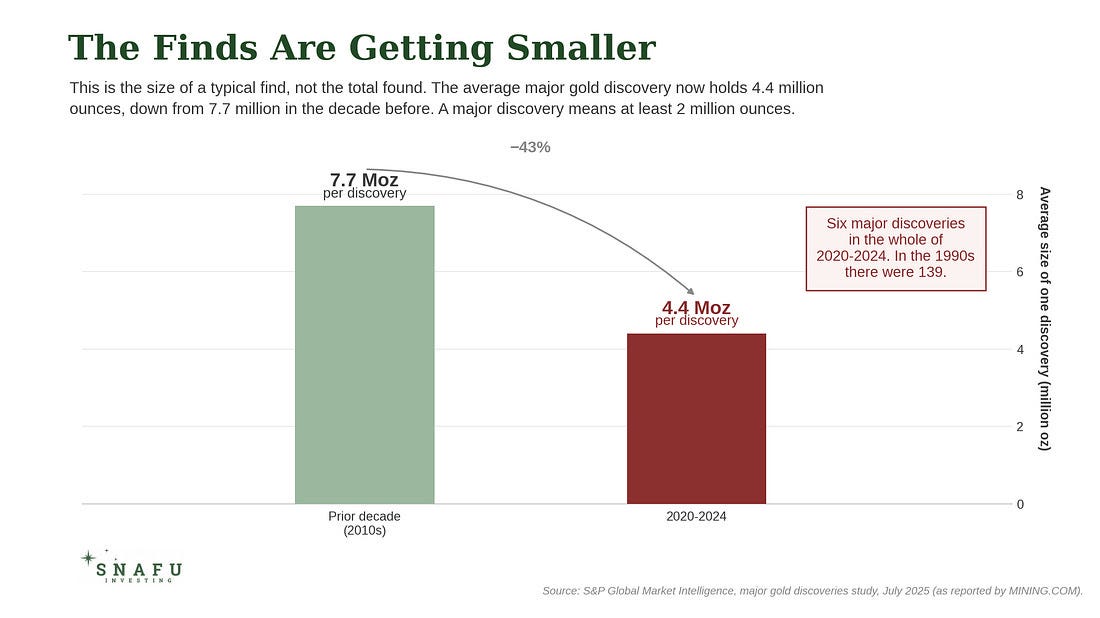
As you can see, the average major discovery now holds 4.4 million ounces, down from 7.7 million in the decade before. That’s a drop of more than 40%. And there have only been six major discoveries since 2020.
Of course even when they do find something worthwhile, there’s another problem. It takes forever to turn a discovery into a mine.
According to S&P Global, mines that came online between 2020 and 2024 took nearly eighteen years on average to go from discovery to first production. Back in the 1990s, it took about six.
Which means a world-class gold deposit discovered this morning probably won’t produce a single ounce until sometime in the mid-2040s. And the industry isn’t finding enough deposits to fill even that timeline.
(There’s recycled gold too, of course. But that’s metal already sitting above ground rather than anything new, and most of it is jewelry scrap. And even that barely moves. Last year the average gold price rose 44%. Recycled supply rose 3%.)
So what are the majors doing about it?
Well, the obvious thing. When you can’t find it, you buy it.
Since 2024 there have been nine major gold takeovers committing more than $24 billion, part of a broader mining deal wave of around $139 billion. That’s the busiest the sector has been since 2011.
What’s interesting is that buyers are reaching further and further down the chain, acquiring companies that have never poured an ounce of gold. Which makes sense, when the alternative is watching your own reserve base shrink while the gold price climbs.
And there’s a predictable consequence to all this. Every deal that closes takes another buildable project off the market. Which makes the ones still standing that much more valuable.
Regards,
Lau Vegys
P.S. If the majors can’t find gold and have to buy it instead, the interesting question becomes who they’d have to buy it from. That's the thinking behind the recommendation in the first monthly SNAFU Investing issue, which went out this weekend. What I wanted was a company that already controls defined ounces somewhere a mine can actually get built, at a price that hasn’t caught up with the metal it’s sitting on.
So if you're a paid subscriber, make sure you haven't missed it. And if you're not, the lead is free to everyone.
Sounds a lot like the talk about Peak Oil several years which never paned out. It takes a couple of years at higher to ramp up production. The price of gold is highly manipulated. The amount recoverable is depended on the price just like oil.
I am not disagreeing that the price of gold going higher but not think this argument should be used.
Henry
I have a number of books in my library, bought in the early 2000s dealing with the topic of peak oil. Since then we’ve had fracking, and there appears to be an abundance of oil today (that’s a separate topic to the war in Iran). It could be that high prices with the advancement of technology, trigger a wave of exploration and reprocessing that results in more Gold being available.