

Remember the oil shock?
When the fighting closed the Strait of Hormuz this spring, the predictions were apocalyptic. Thirteen thousand flights canceled. Britain, we were told, was days from its last shipment of jet fuel. Analysts penciling in $200 oil, and a few of the louder ones going even higher.
Over at Doug Casey’s Crisis Investing (my old shop), readers kept writing in, asking why we weren’t recommending an oil play, or telling me to “look into” this or that oil company.
And believe me, I understood the temptation. On my drive over here to Spain, I was posting photos of German pump prices doing things I hadn't seen since 2022… and half-wondering if the doomers had a point.
Now, on the face of it, the doomsday math was never wrong (more on that below). After all, the 1973 Arab embargo — the one that gave us gas lines, odd-even rationing, and a decade of inflation — took away about 7% of the world’s oil, and prices more than doubled. This time, Hormuz was choking off well over twice that share.
And yet I kept pushing back against any oil recommendation.
Why?
Because someone was absorbing the shock.
Now, if you're thinking it was the International Energy Agency (IEA) riding to the rescue with its emergency release — 400 million barrels from strategic stockpiles around the world — no.
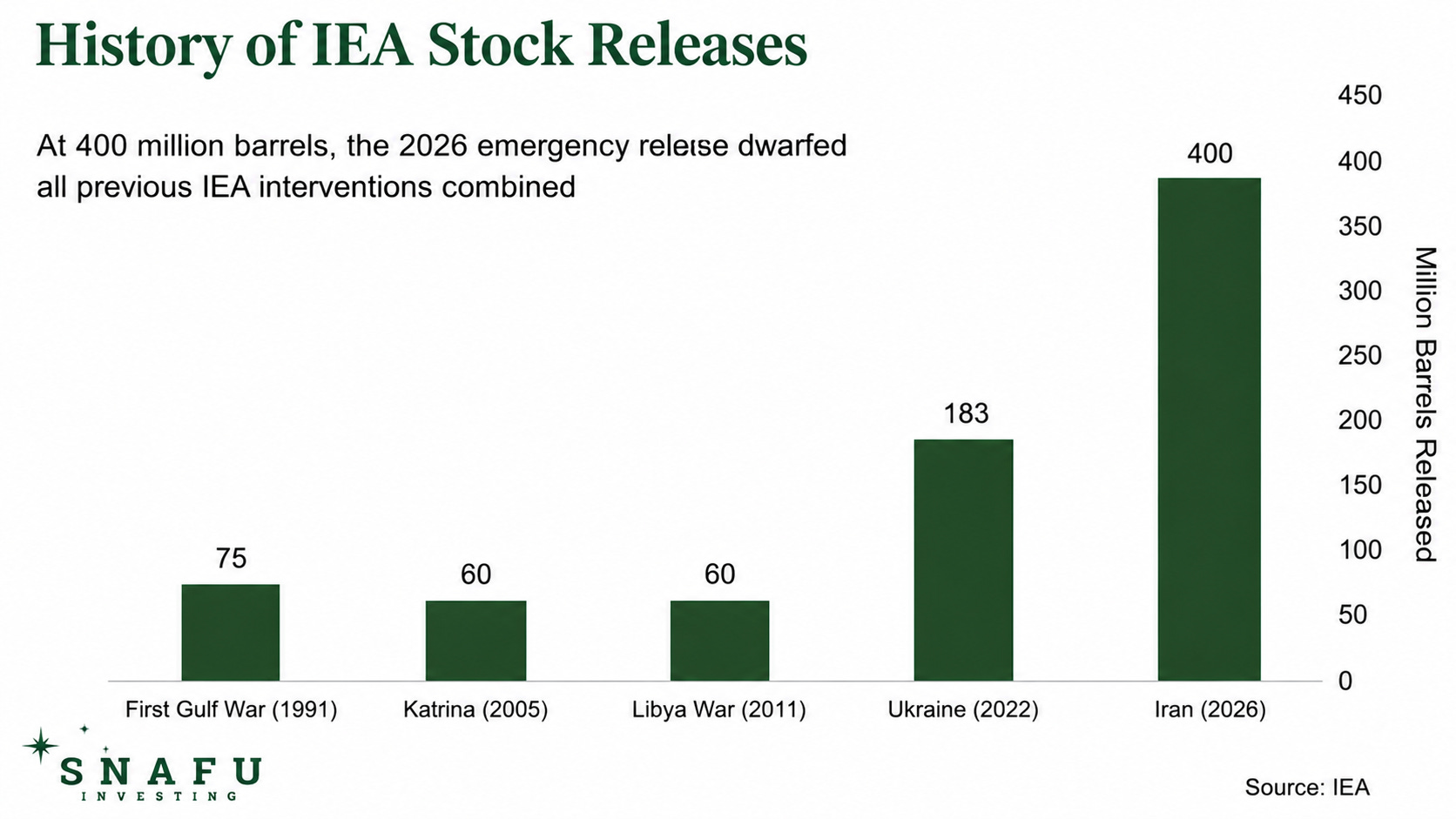
Yes, it was the largest release in history — bigger than all the previous ones combined. (Or pledged, anyway — the barrels trickle out over months.) But it wasn't nearly enough. In fact, it fell short by miles, as I'll show you in a minute.
The someone was China.
While the whole world stared at the strait, Beijing quietly pulled off what may be the largest intervention in the history of the oil market. And it did it without announcing a thing. (That, in a nutshell, is why I steered clear.)
Today, I’ll show you exactly what China did, and how. (Why they did it — and what it means for the dollar, which is the far bigger story — that’s Part 2, next week.)
First, though, let’s take a proper look at that doomsday math.
The Doomsday Math
On any given day, the world produces about 83 million barrels of crude — and consumes about 83 million. That's no accident. Oil isn't like wheat you can pile in a silo and forget about (national reserves aside, which we'll get to). Pretty much every barrel that comes out of the ground gets refined and burned almost as fast. There's basically no slack in the system.
Note: If we counted refined products too, global production and consumption would both be about 100 million barrels a day. And yes, the Strait carries both crude oil and refined fuels. But because the replacement routes we're about to discuss are almost entirely crude, I'll stick to crude throughout this essay.
Which is why Iran’s closure of the Strait was such a big deal. Overnight, roughly 15 million barrels a day stopped reaching world markets. That’s nearly one in every five barrels of the world’s crude.
So what could actually replace those missing barrels?
Well, first you have the bypass pipelines. Saudi Arabia’s East-West Pipeline has a nameplate capacity of around 5 million barrels per day. The UAE’s Habshan-Fujairah line adds another 1.5 million. Combined, that’s 6.5 million barrels per day on paper. And we’re being generous here, because pipelines rarely run at their full nameplate capacity.
Then there was the IEA’s 400-million-barrel release I mentioned earlier. Again, that’s a lot. But the total wasn’t what mattered here. What mattered was how fast those barrels actually reached the market. And if past emergency releases were any guide, that worked out to roughly 2 million barrels a day.
Finally, there was the shadow fleet — tankers still willing to run the Strait with their transponders switched off, accepting the risk in exchange for higher freight rates. At best, they probably added another million barrels per day.
Add it all together. About 6.5 million barrels from the pipelines. Another 2 million from the IEA. Roughly 1 million from the shadow fleet. That makes around 9.5 million barrels per day in total.
But remember: before the closure, roughly 15 million barrels of crude had been flowing through the Strait every day. That still left a gap of about 5.5 million barrels per day. Take a look at what that looked like visually.
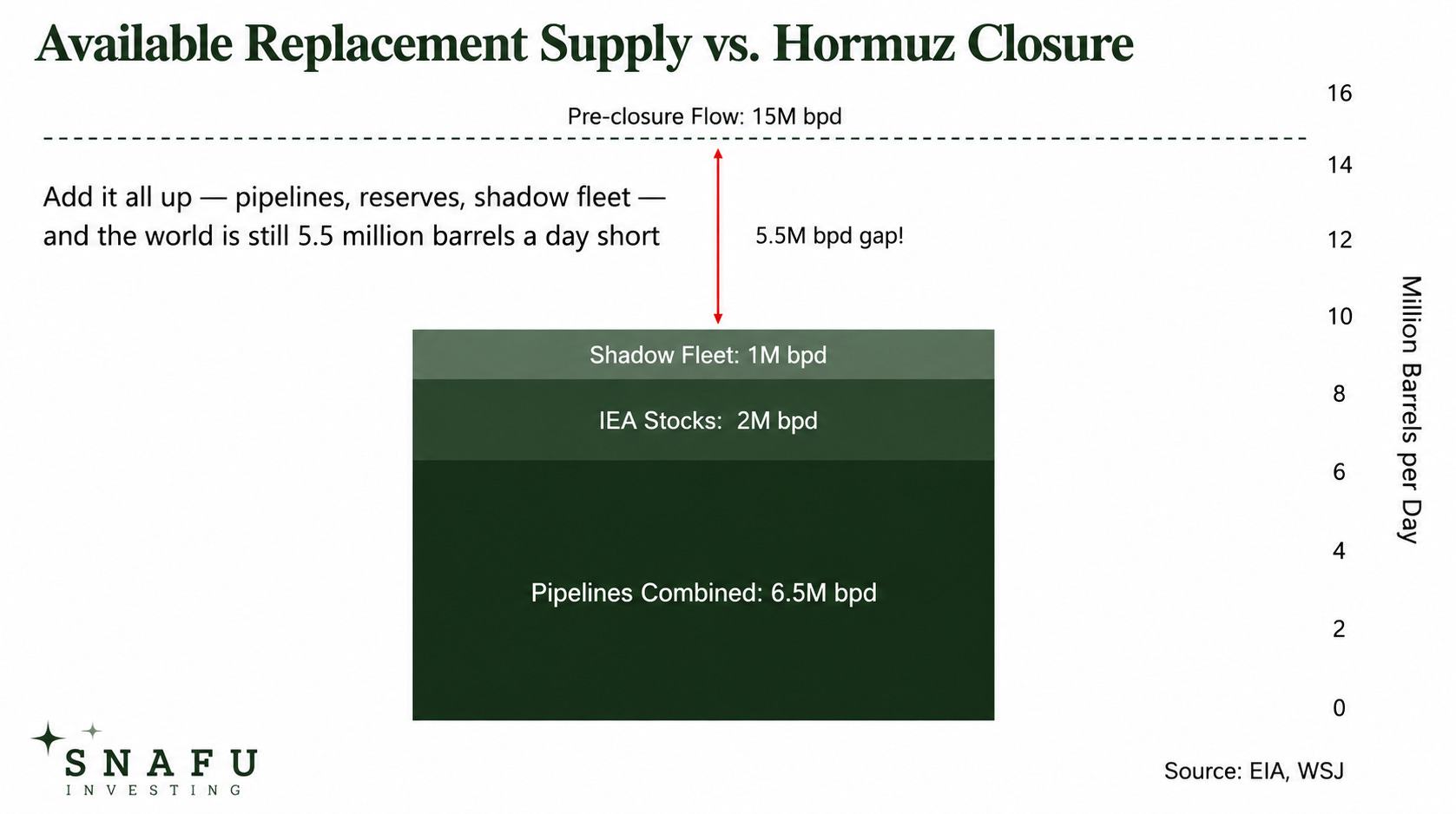
The world was still 5.5 million barrels short. Every single day.
Which of course meant the shortfall was compounding fast. Day one, you’re 5.5 million barrels in the hole. Day thirty, 165 million. By day one hundred? More than half a billion barrels gone.
In other words, the IEA’s record release would have covered less than three months of the gap. Meanwhile, strategic reserves around the world were visibly draining. In the U.S., for instance, the Strategic Petroleum Reserve fell to its lowest level since Reagan's first term.
So no, the doomsday crowd wasn't crazy. It was just math. If all you looked at was the supply gap, it really did point to $200 oil.
Enter the Beast
But then, somewhere around April, reality stopped matching the math.
Despite some ups and downs in the oil price (plenty of jittery action depending on what President Trump was saying at the time), we never saw $200 oil.
In fact, if anything, prices kept easing. Why?
The gap hadn’t gone anywhere, after all.
This could only mean one thing: somewhere out there, demand was disappearing. Millions of barrels a day of it.
I had my suspicions. Then in April, a friend with access to a Bloomberg terminal (the expensive kind) sent me a chart. It looked a lot like this:
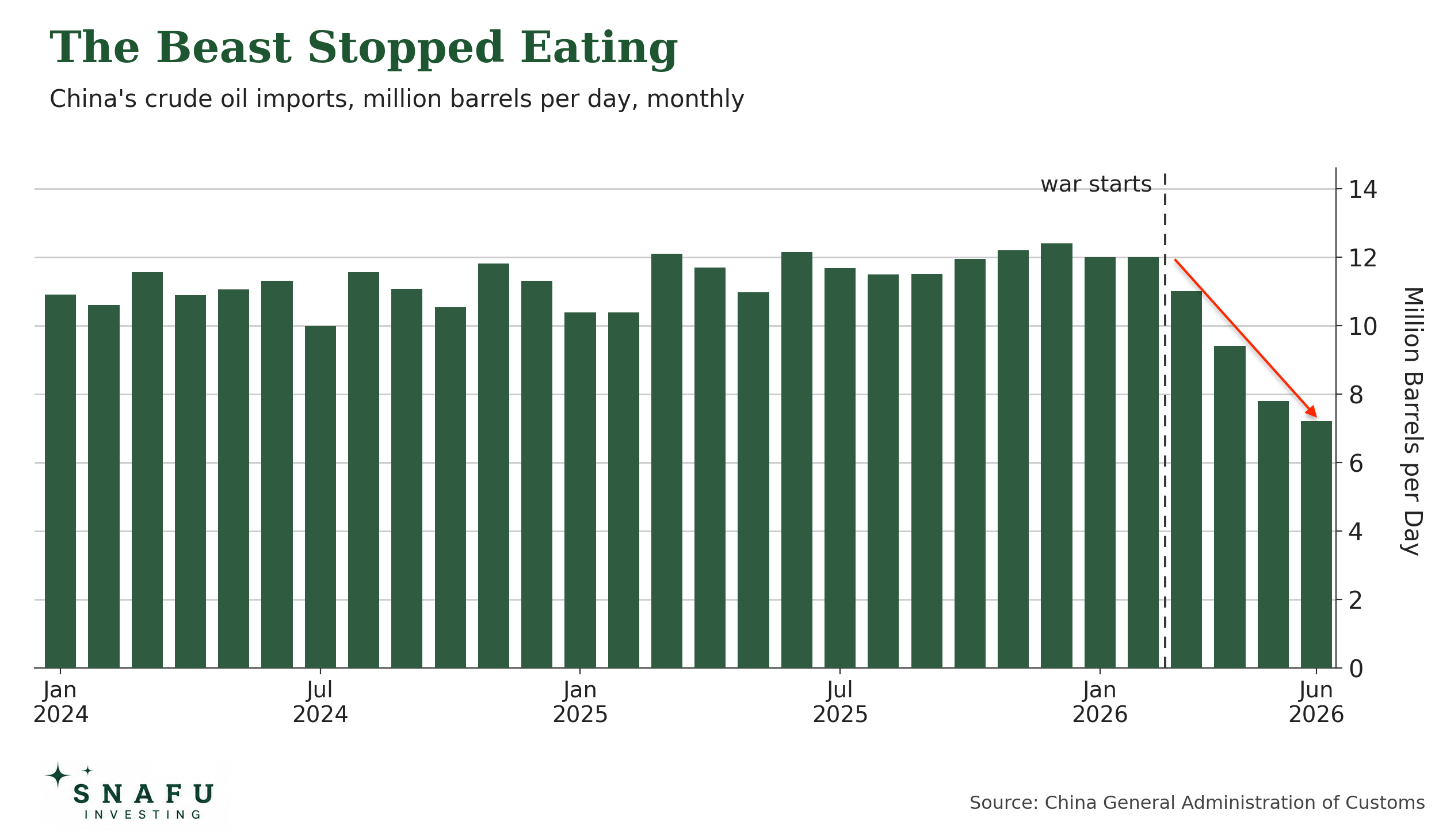
As you can see, China’s imports had been humming along around 11 to 12 million barrels a day for years. Month in, month out.
And then the bars start shrinking. Fast. The slide began in March. By May, imports were down to 7.8 million barrels a day, the lowest in nearly a decade. By June, 7.2 million. That’s down 41% from a year earlier, per China’s own customs data. A cut of 4.9 million barrels a day, and the weakest month since October 2016.
In other words: in the space of four months, the world’s biggest buyer of crude cut its purchases by 40%. That’s nearly half. No announcement. No explanation. It just quietly stepped back from the market.
Now, to appreciate all that, you have to understand that China is no ordinary player in the oil market. Its rise as an oil importer is one of the biggest stories in modern economic history, decades of almost uninterrupted growth that took it past the United States as the world’s largest importer.
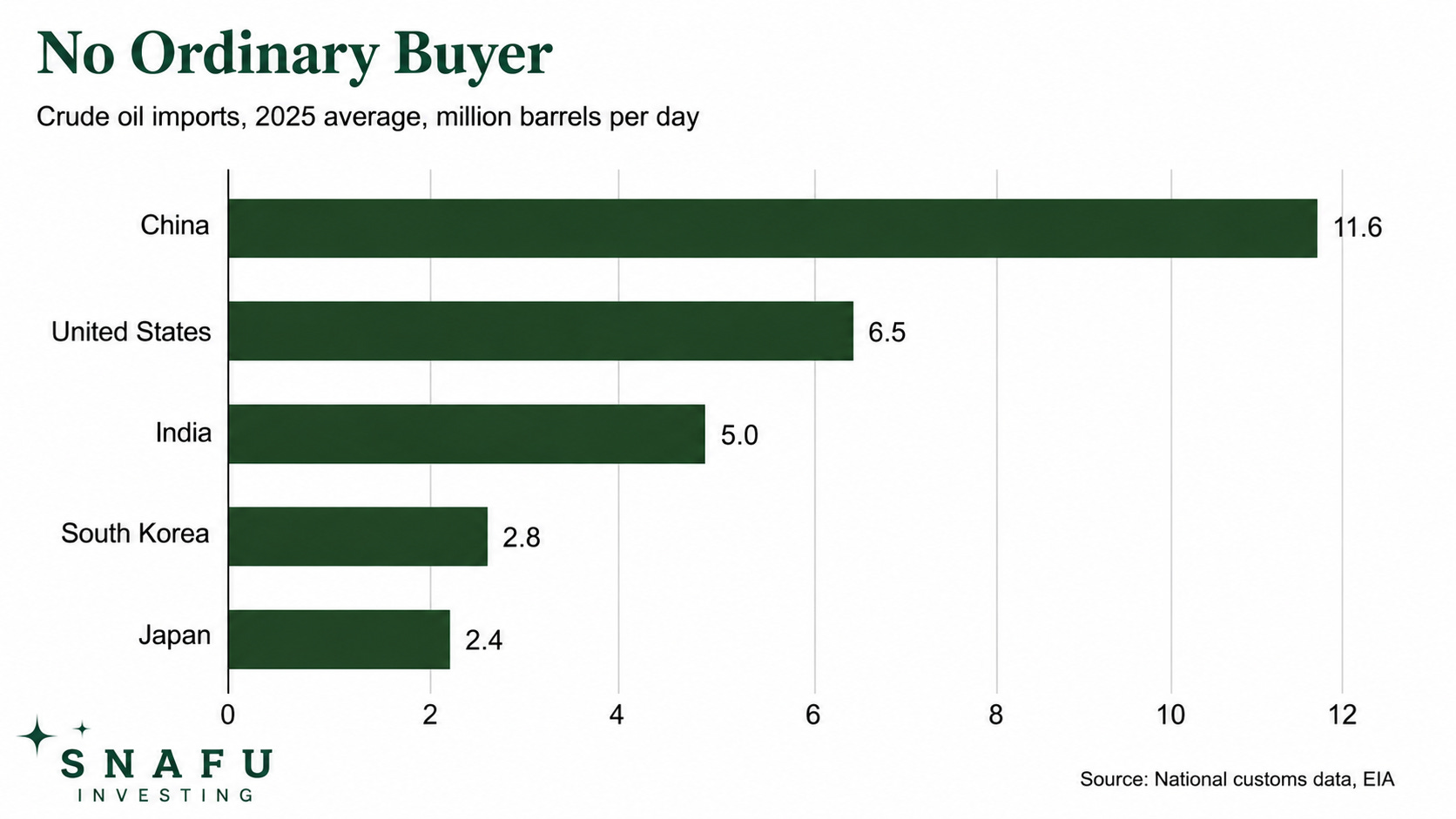
In normal times, China buys more crude from abroad than India, Japan, and South Korea combined. So when it pulled back its imports after the Strait of Hormuz closed, the effect was enormous. JPMorgan found that China alone accounted for 74% of the entire global decline in crude trade.
And of course, every barrel China didn’t buy was a barrel freed up for everyone else.
Remember our doomsday arithmetic? The world was short 5.5 million barrels a day. China cut 4.9. Just like that, the gap was all but gone.
Which is how, without announcing a thing, China saved the world from $200 oil.
How China Canceled $200 Oil
Now that you know what happened, you’re probably wondering how China actually pulled it off. Because if you know anything about economics, you know you can’t just slash your oil imports in half and carry on as if nothing happened. An economy doesn’t work that way.
Now, look — having been born and raised in the USSR under Communist Party rule, it should go without saying that I’m no fan of centrally planned economies. They don't work. Never have. I watched it fail in real time.
But China isn’t really a centrally planned economy anymore. It’s a strange hybrid: a one-party dictatorship bolted onto one of the most ruthlessly competitive market economies on Earth.
And what it pulled off during the Hormuz crisis was a masterclass in crisis management. Which is why it’s worth understanding exactly how it did it.
OK, so let’s start with what cutting roughly 40% of your oil imports actually requires. There are only two ways to do it: either you need less oil, or you get it from somewhere other than the global market.
China did both.
First, coal. This one's big. For all of China's solar-panel headlines, the sun is still only a small slice of its power mix. And unlike the West, China never bought into the crusade against "dirty" coal. The plants just kept humming. In fact, it commissioned more than 50 large coal plants in the previous year alone. Somewhere along the way, it also figured out how to make plastics from coal instead of oil, and fertilizer too. So when the crisis hit, China was in a unique position: it could shift real demand away from oil and onto coal at a scale no Western country could dream of.
Second, a quiet fuel export ban. In March, China ordered its refiners, some of Asia's largest fuel exporters, to stop exporting fuel. China has a huge refining industry that turns crude into gasoline, diesel, and jet fuel. Most stays at home, but a sizeable chunk is exported across Asia. Well, not anymore. There was no announcement; the story leaked through "sources familiar with the matter."
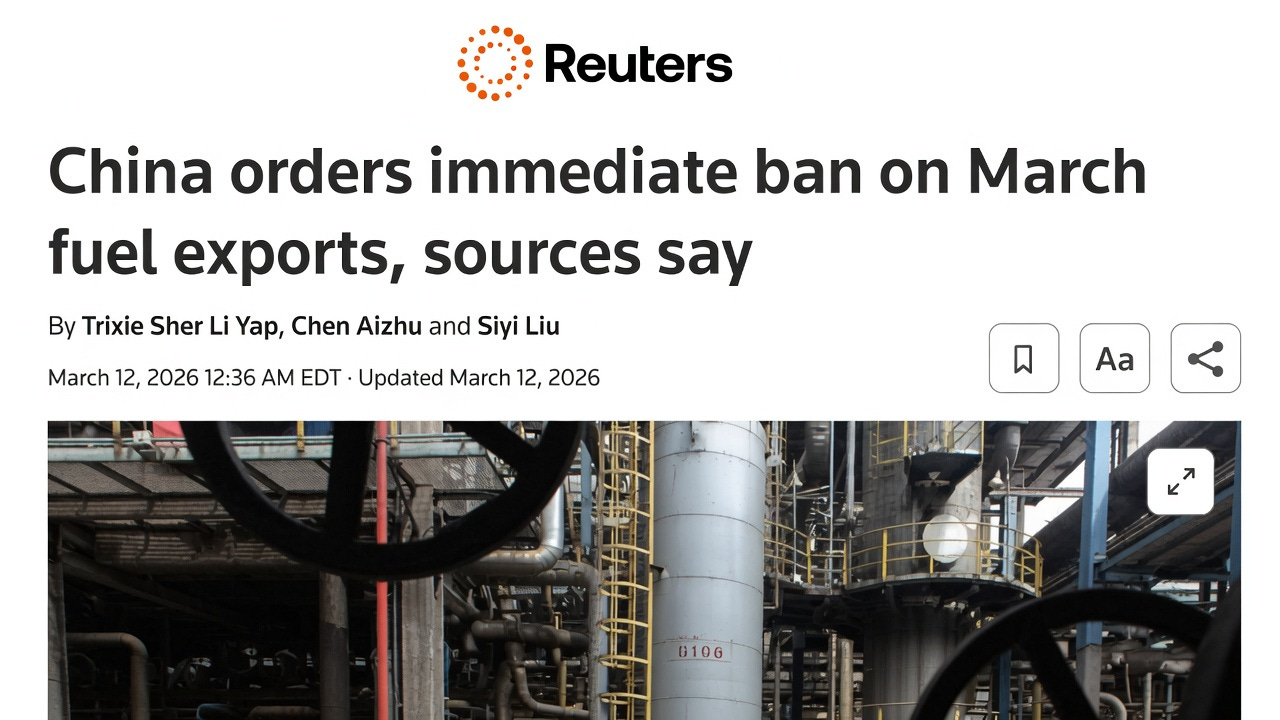
At the time, everyone assumed Beijing was simply building fuel stockpiles at home. Wrong. It turned out to be the first quiet step in the import cuts that were coming. The refineries were about to process less crude. Which meant importing less of it. And here’s the beauty of it: because much of that fuel was headed overseas anyway, China barely had to cut domestic consumption.
Third, years of EV subsidies quietly paying off. China spent the past decade subsidizing electric cars the way other countries subsidize bread. So when Hormuz closed and gasoline prices surged, nobody had to be told what to do. The old Wuling Mini came back out of the garage. Gas-car owners carpooled in a friend's EV. None of this would have been possible if China had started from scratch. You can't put tens of millions of EVs on the road overnight. But you don't have to if you've already spent a decade doing it. China had. And gasoline demand fell accordingly.
Put all three together and you get roughly 2 million barrels a day. Significant. But still nowhere near a 4.9-million-barrel reduction.
So where did the other 2.9 million barrels a day come from?
The silos.
Now, we can only estimate the size of China’s strategic oil reserve, because it’s — you guessed it — a state secret. But we can get surprisingly close thanks to the people whose full-time job is counting storage tanks in satellite photos. The tanks are enormous, and their floating roofs rise and fall with the oil inside. All of it visible from space.
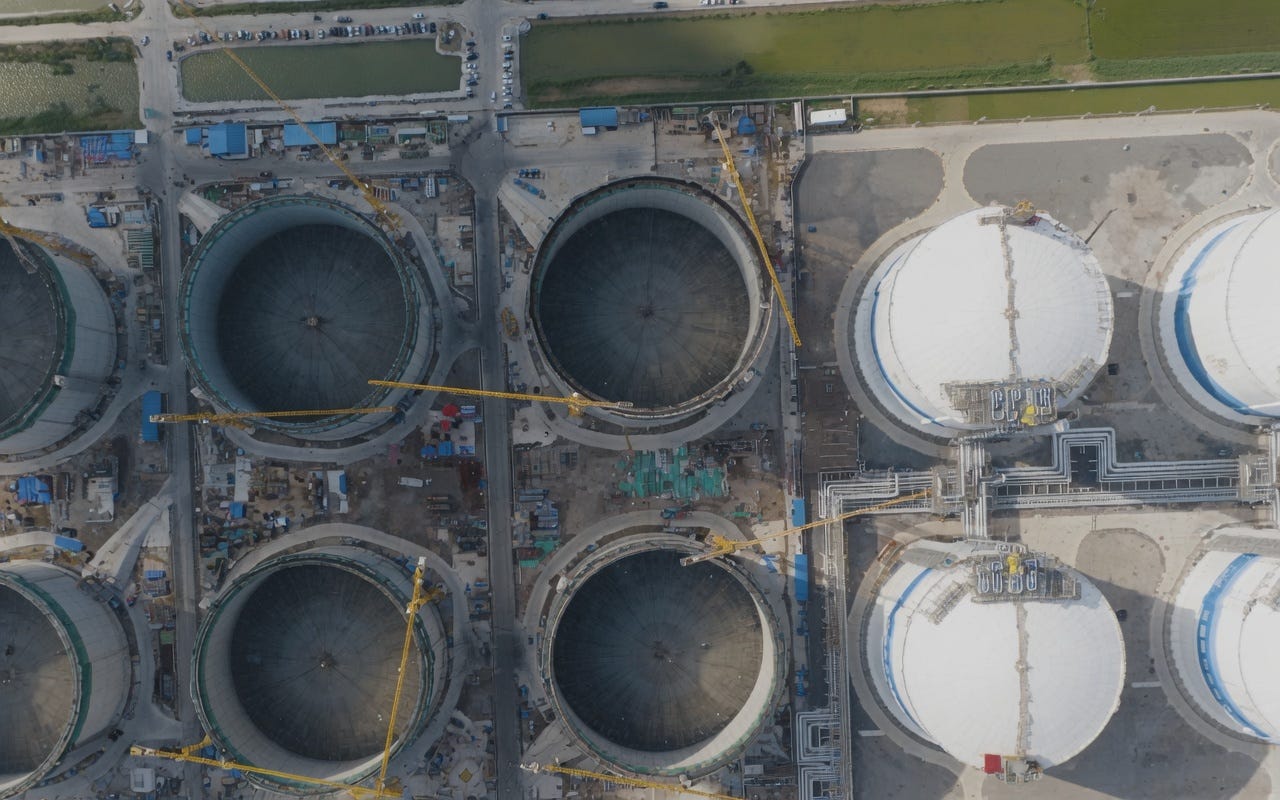
Count the tanks, measure the roofs, do the arithmetic, and you arrive at roughly 1.4 billion barrels of crude. That’s more than every other country’s strategic reserves combined. Just look at the chart below.
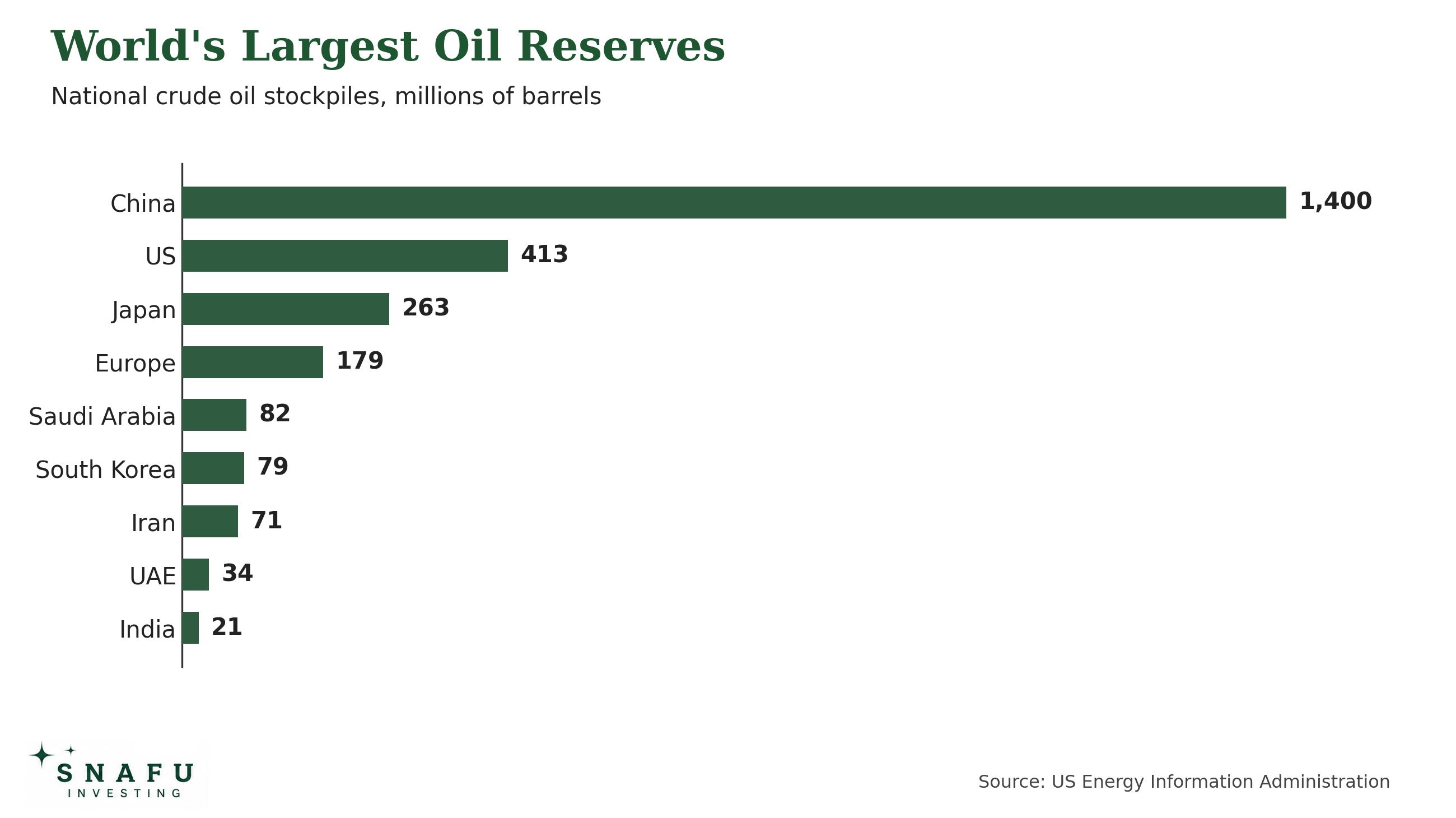
In all honesty, 1.4 billion is probably the conservative estimate. Remember, that's only the visible storage tanks. China has also spent years digging vast underground caverns that no satellite can measure, so the real figure is almost certainly higher. Whatever the true number, the Hormuz crisis revealed just how enormous China’s reserves had quietly become. (Which, by the way, I don’t think was accidental. But more on that in Part 2.)
But like I said earlier, what matters isn’t the total. It’s the daily flow. Simple arithmetic: draw the missing 2.9 million barrels a day from a 1.4-billion-barrel reserve, and it lasts about 480 days. That’s sixteen months, well over a year, before you even count the underground caverns.
To appreciate just how extraordinary that is: if India had to fill a hole that size from its strategic reserve, it would run dry in about a week. America’s (the envy of the world, built up over decades) would last under five months. Most countries measure their emergency reserves in days or weeks. China measures them in years.
So if you were wondering why everyone (but China) spent the first month of the war convinced the sky was falling, that’s why.
The world genuinely did need saving.
Now you know who saved it, and how.
As for why they did it... well, that’s next week’s Part 2. As you probably suspect, it wasn’t out of the goodness of their hearts.
Have a good rest of the weekend,
Lau Vegys
P.S. In the two weeks since SNAFU Investing launched, I’ve recommended two companies to paid subscribers: a uranium play and a silver play. If you’re on the paid side, make sure you haven’t missed them: catch up here and here. Especially now: one of the two just pulled back to the level where, per our playbook, it triggered the second tranche — a chance to add at better prices than the original recommendation. And if you’ve been on the fence about upgrading, this may be the week it makes sense.
Totalitarian State Capitalism is what China practices which has become, unfortunately, the "Free Market Capitalism" model folks naively assume most of the West still practice but they don't. Authoritarianism seems to be the preference the West has adopted. In short, an open authoritarian Fascistic model in order to keep power, change and control. Confuse We The People with meaningless and often counter-intuitive narratives to keep the population in a state of constant confusion, which is the point of the exercise as "The State" is looted from under their feet by those who Swore and Constitutional Allegiance to protect them. The "Enemy" is also variable depending on the circumstances and unspoken and sometimes stated or implied goals.
Conformity is the expectation and those that don't will suffer under the growing and increasingly ruthless Technocratic Control "The State" has adopted and the majority of it's citizens have adopted the very same mechanisms in order to monitor, analysis and Control. How many do you know who don't have a "Smart Phone"? I can count them on one hand. They are holding the Sheath and even paying huge amounts of money initially and an ongoing monthly fee for it and not realizing another holds the dagger for that sheath...........to their throats.
Technocracy and Technocrats are a very ruthless, smart, conniving, sometimes charming-as Psychopaths tend to be, and dangerous, greedy group of folks. In the long run, as this model of Totalitarian Control has been adopted, it is a fragile concept and will not last as log as those who chose this model to hoist upon a Nation---Free Will is the Nature of Man, not false and open hostilities towards those you had Sworn to Represent, Protect and Nurture--Fomenting France in 1789 may be their expectation at some level or a preference would be a much more profitable un-Civil War. The pseudo-intellectuals who have been advising these Administration's for decades clearly don't really understand who actually butters their bread. The Nature of Man will emerge and in contrast to the fake fraudulent types like a Tucker Carlson will be found out and his Bread Buttterer will then be known--No Mr. Carlson, unlike yourself, I am not capable of committing atrocities against my fellow man as you stated that I am able to do. His false humility is a guise in order to, again, control We The People for his handlers. Take the bit out of your mouths folks and the harness will just slip off. Run Free!
God Bless And Protect All Here.
Love One Another---there are implications in doing so. Understand that.
Wow….so China is controlling the silver market AND oil. Guess I should learn some mandarin soon 😬