


Yesterday I had a friend over. He’s American, in town for a couple of weeks, and at some point, as happens these days, the conversation turned to diesel.
He’d just filled up before leaving and was still a little shell-shocked by the receipt. He drives one of those big diesel pickups, a Super Duty with the big 48-gallon tank. At September’s record $6.53 a gallon, that’s a bit over $300 to fill. A year ago the same tank cost him about $175.
But of course, since the guy is a farmer, the pickup is just the beginning. His entire harvest runs on diesel. Combines, grain carts, trucks to the elevator: about three gallons an acre for corn, give or take. Farm diesel in the Midwest is running around $5.60 a gallon, up from $3 last fall. On his acreage that’s thousands of dollars more just to get the crop out of the field.
If you’ve been anywhere near a pump lately, none of this will surprise you. But in some places the problem isn’t the price anymore. It’s that there isn’t any.
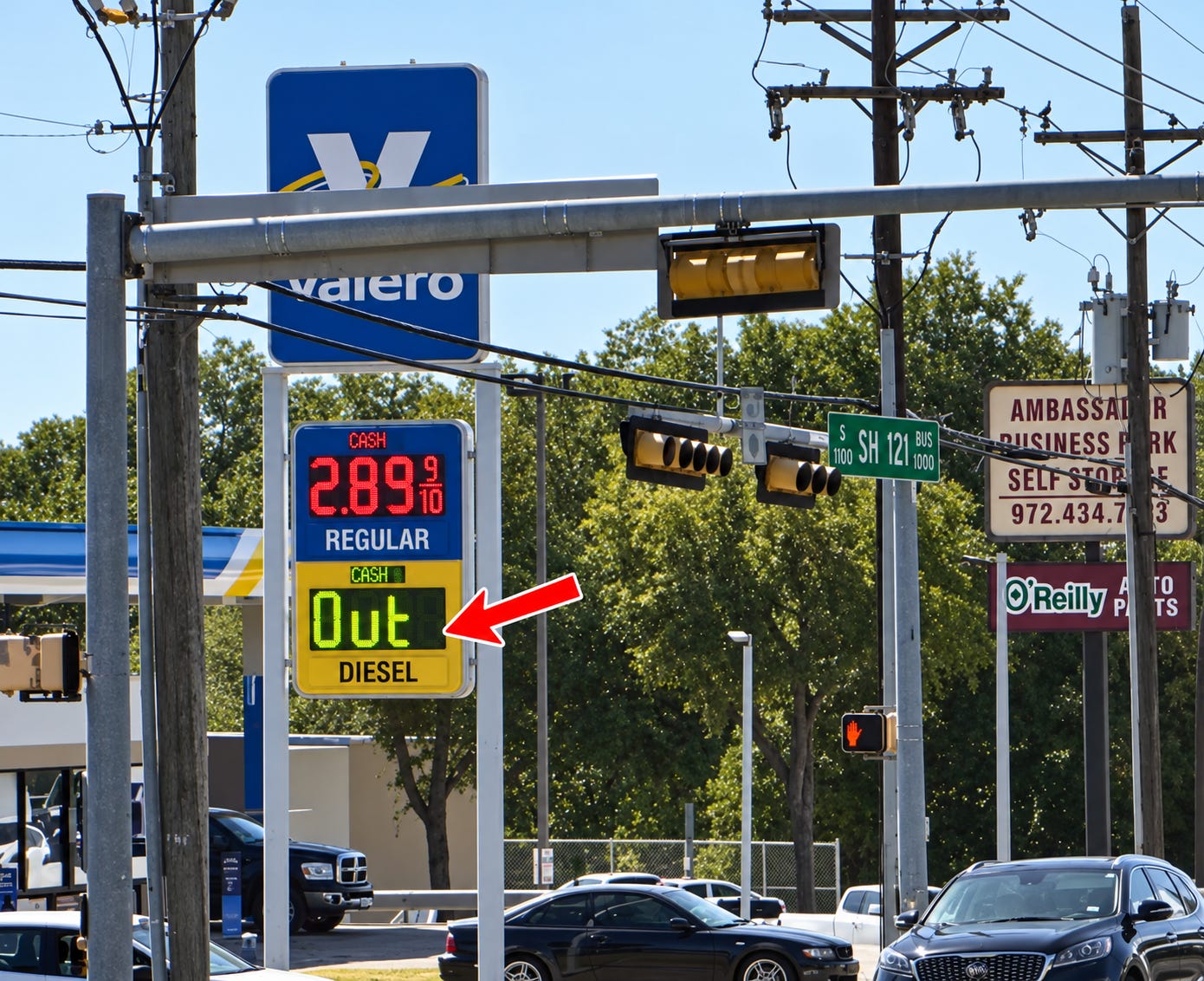
But my friend wasn’t all doom and gloom. If anything he was hopeful, because of Trump’s recent deal with Russia.
You probably know which one. Last Friday, after a ninety-minute phone call with Vladimir Putin, Trump announced that Russia would “immediately” ship over 300,000 tons of diesel to the U.S., another 500,000 tons in November, a million tons right after that, and a further three million “within a short period of time.” To make it happen, the government is setting aside the ban on Russian oil imports it has had in place since 2022 (which has ruffled plenty of feathers on both sides of the aisle, with a dozen senators already demanding the deal be scrapped).
And so, like a lot of people, my friend was clearly convinced the worst was behind us.
Unfortunately, I had to burst his bubble. And since I’d already done it once over the kitchen table, we might as well go through the whole diesel problem here too.
A Drop in the Barrel
So here’s the thing.
For diesel to get meaningfully cheaper, the war in Iran has to end. Trump’s deal isn’t going to do it. Not by a long shot.
Now, I’m not talking about the politics, whether Congress or the courts end up challenging or blocking the deal.
I’m talking about the simple reality on the ground, the one being dictated right now by what’s happening halfway around the world.
I’ll get to all of it. But let’s start with some simple arithmetic.
Russia has promised 500,000 tons of diesel for November. That sounds like a lot until you realize it works out to roughly 125,000 barrels a day.
Diesel is a global commodity, priced on the world market. So the number that matters isn’t American demand, it’s global consumption, which runs at roughly 28.7 million barrels a day.
That means the deal amounts to just four-tenths of one percent of global diesel consumption. It’s hard to appreciate just how little that is until you see it.
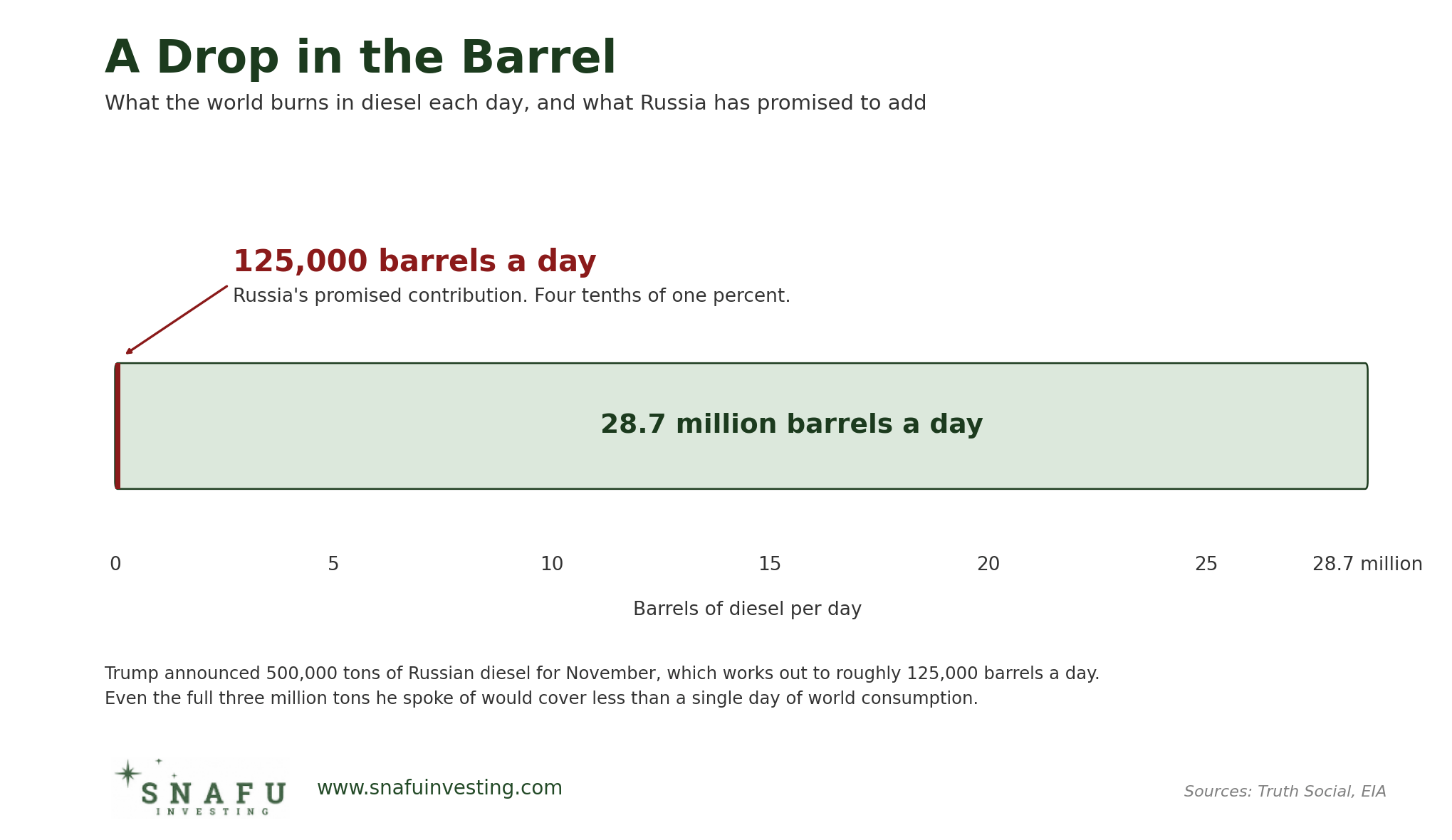
And yes, there’s supposedly more coming. But even the big number, the three million tons “within a short period of time,” is about 22 million barrels. The world goes through that in less than a day.
And that assumes Russia actually has the diesel to spare.
There’s good reason to doubt it does. Russian refinery runs fell this summer to their lowest level since 2002, more than 30% below normal, amid Ukrainian drone attacks. In fact, things got so bad that Russia banned diesel exports in July just to keep enough fuel at home. That same month, we learned that Moscow was quietly buying diesel and jet fuel from South Korea to cover its own shortfall.
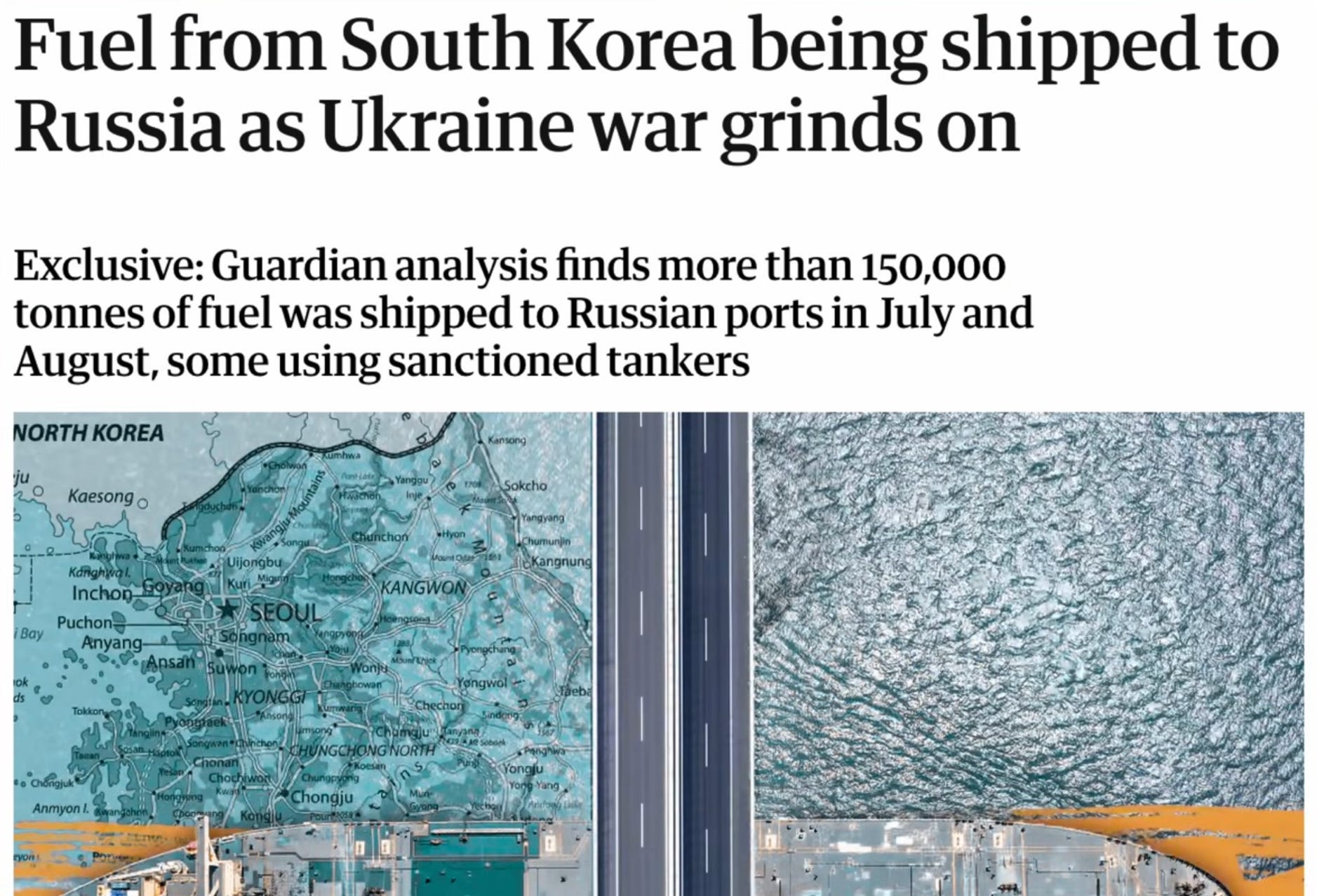
Now, none of this is to say Russia will fail to hold up its end of the bargain. But think about it. If Russia can’t produce the extra barrels, it will simply divert existing supplies from less important customers to America. And so the world’s total diesel supply won’t go up by a single barrel. Which means the world price, the one you pay at the pump, won’t come down by a single cent.
When I put all this to my friend, his response was something along these lines: Fine, the deal is small. But oil has struggled to stay above $100 a barrel. And diesel is just refined oil, so give it a bit of time, and diesel prices should come down anyway. Right?
Wrong.
It’s the Refineries, Stupid
Here’s the thing most people get wrong about this crisis. They think it’s mainly an oil problem. It isn’t. Or at least, not anymore.
It’s a refinery problem.
You see, crude oil, on its own, is useless. The black stuff that comes out of the ground doesn’t go in anything. To become fuel it has to go through a refinery, one of those $10-billion, hundreds-of-acres facilities that take the world’s 100 million barrels a day of crude and turn it into gasoline, jet fuel, and above all diesel.
And the problem is that right now, three of the world’s biggest refining centers are being hit at once, in three different wars.
First, of course, there’s Russia. It’s one of the world’s big three refiners, alongside the U.S. and China, and turning crude into fuel for export is one of its biggest industries. Ukraine has spent this year taking it apart, hitting 27 of Russia’s 32 major refineries so far.
Here’s what that looks like. This is the Moscow refinery, in the Kapotnya district on the southeastern edge of the capital, one of the biggest in the country and the source of about 40% of the city’s fuel, after a Ukrainian drone strike.
And here’s another one, some 500 miles to the southeast, in the Samara region on the Volga, where Rosneft, Russia’s state-controlled oil giant and its largest producer, runs a cluster of three big refineries. Same story.
This explains why Russia banned diesel exports, why it was buying fuel from South Korea, and why Russians themselves have been lining up at gas stations.
Then there’s the Gulf. When the U.S. and Israel attacked Iran, Iran went after the oil infrastructure of the Gulf states that had helped, or that host American bases. And that, of course, included oil refineries. Those states returned the favor and hit Iran’s, and so it went, tit for tat.
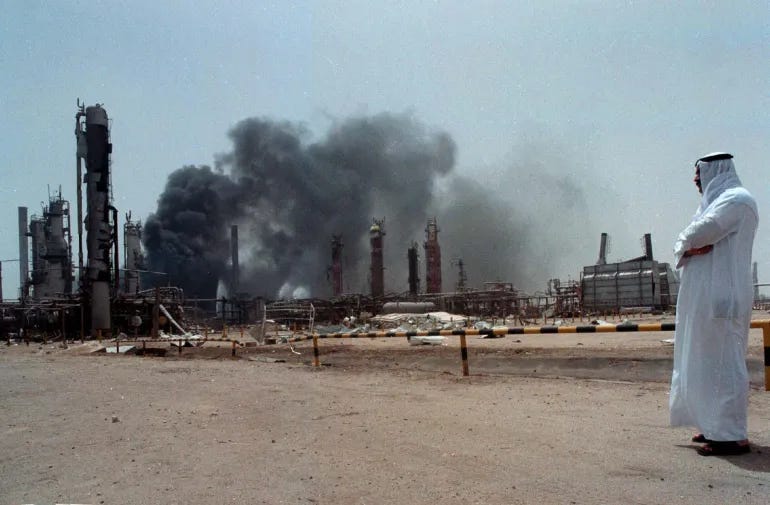
And on top of what’s actually been destroyed, there’s all the Gulf refining capacity that’s still standing but stuck behind the closed Strait of Hormuz, unable to get its fuel to anyone anyway.
Finally, there’s China. As recently as last month, the hope was that the Chinese, who had eased their spring curbs on fuel exports back in July, would ramp up diesel shipments and cash in on the same fat margins American refiners have been enjoying. What happened was quite different. On October 1, less than a week after Trump asked Xi Jinping for help with fuel supplies, China halted fuel exports altogether. All of them, to every destination but Hong Kong and Macau. China, of course, never explains what it’s doing. But my guess is they see a lot of trouble coming down the pipe, and they’d rather keep what they have.
All of this has a very real impact on global diesel supply. To put some rough, back-of-the-napkin numbers on it:
Russia: A year ago it was exporting roughly 600,000 to 800,000 barrels a day of diesel. Since July, exports are banned. That’s all gone.
The Gulf: The Middle East’s refined product exports are down from 4.7 million barrels a day before the war to under 2 million. Diesel’s share of that comes to roughly a million barrels a day.
China: As recently as last month, it was exporting over 300,000 barrels a day of diesel. That’s now zero.
Add it all up and you’re looking at roughly two million barrels a day gone from a global diesel market of about 28.7 million.
That’s about 7% of the world’s diesel supply, wiped out. (Remember, the biggest tranche of Trump’s deal, that three million tons, is a one-time 22 million barrels, enough to cover about eleven days of that shortfall.)
Now, seven percent may not sound like the end of the world. But to appreciate just how serious it is, you need to understand one thing about how diesel gets priced.
Two Prices in Every Barrel
The price of diesel is really two prices stacked on top of each other: the price of the crude, and the price of refining it.
The industry has a funny-sounding name for the difference between the two. It’s called the crack spread.
The logic being that “cracking” is what a refinery does to crude, whereas “spread” is just the gap between two prices. So the crack spread is what the market charges, on top of the crude, to turn a barrel of oil into a barrel of diesel. And you want it low, because low means fuel is cheap to make.
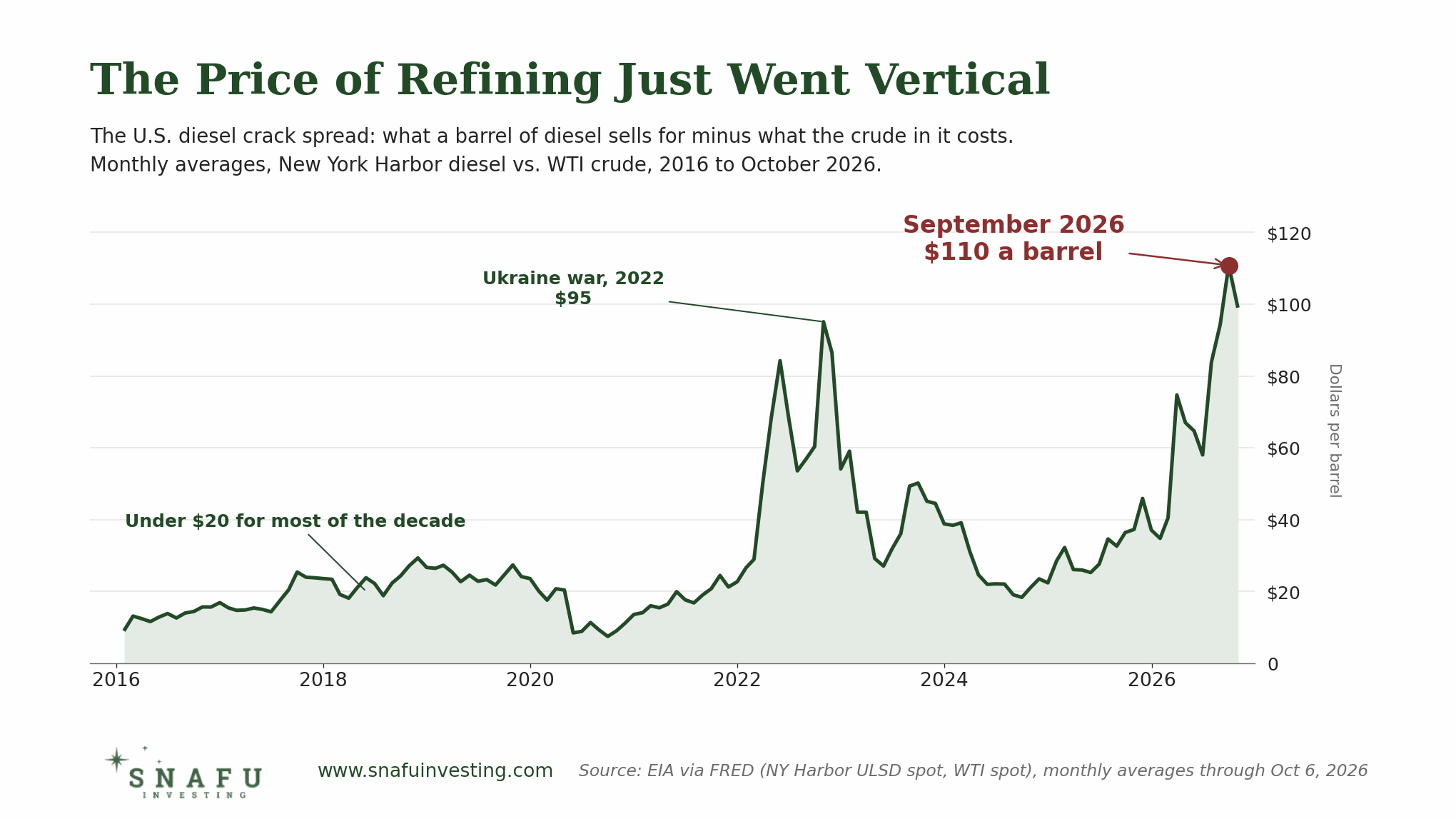
And for most of the last decade, it was. The diesel crack sat around $20 a barrel for years. It spiked when the Ukraine war started in 2022, then came back down.
Now, with all the refinery mayhem I showed you above, can you guess where the crack spread is right now?
It’s over $100. More than five times its normal level, and the highest ever recorded.
Here’s what that means for the price of diesel.
A normal market, about a year ago, might have looked something like this: oil at about $65 a barrel, and a crack spread of about $35. In other words, a barrel of diesel cost about $100. You can see it in the left bar of the chart below.
Now look at the right bar, which is today. Crude, about $100. Refining, another $110. That’s $210 a barrel.
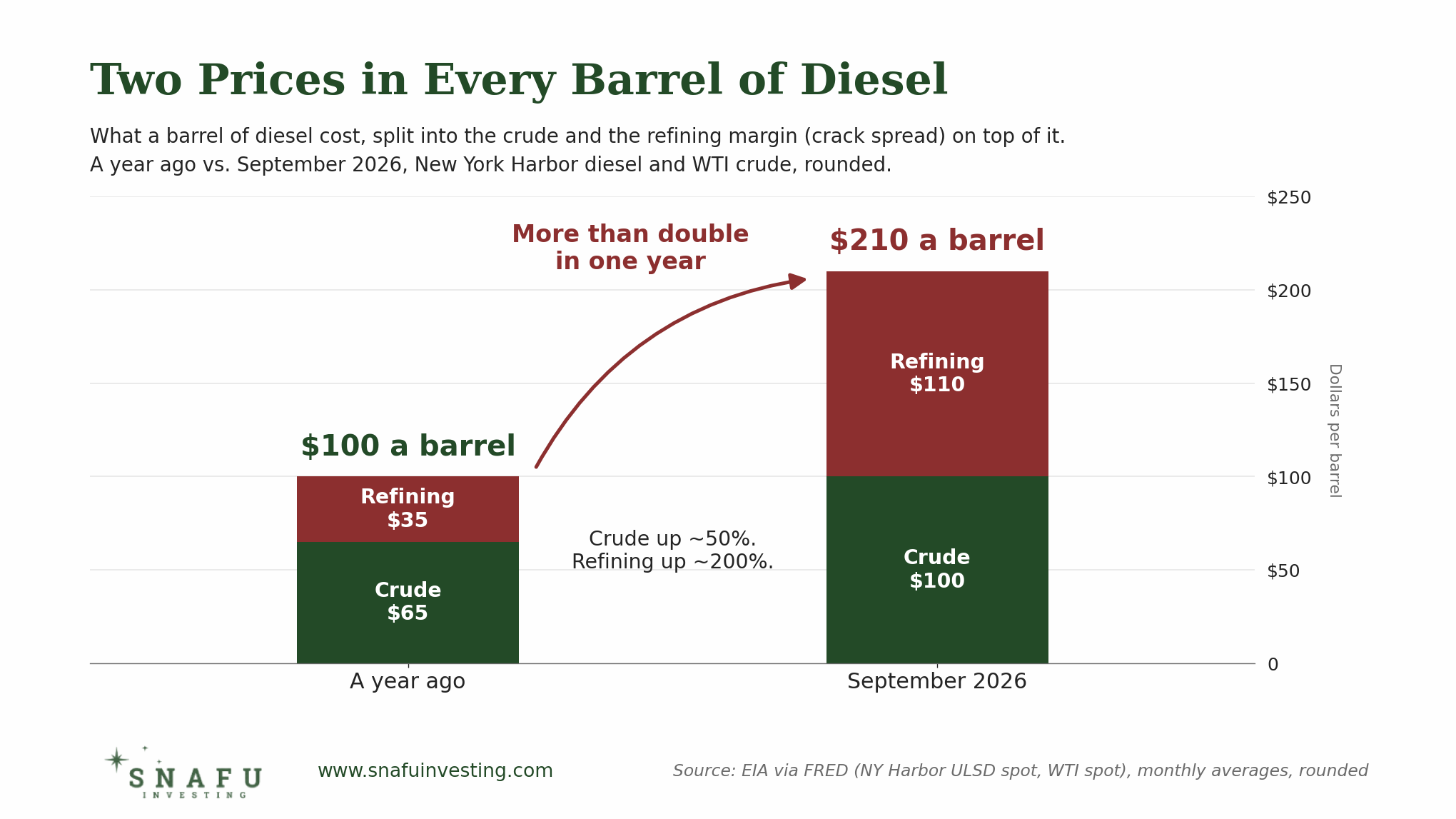
More than double in a year. And look at where the increase came from. Almost all of it is refining, up 200%, whereas crude is up about 50%.
That, in a nutshell, is why Trump’s deal doesn’t move the needle.
No diesel deal can rebuild the refineries being blown up, cut off, or shut down, or stop the next one from being hit. Meanwhile, whatever diesel is still being produced has to travel farther than ever, on ships that now cost a fortune. (Oh, and that’s another part of this story I’ve run out of room to get into today.)
Which brings us back to where we started. For diesel to get cheaper, the war in Iran has to end. And unlike the one in Ukraine, that’s a war Trump actually controls.
Regards,
Lau Vegys
P.S. If you’re a paid subscriber, keep an eye out for this month’s issue. I’m working on it now, and it follows this story to its logical conclusion, with a new investment pick to take advantage of what’s happening. Because the country that kept oil from going to $200 all summer might have just stopped doing so. If you’re not yet a paid subscriber, this would be the issue to join for.
Trump answered blindly to his pro-Israel donors and now it’s killing us all. He should have focused on domestic issues like building our refining capacity, mass deportations, immigration moratorium and rounding up all of his enemies who weaponized the DOJ against him and the rest of us. It really feels like the empire is collapsing.
And yet, this shows that Trump might have finally chosen Russia over Ukraine. The question is whether he’ll be able to control the situation and keep Zelensky and his EU supporters in check. According to some rumors, the Starlink terminals installed on long-range drones reportedly experienced issues yesterday… Who knows...
Of course, that won’t lighten your friend’s bill in the short term.
But then there’s India. If Russian crude is able to flow freely out of the country again, India could run its refineries at full capacity. That might help things out a bit.
In the meantime, I’ve put a few dollars into U.S. refineries and oil tanker companies. They’re doing very well. Muuuuuuch better than the uranium ones to be sure.