

Last week, I wrote to you about the operation in which the United States and Japan went into the currency market together to prop up the falling yen, the first coordinated action of its kind since 1998.
Japan reportedly put in around $75 billion of its dollar reserves. The Treasury put in five to ten billion (selling euros rather than dollars), along with a handwritten note from Bessent that probably did more work than the money did.
Note: As you may remember from my previous writing, a weak yen has become a major problem for Japan, a country that imports nearly all of its energy and about 60% of its food, virtually all of it priced in dollars. Which is why it had already tried to fix the problem on its own. In April and May of this year, the Ministry of Finance went into the currency market and bought $73 billion worth of yen with its dollar reserves. The largest currency intervention in the country’s history.
I ended that piece by saying it didn’t look like a one-off to me. It looked like the opening move in a recurring operation.
What I didn’t tell you was where the money for the next round is probably going to come from. Spoiler: it isn’t euros out of Uncle Sam’s pocket. So let’s dig in.
A Pawn Shop for Governments
On Sunday 2 August, two days after the intervention, Treasury Secretary Scott Bessent took to social media and publicly asked the Federal Reserve to "upsize" something called the FIMA repo facility. Here's his post.
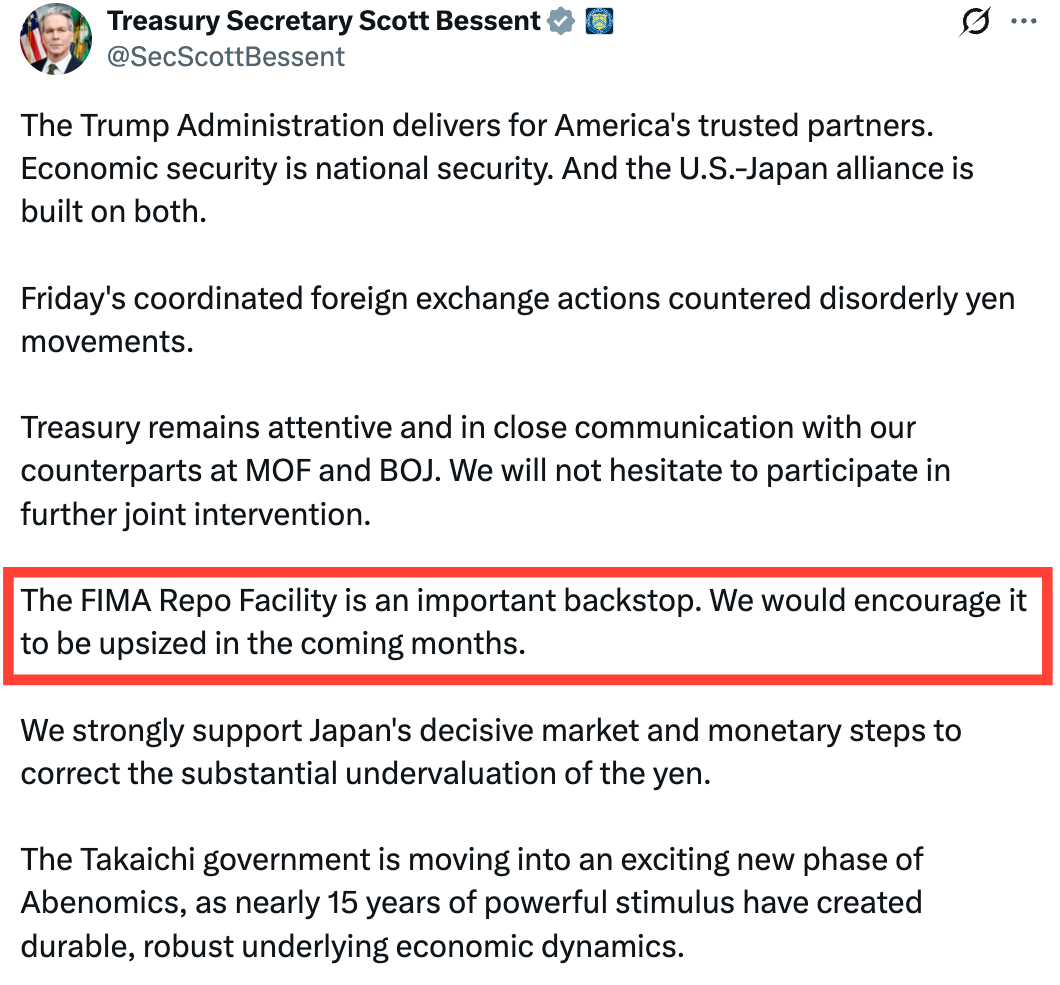
Now, it always strikes me as a little strange when the government brags in public about intervening in another country’s currency. (Aside from the act itself, the bragging tends to lay bare the real reason they’re doing it.)
But it was the last paragraph that nearly made me blow coffee out of my nose.
“Robust” and “durable” are not the words I’d reach for to describe an economy that has needed fifteen years of stimulus to stay upright, that still carries the heaviest debt load in the developed world, and whose currency two governments just had to go into the market and buy.
Anyway, on the same day, Japan’s Ministry of Finance put out a statement of its own. It confirmed the joint action, said Japan would not hesitate to conduct further joint intervention, and then, in the last line, said Japan “also plans to utilize” the Fed’s FIMA repo facility in the future.
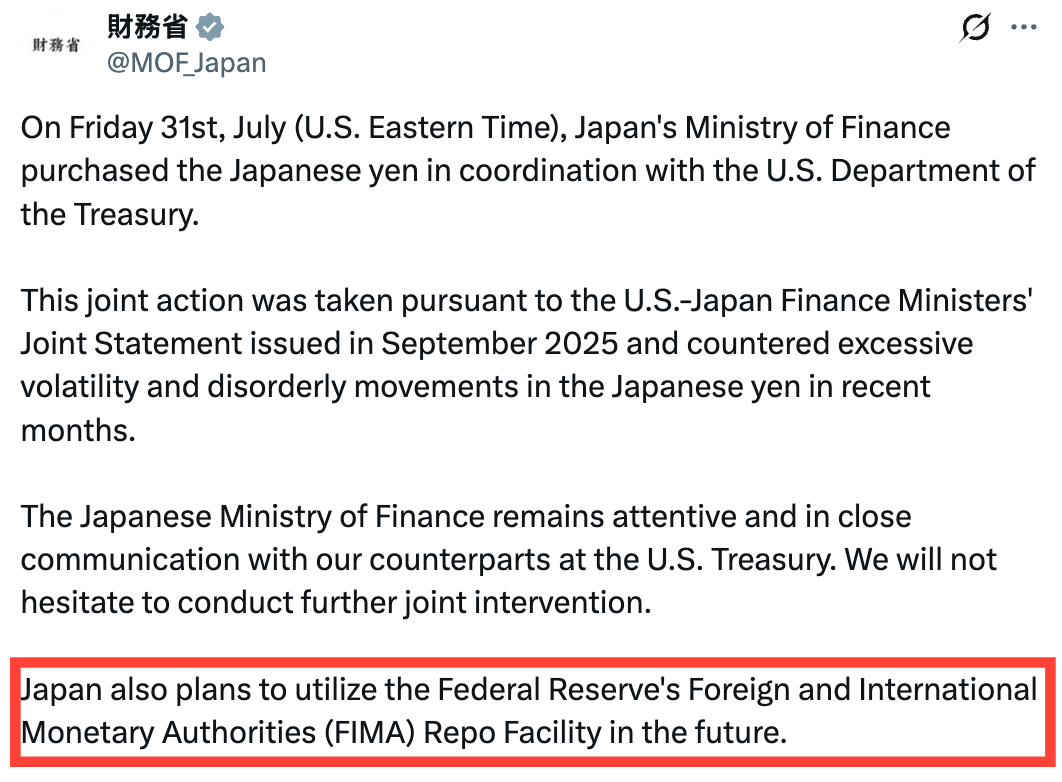
Now, if you’ve never heard of the FIMA repo facility, don’t worry. Few have, and that’s rather the point.
FIMA stands for Foreign and International Monetary Authorities. In plain English, it’s a pawn shop. A foreign central bank hands the Federal Reserve some of the U.S. Treasury bonds it owns, and the Fed hands back dollars. Later the country buys the bonds back and returns the dollars, with interest.
The Fed set the thing up on 31 March 2020, in the middle of the COVID panic, as a temporary measure. But as so often happens with temporary government measures, it became a permanent one.
The facility is there, in the Fed’s own words, to support “the smooth functioning of financial markets, including the U.S. Treasury market,” by giving foreign central banks “an alternative temporary source of U.S. dollars other than sales of securities in the open market.”
Yes, you read that right. The Fed itself tells you the facility exists so that foreign governments who need dollars don’t have to sell their Treasuries to get them.
Now, for most of the facility’s life the balance has been zero, or near enough. There were a few token draws in 2020 and 2021, a billion here and there, never more. (Yes, the thing was built for the 2020 panic and then, in the way of these things, opened after it was over.) It has been drawn on hard exactly once, in March 2023, when the banking system was coming apart around Silicon Valley Bank and Credit Suisse. On that occasion it went straight to $60 billion. Which, as it happens, is the most the Fed will lend any one country at a time.
Take a look for yourself.
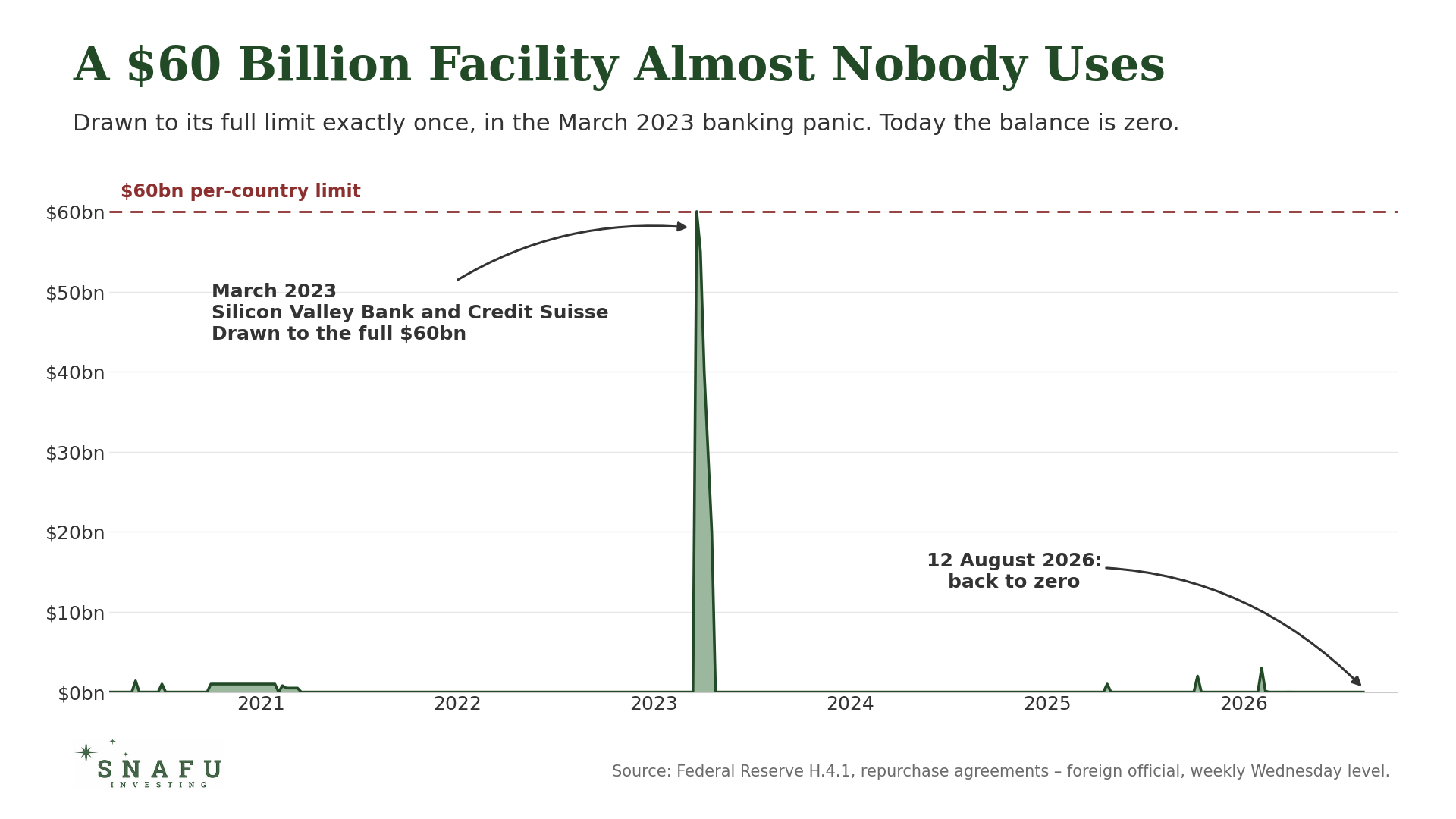
As I write this, the balance is back at zero.
So, the takeaway is that this is a facility built for emergencies. Which is what makes the Treasury Secretary’s request so unusual.
Why Japan Can’t Just Sell
The reason we’re talking about any of this at all is simple enough. Japan needs dollars. Because to defend the yen, Japan has to buy yen. And to buy yen, well... it needs dollars.
Now, being the largest foreign holder of American government debt, Japan has plenty of dollars. Roughly $1.14 trillion of them, in the form of U.S. Treasury bonds.
So the obvious move would be to sell some.
Which is exactly what the U.S. government cannot allow.
As I’ve written more times than I can count, the American bond market is already struggling to absorb what Washington is throwing at it. $739 billion of new borrowing this quarter alone. Japan dumping Treasuries on top of that would send yields straight up. Keep in mind, the 30-year is already at its highest level since 2007. A fire sale by the biggest foreign creditor would make it considerably worse, and the bond market the U.S. government is trying to protect is the one it would have broken.
Hence Uncle Sam’s involvement in this operation. Hence the pawn shop.
Now, I explained its basic mechanics earlier. But here’s a visual that may help you picture what it looks like with Japan actually in it, if the Fed goes along with Bessent’s request.
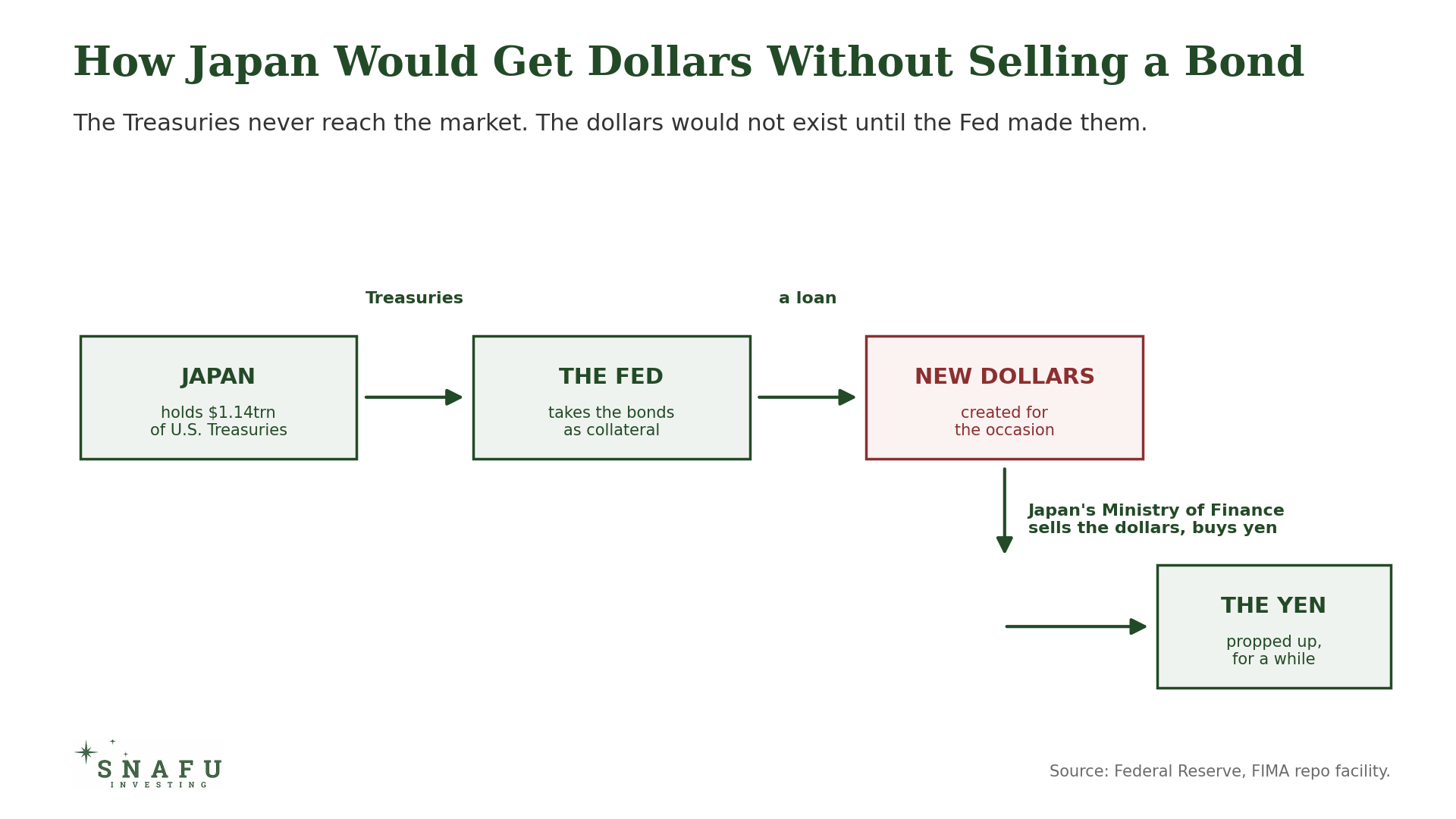
It’s a clever way around the problem. Japan would raise the dollars it needs against its Treasuries without selling a single one of them, and the American bond market would never see the supply.
What They're Really Asking For
OK, so what does upsizing actually mean?
Well, it means raising that $60 billion per-country cap.
If you’re wondering why $60 billion isn’t enough, the answer is exactly why I called this an opening move in a recurring operation.
Propping up a currency, let alone a major one, is an expensive business. Remember, Japan’s defense of the yen this April and May cost $73 billion. The one before that, in the spring of 2024, cost $62 billion. Had either been financed through the facility, it would have drained the entire line and still come up short.
Then there's the bizarre way this came about.
A Treasury Secretary publicly instructing the Fed to upsize a lending facility is not standard procedure, to put it mildly.
What interests me here isn’t the Fed’s so-called independence, which I have no illusions about. It’s that the procedure got skipped at all. Treasury and the Fed have a private line for exactly this kind of conversation. You don’t go around it in public unless you’re in a hurry, or unless you want the market to see you doing it. Frankly, it’s probably both. Which tells you how serious the U.S. government thinks the Japan problem is.
And one last thing. All of it is done with new money. When the Fed lends dollars against those bonds, it doesn’t take them out of a drawer. It creates them. “Prints” them, if you will.
We probably shouldn’t be surprised. Printing, after all, is what a central bank does. But it makes a mockery of all that talk about shrinking the balance sheet. As if it wasn’t already a joke.
Of course, at the end of the day this is just kicking the can down the road. None of it would fix anything for Japan. (I say would, because the Fed hasn’t said yes to Bessent’s request. Not yet, anyway.) It still cannot raise rates meaningfully, because it owes more than twice what its economy produces and the interest bill would eat the budget. And it’s not like it can stop importing energy and food either.
None of it would fix anything in the U.S. either. The U.S. government is still borrowing $739 billion a quarter. Interest on the debt is still the second-largest line in the budget.
What it does show is the lengths the U.S. government is now prepared to go to keep the yen from falling. Because the thing it’s really protecting is the American bond market. And that’s the thing to watch from here.
As I’ve said many times before, when a government is forced to choose between letting the bond market implode and printing the difference, it prints. Every single time.
Regards,
Lau Vegys
P.S. A country that imports nearly all its energy and pays for it in dollars has only so many ways out of a weak currency. One of them is to burn less imported fuel, which is why Japan and much of Asia have been quietly reversing their retreat from nuclear power. That’s part of the reason uranium is where I put SNAFU’s first recommendation, and it’s what my special report, Situation Normal: Uranium, is about. It went out to paid subscribers at the start of the month, so make sure you haven’t missed it.
this is a story that never would have surfaced 10 years ago. Thank you internet.
So many financial "experts" in government are needed to maintain this fiction about dollar "reserve assets", in the form of US treasuries. One country's assets become another country's liability, and this is an example of that design flaw. Now the US government has a way to borrow fiat dollars against an "asset" that isn't really a thing either. To think our forefathers lived in a world where the money reserve (gold) was actually real.
What I haven't pieced together is why no country in the world doesn't revert back to gold reserves and thereby become a magnet for inveestment? I can only guess the incentives of power resist it with force, as El Salvador experienced when using BTC as money and the IMF swooped in with punishment.
Eyes Wide Open: Don't Fall Asleep.