

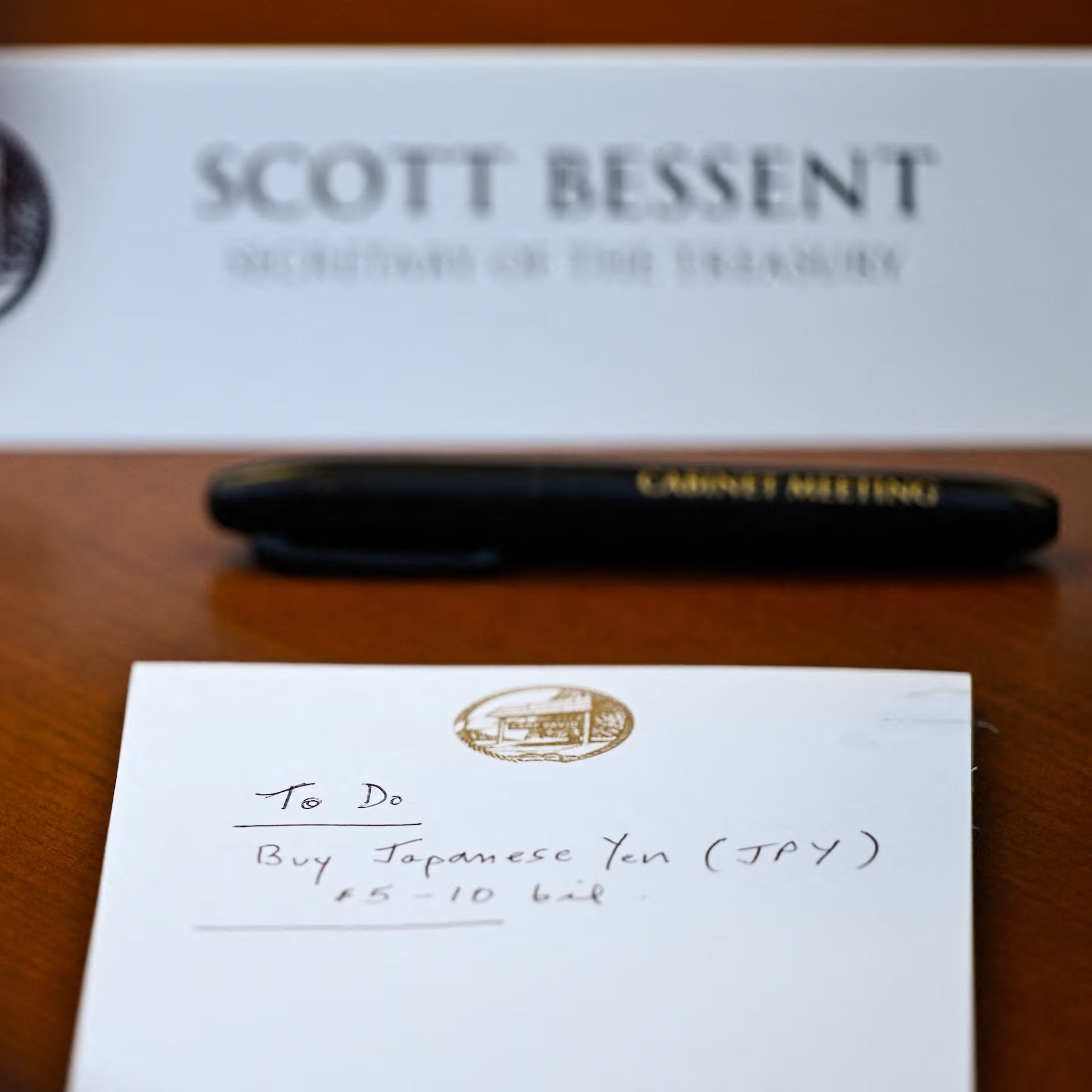
So late last month, Treasury Secretary Scott Bessent walked past a huddle of photographers in Washington carrying a folder with a handwritten note clipped to the front. A Reuters camera caught it at just the right angle. A few words and a number, in plain block letters: “To do: buy Japanese yen. 5 to 10 billion.”
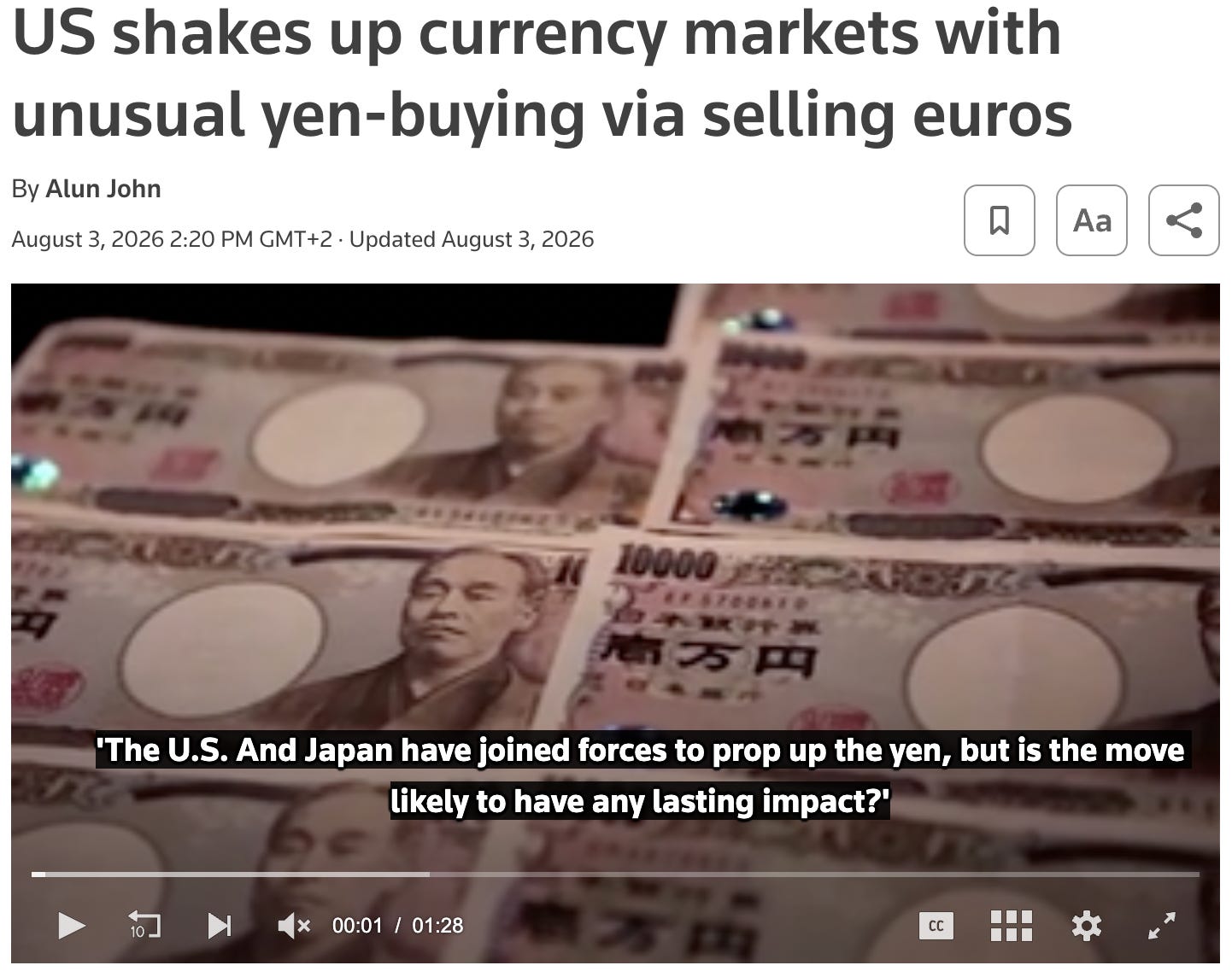
Within days it was official. The United States and Japan were intervening together in the currency market to prop up the yen, the first coordinated operation of its kind in nearly thirty years. Japan reportedly put in around $75 billion. The American contribution was five to ten billion, exactly as the note said.
The last time the two countries did this together, Asia was in the middle of the 1998 financial crisis.
President Trump, asked about it, explained things this way: “We have a good relationship with Japan... they have a weakening yen and they wanted a little bit of help, and we’re always there for Japan. Japan’s been very good to us, with the exception, of course, of Pearl Harbor.”
Say what you want about the man, but he has a way with words, doesn’t he?
Anyway, so that’s the official version. America, helping out a friend.
But I’d like to offer you a different reading of it, one where the helping-out-a-friend story doesn’t hold up very well, as well as two genuinely strange things about this operation that I’ll get to below.
Why America Suddenly Cares About the Yen
If you’re a regular reader, you’ll probably know that Japan has more problems than it knows what to do with. It’s the world’s fifth-largest economy and, at the same time, the oldest country on earth. Or the oldest one that matters, anyway. It also carries the heaviest debt load in the developed world. And it imports nearly all of its energy and about 60% of its food, virtually all of it priced in dollars.
That last part, of course, becomes a serious problem when your currency is in free fall, which the yen has been for years now. In fact, this summer it hit its weakest level in roughly four decades. And when you import almost everything you burn and eat, a cheap currency isn’t the blessing it looks like on an exporter’s spreadsheet. Every time the yen drops, it costs a little more to keep the lights on and the supermarket shelves stocked.
So Japan has been trying to fix the yen directly, by buying it. In April and May, the Ministry of Finance went into the currency market with its dollar reserves, day after day, $73 billion worth of yen-buying in all. It was the largest currency intervention in the country’s history. It worked for about three weeks. Then the yen started falling again.
Which brings me back to the point I made in my last essay on Japan: buying your own currency is never enough. Somebody else has to want it too.
Well, as we now know, a couple of weeks ago somebody finally did.
But before you conclude that the U.S. government has developed a sudden affection for Japanese grocery shoppers, let’s remember one simple fact. Japan is America’s banker. It’s the largest foreign holder of U.S. government debt, sitting on about $1.14 trillion of Treasuries. For forty years Japan sold America cars, chips, and machines, and instead of spending the dollars, it lent them right back by buying Treasury bonds. That arrangement worked because Japan had nowhere better to put the money. Its own interest rates were zero. America’s weren’t.
Not anymore, though. In an attempt to put some kind of floor under the yen, the Bank of Japan has been raising rates. It went to 0.25% in July 2024, then 0.75% last December, then 1% in June, which is the highest the country’s policy rate has been since 1995. And as I write this, more hikes look to be on the way.
And that matters, because every notch up in Japanese rates makes it a little less worthwhile for Japanese savings to sit abroad chasing yield, and a little more tempting to bring them home. We’re talking about an enormous pile of money here, a good deal of which is currently parked in American assets.
And everyone in Washington understands where that road leads. If the yen keeps collapsing and Japan runs out of gentler options, it will have to dump those Treasuries to raise the dollars for the next, bigger intervention. Not to mention the $1.8 trillion pension fund I told you about in my last essay, the one whose own finance minister has been saying out loud that she’d like to see its money come home.
Which is why the U.S. is not really defending Japan’s currency here. It’s defending its own ability to borrow.
The Man With the Notepad
Now to the strange parts of the story, because there are two.
The first is the size. Five to ten billion dollars, in a currency market that turns over trillions every day, is a rounding error. Nobody moves the yen with $10 billion, and nobody knows that better than Scott Bessent. To understand why, you need to know who he is, because his resume happens to be the single most interesting fact in this whole affair.
So indulge me in a short trip down memory lane.
Thirty-four years ago, in 1992, Bessent was a young man working for George Soros in London. Yes, that George Soros, of all people. And he noticed something about Britain that most of the market had walked straight past. Nearly every homeowner in the country was on a floating-rate mortgage, meaning the monthly payment moved up or down with the Bank of England’s interest rate.
Nothing like America, where you lock in a rate for thirty years and forget about it. In Britain, if the central bank raised rates, every household with a mortgage got a bigger bill within weeks. Raise them far enough and millions of people simply couldn’t pay.
To make matters worse, Britain had also promised to keep the pound pegged to the German mark. And the only real tool a central bank has to defend a currency is to raise interest rates, since higher rates make holding that currency more rewarding.
Bessent’s insight was that the two promises couldn’t both be kept. If defending the pound meant bankrupting millions of British households, the government would fold, whatever it said in public.
So Soros bet $10 billion that it would. He did it by borrowing pounds and selling them for German marks, over and over, on a scale nobody had tried before. The logic was simple enough. Every pound he dumped on the market was a pound the Bank of England had to buy back to hold the peg, and sooner or later it would run out of money or nerve. It’s the trade that made Soros famous as the man who broke the Bank of England.
Britain fought. It raised rates from 10% to 12%, then announced 15%, a level that would have been ruinous. And nobody believed it, because anyone could do the mortgage arithmetic. The threat wasn’t credible, so it didn’t work. By the end of that same day Britain surrendered, pulled the pound out of the peg, and the currency crashed. Soros made a billion dollars in an afternoon and the papers named it Black Wednesday. It went down in history as the day a hedge fund beat a central bank.
Interestingly, twenty years later Bessent ran the same playbook in reverse, and, as it happens, in Japan. When the country elected a prime minister in 2012 who announced out loud that he intended to print money and drive the yen down, Bessent took the man at his word and bet against the currency. That one made another billion, with Bessent running the book this time as Soros’s chief investment officer. A few years later he set up his own fund with $2 billion of Soros’s money.
I’m telling you all this so you understand what Bessent took away from it, which is that a currency isn’t defended with money, it’s defended with credibility. And when those two things come apart, somebody gets very rich and somebody else gets a swift kick in the proverbial behind.
So when a guy like that walks past a room full of photographers holding a to-do list that says “buy Japanese yen,” helpfully specific, perfectly legible, angled just so toward the cameras, you’re free to believe it was an accident.
I don’t buy it.
Sure, if this were some career politician who’d wandered into the Treasury building by mistake, I’d probably believe it too. Plenty of them couldn’t tell you what JPY stands for. But this is a man who spent thirty years reading other people’s tells for a living.
By that evening, a photograph of his to-do list was sitting on every trading desk on the planet.
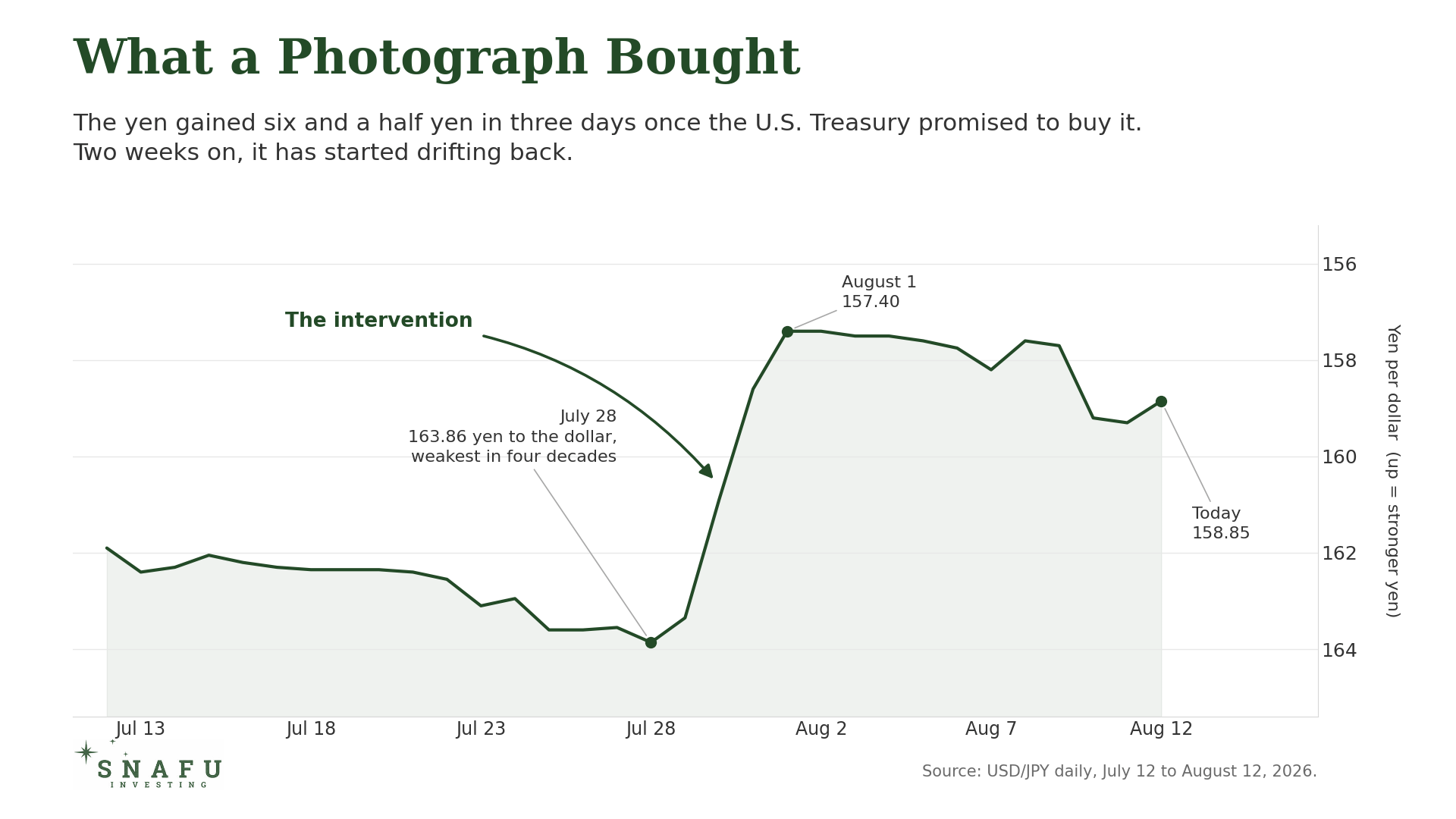
Every trader who was short the yen suddenly had to ask himself whether he really wanted to keep betting against a currency the U.S. Treasury had just promised to buy. Plenty of them, unsurprisingly, decided they didn’t. Within four days it took only 157 yen to buy a dollar, down from nearly 164. In a market where most days bring a fraction of that, this is a very big move.
It’s not as though Bessent had to reinvent the wheel here, mind you. This is one of the oldest tricks in the central banking book. The example freshest in my memory is the summer of 2012, when Europe’s bond markets were coming apart and the head of the European Central Bank, Mario Draghi, stood up at a conference in London and said the bank would do “whatever it takes” to preserve the euro. He didn’t buy a single bond that day. He didn’t have to. The panic stopped, yields across an entire continent came down, and the crisis that had been eating the eurozone for two years was over. For the time being, anyway.
Bessent did much the same thing here, minus the podium.
You Scratch My Back
Of course, keeping Japan from dumping Treasuries isn’t the only reason the U.S. government was so willing to help. There’s a second thing that puts the two governments on the same side of this trade. The Americans want a weaker dollar. The Japanese want a stronger yen. Those aren’t two trades. They’re the same one, seen from either end.
Remember, even before he made it part of his election platform, Trump had spent the better part of a decade arguing that other countries hold their currencies down to undercut American producers, and that a strong dollar is a tax on anyone who still makes things in America.
Then, last year, he put Stephen Miran on the board of the Federal Reserve.
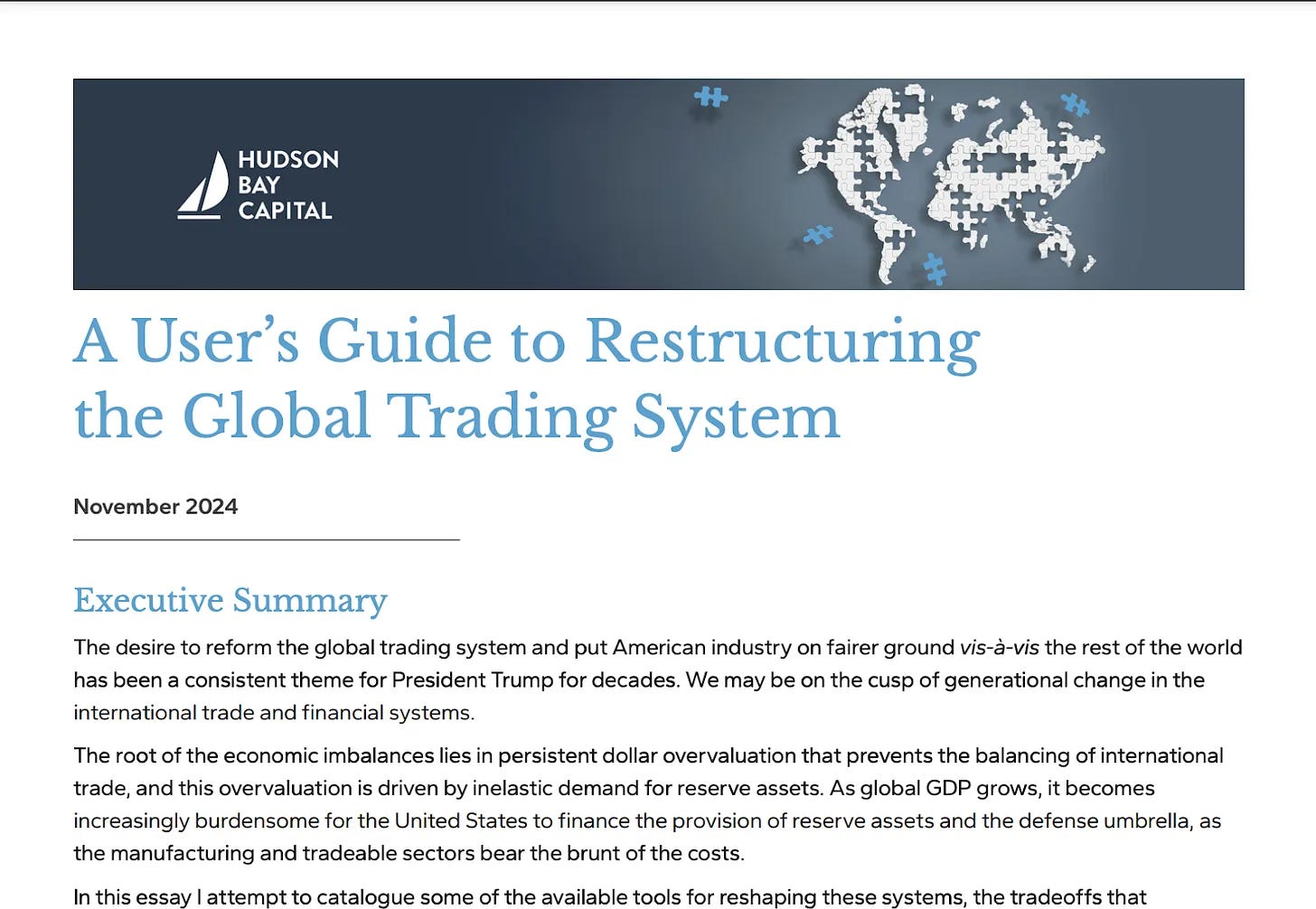
If the name doesn’t ring a bell, Miran is the man some have called the architect of Trump’s monetary reset. Days after the 2024 election he published a forty-page paper titled A User’s Guide to Restructuring the Global Trading System, and the argument in it was straightforward enough. Because the rest of the world is obliged to hold dollars, America has to keep sending them out, running deficits year after year, and that is what slowly hollowed out its own industrial base.
Economists have a name for this bind. They call it Triffin’s Dilemma, after the Belgian economist who described it back in 1960.
Note: Miran didn’t give up his White House job to take the seat. He was the chairman of Trump’s own Council of Economic Advisers at the time, which made him the first person to sit on the Fed and serve in the administration at the same time since the 1930s. The seat was a temporary one to begin with, though, and he handed it over this spring so Kevin Warsh could take it on his way to the chairmanship. But you don’t make an appointment like that by accident.
And Trump’s dollar reset has been working, up to a point. The dollar index fell more than 9% over the course of last year and touched a four-year low early this one.
The problem is, a cheaper dollar doesn’t build a factory by itself. Reshoring, which is the whole point of the exercise as far as Trump is concerned, takes years. Supply chains take longer. And one good run in the currency market doesn’t come close to delivering what these people are actually after. They need the dollar lower, and they need it to stay there.
Which is what makes the yen operation so convenient.
And that brings me to the second strange thing about this operation, namely how the American side actually paid for it.
You may have heard that the U.S. Treasury wasn’t really selling dollars at all. It sold euros. And you might reasonably wonder how that squares with wanting a weaker dollar.
On the surface, it doesn’t. But what actually pushed the dollar down against the yen wasn’t the American side of this operation. It was the other side. The roughly $75 billion Japan spent, because its reserves are held in dollars and Treasuries. The Japanese did the dollar-selling.
So it was, basically, an I-scratch-your-back arrangement.
Why wouldn’t the Treasury simply sell dollars itself, though? It has plenty of them, and it would have done the job directly. Well, the detour is there for a reason, and it’s the same reason none of this can ever be said out loud.
“The United States is selling its own currency” is not an intervention, it’s an announcement. And the moment that announcement lands, every foreign government holding American debt starts working out what those Treasuries will be worth in five years. They sell, yields spike, and the bond market you were trying to protect is the one you just broke. A devaluation only works while it’s deniable.
Helping Japan buy its own currency gets you the same result with none of the fingerprints. On paper, the U.S. Treasury never sold a single dollar. In practice, the dollar dropped about 4% against the yen inside of four days.
Careful What You Wish For
There’s one potential problem with all of this, though, dear reader, and it’s worth keeping on your radar.
The two governments need to get this exactly right, because while both of them want a stronger yen, history is fairly clear that a rapidly strengthening yen is what breaks things. I’ve written about the yen carry trade, the world’s biggest free lunch, and about what happens when it unwinds, more times than I care to count, so I won’t kick that horse again here.
The short version is this. When the yen jumps, everything bought with borrowed yen has to be sold at once to pay the loans back. And since Japanese investors are sitting on more than $3 trillion in net foreign assets, very little of what gets sold is actually Japanese. It’s American stocks, American bonds, and whatever else all that borrowed money happened to buy.
I put together the chart below to show you what that has looked like over the years.
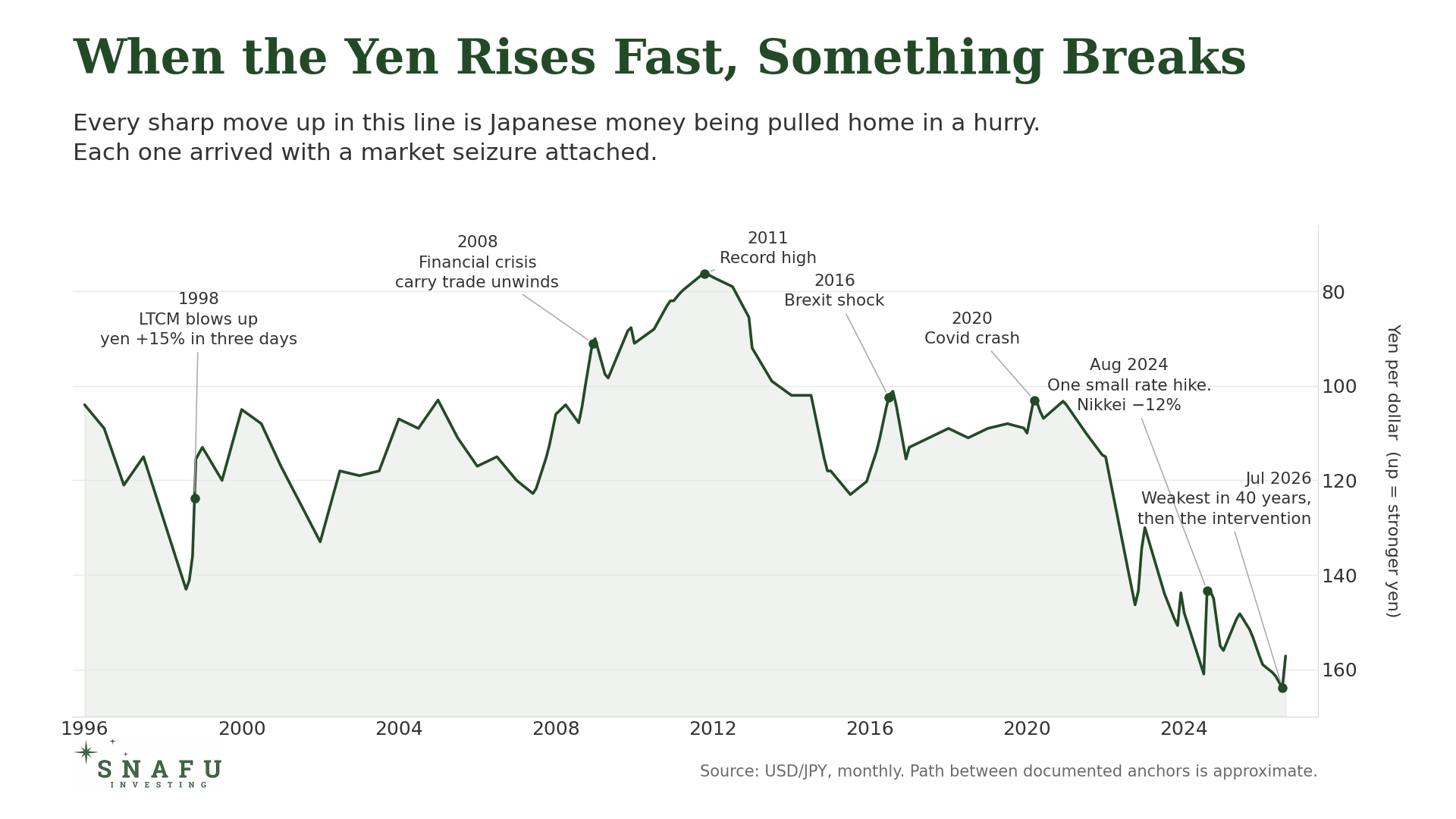
My longtime readers will remember August 2024, when a single modest rate hike in Japan handed Japanese stocks their worst day since 1987 and sent a shudder through markets everywhere. Well, as you can see, that wasn’t a one-off. Just about every violent yen rally of the past thirty years has arrived with a market seizure attached to it somewhere.
What this means is that Bessent is working in a very narrow corridor here. Let the yen keep sliding and Japan eventually sells Treasuries to defend it. Push it up too fast and the borrowed trillions unwind and take everything else down with them. He needs the yen to rise gently, on command, and to stop when told.
Put plainly, Uncle Sam has deliberately started the one thing that breaks markets when it happens quickly, and is betting it can control the speed.
So far it’s holding. But the yen has started sliding again in the last few days. It now takes 159 yen to buy a dollar, where at the start of the month it took 157. My bet is it keeps sliding, which means the next round will cost a good deal more than a photograph.
Bottom line: this doesn’t look like a one-off to me. It looks like the opening move in a recurring operation, where each round has to overcome the market’s memory of the last one wearing off. And every time they go back in bigger, the odds go up that somebody pushes a little too hard and sets off the very unwind all of this is meant to prevent.
I suspect a few of you will ask in the comments what we should all be watching from here, so let me get ahead of it. Three things, mainly.
The 30-year Treasury yield. This is the first thing I look at in the morning, and here’s why. A thirty-year bond is somebody handing over money today on a promise to get it back three decades from now. The yield is what they’re charging for taking that chance. So when it climbs while stocks are falling, I don’t read that as a story about growth. I read it as the market telling us, politely, that it expects to be paid back in weaker dollars.
The yen, and less its direction than its speed. A slow grind higher tells me the plan is working. A sudden lurch tells me it’s getting away from them. So if you see the yen jump several percent in a matter of days, that’s the borrowed trillions heading home, and chances are you’ll feel it in your own portfolio before anybody in the U.S. government gets around to explaining what happened.
And finally, the yellow metal. Gold is the one thing in this whole story that nobody can print more of, which is exactly why I keep half an eye on it. If it starts running while the dollar slides, that tells me the market has already worked out where this is heading. And where it’s heading, I suspect, is another one of those spikes on the chart above. Only this time with a great deal more borrowed money riding on it.
Regards,
Lau Vegys
P.S. A country that imports nearly all its energy and pays for it in dollars has only so many ways out of a weak currency. One of them is to burn less imported fuel, which is why Japan and much of Asia have been quietly reversing their retreat from nuclear power. That’s part of the reason uranium is where I put SNAFU’s first recommendation, and it’s what my special report, Situation Normal: Uranium, is about. It went out to paid subscribers at the start of the month, so don’t let it sit unread. And if you’ve already read it, the uranium play is waiting in the portfolio.
Very informative article about the subtle manipulations between Japan and our Treasury under Scott Bessent. I'm familiar with his background and believe he knows what he's doing and has a steady hand going forward. And I appreciate your color on the actual reasons and need for such a strategy, particularly in terms of the carry trade. A lot of moving parts here that I am familiar with but not at this depth. Lau, do you think Bessent and his counterpart are in explicit communication and reliable agreement about how to protect the yen and devalue the dollar without spooking the bond market with negative impact on equities? PS -- thanks for the heads up again on gold and uranium as defensive moves for us retail investors.
been walking around all day pondering "a currency isn’t defended with money, it’s defended with credibility". Taken to its logical conclusion, bitcoin & gold are easy to defend and the USD eventually must fail with all the disastrous consequences that entails. And yield on the 10-year keeps marching higher, signaling a lack of confidence.
Fix the money, fix the world....says the crypto enthusiast.