


So, earlier this month, Japan’s finance minister, Satsuki Katayama, said out loud that she wants the country’s national pension fund to move its money out of foreign assets and into Japanese ones.
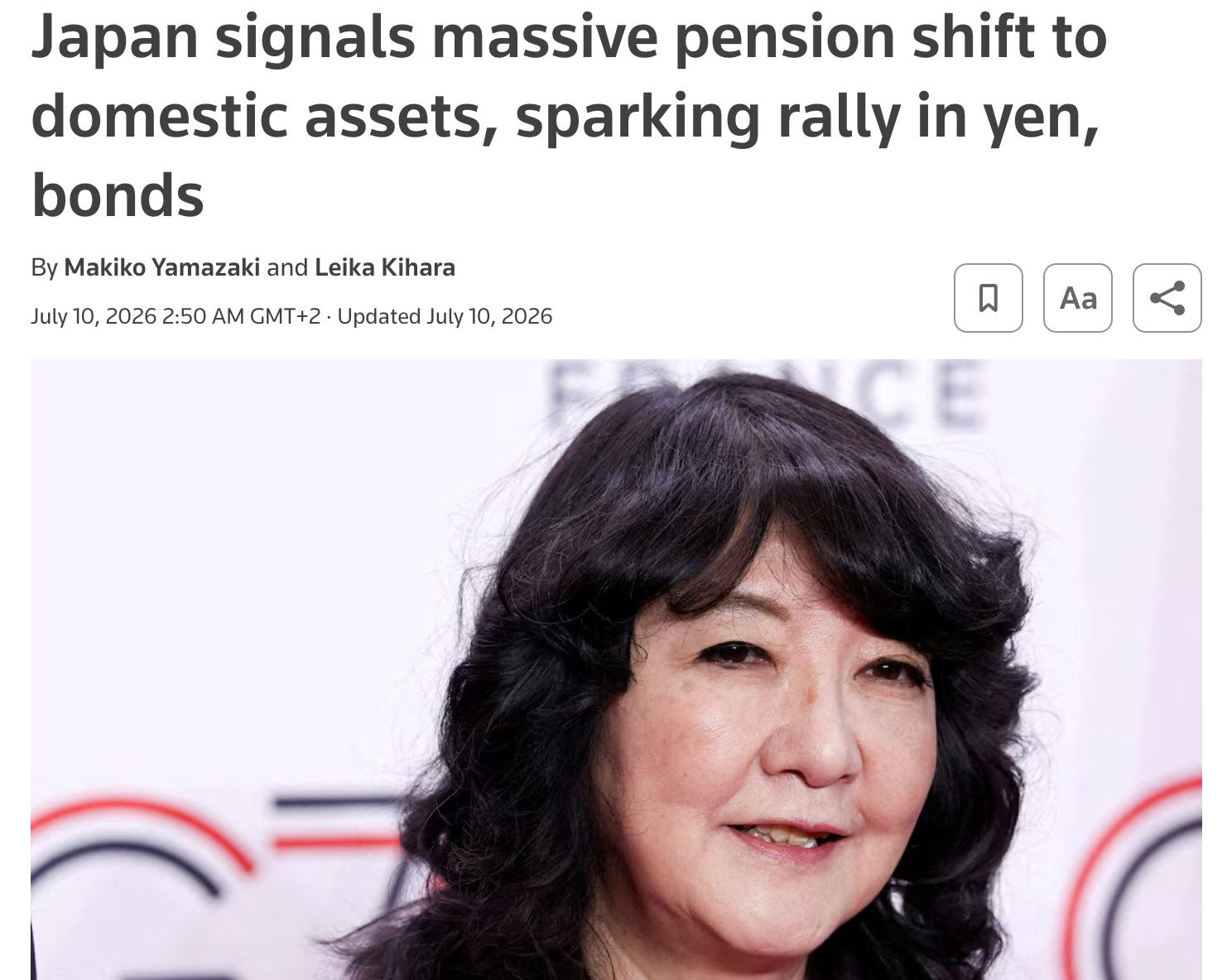
To say that’s a big deal would be an understatement.
The fund is called GPIF. It manages $1.8 trillion, which makes it the largest pool of retirement money anywhere on earth. That's bigger than the entire annual economic output of the Netherlands, Saudi Arabia, or Switzerland.
If you’ve been reading me for a while, you probably know Japan has more problems than it knows what to do with. It’s the world’s fifth-largest economy and, at the same time, the oldest country on earth. Which is challenge enough in itself. But it also has to deal with the largest debt load in the developed world, a currency in free fall, and an economy heavily dependent on imports. That last one was a serious problem long before the Hormuz crisis came along and made it a lot worse.
Japan also happens to be the world’s third-largest creditor nation. Which means whatever it does ends up landing on markets somewhere else. Usually American ones.
So today I want to spend some time on this latest development, because this is exactly the kind of story that reaches your money long before it reaches the headlines.
How the Money Gets Home
OK, so a fund that size has to put its money somewhere. And for the better part of the last thirty years, a very large share of it has sat outside Japan.
Going by its latest disclosure, the GPIF holds about $931 billion in foreign assets. Of that, $232 billion is U.S. Treasuries, and most of the rest sits in foreign stocks, a good chunk of them American as well.
So what does it actually mean when a finance minister says something like that?
Because we’ve seen other Japanese officials make borderline threats about American assets before, only to walk them back a few days later. Last year, for example, Japan’s previous finance minister floated the idea that the country’s Treasury holdings could serve as “leverage” in trade talks with President Trump.
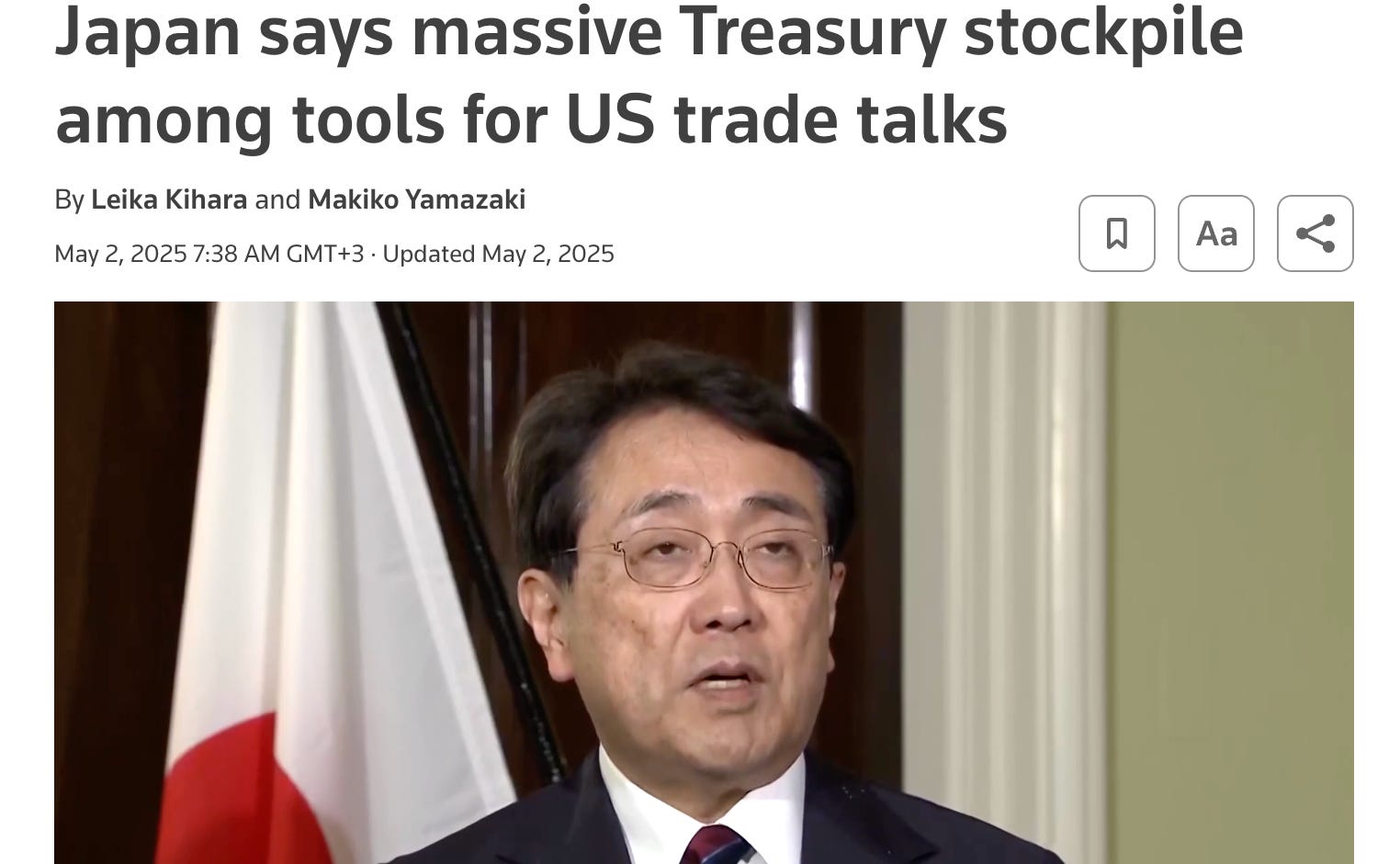
That one lasted about a week.
So is this just another one of those?
Well... no.
But before I explain why, let’s first get the story straight, because I’ve already seen a lot of people get this wrong.
Katayama is the finance minister, but the GPIF doesn’t actually report to her. It sits under the Ministry of Health, Labour and Welfare because it manages the reserve assets of Japan’s public pension system. And even that ministry doesn’t tell the fund what to buy. Instead, every five years it sets broad investment objectives, and the GPIF’s own board translates those into a target allocation the fund then has to stay reasonably close to.
That allocation is famously simple: 25% domestic bonds, 25% domestic stocks, 25% foreign bonds, and 25% foreign stocks.
So, strictly speaking, the finance minister can’t order any of this.
But here’s the thing you need to understand about how Japan works.
Government decisions there are made through something called nemawashi. In a very Japanese fashion, the groundwork gets laid privately first, circulated between ministries and negotiated toward consensus, long before anyone says a word in public. So by the time a minister stands at a press conference and says something like this, it has usually already been cleared behind the scenes.
Now, those target weights don't come up for review until 2030, which is when I'd expect Japan to properly reshuffle the deck.
But here’s the important part.
They don’t actually have to wait until 2030 to start bringing money home.
Why?
Because those 25% targets aren’t hard limits. They’re allowed to drift within a fairly generous range without anyone changing the policy. Each bucket can move roughly 5 to 6 percentage points on either side of its target.
Which means foreign bonds and foreign stocks could both fall to around 20% without anyone touching the official allocation. On a fund this size, that’s roughly $180 billion that could come home under rules that already exist. And with $232 billion of the GPIF’s money sitting in Treasuries, a good slice of it would come straight out of American paper.
And if you look closely, the money is already starting to move.
In June, just about a month ago, Japanese life and casualty insurers bought more of their own government’s long-term bonds than in any month in the past three years.
These are private companies. Nobody told them to do this. They looked at what they could earn at home, without taking currency risk, compared it with what they were getting abroad, and decided they were better off buying more Japanese government bonds.
One of the biggest, Meiji Yasuda, doubled its planned purchases for the year to ¥2 trillion (about $12 billion).
What Backed Them Into This
Now of course, if you’ve been reading my past essays on Japan’s troubles, you probably know why this is happening. A weak yen, and the heaviest debt load in the developed world. (And, as you'll see, they're really just two sides of the same problem.)
Just to give you a sense of how bad the yen's decline has been...
In early 2021 you needed about 105 yen to buy a dollar. Today you need about 163. In five years the yen has lost more than a third of its value against the dollar, and it’s now the weakest it has been in roughly forty years.
The reason isn't especially complicated. It goes right back to what I mentioned a minute ago.
For decades, the Japanese government dealt with the country's problems (an aging population, turtle-speed growth, and a shrinking workforce) the same way governments often do: by borrowing. A lot.
The pile is now north of 200% of GDP, or roughly $8 trillion. And the way Japan managed to carry it was with a familiar playbook: keep interest rates near zero and have the central bank print money to buy the government’s own debt.
That works... right up until the rest of the world starts paying interest and you don’t.
When America was paying around 5% on cash and Japan was paying next to nothing, money did what money always does. It went where it earned the better return. Investors sold yen, bought dollars, and moved their money into American assets. As more money left Japan, the yen kept falling.
Unfortunately, for a country that imports almost everything it burns and eats, a weak currency isn’t the blessing it looks like on an exporter’s spreadsheet.
Japan imports nearly all of its energy and about 60% of its food, virtually all of it priced in dollars. So every time the yen falls, the cost of keeping the lights on and the supermarket shelves stocked goes up.
So Japan has been trying to fix the yen directly, by buying it.
Just this year, in April and May, the Ministry of Finance went into the currency market and started buying yen with its dollar reserves. Day after day, $73 billion worth. It was the largest currency intervention in the country’s history.
It worked for about three weeks. Then the yen started falling again. Turns out that's not enough. Somebody else has to want your currency too.
Japan also tried raising interest rates.
You can almost watch the capitulation happen in the numbers: 0.25% in July 2024, 0.75% last December, then 1% in June — the highest policy rate since 1995.
The yen fell anyway.
Note: The Bank of Japan meets again this week to decide whether to raise interest rates further. The decision is due Friday, and another hike wouldn't surprise me.
Interestingly, inflation came in at 1.6% just last week. That’s below the Bank of Japan’s own 2% target for the fifth straight month. Under normal circumstances, that should have pushed long-term yields lower. Inflation is being tamed. Yay.
Instead, long-term yields rose. (Which means Japan’s borrowing costs on that $8 trillion just went up.)
That alone tells me the bond market has stopped worrying about inflation and started worrying about something much bigger. Who's going to keep buying all this debt?
And that's really what I think Katayama was getting at when she said she wanted the pension fund to sell its foreign assets and buy Japanese ones. If the rest of the world won't buy this debt, the Japanese will have to... which means cashing out of assets parked abroad, including the good ol' USA (and buying a great deal of yen on the way).
Situation normal. Plan accordingly.
Regards,
Lau Vegys
P.S. I realize you probably don’t spend much time thinking about Japan’s economy. Most people don’t. But I’ve been banging the table about this for the past year or so because I think it’s one of the most overlooked stories in global markets. Japan owns about $1.1 trillion of U.S. government debt (already noticeably less than when I last wrote about Japan). If a buyer that big starts heading for the exit, it doesn’t just become your government’s problem. It eventually spills over into mortgage rates, car loans, corporate borrowing costs, and, ultimately, your portfolio.
These are exactly the kind of situations I want to stay ahead of, and a big part of why I launched SNAFU Investing earlier this month. There are two picks in the portfolio already, two special reports on the way, and the first monthly issue landing next month. It’s all just below, if you’re curious.
Keep us posted. More trouble, no doubt, ahead. When to duck? How to shuffle? This is a no fun dance. But dance we must. Thanks.
From a selfish USA perspective, we should pay attention to Japan because it is a mirror for us in 20 years. Boomers fully extracting wealth from a shrinking generation of workers, debt exploding upwards and various monetary tricks to paper over the fiscal prolificacy.
The Japanese custom of nemawashi is strong, as is the culture of doing what the government tells you, so Japanese will save and tighten their belts if told to. Yet nothing can change the math. Their reserves are in large part a debasing fiat currency. They are dependent on outsiders for food and energy. Nothing has been going in their favor since 1990. The self-inflicted wounds of debt and shutting down their nuclear program for 12 years is bearing fruit.
A fabulous culture and society is destroying itself because it won't make hard choices now rather than have them forced on them in some unknown future. But revolutionary change is coming. Math never lies.
p.s. little nit - Japan is not the oldest country on earth. That distinction belongs to San Marino, a beautiful and majestically run republic near the Adriatic coast established in 301 AD. It is remarkable how different it is from surrounding Italy. No border, no dysfunctional society, no army, and a debt/GDP ratio under 60%. Policies matter.