

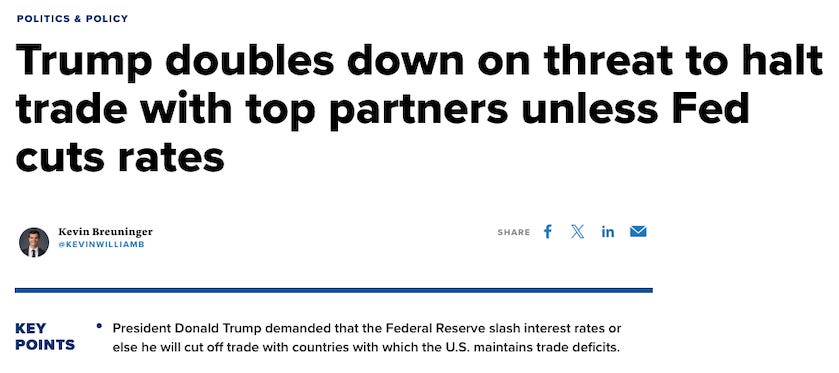
If you want to understand just how serious America’s $40 trillion debt problem has become, consider what President Trump threatened to do earlier this month.
“LOWER THE RATE OR I’LL STOP TRADING WITH COUNTRIES WITH WHICH WE HAVE A DEFICIT,” he wrote on Truth Social.
Just to give you an idea of how crazy this would be in practice, below are some of the countries with which the U.S. runs a trade deficit.
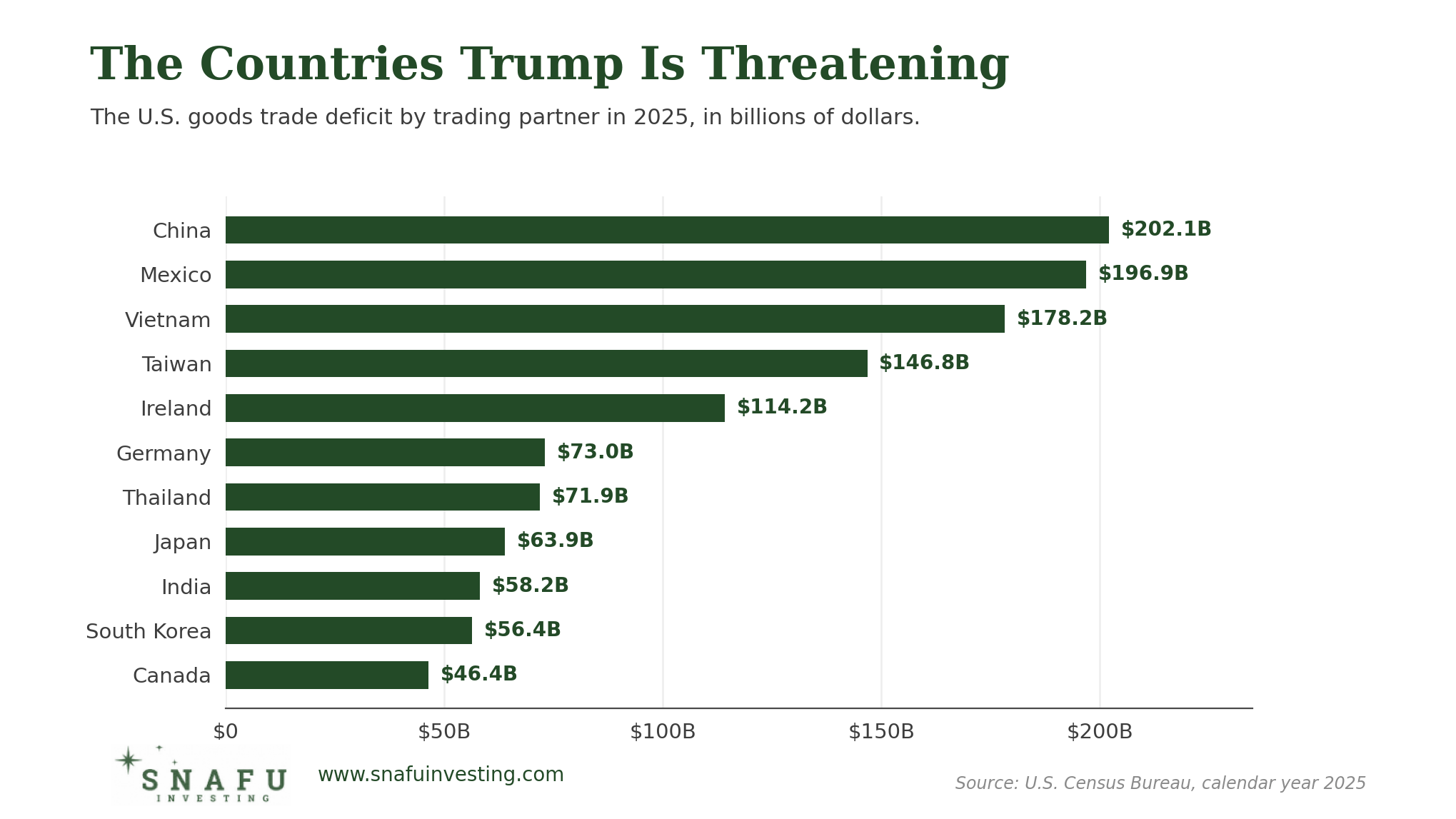
China. Mexico. Canada. Germany. Japan.
We’re talking about some of America’s largest trading partners. Hundreds of billions of dollars in trade every month.
Actually stop trading with them and the consequences would be enormous. Supply chains would seize up. American companies would lose suppliers and customers. Prices on all kinds of imported goods would jump. Investment would almost certainly get postponed as companies tried to figure out what the hell was going on.
In other words, crazy.
So why would Trump put some or all of that on the line for one thing?
Well, he says it himself. He wants lower interest rates. Always has.
Trump spent years attacking Jerome Powell for not cutting rates fast enough. And he’s been banging the same drum again for months. America, he says, should be paying the lowest interest rates in the world.
I mean, it kind of makes sense.
The U.S. national debt crossed $40 trillion last month. And when you owe that much money, of course you want the smallest interest rate you can get.
It’s Not About Trade
Predictably, plenty of people on both sides of the political divide immediately started treating Trump’s threat like a trade story.
“Look at Trump. He wants us to stop trading with half the world. Interest rates are just the pretext. Tariffs and decoupling were always the goal.”
That completely misses the point. This is not a trade story.
So what is it about?
I think this is really about America’s debt and the increasingly difficult question of who is going to keep financing it.
Just consider this simple fact.
Many of the countries Trump is threatening to cut trade ties with are also the same countries that have spent decades financing the United States.
If you need a refresher on how this usually works, let’s start with a very simple example.
Say you buy a $50,000 Lexus made in Japan.
You get the car. Somewhere on the other side of that transaction, Japan gets $50,000.
Japan could turn around and spend those dollars buying something made in America. If that happened every time, trade would more or less balance itself out.
Obviously, that isn’t what happened.
America has been importing more than it exports for decades. So year after year, hundreds of billions of dollars flowed overseas to pay for Japanese cars, Chinese electronics, German machinery, Saudi oil, Korean semiconductors, and everything else Americans wanted to buy.
And those dollars had to go somewhere.
Some were spent on American goods. Some bought American companies, stocks, property, corporate bonds, and so on.
But a huge amount ended up in perhaps the most obvious place in the world to park a mountain of dollars.
U.S. Treasuries.
It’s been a remarkably convenient arrangement if you happened to be the U.S. government.
America bought the world’s stuff. The world accumulated dollars. Then the world lent a good chunk of those dollars right back to America.
Probably the best example of just how convenient this arrangement has been is the petrodollar system, which I went over in my piece about China and the Strait of Hormuz about a month ago.
America buys oil from Saudi Arabia and the rest of the Middle East. The oil exporters accumulate dollars. And instead of spending all those dollars on American goods, they recycle a lot of them back into American financial assets, including U.S. government debt.
The broader trade system worked in much the same way.
And that has a pretty obvious implication for Trump’s threat.
Actually blowing up those trading relationships would risk damaging the very system that has helped finance America for decades. Fewer dollars flowing abroad means fewer dollars naturally coming back into dollar assets. And using access to the American market as a weapon gives countries one more reason to reduce their dependence on the U.S. in the first place.
So taking the threat literally makes very little sense.
So what the hell is going on here?
The Rate Problem
I’ve written extensively about what a big problem America’s $40 trillion debt burden has become (here and here, for example), so I won’t beat that dead horse again.
But there is one number worth remembering.
America’s interest bill is already around $1 trillion a year. It’s now the second-largest line in the federal budget, bigger than the entire military and Medicare. Only Social Security costs more.
That’s what higher rates do when you’re sitting on $40 trillion of debt.
And of course the bigger that debt gets, the more every extra point of interest hurts.
So the people running the government have every reason to want lower financing costs.
And Mr. President wants them doubly so.
But there’s a problem.
The Fed can’t simply give them to him. Yes, even with Trump’s guy Kevin Warsh now running the place.
Inflation is still running well above the Fed’s target. The latest PCE reading was 3.7%. Energy costs have surged. Oil is above $100. And bond investors have already pushed the 10-year Treasury yield to around 5%.
Now imagine the Fed responding to all that by aggressively cutting rates.
“Inflation is rising, but the president asked us nicely, so we’re cutting rates.”
Bond investors would go crazy.
“We lent you money. Inflation is already eating away at what those dollars will buy, and now your central bank is deliberately making money cheaper?”
“Fine. Pay us more.”
So if rates ultimately have to come down, and believe me, with $40 trillion of debt there’s just no other way, policymakers need a reason to cut them without looking like they’re simply monetizing the government’s debt.
A stock market crash would do it. So would a serious recession or some kind of financial crisis.
But those are painful. And once they start, they’re notoriously hard to control.
Trade threats are different.
Do a convincing enough job threatening to shut down a huge chunk of world trade, and growth forecasts come down. Companies delay investment because they don’t know what tariffs they’ll face or where they’ll be able to source parts six months from now. Hiring slows. Consumers get nervous. Economic activity weakens.
Suddenly the Fed has a reason to cut.
Not because Trump told it to.
Because economic conditions supposedly require it.
Who Buys the Debt?
Of course, even that only deals with part of the problem.
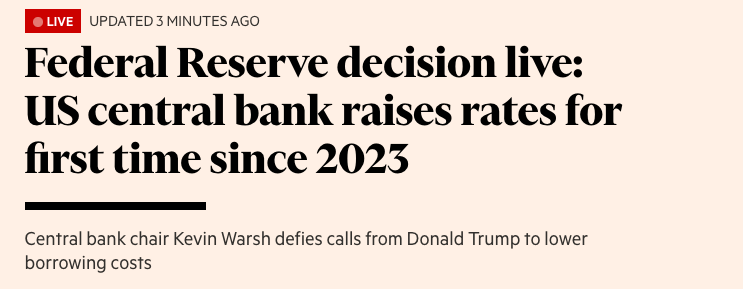
As I write this on Wednesday, the Fed went ahead and raised the federal funds rate by a quarter point, exactly as the market expected. It’s the first hike since 2023. So it will be interesting to watch Trump’s rhetoric over the next few days.
But whatever he says, what really matters here goes far beyond today’s rate decision.
Let me explain.
The Fed does set the overnight federal funds rate and, by doing so, has enormous influence over the short end of the yield curve (basically, shorter-term debt). True.
But what it cannot simply dictate is what investors will accept to lend the U.S. government money for 10, 20 or 30 years.
That’s the long end of the curve.
Those rates are set in the market. And they matter because they feed through the rest of the economy.
Mortgages. Car loans. Corporate debt. Pretty much everything.
And this is where America’s foreign lenders come back into the picture.
Because for decades, some of the biggest buyers of U.S. government debt have been foreign governments and institutions.
Yes, many of the same countries Trump is now threatening with trade restrictions.
But here’s the real problem. Even without Trump’s latest rhetoric, those traditional foreign buyers have already stopped keeping pace with America’s borrowing.
An important turning point came around 2014.
Russia annexed Crimea. The U.S. and its allies responded with financial sanctions. That was an early reminder that access to the dollar-based financial system could be used as a geopolitical weapon. The lesson became much harder to miss after Russia’s central bank reserves were frozen following the 2022 invasion of Ukraine.
China, in particular, began reducing its Treasury exposure. I’ve been writing about that for years.
But forget China for a moment. Look at foreign official demand as a whole.
At the end of 2014, foreign central banks and other official institutions held a little over $4.1 trillion in U.S. Treasury securities.
By late 2025, that figure was below $3.9 trillion.
You might look at that and say, okay. A slight decline. Definitely no growth, but hardly the end of the world.
Now consider what happened on the other side of the equation.
Over roughly that same period, total U.S. federal debt went from around $18 trillion to around $40 trillion.
That’s an extraordinary divergence.
America added more than $20 trillion of debt while its traditional foreign official lenders added essentially nothing.
We also know where central banks have been putting a lot more of their money instead.
Gold.
Global central banks bought 863 tons last year, after three consecutive years of 1,000-plus-ton purchases. Over the past four years, they have bought an average of roughly 1,000 tons annually. That’s about twice the average pace of the preceding decade.
Needless to say, all of this creates an enormous problem for a country that needs to borrow trillions of dollars every year.
And that’s trillions more every year, on top of the $40 trillion pile already there.
If the traditional buyers won’t buy enough, where does the money come from?
That’s a subject worthy of a much longer essay, and I’ll probably write one. But there are basically four ways I see this playing out. Let me run through them quickly.
First, create new buyers. Stablecoins are the most obvious example. Under the GENIUS Act, dollar stablecoins have to be backed one-for-one by a narrow set of liquid assets that includes short-term U.S. Treasuries. So as the stablecoin market grows, potentially into the trillions, it creates another enormous pool of demand for government debt. Treasury Secretary Scott Bessent has been quite explicit about this, saying the law should lead to a “surge in demand” for Treasuries. Banks, money-market funds, insurers and pensions can all be pushed in the same general direction through regulation. Ultimately, the new buyer is you and me.
Second, stop existing foreign buyers from becoming sellers. Think of it as a Treasury pawn shop. A country like Japan can use the Fed’s FIMA facility to get dollars by temporarily putting up its Treasury holdings as collateral rather than selling them into the market. In fact, right after this summer’s intervention to support the yen, Japan’s Ministry of Finance said it plans to do exactly that. Bessent has since called for the Fed to raise the facility’s $60 billion per-country cap. Need dollars? Fine. Pawn your Treasuries. Just don’t sell them, please.
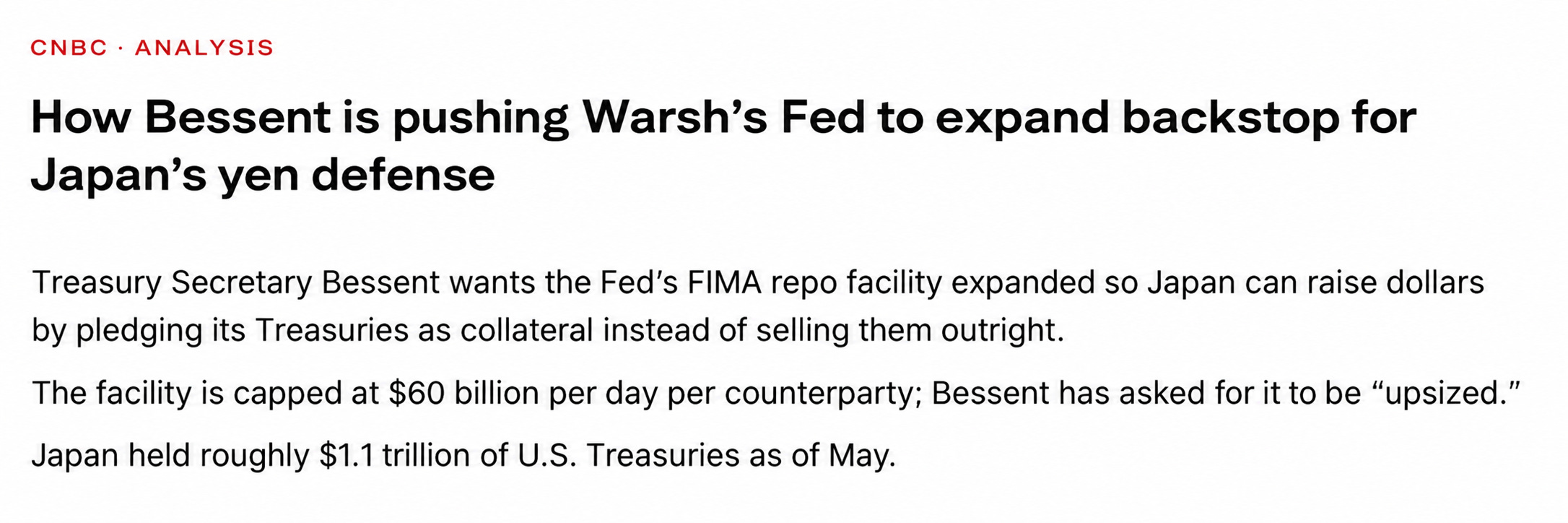
Third, issue more debt where rates are easier to influence. The Fed cannot dictate what investors demand on a 30-year Treasury, but it has much more influence over very short-term rates. So Treasury can lean more heavily on bills and other short-dated debt, moving more of America’s financing toward the part of the curve where the Fed has greater control. And conveniently enough, the stablecoin rules I just mentioned create demand for exactly this kind of short-term debt. Under the GENIUS Act, if stablecoin issuers use Treasuries as reserves, those securities generally have to mature within 93 days. In other words, the government gets a potentially enormous new buyer for precisely the part of the debt market where the Fed has the most influence over rates.
And finally, there is one buyer that can never technically run out of dollars: the Federal Reserve. We’ve seen this movie before. And it doesn’t necessarily take the proverbial sky falling. If the economy weakens, financial conditions get too tight, long-term borrowing costs become uncomfortable, or the Treasury market itself comes under stress, the Fed can create reserves and buy government securities itself. Call it QE. Call it liquidity support. Call it whatever you like. The mechanics are the same, made possible by one simple fact: the buyer with the deepest pockets in the room happens to own the printing press.
Regards,
Lau Vegys
P.S. Interest rate hike or not, given everything I’ve talked about today, gold will continue to be money in the eyes of the market. So a good way to protect yourself from the continued erosion of your purchasing power is to convert some government currency into real money. That’s the first step. Then, for potentially greater profits, there are gold stocks, which give you leverage to the gold price. That’s why SNAFU Investing’s first monthly issue, which went out to paid subscribers recently, featured a fresh gold pick. It’s still trading below our buy-up-to price, so if you’re a paid subscriber, there’s still time to get in. If you’re not, the intro is free to everyone.
Thank you for great explanation.