

Lau here.
What a start to the week.
Nvidia CEO Jensen Huang, married to his college sweetheart for more than three decades, sent his employees an email admitting to an affair with an alleged Chinese spy. Alice Huang, a former model and executive at one of Nvidia’s customers in Singapore, was suspected by U.S. intelligence of working for China’s Ministry of State Security and cultivating the CEO to learn about Nvidia’s technology.
The news spread like wildfire, sending Nvidia’s shares down like a rock and wiping out about $200 billion in market value.
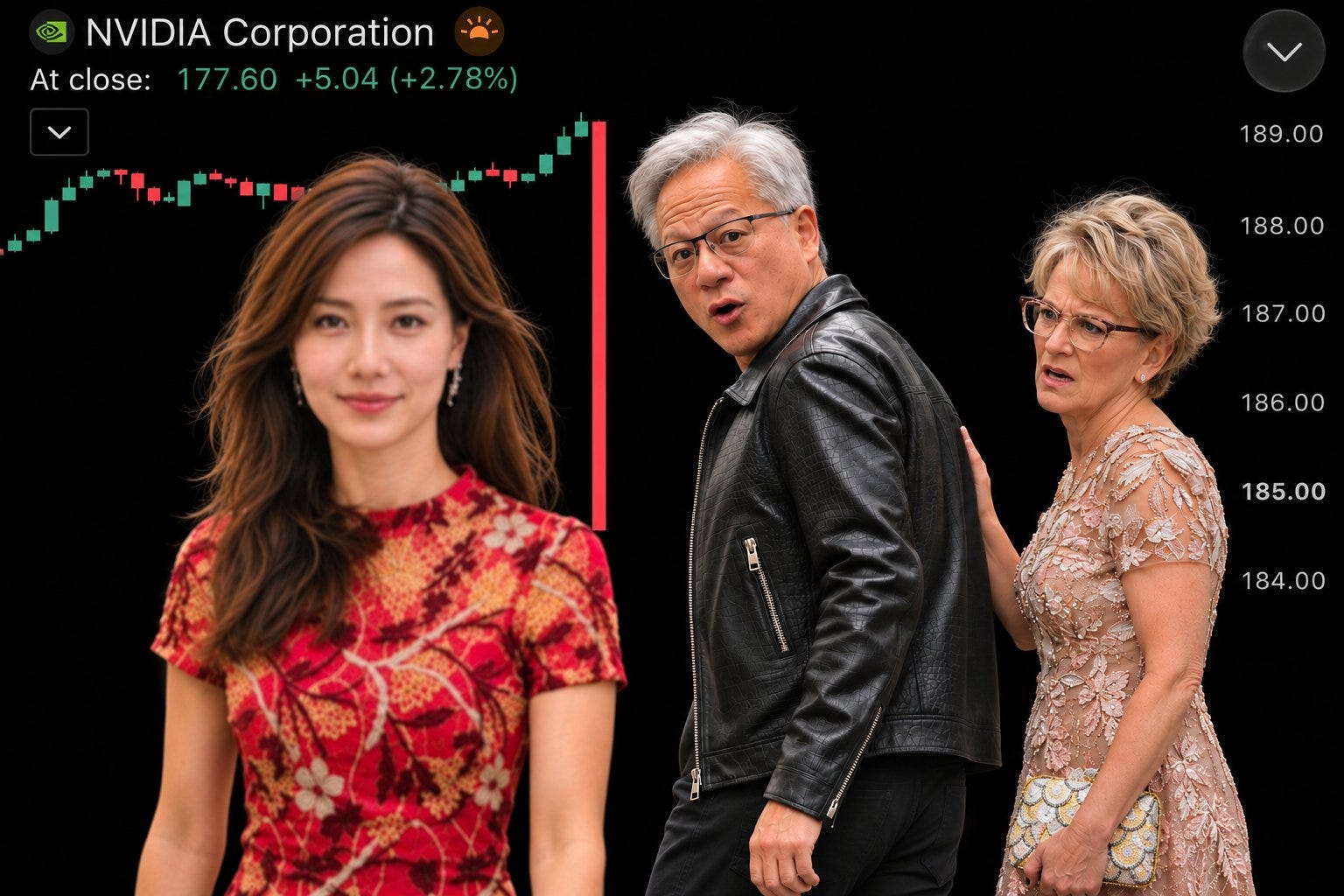
That came on top of last week’s losses, when the blue wave left the market with a hangover. Apparently, Mr. Market doesn’t take kindly to infidelity. Especially of the James Bond variety.
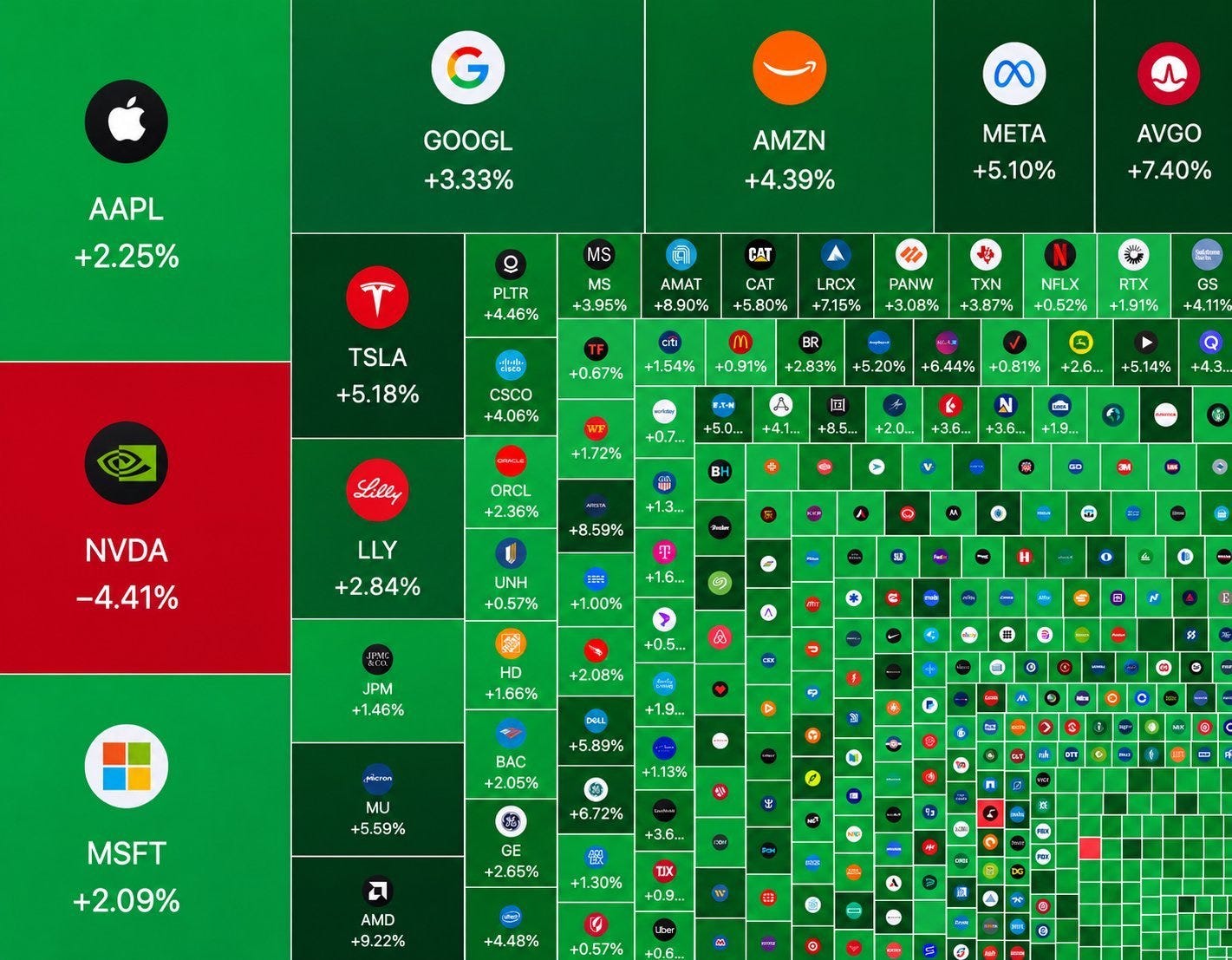
Never mind that China called the allegations unsubstantiated, or that Nvidia’s board opened an independent investigation and said it had no reason to believe any secrets were compromised. Or that the market actually rallied yesterday, leaving Nvidia sticking out like a sore thumb.
Of course, investors are probably more worried about Huang being removed as CEO. Dan Ives, one of Wall Street’s better-known tech analysts, puts the odds at about 15% and reckons the stock would fall 25% to 30% if it happened.
It’s not hard to see why. Huang co-founded Nvidia in 1993 and turned it from a graphics-card maker into the engine of the AI boom. In the market’s eyes, the man and the company are almost one and the same.
The internet, meanwhile, has been having a field day. My X feed has been flooded with memes and AI-generated videos since Sunday, and a few gave me a good chuckle.

Others have been circulating collages of AI bigshots with Chinese wives and girlfriends, raising questions about whether people close to the men building this technology could be passing secrets to China.
But even if we ignore the noise and simply look at Nvidia on its own, there’s still an awful lot riding on this one company. Despite the past week’s selloff, it’s still worth more than $4 trillion. And as I wrote in last week’s essay, it’s the biggest piece of an AI trade the whole market now rests on.
And that’s the rub. AI can be every bit as real as promised and still be a bubble, just as the internet was in 2000, when the Nasdaq lost more than three-quarters of its value over the next two and a half years. Only this time, the AI trade is sitting in nearly everyone’s brokerage account and 401(k), whether they realize it or not.
This is why I keep harping on about AI. And why I think the growing political backlash against it, which played a big part in last week’s elections, could spell serious trouble for the stock market heading into 2028. I explored that argument in last week’s essay, linked below alongside my other recent pieces, including Joel Bowman’s account of Brazil’s election and an alert for paid subscribers.
The Democrats Are About to Break the Stock Market

It seems the market isn’t loving the Democrats’ blue wave. The AI trade in particular.

It’s Not the Votes That Count

As I write this, the last U.S. midterm ballots are still being counted, but from the looks of it, the Democrats have taken both houses of Congress. So I figured this is a fitting moment to talk about another election result, one that came in last week a few thousand miles south, because it probably has more to do with your money than you might think.
From the Comments
One of the things I’ve come to appreciate most about writing here is the conversation that happens in the comments. Here are six from last week that stood out, for different reasons. Each links back to the piece it appeared on, so you can click through if you’re interested in the context.


Thanks again to everyone who left a comment last week. I read all of them, even the ones I don’t get a chance to reply to individually. Over the coming days, I’ll try to catch up on the questions and the longer threads.
Regards,
Lau Vegys
P.S. If you joined as a paid member last week, welcome aboard. Here are three links to help you find your way around:
The latest issue: our newest recommendation, an oil producer selling cheap shale crude to Asia from a coast no one can close.
The uranium special report: a deep dive into the case for the whole sector, and the thesis behind our first pick.
The live portfolio: every position we hold, with the original entry price, the current price and the full tranche guidance, plus links to each original write-up. (If it doesn’t load properly, try refreshing the page.)
Lau, could it be that Jensen Huang pulls of the playbook of Lou Pai of Enron?
Lou Pai
> Born in China in 1947
> Moves to America at 2yo
> B.S. and M.S. Economics at U. of Maryland
> Joins Enron in 1987 and heads subsidiary of Enron Energy Services in 1997
> Internally called the "invisible Enron CEO"
> Loves going to strip clubs and starts having an affair with a Houston stripper
> Wife finds out and judge forces him to liquidate Enron shares in divorce settlement
> Leaves Enron in 2001 with $280m
> Enron files for bankruptcy few months after he leaves
> Other Enron execs that sold shares before collapse are investigated and some go to jail
> Pai never criminally charged and moves on as Colorado's 2nd largest landowner (and world's luckiest businessman ever)
Transfered to Jensen Huang:
Jensen Huang getting caught with a suspected Chinese spy is not a national security crisis. It's the greatest liquidity event in market history.
He's running the Lou Pai Enron playbook to perfection. How do you dump billions in $NVDA at the absolute peak of the AI bubble without spooking the tape or triggering an SEC/DOJ insider trading? You get a divorce judge to legally force you to liquidate the position.
Zero regulatory blowback. Generational bag secured. 🏆 Undisputed GOAT.
Regulators hate this one simple trick.
every man is susceptible, but rich men most of all.
Be like Sam Walton - drive a beat up truck and don't become an attack surface.