

It seems the market isn’t loving the Democrats’ blue wave. The AI trade in particular.
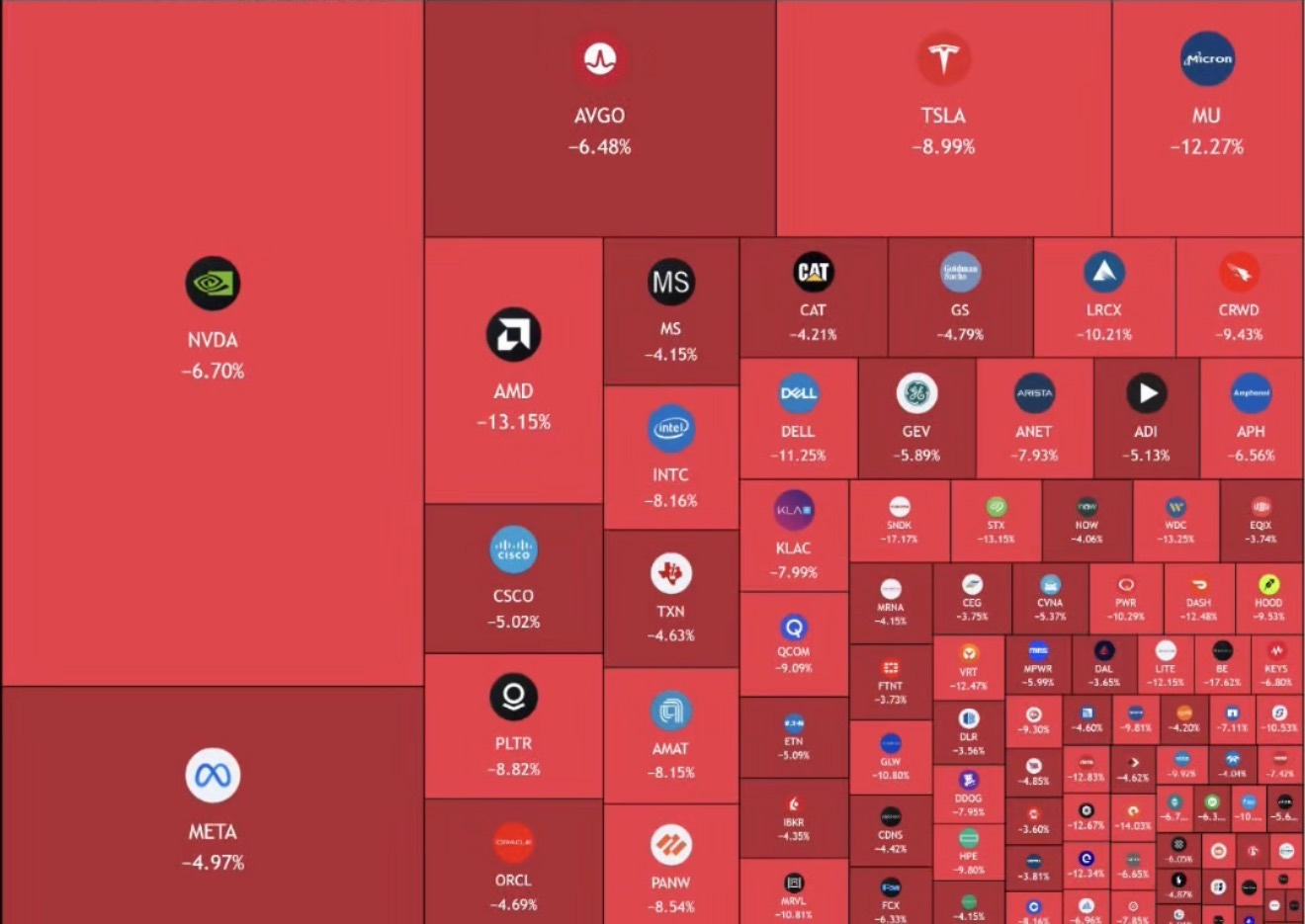
On Thursday, two days after the midterms, the Nasdaq had its worst day since the tariff panic of April 2025. The Nasdaq 100 lost US$2.3 trillion in a single session, which has never happened before. The chip index fell 12.3%, its worst day since the Covid crash in March 2020. Nvidia alone gave up something like US$450 billion. Even the S&P 500, with its 500 stocks and all that supposed diversification, dropped 4.4%. But if you owned anything with “AI” or “data center” in the description, chances are your day was a good deal redder than that.
Now, this is a strange way for the market to greet a midterm election. Because if you ask anyone on Wall Street what the midterms mean for stocks, you’ll get pretty much the same answer: the uncertainty is gone, and that’s good for the economy and good for stocks.
And there’s a good reason they all say that. If you look at the historical record, there have been 19 midterm elections since 1950, and in the twelve months after every single one of them, the S&P 500 was higher. Nineteen for nineteen. The average gain was about 15%, against roughly 9% in a normal year. You can see all of them in the chart below.
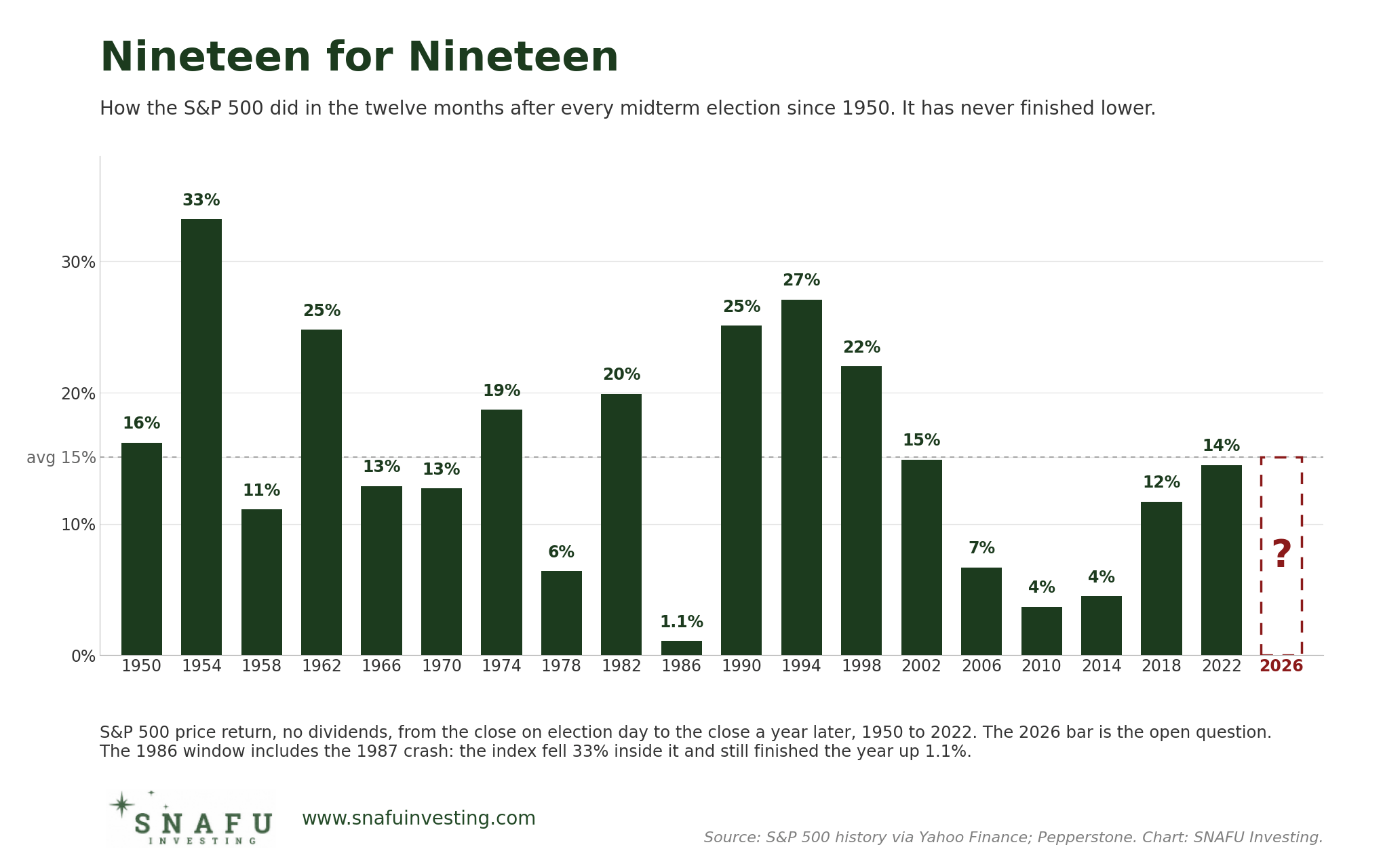
Importantly, this isn’t a cherry-picked stat either. The streak survived the 1987 crash: the twelve months after the 1986 midterm included Black Monday and a 33% drawdown, and the index still finished the year up 1.1%. It survived the December 2018 selloff. It survived 1974, 2002 and 2010. Recessions, wars, a crash. The streak held through all of it.
So you’d expect that after Tuesday, the people who know this stat, and that’s everyone on Wall Street, would be buying. Instead they dropped the AI trade like a hot potato. And I think they were right to.
When Wall Street Rallies
But before I get to all that, let’s talk quickly about why the streak exists at all. There are basically two reasons.
The first is that elections are uncertainty. If you’ve been in the markets for any amount of time, you’ll know that the market hates uncertainty more than it hates bad news. Once the votes are counted, whoever wins, investors have at least a rough idea of what the next two years look like and can price it. That alone is worth something.
The second reason is arguably bigger.
We can knock Trump for not living up to his promises on bringing prices down, cheap energy and no more forever wars, and I have. But if history is any guide, he was always going to lose this one (though maybe not quite this badly). The chart below shows how the president’s party, Democrat or Republican, has done in the House in every midterm since 1950.
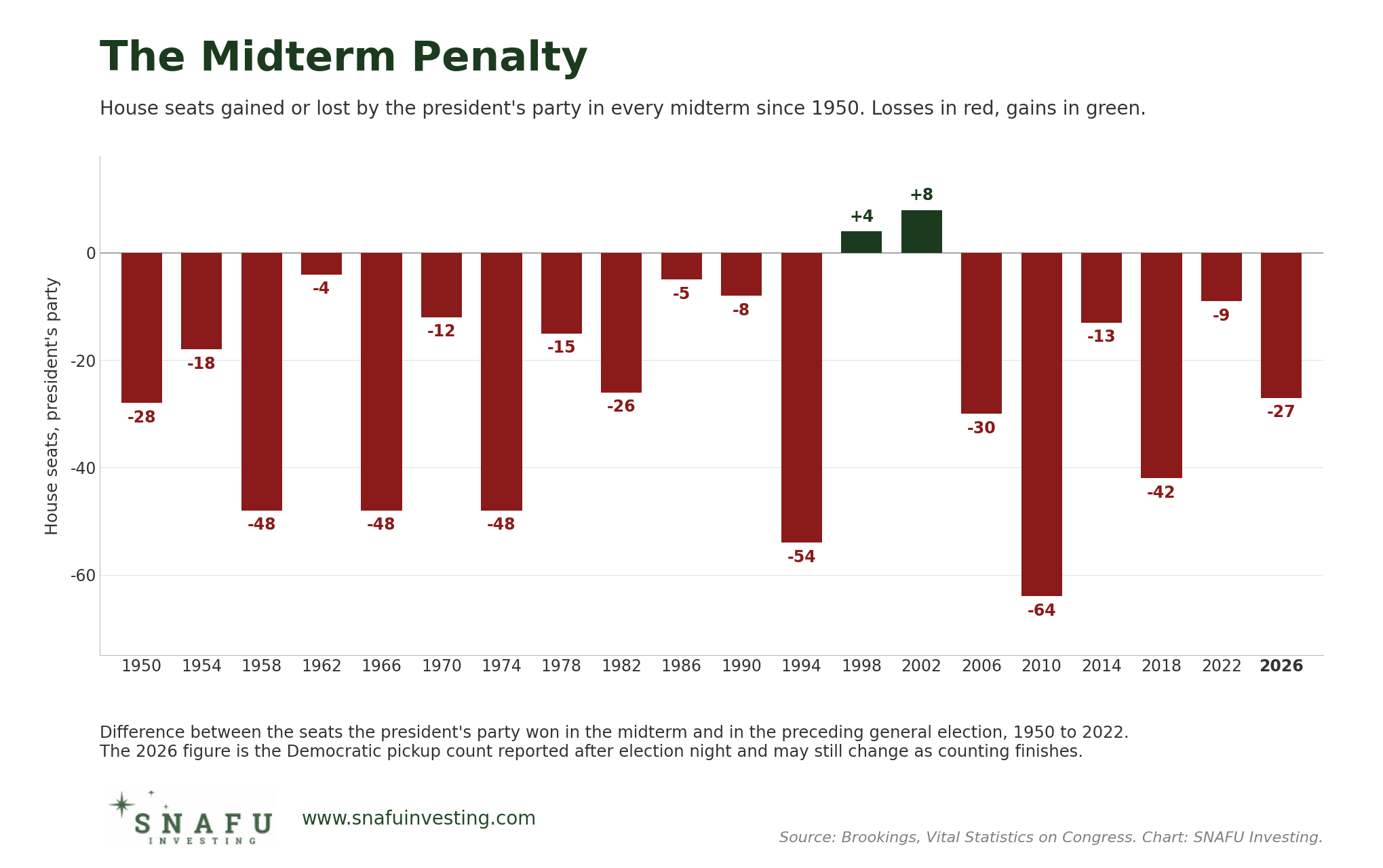
As you can see, the president’s party has lost seats in 18 of the last 20 midterms (this one included). And usually that’s enough to hand the other side at least one chamber. In other words, the normal outcome of a midterm is a divided government. And divided government, as far as Wall Street is concerned, is the best government there is, because it can’t do a whole lot.
Hard to argue with that, really.
And it literally doesn’t matter who wins. The Democrats in 1954 and 2006, the Republicans in 1994, 2010 and 2014, the market rose every time.
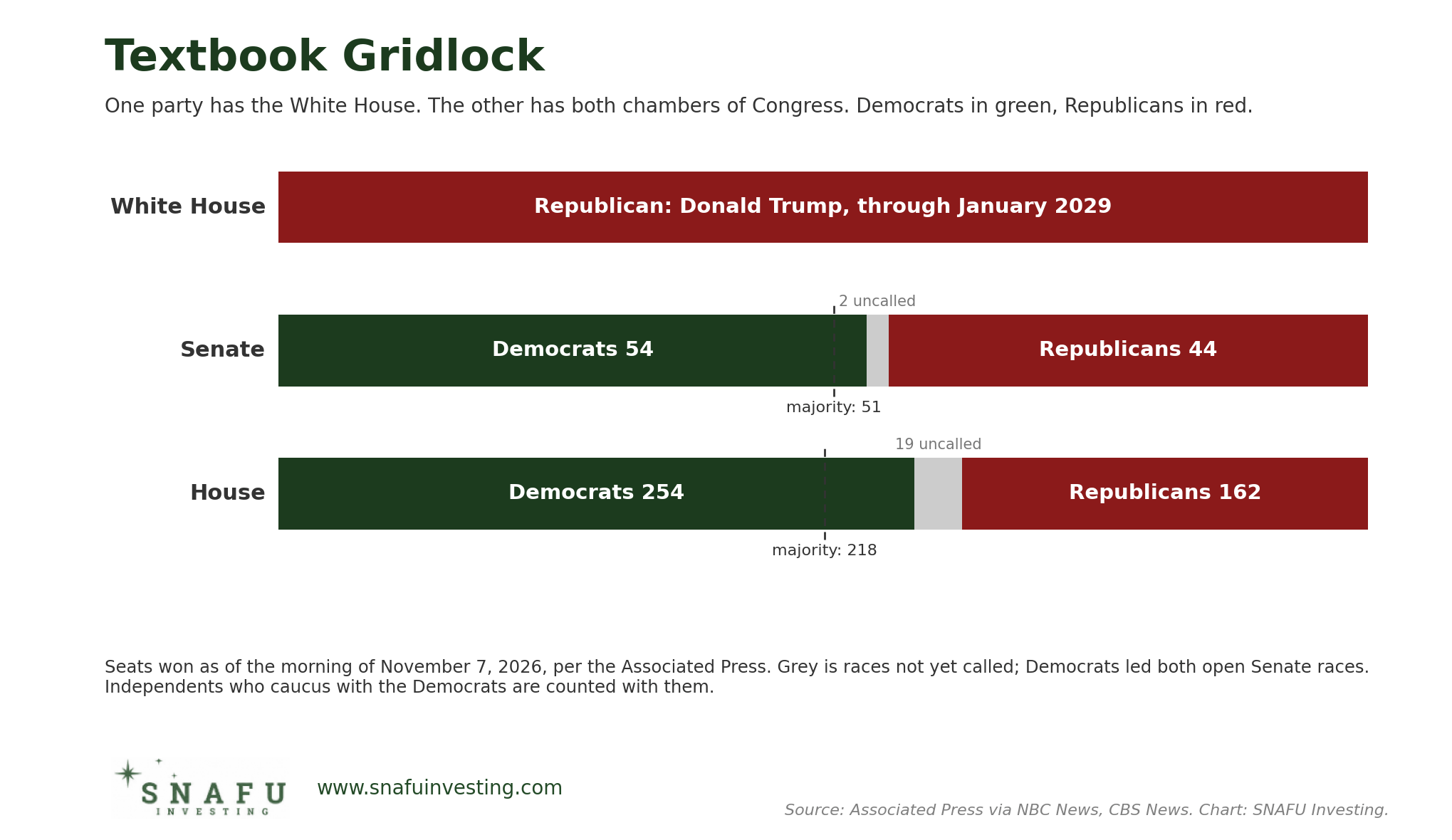
This year, of course, that’s precisely what the market got: a Democratic Congress and a Republican president. A divided government, right out of the textbook.
So, on paper, stocks should be in for a good twelve months. Here’s why I think it may be different this time.
Too Few Legs to Stand On
See, there’s a problem with applying that historical record to today’s market. Take the S&P 500, the broadest gauge we have and what most people actually mean when they say “the market.” It isn’t quite the same beast it used to be.
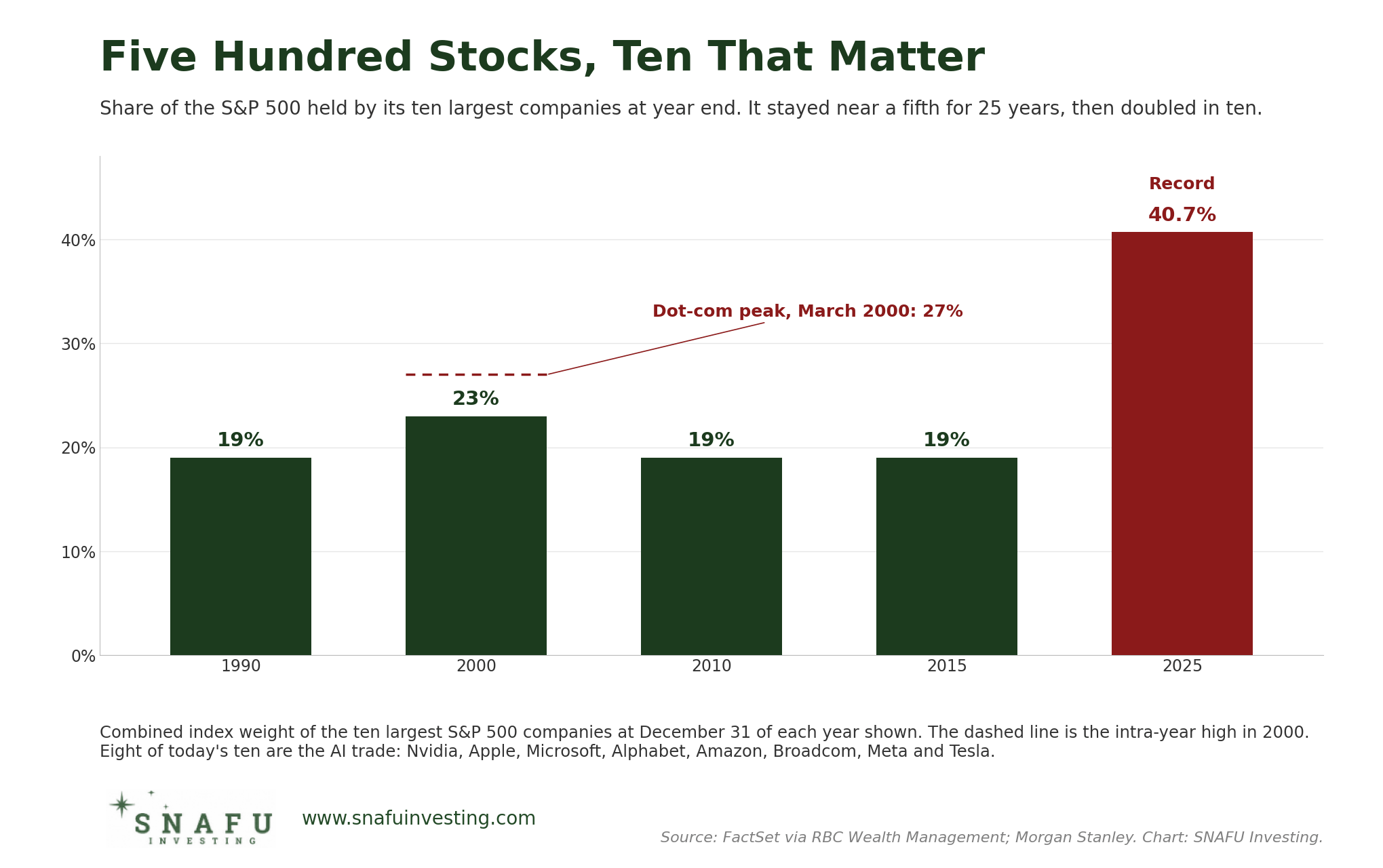
For one thing, it’s become extraordinarily concentrated. The ten biggest stocks, most of them tied to the AI trade in one way or another, now account for about 41% of the index. (Seven of them, the so-called Magnificent Seven, make up roughly a third of it on their own.)
And just two companies, Nvidia and Alphabet, Google’s parent, delivered nearly 30% of the market’s gains last year. Six delivered more than half.
Think about that. It’s like a company with 500 salespeople where two of them bring in a third of the revenue. Great, as long as those two keep selling. But what happens when one of them quits, has a bad year, or gets on the wrong side of the regulators? Suddenly, the whole company has a problem.
And if you’re reading this from outside the U.S. and thinking this is an American problem, think again.
In 2008, American stocks accounted for about 47% of the MSCI World Index, which tracks stocks across developed markets worldwide. Today, it’s over 70%.
So even if you own what you think is a globally diversified index fund, chances are nearly three-quarters of your money is invested in U.S. stocks. And a good chunk of that, as we’ve just seen, is riding on the same handful of AI-related companies.
That’s the market we’re in.
Enter the Democrats.
Fighting the Monster
Now, many people don’t realize this, but AI was actually a big issue in this election. Not the biggest, but big. In the NBC exit poll, 56% of voters said AI and data centers were a crucial or major factor in their vote, and those voters went nearly two to one for the Democrats. Data center measures were on the ballot in 41 places across ten states, and voters went against the data center in 40 of them.
What’s more, candidates in about 20 of the 36 governor’s races ran on data center moratoriums, and three of the ones who won did it in states Democrats aren’t supposed to win: Texas, Georgia and Ohio, all of them Republican strongholds the party hadn’t held in years. Texas alone, by one estimate, is a quarter of the U.S. data center capacity due to come online by 2030, and its new governor promised a ban on approvals until the legislature passes protections.
None of this came out of nowhere.
Most Americans have soured on AI. For three years now, more of them have said the technology worries them than said it excites them, and the gap between the two has never been wider. The chart below shows it.
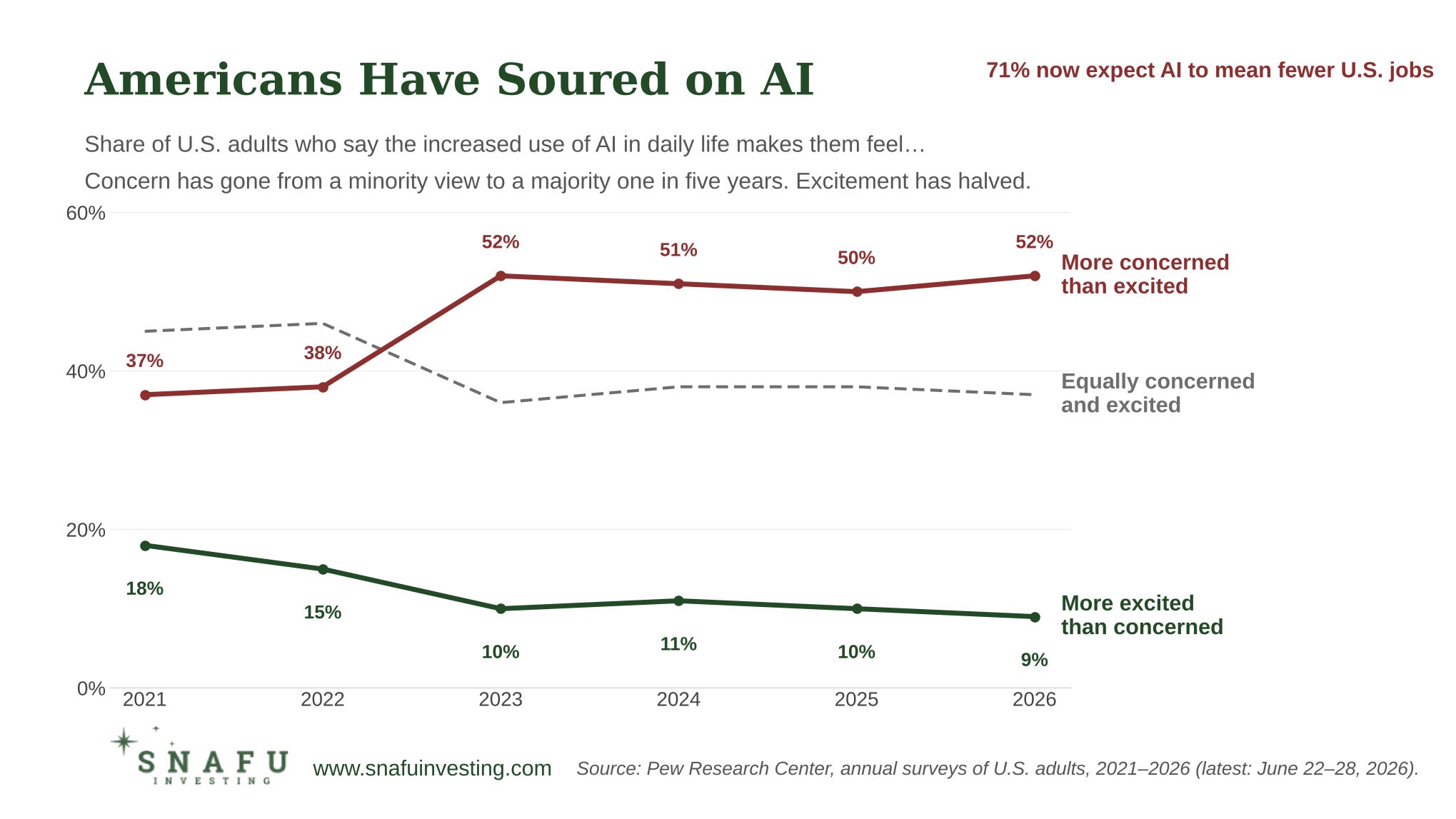
The Democrats read the American mood correctly. People are worried about AI and what it could do to their ability to put food on the table, and that was a big part of why they won.
And what did the Republicans do? Not much. Trump’s biggest contribution to the AI debate was renaming it “SI.”

This was an incredible failure to read the room. Americans don’t wake up in the morning thinking, you know what, this AI thing should really be called super intelligence. What a missed opportunity. They do, however, wake up wondering whether their job is next on the chopping block in the name of “AI-driven efficiency.”
So, having won on the anti-AI message, the Democrats will now want to be seen fighting AI. What might that look like?
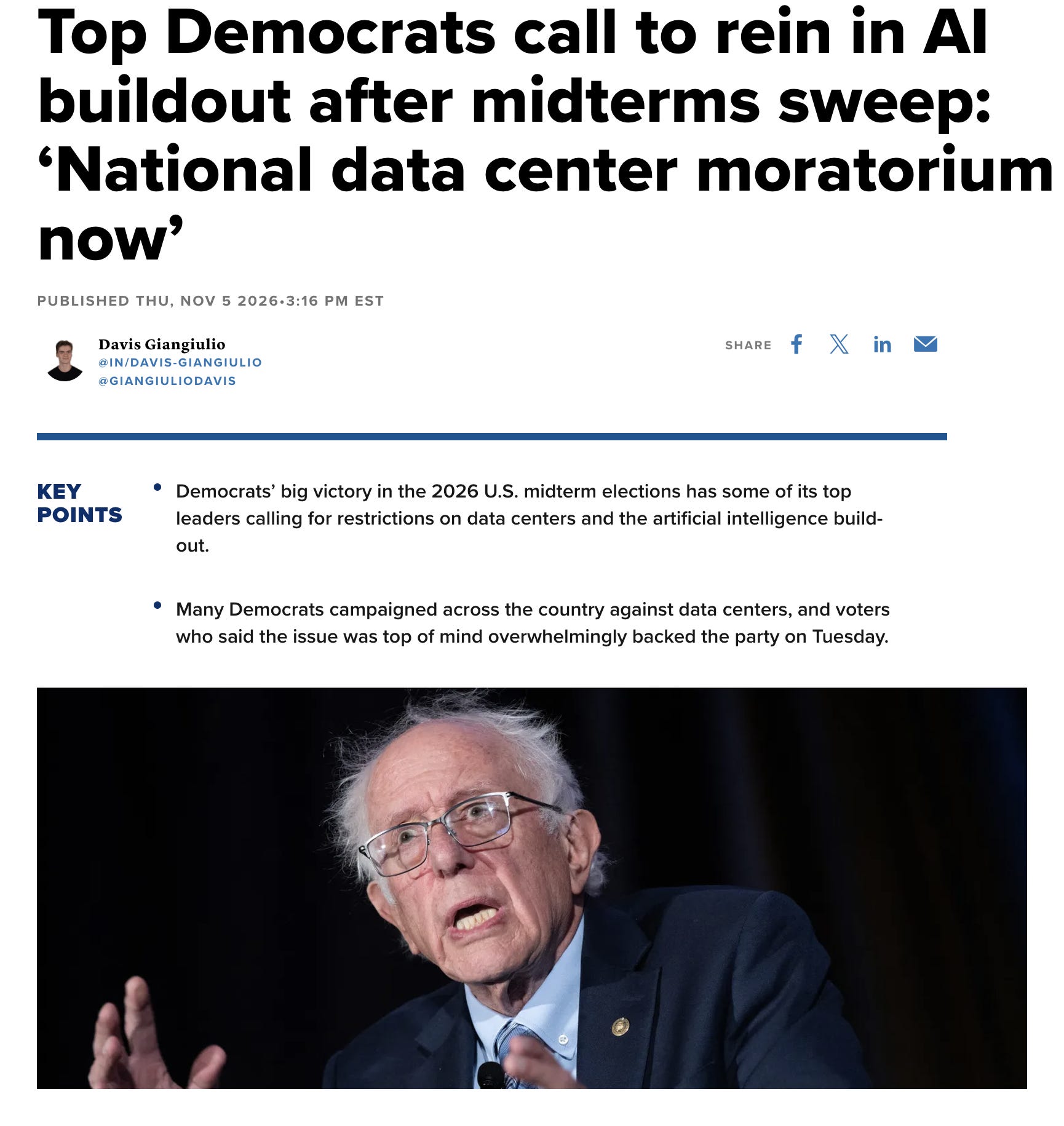
Well, Bernie spelled it out in the days right after the election: a national moratorium on data centers, a pause on advanced AI development, an outright ban on the next generation of it, and so on.
You might say who cares what Bernie wants. He’s a socialist, most Democrats aren’t (or so they’d tell you), and anyway their lot is owned by Silicon Valley too.
But here’s the thing. The Democrats who just won are not the Biden-era party anymore. (Democratic) socialists tripled their caucus in the House in these elections, and a whopping third of Democratic voters now call themselves democratic socialists. That’s a long way from the party of Chuck Schumer, which never met a big donor it didn’t like. (Five of the new Democratic senators, by the way, have already said they won’t vote for him as leader.)
As for Silicon Valley: the big AI super PAC bet “bigly” on deregulation this cycle, and, as we now know, the Republicans it backed mostly lost.
And remember, while a divided government may struggle to pass legislation, it doesn’t take an act of Congress to stop a data center from being built. The newly elected Democratic governors and local authorities can do plenty of that on their own.
One final point.
If AI mattered in this election, it’ll be a much bigger issue in 2028, because by then the job losses will really start to sting. The Democrats know that full well. Which means one thing: for the next two years they have to be seen fighting the “monster.” That’s if they want to keep what they just won and take the White House on top of it in 2028. So they’ll go hard, and they’ll go fast.
And if all that happens to sink a lopsided, top-heavy market that’s bet everything on one trade with the fundamentals nowhere (yet) in sight, well, too bad. (Democratic) socialists never had much love for the stock market, capitalism or one-percenters anyway.
Enjoy the rest of your weekend,
Lau Vegys
P.S. One of the reasons I started SNAFU Investing was to look for opportunities outside the crowded trades everyone on Wall Street seems to be chasing. You won’t find the usual Magnificent Seven suspects in our portfolio. Instead, we’re invested in carefully selected companies in sectors I believe have much bigger things ahead of them, regardless of what happens to the AI boom.
And here’s the best part. The market volatility of the past couple of months has pushed down the share prices of several of our picks, even though the reasons we bought them haven’t materially changed. In other words, some of the opportunities I liked before are looking even more attractive today.
And we’ve been taking advantage of that. We’re able to do so because we build our positions in tranches rather than going all-in from the start, keeping some powder dry for when opportunities like these come along.
If you’d like to see what we’re buying, why we’re buying it, and at what prices, consider becoming a paid subscriber to SNAFU Investing. You’ll get access to our full portfolio, monthly issues, special reports, and ongoing alerts and updates as things develop.
Well written and reasoned, and a good warning. Although I don't think the AI boom is going to crash overall, it will no doubt bounce hard and many of the overextended companies will collapse or be absorbed into the winners. All that is healthy in the long run. It is important to be well positioned and flexible. Keep plenty of dry powder and reserves. Meanwhile, SNAFU portfolio continues to be important to our overall market exposure. Thanks, Lau, for your insights and guidance.
Would you please begin seriously to examine the bond markets, particularly the market in US Treasury bonds? Methinks danger is afoot.