


So about a week ago, the Energy Information Administration (EIA) quietly put out its Uranium Marketing Annual Report for 2025.
It’s not a document anyone reads for pleasure. It’s basically a spreadsheet with a cover page. It comes out once a year, gets a paragraph in the trade press, and disappears. But it is the only place you can find out where the fuel in America’s nuclear reactors actually came from.
And if for some reason you found yourself perusing it, one number would stick out like a sore thumb.
Of all the uranium delivered to American nuclear power plants last year, 7% of it came from the United States.
That’s remarkable, because no country on earth burns more of it than America does.
We’re talking ninety-four reactors, the largest operating fleet in the world, producing about a fifth of all the electricity in the country. And it isn’t shrinking. As I write this, twenty of those plants are working through license renewals, and roughly 95% of the fleet now plans to run for eighty years or more.
And that’s before you count the three shuttered reactors being brought back from the dead: Palisades in Michigan, Three Mile Island Unit 1 in Pennsylvania, and Duane Arnold in Iowa (about 2.3 gigawatts between them). On top of all that, President Trump signed four executive orders last year aimed at taking American nuclear capacity from around 100 gigawatts to 400 by 2050.
Everybody Else’s Uranium
The point is, America needs a lot of pounds to keep all of that running. And it doesn’t have them. Because if it did, 93% of the uranium bought by domestic nuclear power plant operators wouldn’t be coming from overseas.
So where is it coming from? I put together a chart to show you exactly that.
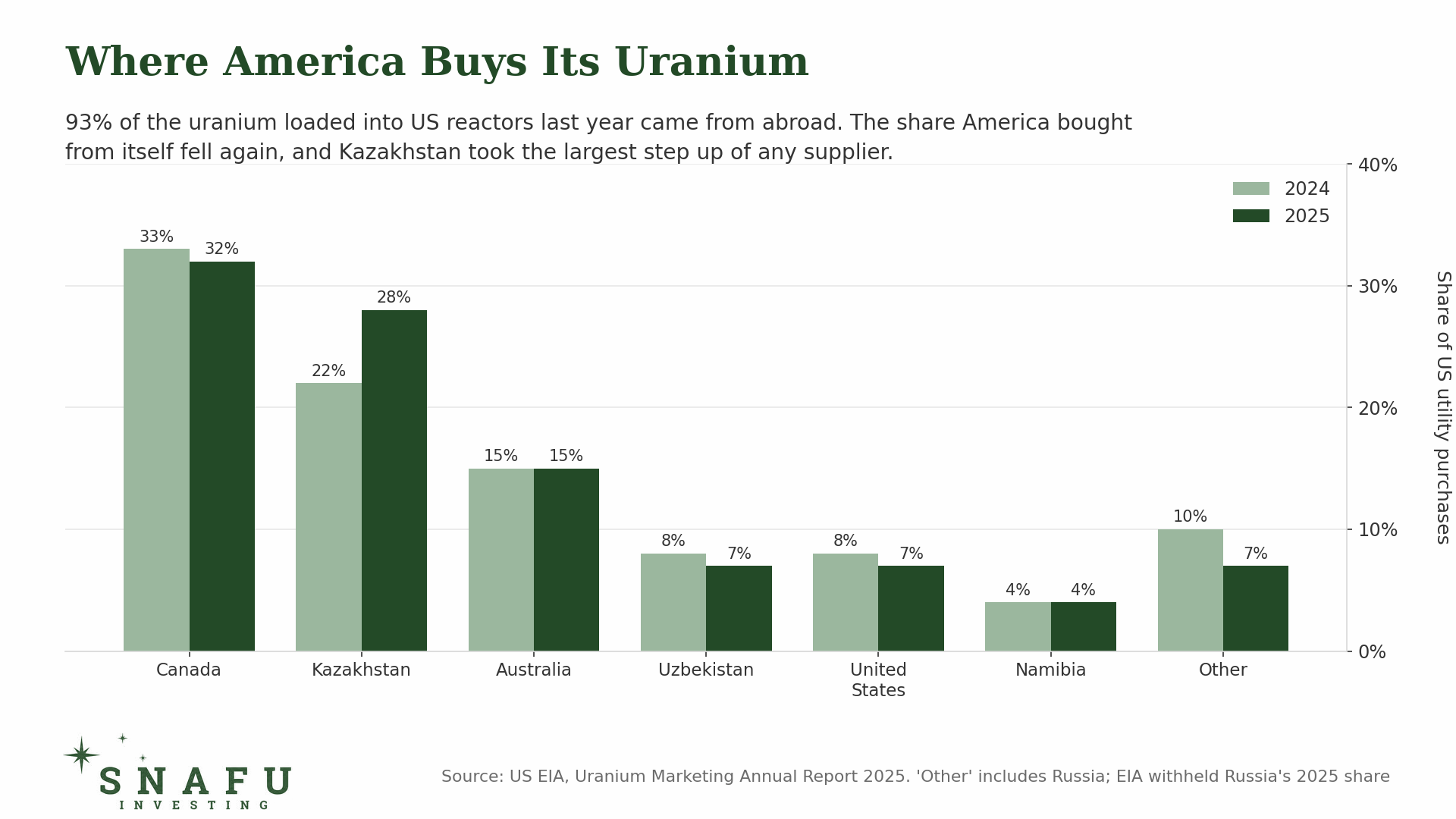
As you can see, Canada is the primary source, accounting for 32% of everything American utilities bought last year. Kazakhstan comes next at 28%, followed by Australia at 15%, Uzbekistan at 7% and Namibia at 4%.
Interestingly, that 7% America bought from itself is actually down on the year before, when the figure was 8%. So in a year when Trump was signing executive orders about domestic fuel production, American reactors ended up buying a smaller share of their uranium from America than they had the year before.
Just as interestingly, Kazakhstan went from 22% to 28%. That’s six percentage points in a single year.
If you’re surprised by that, you shouldn’t be. Kazakhstan is often referred to as the “Saudi Arabia of uranium.” In fact, it’s more than three times as dominant in uranium production as Saudi Arabia is in oil. This Central Asian republic produces about 40% of the world’s uranium.
You can see it in the chart below, which ranks world supply by the home country of the company doing the digging.
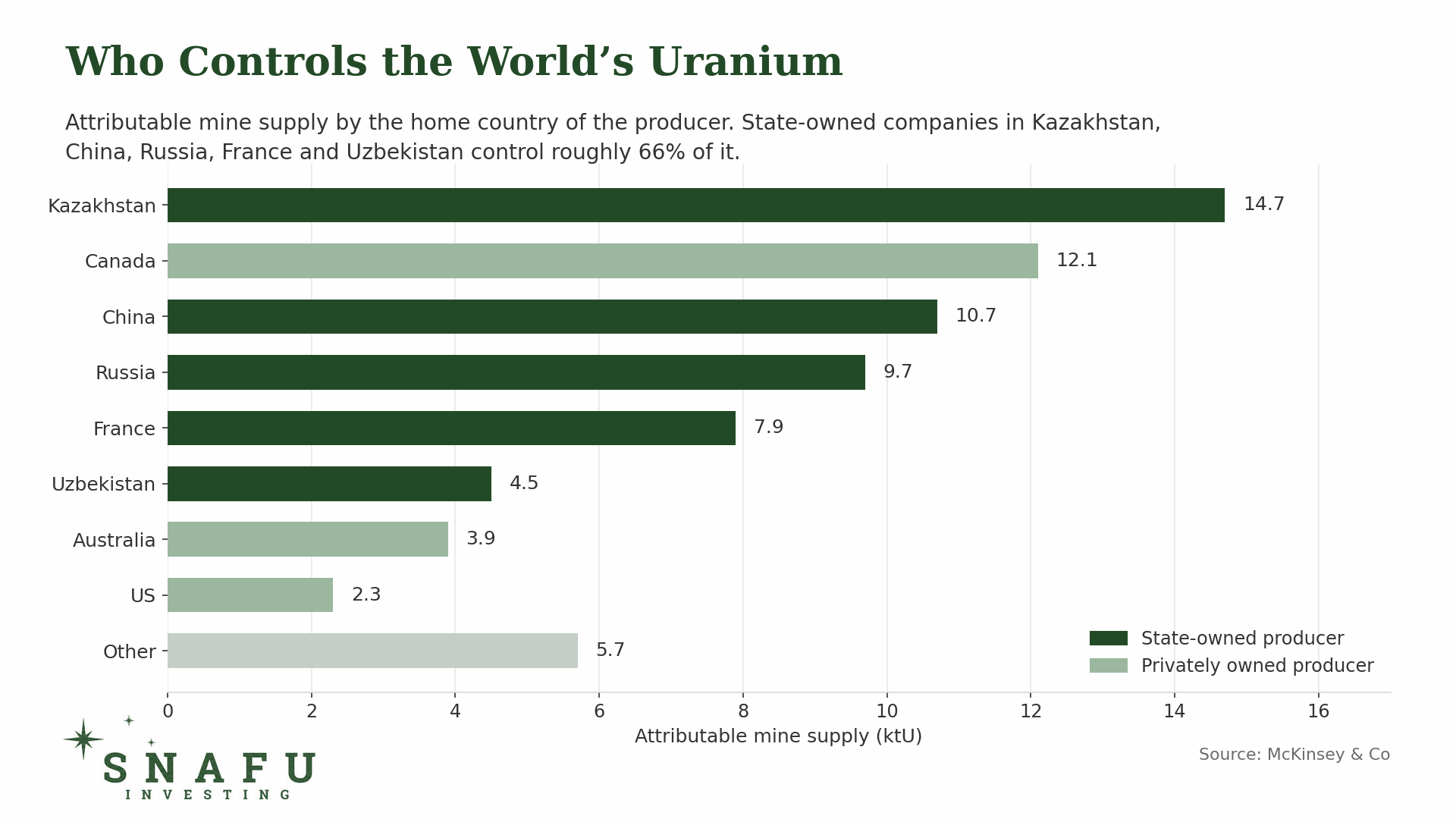
Add to that Uzbekistan, and over a third of American uranium comes from two ex-Soviet republics that aren’t especially stable and are increasingly looking eastwards.
What do I mean by eastwards?
Well, China basically.
China has spent the last few years quietly working its way into Central Asia’s uranium, and not necessarily by building mines of its own out there. By buying its way into the ones that already exist.
In December 2024, for instance, Uranium One, a subsidiary of Russia’s state nuclear giant Rosatom, sold its stakes in three Kazakh uranium entities: the Zarechnoye and Khorasan-U mining ventures, and the Kyzylkum processing operation.
Sold them to whom? Chinese state buyers.
And that’s just one deal. According to the World Nuclear Association, China now receives more than half of Kazakh production.
You get the point.
By the way, none of this should surprise anyone. China needs all the uranium it can get its hands on, because it is building more reactors than the rest of the world combined. If you look at the chart below, you’ll see just how far ahead of the competition it is. Each square represents a single reactor. The dark green ones are running today, the gold ones are under construction, and the paler shades show what’s planned and proposed. China’s block is more than twice the size of anyone else’s.
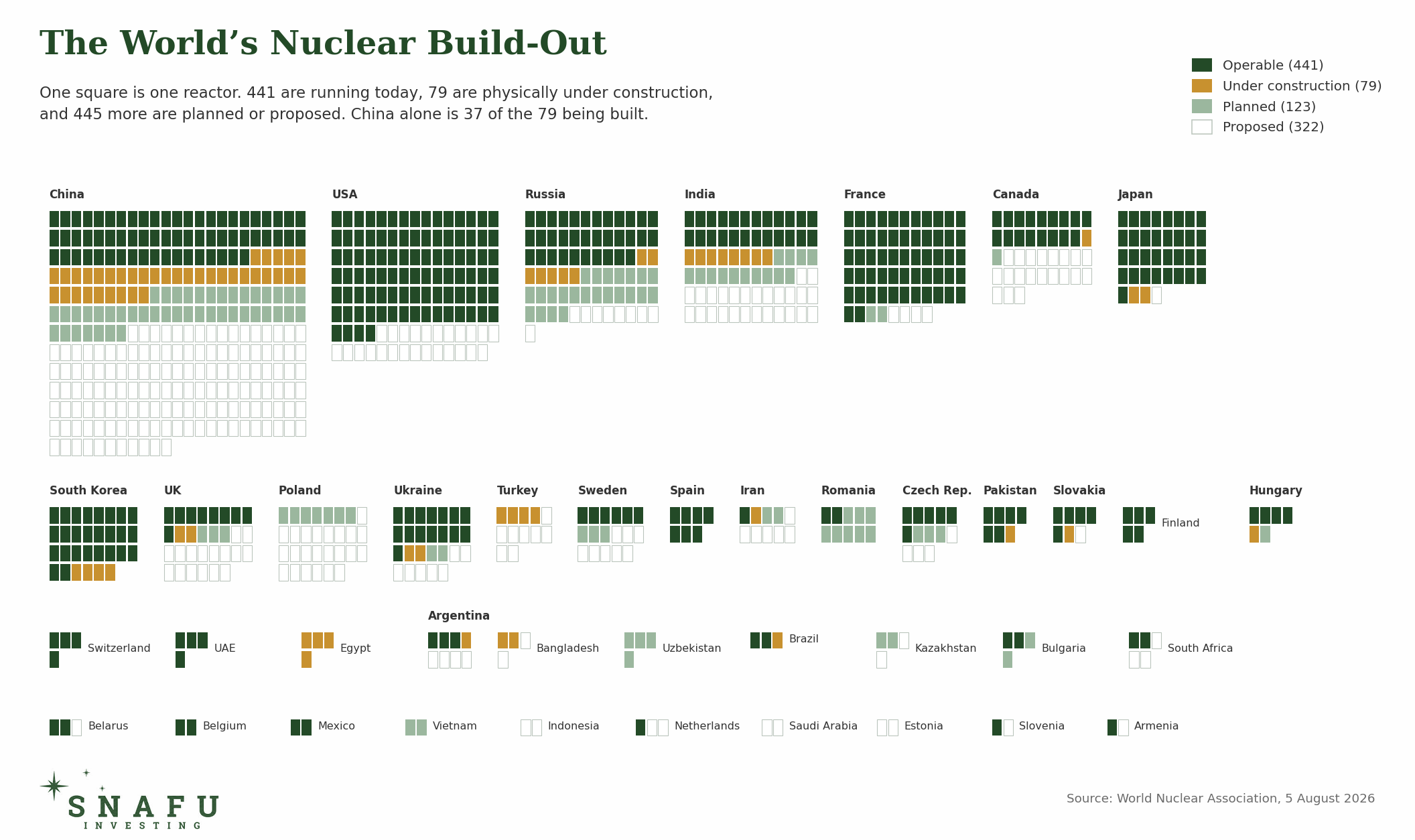
To save you all the counting of the squares, China has 64 reactors already running and another 37 going up right now. That second number is just under half of every reactor under construction on the planet. And that’s on top of a further 186 planned or proposed, and an official target of 110 gigawatts by 2030 against roughly 60 today.
All of which adds up to an appetite for uranium that isn’t getting satisfied any time soon.
Unsurprisingly, then, China pays well, it pays early, and it contracts years forward. That’s a hard combination for any producer to turn down. And out in that part of the world, most of them are state-owned, which means the decision isn’t purely commercial anyway.
In other words, America isn’t simply importing most of its uranium. It’s importing it from a region where China is the bigger customer, and where China is better placed to stay that way. It has the relationships, the checkbook, the patience, and often a shared border.
The U.S. government has a great many advantages in the world. Lasting influence in Central Asia has not tended to be one of them.
And the Pounds Are Only Half of It
But the thing to understand is that America’s dependence isn’t only about pounds in the ground.
As you may know, raw uranium is not suitable as fuel for nuclear plants. It needs to be refined into uranium concentrate, U3O8, commonly referred to as “yellowcake,” then converted into gas, and subsequently enriched.
It’s not uncommon for U.S. companies to buy yellowcake from some countries and then contract enrichment services in other countries.
And until recently, the country America leaned on for that last step was Russia.
I say until recently, because that arrangement is now illegal.
In August 2024, the U.S. banned imports of Russian low-enriched uranium. Waivers were permitted in the meantime, but they all expire on January 1, 2028, and the underlying prohibition runs to the end of 2040.
Okay. So a full year into that ban, who was actually enriching America’s uranium?
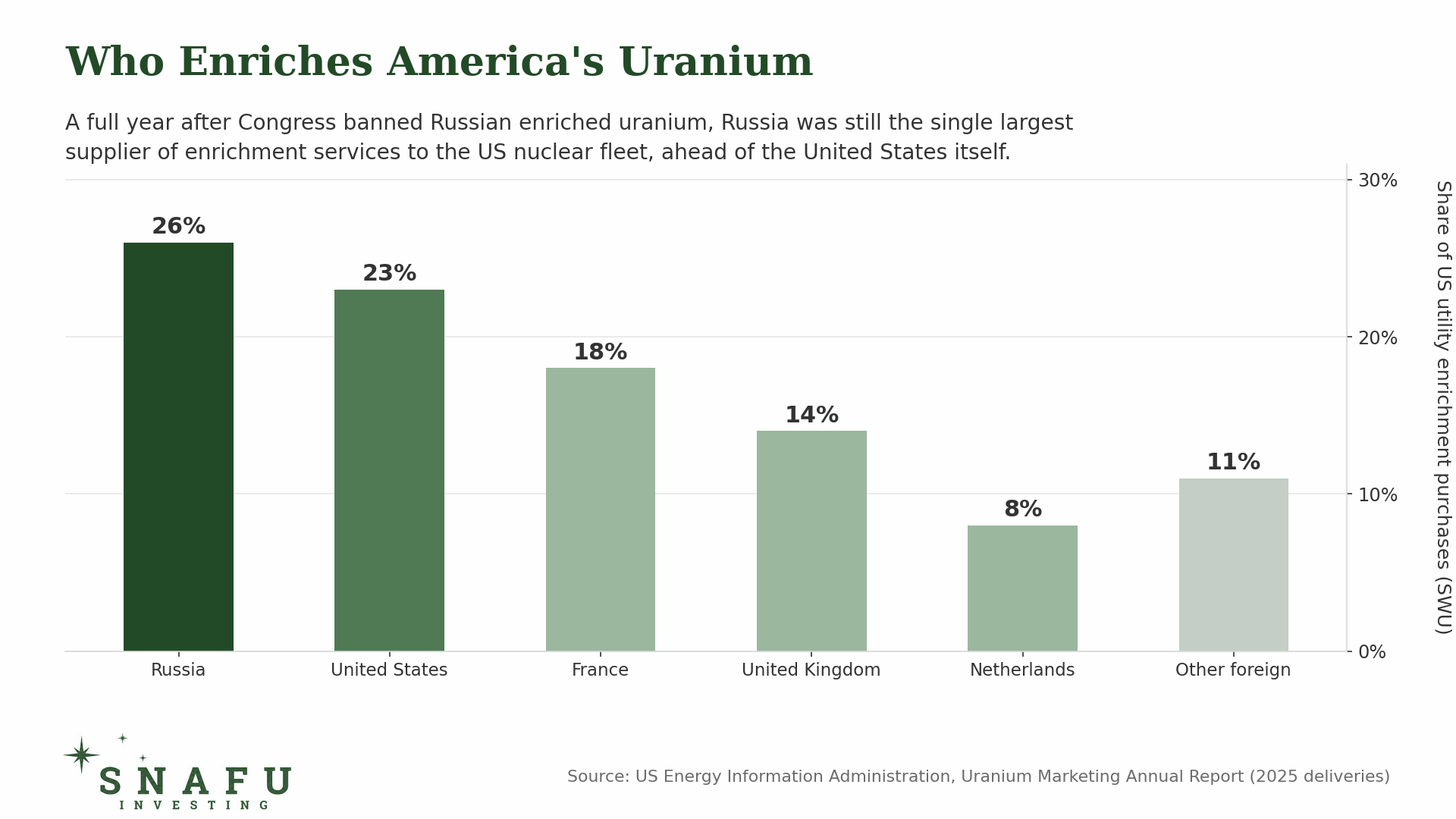
Well, turns out, it’s (still) mostly Russia. In fact, as you can see, Russia supplied 26% of it.
Which tells you that Washington isn’t in any great hurry to get rid of the Russian stuff. It has been handing out waivers and grace periods to keep it coming. Why? Because if you switched Russian enrichment off overnight, some American reactors would simply go dark.
So for now, even a year after Congress banned Russian enriched uranium, Russia remains the single largest supplier of enrichment to the American nuclear fleet.
Where This Leaves Us
As you may guess, all this leaves the U.S. in a bit of an awkward spot. It has to buy an enormous quantity of uranium, for years, out of a pool that keeps getting smaller.
And despite President Trump’s slew of executive orders, an order doesn’t produce a single pound. Permitting a deposit, drilling it and commissioning a plant takes years, and America has spent four decades barely doing any of it. Worse, the enrichment waivers American utilities have been riding on expire on January 1, 2028, and the Western enrichment capacity meant to replace all that isn’t ready yet.
I go into all of this and a good deal more in the uranium report I put out last week for paid subscribers. But suffice it to say, this is an opportunity for U.S.-based uranium producers, because America now has to replace a great many imported pounds and a great deal of Russian enrichment, on a deadline.
And remember, none of this is happening in a calm world. We’re in the middle of a major energy crisis right now, and despite China’s best efforts, it keeps rolling on.
Which makes it a very good time to own the uranium companies that have already made headway on American soil.
Situation normal. Position accordingly.
Have a great rest of the weekend,
Lau Vegys
P.S. The uranium story is the reason why, for our first ever SNAFU Investing recommendation, I chose a uranium play. A producing uranium company based in the U.S., which puts it in about as good a position as a company can be in when the country it sells to imports 93% of what it burns. And no, it isn’t one of the usual suspects like Uranium Energy Corp. As I write this it is still trading below my buy-up-to price. If you’re on the free list and you’ve been meaning to upgrade, this is a reasonable week to do it.
Lau, I did finally get time to read your white paper Uranium Report. Great work, as is this quicker summary. I'm already invested in your US recommendation. I'll put in some more. Thanks for the reminder. Of course it's still small speculative investment, but the right place to be possitoned in this space. I hope you'll go more into how we're going to rapidly improve our uranium processing supply chain. Any of us, given a moment of reflection, can see why the shouting and positioning by Trump Adm is so misalighned at the fundamental level with what we need to keep our industrial base or rebuild what we have left, and yet politics for this gang is no different that politics for all the administrations around the world (with a few exceptions). I hope, honestly, that inspite of the apparent threats, sanctions, bullying from the megaphones in power around the world, in fact the Chris Wrights and Scott Bessants of the world have some clear through put to their counterparts enough so to keep us on course inspite of the storms. Also, Lau, regardubg using spent fuel as France and Japan are able to do with their different style reactors. Any progess or suggestions there? Keep up the good work. Jay
Hi Lau. Where do you think Thorium fits in this whole picture? Enjoying your detailed analysis. Thanks Sier