

Lau here.
As I wrote earlier this week, the Fed went ahead and raised rates by a quarter point, its first hike since 2023.
On paper, that should be bad news for gold. Higher rates make cash and bonds more competitive with a metal that pays no interest. They also tend to support the dollar.
And since gold and silver are major themes in our portfolio, I wanted to send you an update on what this hike means for us.
I’ll get to some of our individual positions below. But first, let’s look at what happened after the decision, because the market’s reaction was telling.
As you may know, gold initially sold off, especially after Fed chairman Kevin Warsh made it clear that another hike could follow.
But then the buyers stepped in.
By Friday, gold had recovered and finished the week up 0.5%. Silver did even better, ending 3.1% higher.
I, for one, find that interesting.
The Fed raised the price of short-term money, which pushed up the yields available on shorter-term Treasuries. In plain English, investors could suddenly earn more by lending money to the government for a couple of years.
Long-term yields, of course, barely moved. The Fed does not control those directly. So the gap between short-term and long-term rates narrowed. That is what people mean when they say the yield curve “flattened.”
That combination is not supposed to be friendly to precious metals.
Yet gold and silver absorbed the hit and finished the week higher anyway.
On top of everything else we have seen this year, that is another confirmation that there is real buying underneath this market. More importantly, it tells me the forces driving this bull market are bigger than one quarter-point rate hike.
Again, that does not mean we will not see volatility and weakness in the weeks ahead. We almost certainly will. That is precisely why I sat down to write this alert.
But because we build our positions in tranches, that weakness is more of an opportunity than a problem. It gives us the chance to add at better prices. (If you need a refresher on how the tranche system works, I laid it all out here.)
Before we get to the individual names, though, we need to understand what the Fed is really up against, and what it can realistically do from here.
The Fed Cannot Print Oil
The official explanation for the hike is simple enough.
Gasoline was up 27% from a year earlier, while producer prices for diesel jumped 24% in August alone. Brent crude pushed back above $100 as the fight over the Strait of Hormuz dragged on.
The Fed saw inflation moving in the wrong direction and decided it had to look tough.
There is just one problem.
The Fed can set the price of money. It cannot produce a barrel of oil. It cannot keep the Strait of Hormuz open, end the war or manufacture the metals the world is running short of.
And this is hardly the first time inflation has outrun the Fed’s promises.
If you take a look at the chart below, you can see just how consistently it has done so. The chart uses CPI rather than PCE, the Fed’s preferred inflation gauge. But whichever official measure you prefer, the basic picture is the same.
Inflation has now been above 2% for six straight years.
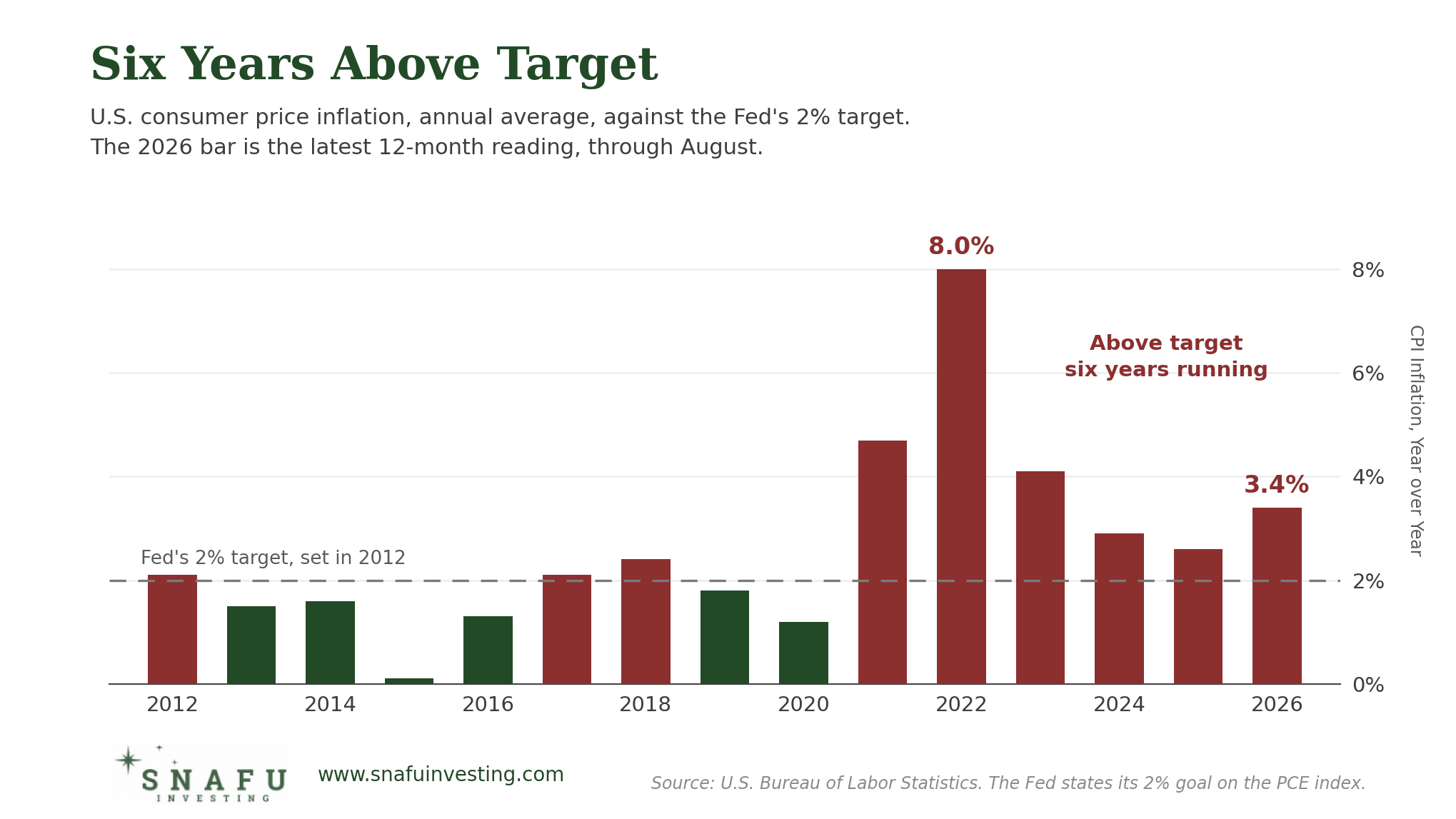
Six years.
Remember, the Fed already raised rates by 525 basis points from 2022 to 2023. It still failed to bring inflation back to target.
Now it is raising rates again in response to an oil shock it cannot control. All that can really do is make money more expensive and the economy weaker.
So why do it?
Credibility, at least in part.
After six years of above-target inflation, the Fed cannot simply sit on its hands while prices begin climbing again. A quarter-point hike allows it to show that it is serious, even if it is prescribing the wrong medicine for the disease.
That is how I see this move. It looks less like the beginning of another Volcker-style hiking cycle and more like the Fed trying to prove that it still means business.
It may even hike once more. But one or two hikes are very different from a sustained campaign to force inflation back to 2%.
And there is another, much bigger reason I doubt the Fed can keep raising rates from here.