


So a few weeks back, BlackRock CEO Larry Fink was up on stage at Texas State Technical College in Waco, sitting next to Texas Governor Greg Abbott.
It wasn’t a particularly interesting conversation, to be honest. But then he said something that caught my attention. Fink casually said that the trillions of dollars needed to build AI data centers in America “will come from savings accounts, from pension accounts, from insurance companies.”
The Governor nodded along. Take a listen.
Now, I originally posted this video as a Note on my Substack, and a fellow - let’s call him Jerry - sent me a comment. Here’s what he wrote, unedited:
You’re an idiot. He’s simply saying that our capital, invested in the market, will be used to fund AI, mostly because it’s seen as a good investment. I’m certain you can chose to invest your money in companies not involved in AI.
He’s since deleted the comment, taking my rather long reply along with it. But it got me thinking. Jerry probably isn’t alone in believing this. That you can simply “chose to invest your money in companies not involved in AI.” (That’s basically why I sat down to write this today.)
Of course, what Jerry probably missed is that Fink isn’t just another guy with an opinion. He runs BlackRock, the largest asset manager in the world. About $11 trillion of other people’s money. And a very large share of that money sits in American retirement accounts. BlackRock’s iShares is the biggest ETF family on the planet, and its LifePath target-date funds are the default investment option in thousands of 401(k) plans across the country. If you have a 401(k), you’re probably already their client, whether you like it or not.
Now, as you may or may not know, the funds in your 401(k) are required to hold whatever’s in the index, in the same weights. So if you own an S&P 500 fund, you own whatever the S&P owns. And about 35% of the S&P right now is the Magnificent 7: Apple, Microsoft, Alphabet, Amazon, Meta, Nvidia, and Tesla. Every one of them is up to its neck in AI. Microsoft backs OpenAI (more on that in a minute). Alphabet runs Gemini. Meta has Llama and is building data center campuses. Amazon backs Anthropic and runs the cloud most of this sits on. Nvidia sells the chips. Apple and Tesla bake AI into the products. So 35 cents of every dollar in an S&P 500 fund goes to AI by default.
But sure, I guess you could technically opt out. Liquidate your index funds, build a custom non-AI portfolio (good luck excluding everything that touches AWS or Azure, the cloud platforms most of the internet runs on), and give up your 401(k) employer match.
None of this is really an option for most working people.
So no, you can’t really “chose to invest your money in companies not involved in AI.” And it’s worse when you’ve got a guy like Fink calling the shots, who - let’s just say - probably doesn’t have your best interests at heart. After all, this is the same man who for years pushed for woke capitalism and ESG investing. Under his leadership, BlackRock shifted decision-making power in American capitalism away from shareholders and towards so-called stakeholder capitalism. He prioritized Net Zero emissions, board diversity, and “purpose-driven” commerce over actual value creation. A buddy of Klaus Schwab, he’s now interim co-chair of the World Economic Forum, part of the “Great Reset” crowd advocating for people to “own nothing and be happy” by 2030.
Quite a resume.
The Great Pivot
Wait a sec. Isn’t it curious that the same people who spent the last decade selling you Net Zero and ESG are suddenly all in on data centers? Which, for what it’s worth, are the most energy and water intensive infrastructure humans have ever built at scale.
And Larry isn’t the only one here. Just take everyone’s favorite philanthropist, Bill Gates. The man behind some of the most questionable global initiatives of the past twenty years. And, while we’re at it, a former pal of Jeffrey Epstein.
For a solid decade, Bill has been the loudest voice on climate. He’s done it all. Apocalyptic warnings, cow flatulence detours, the “we need to dim the sun” geoengineering pitches, the whole package. Then, on his 70th birthday last October, he publishes a 17-page memo titled “Three Tough Truths About Climate.” And here’s the quote that would have caught your eye, had you had some time to waste reading it.
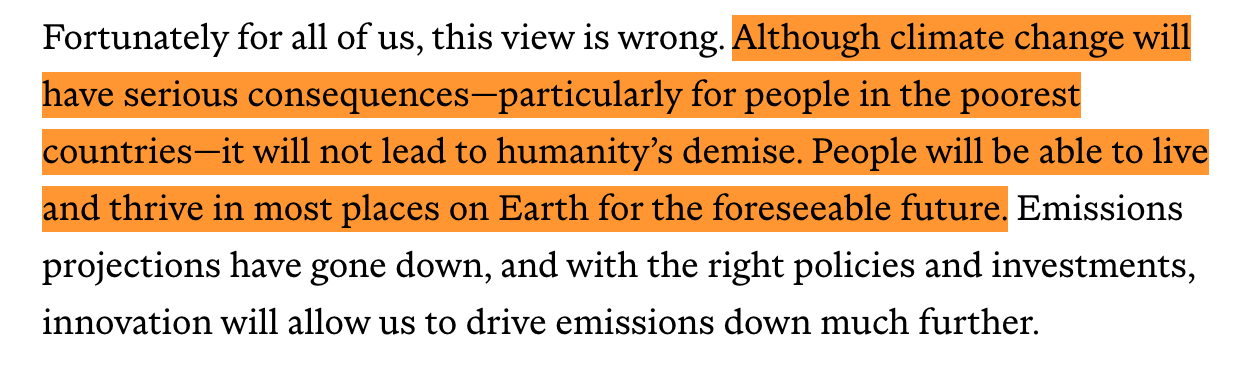
Imagine that. If that isn’t a 180 on a decade of his own climate evangelism, I don’t know what is. And what’s the new metric Bill wants everyone to refocus on instead of emissions and temperature?
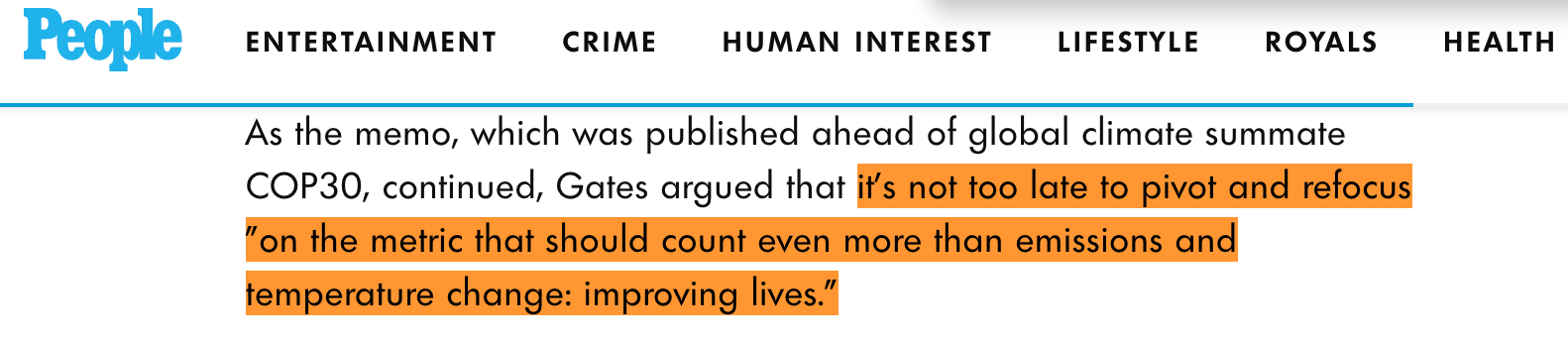
Ah, improving lives. Of course. Surely this sudden change of heart doesn’t have anything to do with something more earthly. Like, I don’t know, money. And power.
Bill’s money and Bill’s power, to be specific. Both come from Microsoft, the company he founded and still owns billions of dollars worth of stock in. Microsoft is in the middle of the largest AI infrastructure buildout in human history. Roughly $80 billion per year going into AI data centers. Microsoft is also the largest backer of OpenAI.
Larry and Bill are just two examples of how the climate scare is being quietly ditched in favor of something the same people find a lot more profitable.
Now, before we go further, let me say something up front. I don’t necessarily have a problem with AI as a technology. For better or worse, it’s just the logical progression of human achievement. Something that would have happened sooner or later given our penchant for improving things incrementally. Tools are tools. Like the internet, or for that matter like guns, they can be used for good or for bad depending on who’s holding them.
What I have a problem with is how it’s being built. How it’s being paid for. How it’s going to be used, and for what purpose. And what may soon be happening to anyone who objects.
Four things.
Well, we just talked about the paying part. And the using part I covered in a recent essay on this very subject. So let’s walk through the other two.
What They’re Building
There are now nearly 4,200 data centers in the United States. That’s roughly eight times more than either Germany or the United Kingdom, the next countries on the list.
The reason is simple: capital. American tech companies have been throwing every dollar they can find at AI infrastructure for the past three years. Spending on data center construction has grown 336% since 2022, and now sits at about $50 billion a year. For the first time in U.S. history, that’s more than what the country spends building office buildings ($43 billion, and shrinking). Take a look at the chart below.
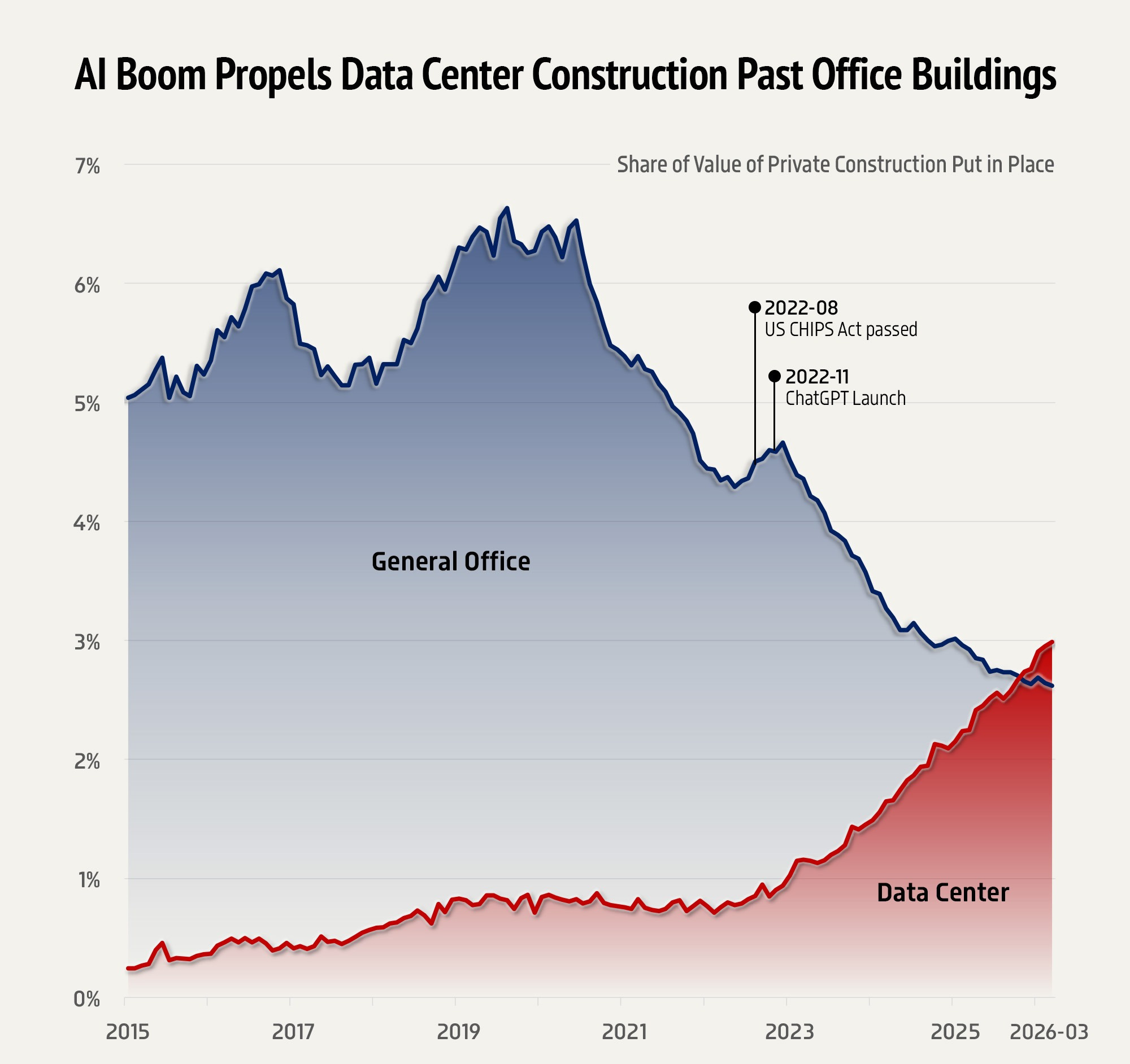
The American economy is now physically rebuilding itself around data centers. In fact, Harvard economist Jason Furman recently calculated that without investment in data centers and information processing technology, U.S. GDP growth in the first half of 2025 would have been about 0.1% on an annualized basis. Effectively zero. A growing number of economists now think the country would already be in recession if not for AI capex.
That’s how big this thing has gotten.
Now, these things, what the industry calls “hyperscale” data centers (the really big ones owned by Google, Amazon, Microsoft, Meta, and a few others), are absolute power hogs. A single hyperscale facility consumes more electricity than 500,000 homes. Which creates two problems for the people who happen to live near where one is being built. First, your electricity bill is about to go up, because the local grid suddenly has a customer drawing more juice than a midsize city. Second, your land may be next.
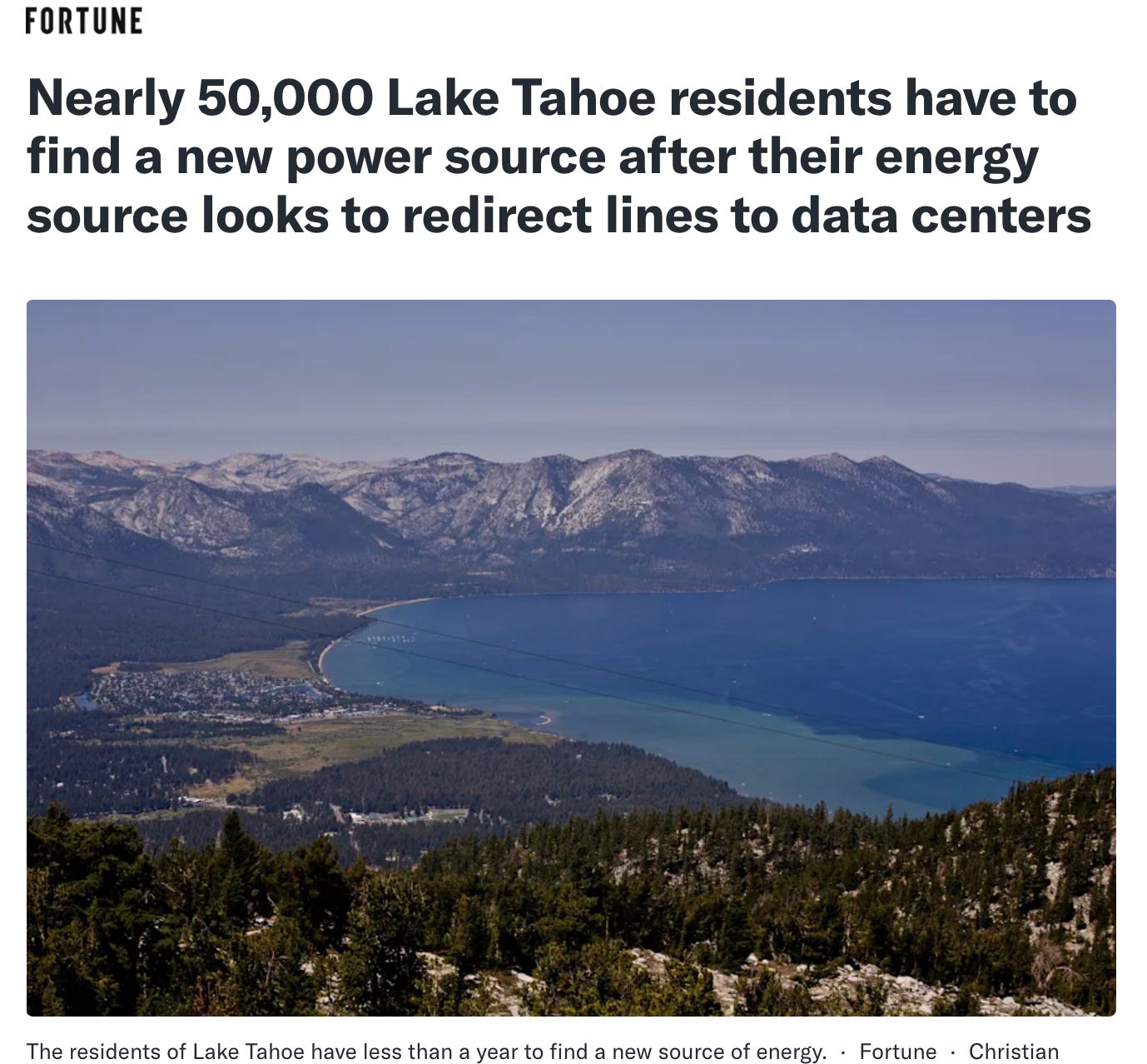
On electricity, you might have already heard about Lake Tahoe. Earlier this year, the residents (about 50,000 people) were told by their local power supplier that the supplier was redirecting grid capacity to data centers. Their options were to wait years for new transmission infrastructure, or pay two to three times the wholesale electricity rate.
Now about the land. Across Georgia, Kentucky, and Virginia, journalists have been documenting the same pattern. Homeowners receive letters from utility companies informing them that high-voltage transmission lines will be running through their property. The lines are being built to serve data centers that haven’t been publicly identified. The legal mechanism is something called eminent domain. In plain English, that’s when the government (or, increasingly, a private utility acting under government authority) takes your land for “public use.” The Constitution allows it. They have to pay you something for it. But you don’t get to say no.
In Georgia, a woman whose childhood home is being seized for a transmission line told reporters that her family had lived on the land for generations. Nobody asked her if the line could go elsewhere. The notice arrived. That was it.
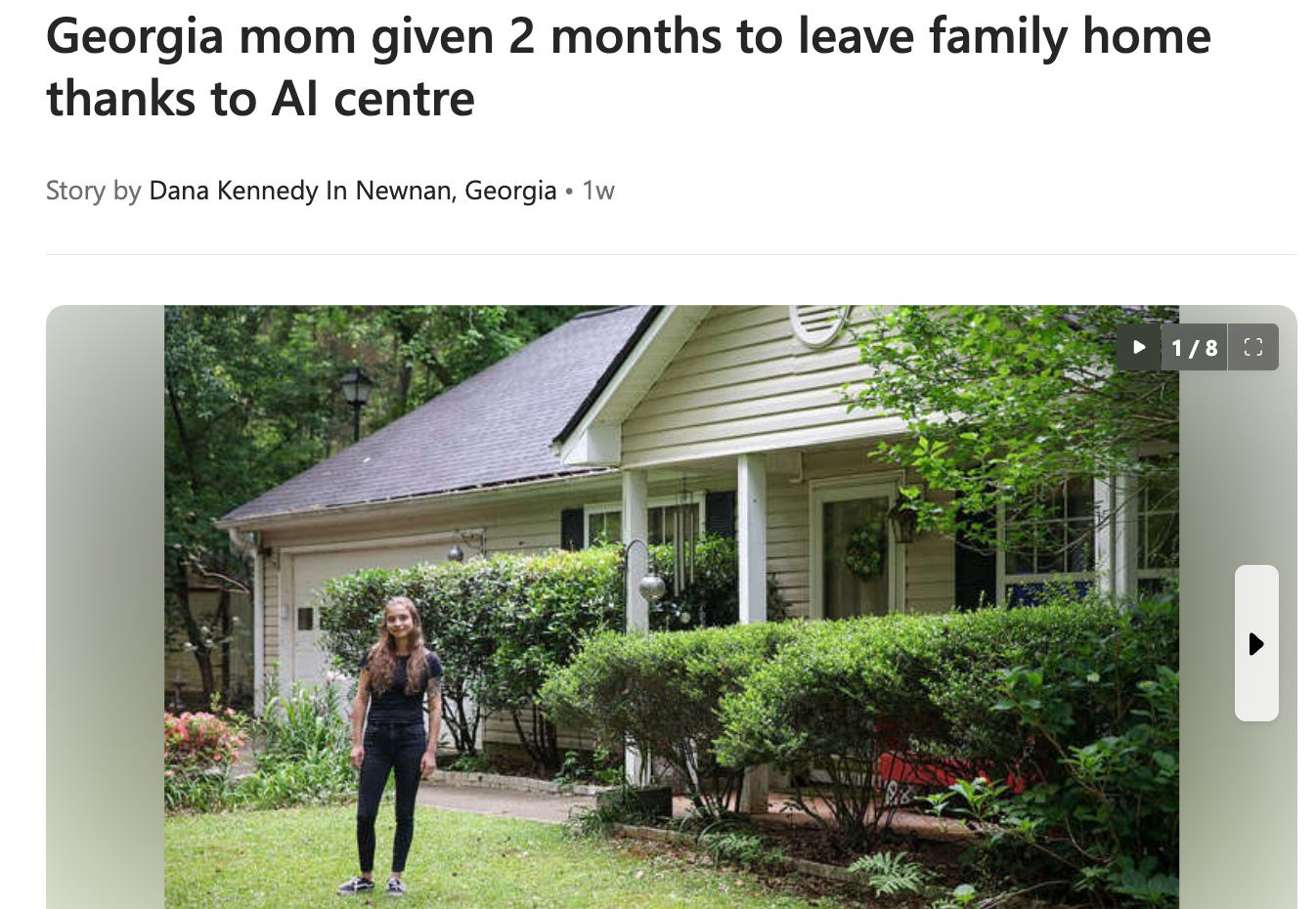
In Kentucky, more than a dozen farmers have received similar letters. In Virginia, one farmer was offered $1,500 per acre for land that’s worth, by his own assessment, ten to fifteen times that amount on the open market. He doesn’t have to accept the offer. But if he refuses, the case goes to court. And in court, he loses.
Interestingly, the companies actually building these data centers are increasingly invisible. Google has used shell companies to keep its data center activity quiet in at least five U.S. cities. In Texas, the company operated through “Sharka LLC” and “Jet Stream LLC.” In Ohio, “Magellan Enterprises LLC.” In Minnesota, “Harmony Group LLC.” None of these are identifiable as Google from public records.
It’s basically the same playbook Disney used in the 1960s, when they quietly bought up thousands of acres in central Florida under fake corporate names for what would become Disney World.
That’s not to mention what living next to one of these things actually feels like. Apartments doubling or tripling in rent within months of a construction announcement (Louisiana, Meta). Local water utilities projecting deficits that will essentially end all new residential permits within five years (Newton County, Georgia). A nonstop low-frequency drone that residents compare to a helicopter hovering over their neighborhood day and night (Virginia). It’s a long list of real inconveniences.
Now, the point I’m making here isn’t that every community is uniformly opposed to these buildings. Nor that they should be. I’m sure that many local governments, for example, welcome the property tax revenue. The point is that locals don’t really get a choice. The decisions are being made above their level, by entities they can’t see, for purposes they aren’t really allowed to question.
What Happens If You Object
So suppose you live in one of these communities, and you don’t like it. You show up at the local zoning meeting. You write to your senator. You start a group of neighbors planning to file suit against the next data center proposal in your county. Maybe you even hop on Facebook and vent. Drop a few choice words about your corporate and political overlords.
What happens to you?
Well, probably nothing for now. But you just watch.
In April, the New York Intelligence Bureau, a department of the Department of Homeland Security, quietly introduced a new threat category: “Anti-Tech Violent Extremism.”
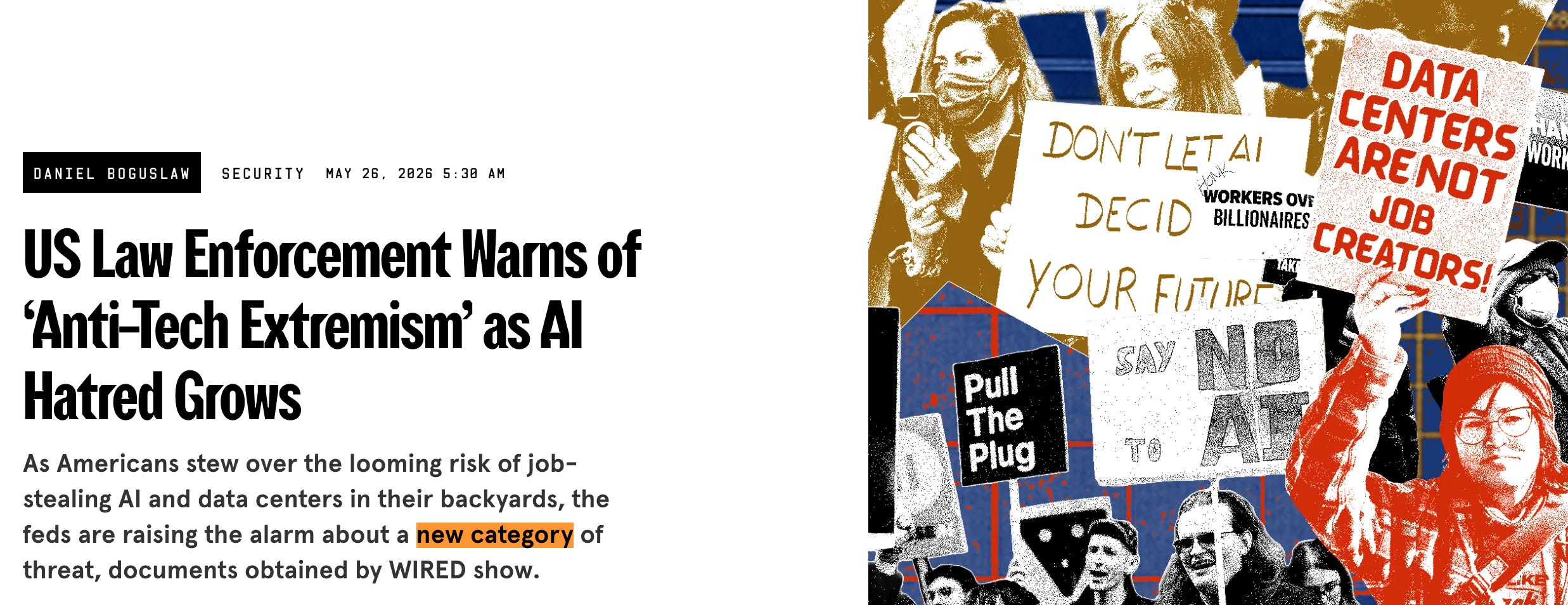
Now look, anti-tech violence has happened. It’s a real thing. Ted Kaczynski, the Unabomber, killed three people and injured over twenty more between 1978 and 1995, mailing homemade bombs to scientists, computer-store owners, and airline executives, all from a remote cabin in Montana where he was writing a 35,000-word manifesto called “Industrial Society and Its Future.”
So in theory, having a federal threat category for that kind of thing isn’t exactly crazy.
At the same time, putting any stock in what the government decides counts as terrorism is a dangerous business under the best of circumstances. And this particular category, as written, is broad enough to encompass writing critical of AI, organized opposition to data center construction, and any “anti-corporate” rhetoric coupled with what the federal government chooses to call “intent to disrupt.”
Which means, for instance, it’s certainly broad enough to include the woman in Georgia fighting to keep her family’s land from being seized. Or the farmer in Virginia organizing against the next transmission line. And it’s certainly broad enough to include you, if you happen to decide you don’t want one of these things in your county and you organize against it loud enough.
In any case, I suspect this is just the beginning of an effort to get you to do exactly what former Google CEO Eric Schmidt told a graduating class recently when they booed his AI cheerleading: “Find a way to say yes.”
Regards,
Lau Vegys
Good article, Lau, and it should be read by everyone. Interesting that Peter Thiel just moved to South America to escape the California taxes; but also said that AI is not going well in its harnessing in the states. Wonder what he has planned.???!!!. They simply cannot leave people alone in their quest for power. While AI is going to go well in some aspects of business; trying to work with it's problems is hard. No sense fighting the Data Centers. People just do not have that kind of money for the courts.
I’m just waiting for the day when the Department of Human Stupidity (DHS) decides to issue an arrest warrant for both Sen Bernie Sanders and Rep Alexandria Ocasio-Cortez. Then we’ll know that they’ve really gone bonkers.