


Lau here, writing from Spain.
I launched SNAFU Investing two days ago. Yeah, I know — not the most conventional name for an investment publication. There’s a real story behind it, and it’s all in the launch essay. But before any of that, the most important thing that happened last week — the one I suspect a lot of you skimmed past in the launch essay itself.
And for most folks, it probably slipped under the radar, buried beneath the renewed shooting in Hormuz. But it may be the more significant story of the two.
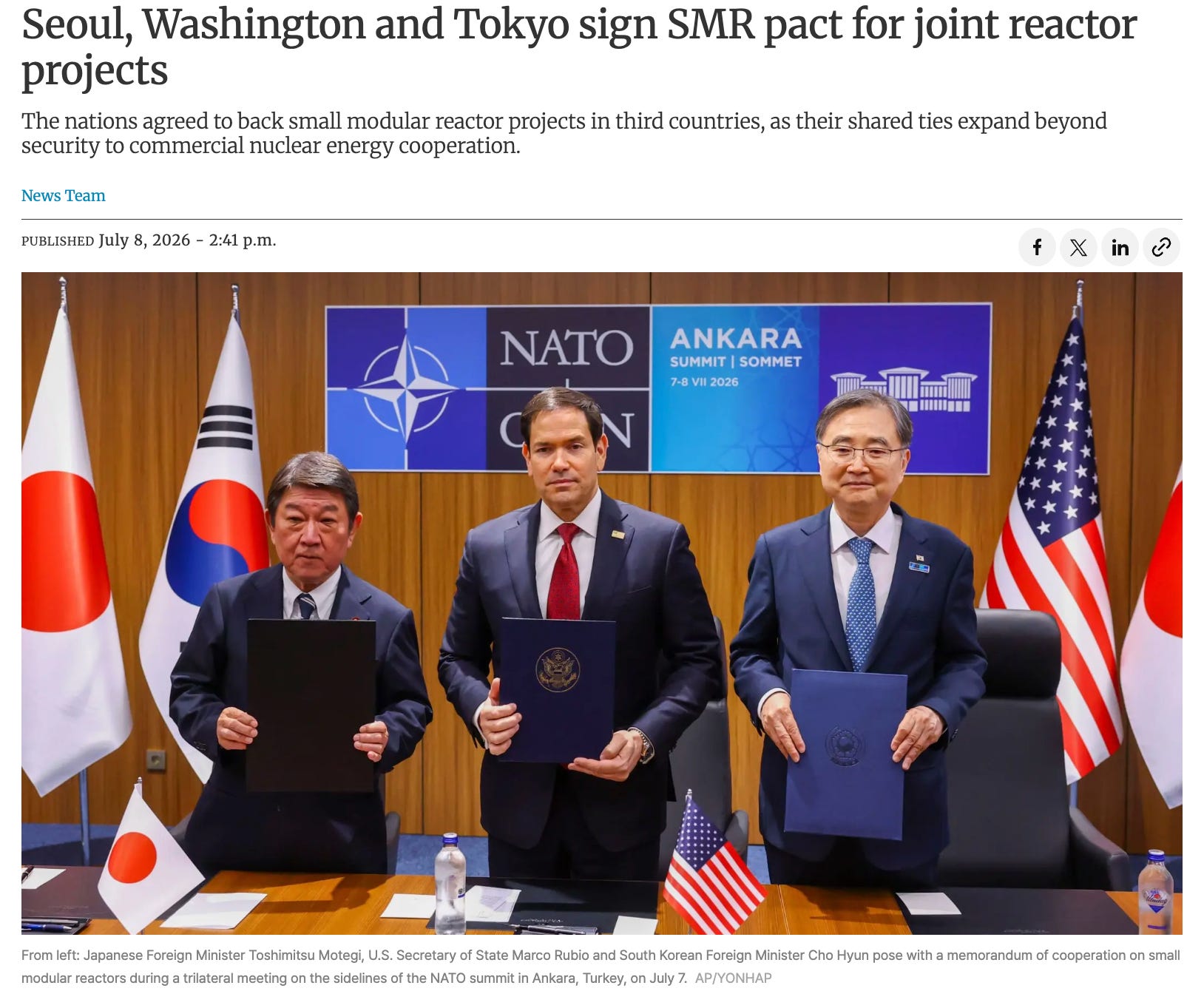
Japan and South Korea just signed an agreement with the United States to jointly deploy small modular reactors, or SMRs, across Asia and beyond.
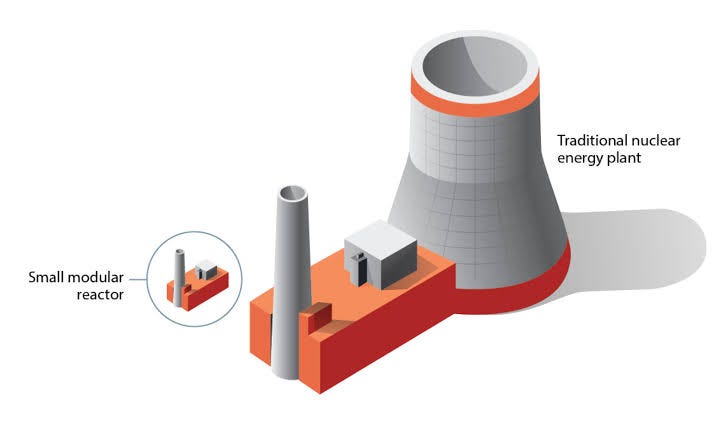
SMRs are exactly what they sound like: smaller, factory-built reactors, designed to be faster and cheaper to stand up than the giant conventional plants of the past. That size — just look at the image below for the difference — lets them put nuclear where a traditional plant never could: remote sites, smaller grids, even data centers. More reactors, in more places, means far more demand for the fuel that runs them: uranium. And three of the world’s most important economies just signed on to making it happen.
One paid subscriber, a former submariner, put it better than I could:
Been reading your free stuff for a while now, and I joined this morning. As a side note, I spent several years under water in subs. We had a small nuclear reactor that I spent years next door to. The Navy has had them for many years now with no problems. The technology is there and proven.
— Nelson
This deal gets at the heart of something I’ve been banging the table about for years. For all the noise about the West and nuclear, the real turn is happening in Asia.
Go back to Fukushima in 2011. Before the meltdown, Japan was a nuclear powerhouse, drawing roughly a third of its electricity from reactors. After it, the country panicked — shutting its entire fleet, one plant after another, and setting the industry back by years. Much of the world followed. That reflex is now clearly reversing, and the SMR deal is just one piece of it. And where Asia leads on this, other countries will follow — exactly as they did on the way down.
What drove it home was Hormuz. This spring, one strait — a fifth of the world’s oil and gas — turned into a shooting gallery, and every energy-importing country got a hard lesson in how much of its lifeline runs through a chokepoint someone else controls. Nowhere did that land harder than in Japan and South Korea: two of the most energy-starved economies on earth, importing nearly everything, much of it straight through that strait. (I laid the whole thing out in the launch essay, if you missed it.)
So these Asian powerhouses are now scrambling back toward the one clean, always-on power source they spent a decade dismantling. That’s the SNAFU in a sentence: nothing works the way it’s supposed to, and everyone pretends it’s fine — until they can’t.
All of it is great news for uranium. Because here’s the catch on supply: Russia’s uranium is effectively banned in the West. Kazakhstan, which mines nearly half the world’s, is Moscow’s closest friend and has been quietly promised to China. That leaves America, Europe, Japan, and Korea all bidding for the same thin sliver of Western supply.
Which is exactly where our first pick sits: a Western uranium producer that’s already producing, not promising to someday. If you’re a paid subscriber, it’s all in the launch essay — the full writeup, the numbers, and my buy-up-to price. And if you’re still on the fence, the thesis is free to read — and if it grabs you, everything you need to get in is just below.
By the way, the feedback on that first pick has been good. Here’s one from a paid reader:
Love the first pick. I’ll be adding this week for sure. Subscribing with you is a no-brainer. Will certainly recommend to others.
— Josh
As for the launch itself — I’m a little overwhelmed, in the best way. Two days in, the response has been more than I expected. Thousands of readers showed up, and as of the weekend, SNAFU Investing is sitting at #2 on Substack's Rising list in Finance.
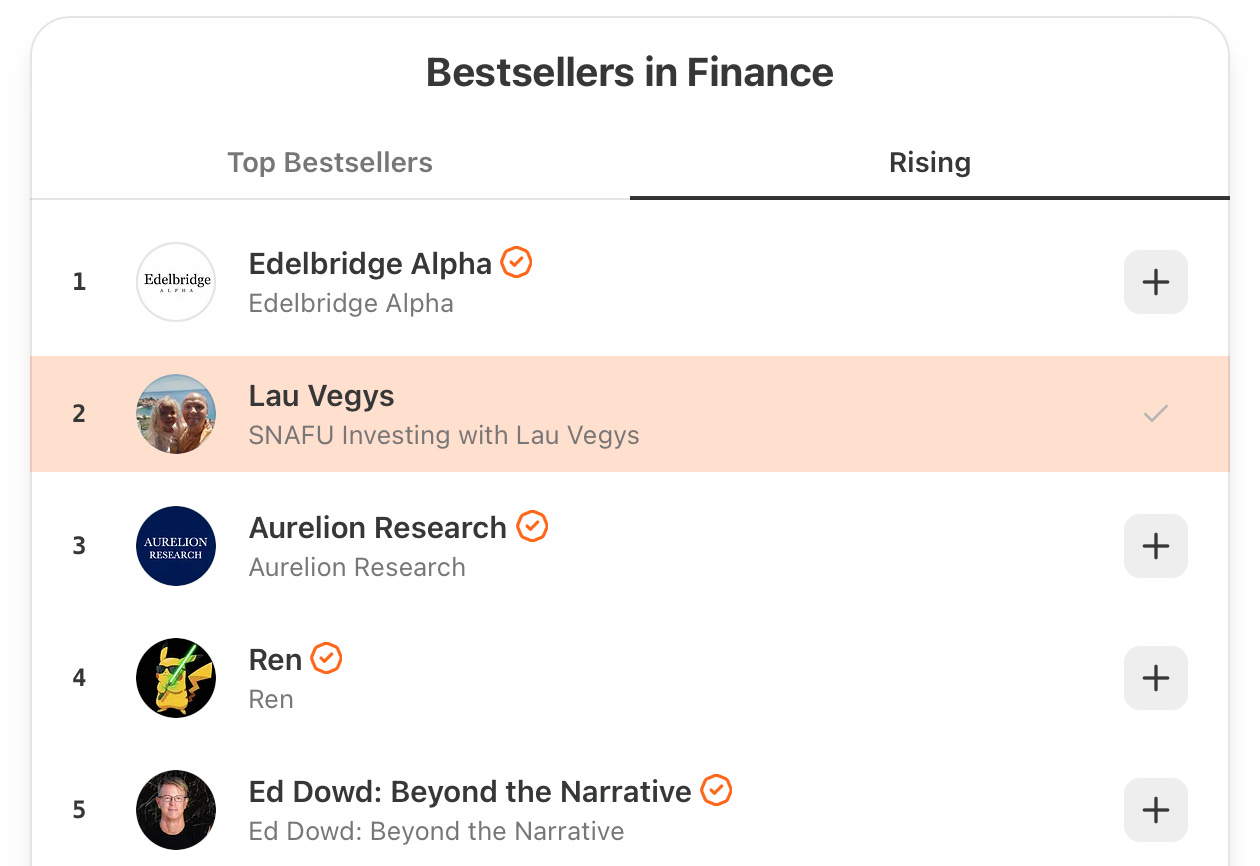
In short: not a bad start. And thank you to everyone who’s been part of it.
Now, a lot of the early feedback hasn’t been about the pick or even the investment case itself. It’s been about the format. The portfolio lives on its own page, updated live — every position with its entry, its exit, and its current price, on the record from day one. No digging through a bulky PDF to find what you own and what to do about it. As one subscriber put it:
I’m looking forward to being able to look at the stock recommendations and updates, rather than having to wade through a whole 25-page document to get what I want. It seems the way you are doing it is a much better way.
— David
I'm glad that landed, because it's something I really wanted to get right. At my old shop, readers had asked for years for a live portfolio — or at least a separate, dedicated place where they could see all the picks at once — and I pushed for it more than once. For whatever reason, it never happened. Here, it's been in place since day one. Paid subscribers can see it on the website or through this link — one position for now, with the second coming this week.
One last housekeeping note: As I outlined in the launch essay, I’m running a launch offer: $199 for your first year, instead of the regular $349. You can claim it here: www.snafuinvesting.com/launchweek.
The offer closes Friday, July 17, at midnight New York time. After that, it’s back to the regular price.
A quick heads-up, though, because a few people have already tripped on it: the $199 rate only works through the launch link above, the one ending in /launchweek. Use that link, not the regular “Subscribe” button on the site or app — the Subscribe button charges the full $349. When you click the launch link, Substack asks for your email first, and the $199 shows up on the very next screen. (Outside the U.S., you’ll see the equivalent in your local currency.)
And a quick reminder of what’s ahead, this week and this month: recommendation #2, from a different corner of the resource market than the first. Two special reports before the month is out. And the first recommendation, as I mentioned, is already live.
From the Comments
One of the things I’ve come to appreciate most about writing here is the conversation that happens in the comments. Here are four that stood out last week, for different reasons. Each one links back to the piece or note it appeared on, so you can click through if you’re interested in the context.


Thanks again to everyone who left a comment recently. I read all of them, even the ones I don’t get a chance to reply to individually. Now that the launch is behind me, I’ll catch up on the questions and the longer threads over the coming days.
Regards,
Lau Vegys
The cheapest and most reliable kilowatt is the one you don't use. We can reduce our energy consumption by 99% while multiplying our quality of life similarly. Less is more, but few can make money that way. But some can and they will change the world.