

My buddy Rob Smallbone over at The Contrarian Capitalist posted this image on his Substack the other day:
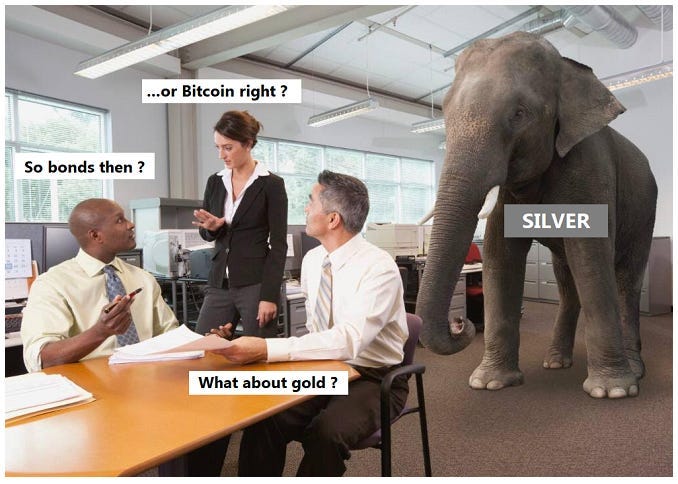
It’s a joke, of course. But like most good jokes, it works because it’s true: nobody wants to talk about silver right now. And I understand why. It’s been a rough year for the metal. After doing something it had never done before — crossing $100 an ounce, then topping $120 — silver got cut in half. As I write this, it’s trading around $57. So it’s understandable... Anyone who bought the top would rather talk about gold. Or bonds. Or Bitcoin. Anything, really.
But if you assumed $57 is what the poor man’s gold trades at around the world, you’d be wrong. That’s just the price in New York.
In China, the hungriest silver market in the world, the same ounce goes for about $64. That’s the price on the Shanghai Gold Exchange, and the venue matters: it’s where China’s physical metal actually changes hands. In other words, bars move in and out of vaults, not paper promises. Call it a 12% premium over the Western price.
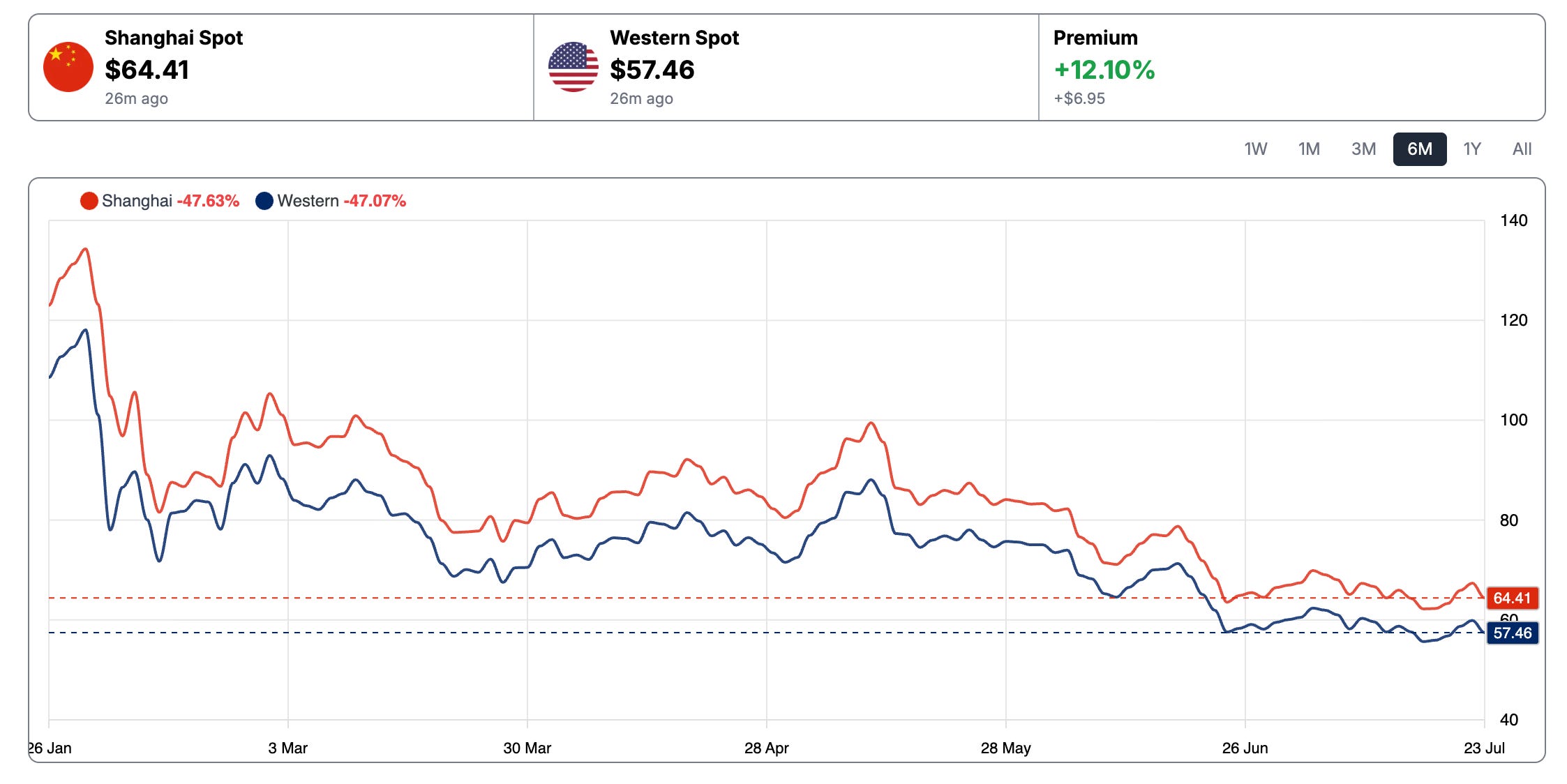
Same metal, two very different prices… depending on which side of the planet you’re standing on.
Today I want to walk you through why that gap exists, why it’s not going away, and why the metal crossing into China these days is probably making a one-way trip. Because I think it tells you more about where silver is headed than any bank’s price target.
The Great Silver Exodus
If you’ve been reading me for a while, you’ve heard me talk about the gold exodus from West to East, and how it’s been picking up speed for years. Interestingly, the same thing has been happening with silver.
I call it an exodus because premiums this large create a prime arbitrage opportunity that speculators can’t ignore: buy metal in the West, ship it east, sell it at the higher price, pocket the difference. And so the silver continues to flow eastward.
And as the arbitrageurs cash in on the price difference, Western vaults get depleted. Sooner or later, the price has to notice.
That was exactly the situation when I first wrote about this, a little over two years ago. Here’s what I said back then:
Take the mentioned LBMA, for example. It now holds around 300 million ounces of silver, which is 66% less than it had at the beginning of the year (870 million ounces). Meanwhile, COMEX in New York has seen its stacks shrink by about 46%, down to 60 million ounces from 110 million ounces.
If the Red Dragon doesn’t slow down, these reserves will be nearly gone. Silver could easily break $50 when that happens.
What happened next? The Red Dragon didn’t slow down — and silver did exactly what I said it would. By last fall, it had blown through $50. But as you well know, it didn’t stop there. By early this year, it was trading above $120.
Now, are Western inventories getting drawn down at that same pace today? Not quite. But that’s just a matter of time. As long as the premium persists, silver will keep moving from West to East.
Interestingly, unlike gold, it’s not central banks driving this. It’s Chinese investors.
Now, to understand why the Chinese keep buying, you have to look at what a saver’s options actually are over there, because they’re nothing like ours in the West.
Even in the U.S., with the Fed cutting rates since late last year, you can still park cash in a CD at around 4% and more or less keep pace with inflation. Not exciting, but your money has somewhere to sit.
A Chinese saver has no such luxury. Bank deposits there pay about 1%, and the central bank has promised more cuts, not fewer. Property — where Chinese families kept the bulk of their wealth for a generation — has been deflating for years. The stock market has burned retail investors more than once. And capital controls mean you can’t simply move your money out of the country and into something better.
That leaves precious metals. And that’s exactly what they’ve been buying — first gold, now silver.
And that’s before you even count the factories. Because China isn’t just the biggest saver-buyer of silver — it’s also the world’s largest industrial consumer of the metal. It builds most of the planet’s solar panels (silver’s biggest single use), plus the EVs and electronics that need it too. And unlike a saver, a factory doesn’t get to change its mind when the price rises. It either buys silver or stops producing.
The Whale and the Throttle
Now, if you know a thing or two about markets, you should be asking the obvious question: why don’t those same arbitrageurs just close the gap for good?
Here’s the catch. China charges a 13% value-added tax on imported silver. It’s the same VAT China slaps on most goods.
Here’s what that means in practice: you buy your ounce in New York at $57 and ship it to Shanghai, where it sells for $64 — a $7 profit, in theory. Except at the Chinese border, the taxman takes his 13% — about $7.40. So now you’re all-in around $64.40, selling at $64. You’d lose money on every ounce — and that’s before you’ve paid to ship, insure, and finance metal halfway across the planet.
In short, the premium has to blow past the tax line before the trade works.
This is all to say — and it’s the part so much financial commentary glosses over — the metal doesn’t simply flow from West to East in a steady stream. It moves in waves: every time demand pushes the premium through the toll, a wave rolls.
And the last big one wasn’t back in mid-2024, when I first wrote about this. It came just this past winter, when the premium on the Shanghai exchange blew out past 30%. That’s more than double the toll. We know what happened next from Chinese customs data: China imported nearly 470 tons of silver in February alone, the most ever recorded for that month. Imports of refined silver ingots rose 5,910% from a year earlier.
That’s not a typo. About sixty-fold.
But if China wants the world’s silver as much as it clearly does — you might wonder — why not just drop the VAT completely and let it pour in?
Well, I can’t read minds in Beijing, but I can read incentives. So consider this...
China is the largest buyer in the silver market. Remove the toll, and Chinese demand hits the world price at full force — and every ounce China still wants to accumulate gets more expensive.
That’s the last thing a whale would want. A whale that wants to keep buying doesn’t announce its bid. It buys slowly, quietly, and at its own pace.
So I find it helpful to think of the tax as a throttle that keeps China’s own appetite from bidding up the metal against itself.
That said, I can see the throttle getting eased — not necessarily scrapped overnight, but loosened a notch at a time until one day it’s gone. There’s a precedent for that too: gold. Back in the early 2000s, China made investment gold traded through the Shanghai Gold Exchange VAT-free. Well, we know how that ended: Chinese gold demand skyrocketed — and the gold price with it.
Incidentally, proposals to exempt silver, at least partially, pushed mainly by the solar industry, have been floating around for a while now. Again, I’m no mind reader of Chinese apparatchiks, so I can’t tell you when that might happen. But I do know this: the day China gives silver the same treatment it gave gold, it will be every bit the game changer for the silver price that it was for gold’s.
And something happened earlier this year that makes me think that day may be closer than most people think.
When One Market Becomes Two
If you've been reading me at all this year, you might already know where I'm going with this. In January, China reclassified silver under "dual-use export controls" — the rules reserved for materials that serve both civilian and military purposes.
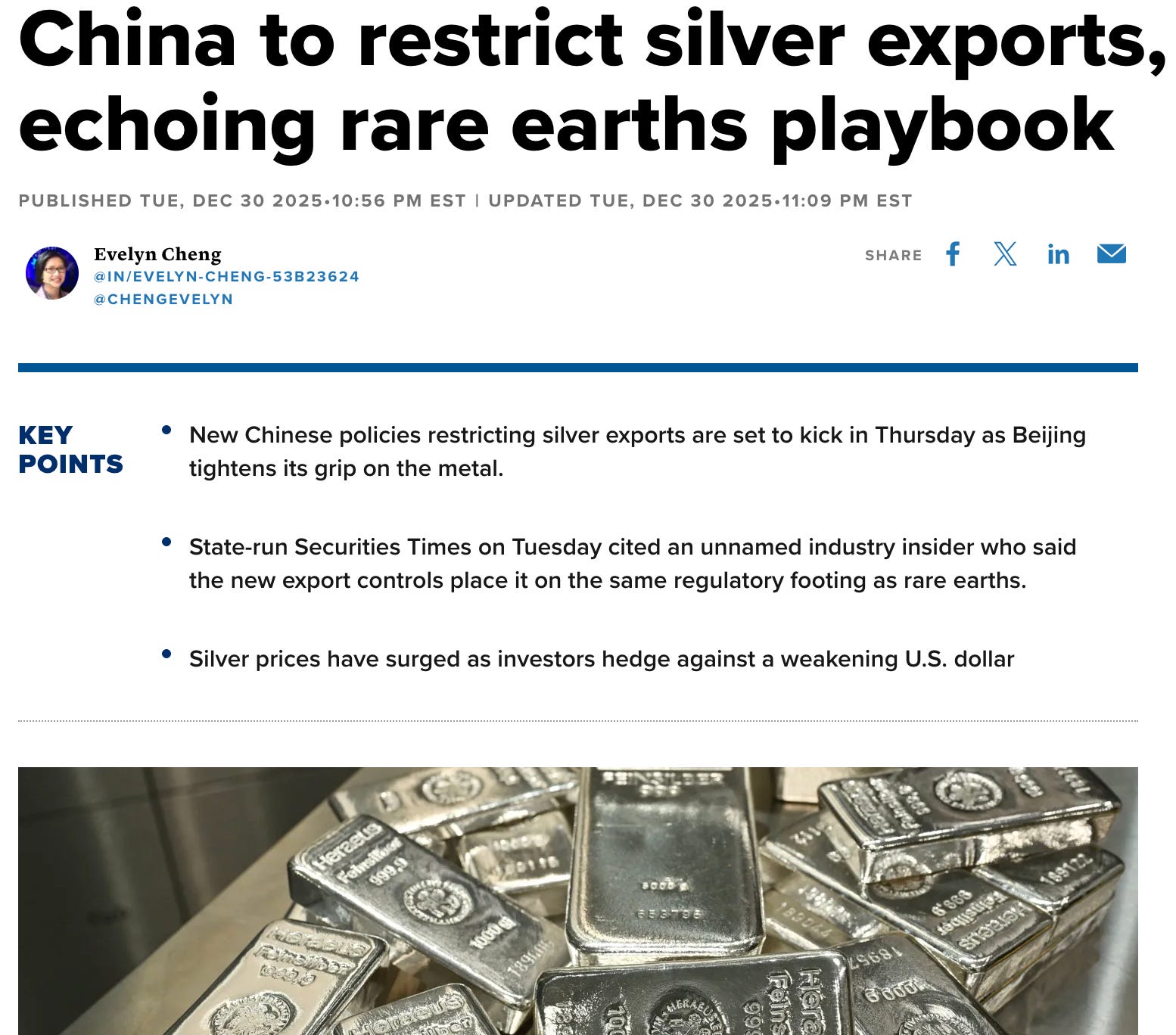
In plain terms: exporting silver from China now requires government authorization. Only 44 companies have been approved to export silver during the 2026–2027 period, giving Beijing tight control over who can sell refined silver abroad.
Think about what that means. You don’t put washing machines under dual-use controls — you do that to things you consider strategic. And so, with one stroke, China officially stopped treating silver as just another industrial commodity.
And the way China went about this — compared to its much more gradual approach with rare earths, for example — shows you just how much it cares about silver.
Now, silver is not yet where gold is. On the other hand, January brought its first reclassification in decades. The only rung left above it on the ladder is gold’s. That’s the one where the VAT comes off — and where the world’s biggest buyer of silver stops merely guarding its own metal and starts pulling in everyone else’s.
And the fact that silver is the only metal that’s genuinely both things — industrial like copper, monetary like gold — makes that last step that much more likely.
But forget all the ladder business for a second. Even if China never touches the VAT and never puts silver on a par with gold, the export controls alone change the game.
Remember, most of the world’s silver passes through Chinese infrastructure on its way to becoming usable metal — something I mentioned on Saturday, in the piece that also carried SNAFU Investing’s second recommendation. So when Beijing puts itself in charge of what leaves and what stays, even freshly mined silver from Mexico or Peru can end up joining China’s pool rather than the West’s.
Put it all together, and the old self-correcting silver market — where a shortage in one region simply pulled metal in from another — is breaking down. And it’s breaking in one direction. Silver gets scarcer in the West, and Western paper markets can no longer hold the price down the way they always have: by selling promises of metal that rarely turn into actual bars.
Which means the silver price may soon stop being set by traders in New York — and start being set by whoever actually has the metal. (And by now you know exactly who that is.)
So if you needed one more reason to be bullish on silver, there it is. And I think it’s a big one.
Regards,
Lau Vegys
P.S. If you want the actionable version of all this — the silver miner I recommended on Saturday, with the full case, my buy-up-to price, and how I’d size the position — it’s here for paid subscribers. If you’re one of them and haven’t read it yet, don’t let it slip by. (As I write this, the stock is still trading below my buy-up-to.) And if you're on the free list — the first part of that piece is free to read anyway.
I always drop what I'm doing to soak up your analysis. It's clear you've thought through the various possibilities. An interesting graphic would be tons of gold & silver moving about the world each year - to visualize the enormity of change occurring behind the scenes.
In past decades, silver investment has usually led to tears, but I think this time IS different. The industries driving the economy consume lots of silver. The Chinese government has made their policy clear - silver supplies are a national resource. Anything a government wants will become scarce, and therefore expensive.
A good read thank you Lau; as an on/off First Majestic holder for years I recall Keith Neumeyer talking about where Chinese demand stood in driving silver prices higher, although I forget where most of his dore bars actually get sold/processed - although I think up to 10% now gets processed in his own mint, plus he holds back sales when prices go low. Took some nice profits out of FM earlier this year, but have now bought back, meaning almost doubling my shareholding, but one I doubt I'll trade again in the near future, as I think they have a decent upside in this market.