

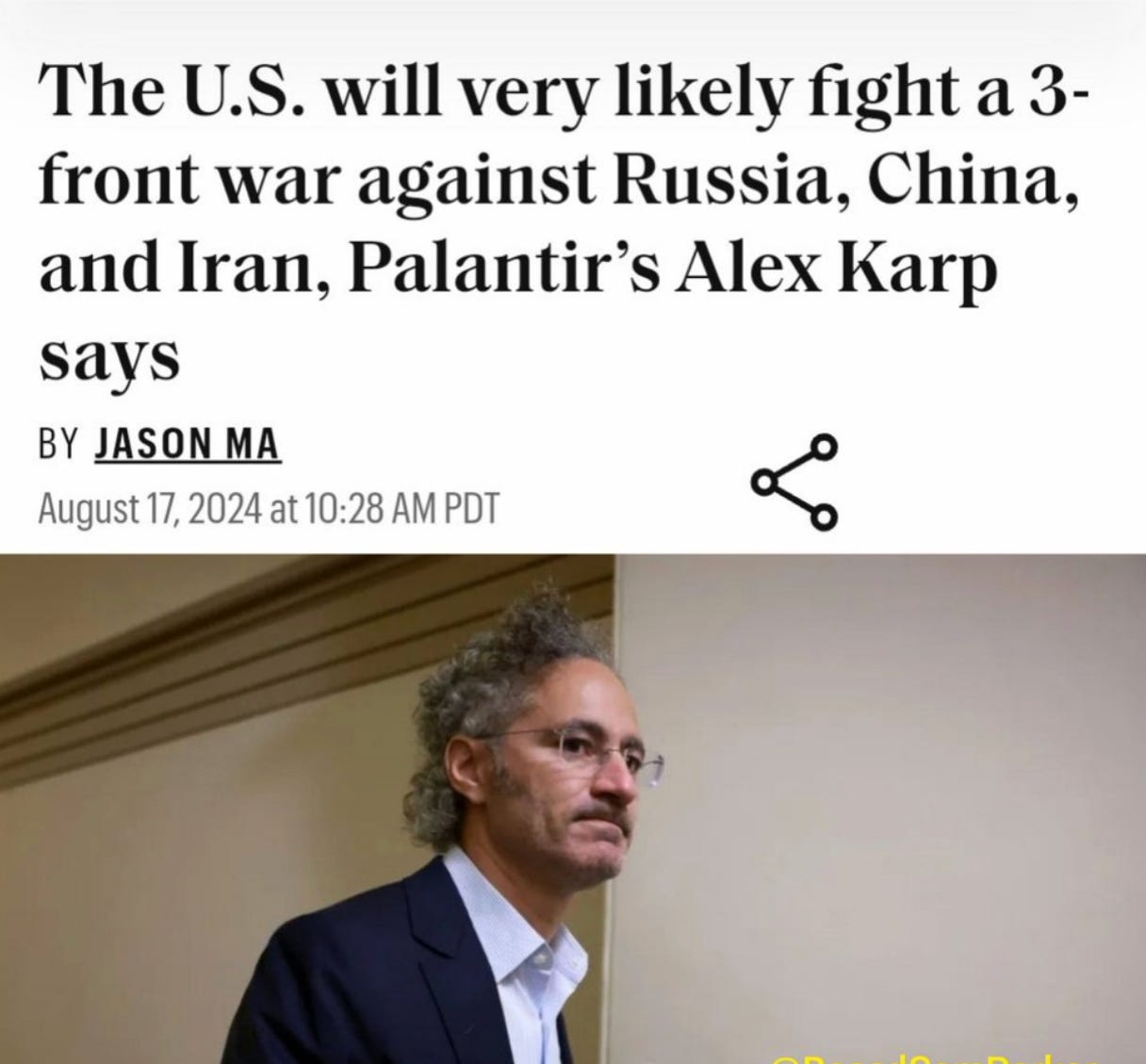
In August 2024, eighteen months before the first Tomahawk hit Iran, Palantir CEO Alex Karp told the New York Times which wars America was going to fight.
He named three. The U.S., he said, would “very likely” find itself in a three-front war with China, Russia and Iran. Here’s the headline from the time.
Well, it didn’t take long for the first shoe to drop.
In February 2026, Benjamin Netanyahu convinced Donald Trump to launch a war against Iran. We got plenty of conflicting explanations along the way: preventing attacks on U.S. bases, protecting Israel from an imminent strike, stopping a bomb, regime change. Whatever the reason, on February 28 the missiles started flying.
And on that first day, two Tomahawks hit the Shajarah Tayyebeh elementary school in Minab, in the south of the country. More than 150 people were killed. At least 123 of them were children.
For months, the official line was that nobody could say what happened. Trump, on Fox: “I don’t think anybody’s going to ever be able to say what happened there.”
Then, last month, Bloomberg got hold of the Pentagon’s own internal review. And it turns out somebody can.
Here’s what happened.
The target list for day one was built with Maven, the AI targeting system the Pentagon buys from, you guessed it, Palantir. Karp’s company. Maven takes the intelligence, crunches it, and turns it into targets. Work that used to take analysts hours now takes minutes.
Somewhere in the U.S. database, the compound in Minab was listed as a facility of the IRGC, Iran’s Revolutionary Guard. That was old. Satellite images show the walls and separate entrances going in by 2017, the soccer pitch and playground markings by 2018. An analyst noticed the change in 2019 and wrote it down, in a system that wasn’t connected to the targeting database. The school had its own website. It was on Google Maps.
Maven took the stale entry, ran it with the other candidates, and recommended it as a day-one target.
Nobody caught it. According to the review, some of the people at CENTCOM, the Pentagon’s command for the Middle East, which runs the war, had come to lean on the AI, expecting it to flag exactly this kind of thing. The people whose job it actually was, the civilian-harm team, had been cut by about 90%. Nobody looked at the site before the strike. Some knew within hours that they’d hit a school.
Palantir’s response, through a spokesperson, was rather predictable: the company “is not responsible for the underlying data.”
Hunting Season
Now, all of this matters a great deal right now, because the targeting list is being built again as I write this.
Just this Wednesday, ABC and the New York Times reported that the U.S. and Israel have drawn up plans to resume joint strikes on Iran “in the coming weeks.” Petrochemical facilities, nuclear sites. The one thing everyone agrees on is the date: after November 3. Trump himself put it in writing. On October 8 he posted that the U.S. “will not be attacking Iran at any time prior to the Midterm Elections to be held in the United States on November 3rd.”
Which makes sense from where he’s sitting. The last thing he wants is oil at $150 the week people vote.
An Israeli source summed it up for ABC: “Hunting season is open as soon as the elections end.”
So, the war is coming for sure.
Here’s Netanyahu on his call with Trump on Monday, thanking him for his endorsement ahead of Israel’s October 27 election, which happens to land a week before the American one.
Netanyahu: “I’m so grateful for this incredible endorsement. You’ve been an incredible leader of the free world, of America. By far the greatest friend Israel has ever had or will have in the White House. And all of civilization is emboldened by your boldness.
“Donald, we have a job to finish. You said it, and we’ll finish it together. We’ll finish it, and no one else will do it.”
Trump: “Actually, I actually crafted that one myself. That wasn’t one that was put out by some guy writing something. That was crafted by me.
“You’re a warrior. You’ve been treated unfairly… And we will prove that. We will prove that very soon. I think it’s terrific.”
That “job to finish” is rather chilling, is it not? Mostly because nobody knows what it means. Are we back to regime change? Something else?
Either way, it’s right in line with what I told you in my recent piece on oil: if the war isn’t resolved before November 3, a quick resolution becomes less likely afterward, not more. Before the election, every cent at the pump is a vote. After it, you get one of two things. Escalation, which is the road we now seem to be looking down. Or, not much better, the war turns into a legacy question. And legacy questions have a way of dragging on.
At any rate, here’s where things stand on the ground as of this writing:
Two carrier strike groups, the George H.W. Bush and the George Washington, are already in the Arabian Sea. A third, the Theodore Roosevelt, left San Diego on September 27 and is due by the end of November, along with roughly 10,000 additional personnel, including a Marine Expeditionary Unit.
CENTCOM has been repositioning troops and hardware across its Middle East bases. Its own line is that it “regularly moves” assets to “optimize readiness.”
The State Department has ordered non-essential staff out of Saudi Arabia.
Hegseth made an unannounced trip to Israel, where the strike plans were discussed and new intelligence shared.
The reported target set: Iran’s petrochemical facilities and nuclear sites, including Pickaxe Mountain, a nuclear site buried hundreds of meters under rock that earlier strikes never reached. Trump hasn’t signed off, yet.
Iran, for its part, has run a volunteer mobilization drive it says has drawn more than a million sign-ups, and has threatened U.S. bases and Gulf oil infrastructure if the strikes resume.
Not Your Vanilla Defense Contractor
So, how does Palantir fit with all that?
In a couple of ways.
First, there’s the usual job: picking targets. Every war needs someone to do it, and apparently, despite the mess I just described, the best man for the job is still Palantir. The way it works is simple enough. The intelligence gets gathered, it goes into Maven, Maven produces the list, and the list gets hit. Palantir says the system now double-checks itself. Maybe it does.
But then there’s the second thing, and this is the part most people don’t know. Palantir isn’t your regular defense contractor that happens to sell software. It’s a company with a worldview, and it has had one from the beginning.
I’ll get to the worldview in a second. But first, a few words on where it comes from, because that’s the part most people have never heard.
You see, Palantir was basically spun out of the CIA, backed by its venture fund. Back in 2018, Google’s own employees refused to build the Pentagon’s AI targeting project (more than 3,000 of them signed a letter saying no), and Palantir took it over. That project is now known as Maven. The one that picked the school in Iran.
Par for the course for a company whose CEO, in addition to his uncanny ability to predict wars, is on record saying, and I quote: “Palantir is here to disrupt… and, when it’s necessary, to scare enemies and on occasion kill them.”
Curiously, in that same 2024 New York Times interview, Karp also came out as “pro draft,” because, as he put it, “only people who are middle- and working-class do all the fighting.”
Now, I can’t tell you how genuine Karp’s concern for the working class is. But if you put the draft next to his prediction, a three-front war, not just Iran but China and Russia too, it makes perfect sense. You can’t fight that with an all-volunteer force. There aren’t enough volunteers. If you believe three wars are coming, and you’re in the business of supplying them, at some point you have to say where the soldiers come from.
And Palantir didn’t wait long to make that stance official company doctrine.
In April, it published a 22-point political manifesto on X, from the company’s official account. This was one of the points:

If you’re thinking it’s not every day a tech company publishes a political manifesto, you’re right. But like I said, Palantir is not your everyday vanilla company.
The rest of the manifesto is in the same spirit. They say things like “hard power in this century will be built on software,” their software, naturally. Weirdly, they also want Germany and Japan remilitarized. Actually, I take that back. It isn’t weird at all if you’re preparing for a war with China and Russia. You need allies, right?
All in all, the whole thing paints a world where coexistence with other civilizations isn’t really an option. The only path forward is permanent technological dominance. It reads like a company that’s itching to go from picking the targets in wars to picking the wars themselves.
But here’s the interesting thing.
You may actually read the manifesto and find yourself nodding along, because some of it you can agree with. They talk about how Silicon Valley owes a debt to the country. How public servants should be held to higher standards. And who, on occasion, doesn’t want to go rah-rah-America and project power around the world?
Of course, to do that you’d have to conveniently forget that every single point in it benefits Palantir’s bottom line. More militarization, more contracts. AI as the new deterrent, more contracts. A draft, more wars to sell into.
In short, it’s a business plan dressed up as a political vision. And in a couple of weeks, when “hunting season” reopens over Iran, it looks like it’s about to get another round of business.
Enjoy the rest of your weekend,
Lau Vegys
P.S. Round two in Iran is also why oil is nowhere near done. That’s the premise of the October issue, which went out last weekend, along with a new recommendation built to profit from exactly this. If you’re a paid subscriber, make sure you haven’t missed it. If you’re not, the intro is free to read.
I feel like I'm living in Rome and the Proletarian guard is visiting every house to find teenage boys (and now girls and the other genders) to "serve their country". I'm hiding my military age children in the mountains and buying bullets along with BTC, gold, silver, and oil contracts.
Not one of your more uplifting, market focused articles, but nonetheless accurate. Invest accordingly!
Incidentally, despite the US/Iran war, Palantir stock didn't do that good in 2026. It went down during the whole spring and only get back up in summer to it's all time high from Oct. 2025 a few days ago.
But it is still 2000% up since winter 2024 !