

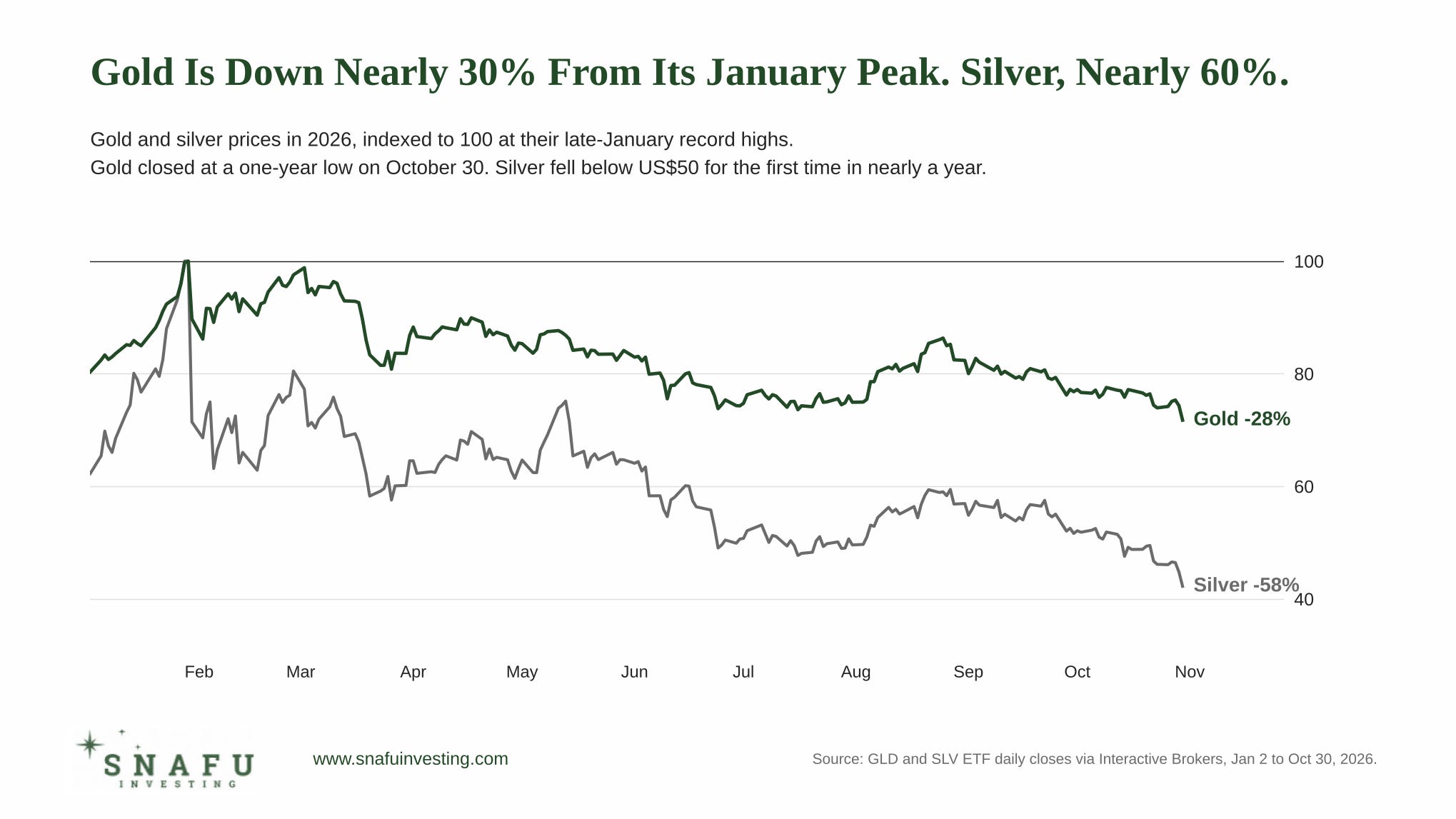
Gold fell to a one-year low yesterday. It closed at about US$3,900, down 30% from the record it set in January, and it was the worst October for gold since the financial crisis. Silver did even worse. It broke below US$50 for the first time in nearly a year and is now down 60% from its January peak.
So you may be wondering what on earth is going on. And if you have money in precious metals, you’re probably wondering it twice as hard. So let me walk you through what happened this week and why, and then explain why I still think the right response is to buy, not sell.
What Actually Happened
You may have seen that the Fed met on Wednesday and left rates where they were, at 3.75 to 4%.
Now, you might think that would have been good for gold. The thing everyone was afraid of, another hike, didn’t happen. And yet gold fell the next day, and then fell harder the day after.
So what gives?
Well, it was a hold, but a hawkish one. The Fed didn’t move, but two members of the committee voted to raise rates right then and there. And Kevin Warsh, in his press conference, said inflation is “too high,” has been for too long, and that he isn’t going to tell anyone in advance what he plans to do about it.
And the next day, the data backed him up. The September inflation numbers came in hot: 3.6%, the biggest monthly jump since March.
Meanwhile, the government’s own numbers showed the economy growing at 3.4% in the third quarter.
The bond market took the hint. Hot inflation and a supposedly strong economy are exactly the kind of backdrop that gives a central banker room to keep hiking, and traders priced it accordingly. Before Wednesday, a hike at the next meeting in December was far from certain. By Friday it was priced at better than 80%.
Remember, the Fed already raised rates once this year, in September, its first hike since 2023. So what the market is now thinking is that September may not have been a one-off.
Why does that matter for gold?
Because gold pays no interest. Meanwhile, the 10-year real yield, which is what you earn on government debt after inflation, was 2.3% in late August. By early October it was nearly 3%, the highest since 2008.
Why hold something that yields nothing when government paper pays you more than 3% just to sit there?
That’s what the conventional wisdom says, anyway.
That said, there was another side to Friday’s drop, and it had nothing to do with the Fed.
You see, it wasn’t just gold and silver taking it on the chin. It was the stock market too. Take a look at what the market looked like at the open.
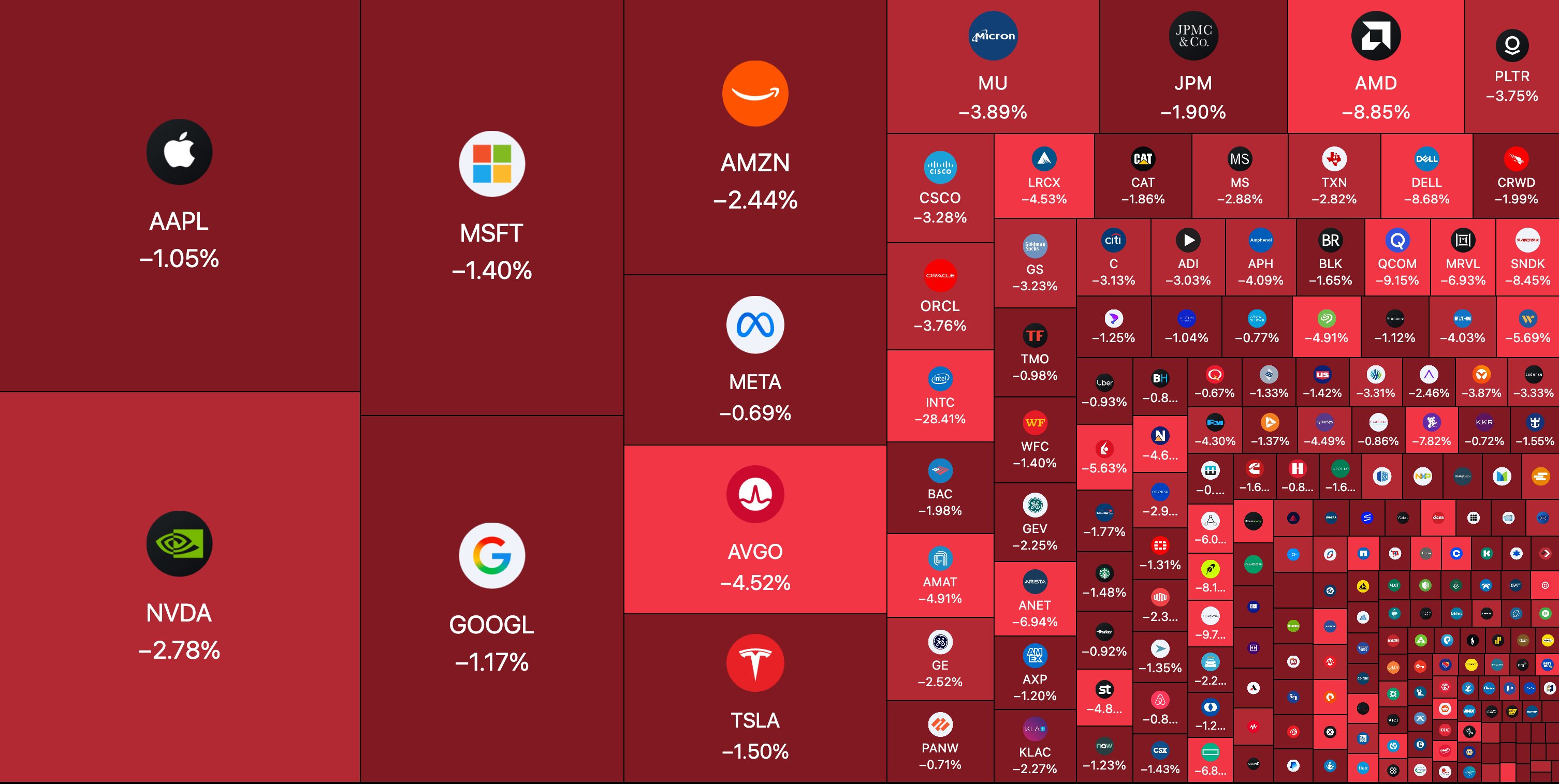
By the end of the day, the S&P 500 was down 1.8% and the Nasdaq nearly 3%. Intel alone shed almost 30% of its market value. All in all, more than a trillion dollars of U.S. stock market value, gone in a session.
It may sound counterintuitive, but that’s bad for gold too. When stocks drop like that, anyone who bought the AI trade with borrowed money gets a call from their broker. And when that call comes, you sell what you can sell, not what you want to sell. Gold and silver are in a lot of those same portfolios these days, and they’re about the easiest things in them to turn into cash.
So they got sold too.
That’s also why the gold ETFs fell more than the metal itself on Friday. It was a scramble for cash. Pure and simple.
What About the Central Banks?
Now let’s talk about central banks for a minute. After all, their buying was one of the main forces behind gold’s run last year and the record highs in January.
And the first thing we have to contend with is that, yes, some of them have been selling.
Russia is the obvious one. Cut off from most of the world’s banking system and paying for a war, it has been dipping into its reserves to cover the bills. It sold 56 tonnes of gold this year.
Then you have Turkey. The country imports almost all of its energy, so when oil spiked this spring the lira came under heavy pressure. To keep it standing, the central bank sold or swapped nearly US$20 billion worth of gold.
I don’t see either of those as a vote against gold. Reserves exist to be spent on the worst day, and for those two countries these were arguably some of the worst days in recent memory.
But here’s the thing. As a group, central banks are still buying, and the way they’ve been buying tells you something. It’s true that in the first quarter, with gold at its record, they bought the least of any first quarter in over a decade. In the second quarter, however, as the price fell, they bought a record 289 tonnes. That’s five times what they bought in the first quarter, and more than 60% above the same quarter last year. Here’s what that looks like.
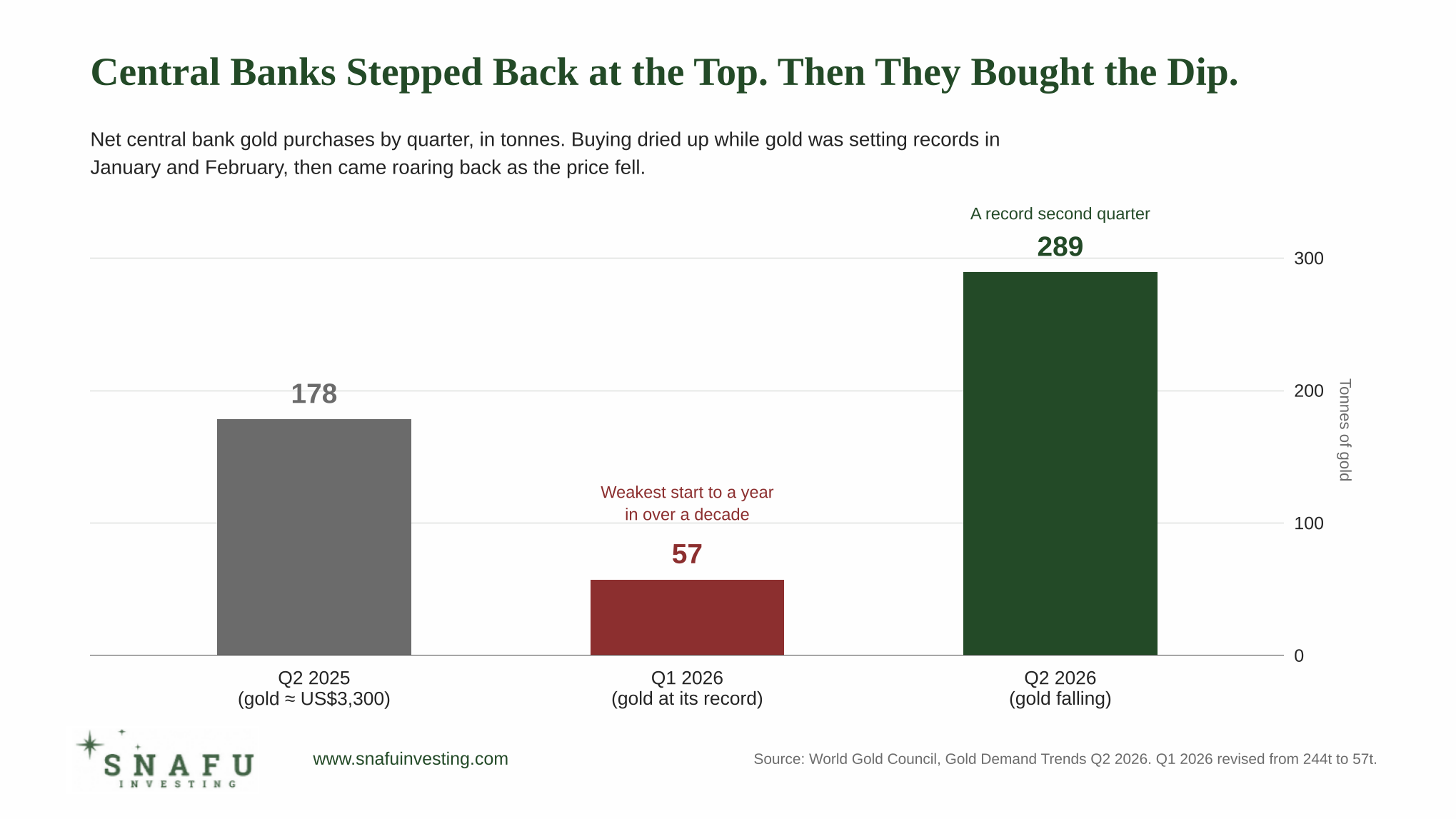
This is typical central bank behavior, by the way. They want gold, but they want it at a bargain.
Now, you have to remember that in the second quarter of this year, gold averaged about US$4,500 an ounce. That’s roughly 15% higher than where it closed yesterday. In other words, central bankers looked at US$4,500 gold and decided it was cheap enough to buy a record amount of it.
Make of that what you will, given where the price is now.
And keep in mind, that buying comes on top of what were already record holdings. By the European Central Bank’s count, gold made up 27% of the world’s official reserves at the end of last year, up from 20% a year earlier. If you recall, that put it ahead of U.S. Treasuries, at 22%.
Note: Even at today’s lower price, gold’s share would drop to about 25% at most. Still comfortably ahead of Treasuries.
As of late, to the surprise of no one, the biggest buyer has been China.
China’s central bank added 21 tonnes in September, the most in three years and close to two years of buying every single month. And it’s not just the central bank. China as a whole, counting banks and private buyers, has imported more than 1,000 tonnes this year through August, a record, and already more than in all of last year.
And it’s not just China. The quiet money elsewhere, the kind that doesn’t have to report what it owns, has been moving the same way:
The world’s richest families. UBS surveyed 307 of the biggest family offices this spring, average fortune US$2.7 billion. Two-thirds expect confidence in the dollar to weaken, and those changing their allocations plan to lift gold by half.
Buyers who don’t show up in the statistics. The World Gold Council counted 571 tonnes of gold bought privately and off the books in the first half of this year. That’s nearly a quarter of all demand, and it doesn’t show up in any ETF or exchange data.
The people who store it. The Financial Times reported in August that Swiss vault operators are expanding every site they have, and one of the big refiners is building a dedicated vault for clients with US$50 million or more in bars. Hong Kong wants room for 2,000 tonnes within three years.
So, put it all together and the picture that emerges is one of paper gold being sold by funds that need cash, and bars being bought by people who plan to hold on to them.
Why This Is a Buying Opportunity
Yes, I’m treating the current weakness in precious metals as an opportunity. Who’s buying is one reason. But here’s the other.
First, take a look at the chart below. It shows the three big gold bull markets since gold started trading freely in 1971, the 1970s, the 2000s and this one, each measured from where it started.
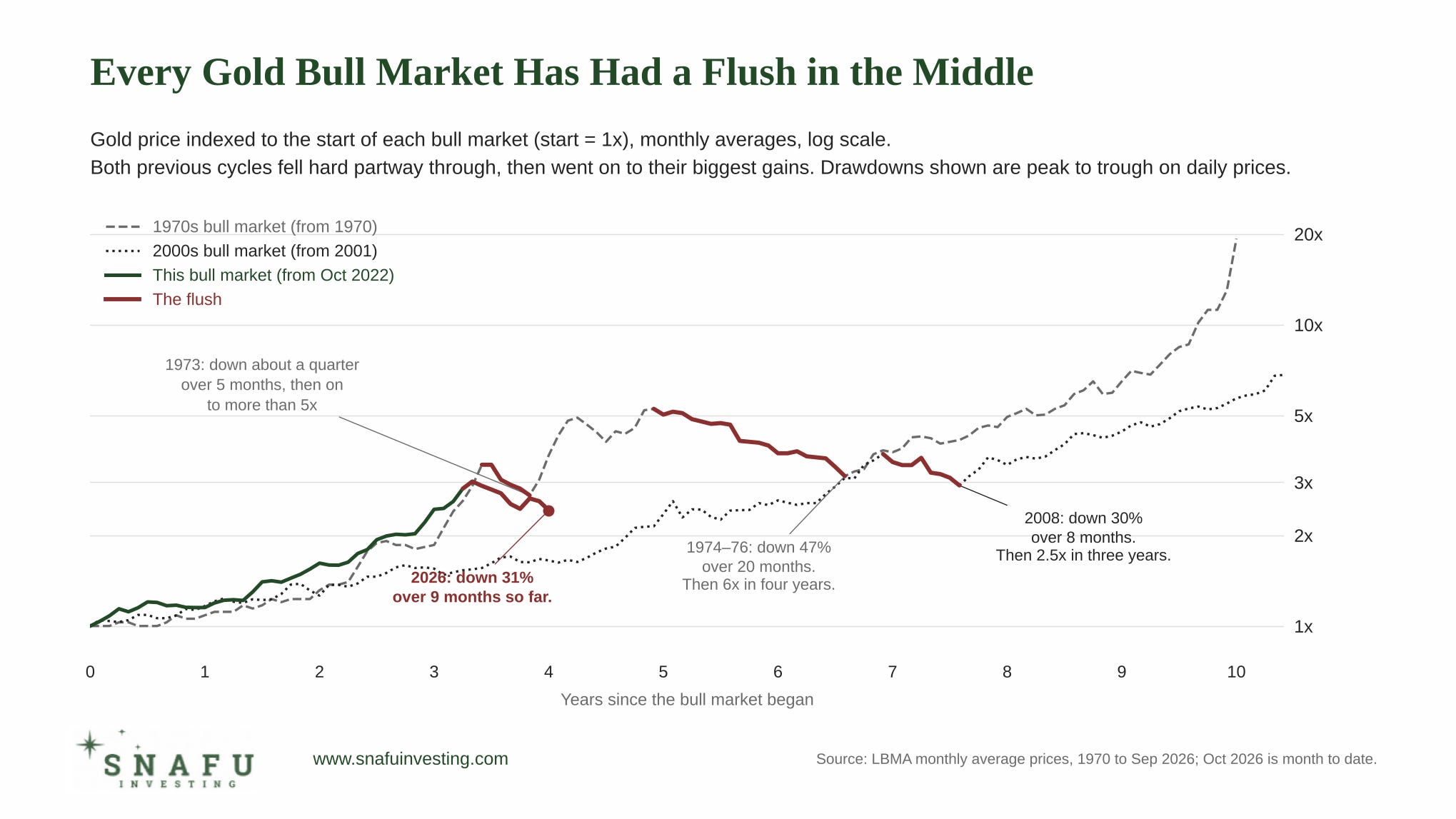
What should jump out at you is that none of them went up in a straight line. Every one had at least one flush along the way, a drop deep enough to convince people the bull market was over.
Start with the 1970s (the grey dashed line). The first flush came in the summer of 1973, after gold had run up to about three times its starting price. From there it dropped by roughly a quarter over the next few months.
Interestingly, that’s almost exactly where the green line is today, as you can see in the chart. Back then, gold shook it off and ran to more than five times its starting price by the end of 1974.
Then came the second flush, the big one. Gold fell 47% between the end of 1974 and the summer of 1976. Granted, that was twenty months of decline. But then it went up six times in the four years that followed.
In the 2000s (the black dotted line), gold nearly quadrupled, and then dropped 30% in the 2008 crisis, over about eight months. And then it went from about US$750 to over US$1,800 in three years.
So in both cases, the flush came several years into the bull market, after a big run. And in both cases, it was deep enough and lasted long enough to shake out everyone who wasn’t sure.
Now, I don’t expect this one to drag on for twenty months, for what it’s worth. We’re already nine months and 30% into it. That’s as deep as the 2008 flush went, and deeper than the 1973 one, so my sense is that the worst is behind us. But I could be wrong about that, and it wouldn’t change the point.
Because here’s the thing. In both cases, the biggest gains of the entire bull market came after the flush. Not before. After.
That aside, I also find it useful to remember how the current bull market started back in 2022, because it feels a lot like what we’ve been watching lately.
In February 2022, the war in Ukraine began. Within two weeks gold was over US$2,000.
Then oil went through the roof, inflation hit 9%, and the Fed raised rates from zero to 4% in just nine months. That was the fastest in forty years.
That sent gold falling for seven straight months. It bottomed at about US$1,615 in late September 2022, roughly 22% below where it had peaked in March.
Sound familiar? War, oil, inflation, and a Fed hiking into it. And all through it, central banks were net buyers, much like today.
And once again, that September 2022 low is where the green line in the chart above begins. From there, gold went from US$1,615 to US$5,600.
Put differently, the people who sold at the bottom watched it triple without them.
I could go on about the bigger picture too. Like how every dollar of the U.S. government’s US$40 trillion in debt is now being refinanced at 5%, and how it already spends 22 cents of every dollar it collects just on interest. Or how a Fed that keeps hiking into that could quite literally break the budget (since interest is already the second-biggest item in it, behind only Social Security). Or a president who wants rates at 1% and will hand the current Fed chair any excuse to start cutting.
The point is, nothing about the case for owning one of the few assets that isn’t somebody else’s liability has changed. (And as I showed you recently, there isn’t exactly a flood of new supply coming either.)
In short, I’m not selling. If anything, I’m looking for things to buy.
Enjoy the rest of your weekend,
Lau Vegys
P.S. Yesterday afternoon I sent paid readers a short alert, because this week’s selloff did something useful: it brought one of the most promising positions in the SNAFU portfolio, a precious metals producer, back under our buy-up-to price for the first time since August. This is a company that’s still above where I recommended it in July, even after all this, with a producing mine, a second one fully funded and under construction, and no debt. The alert covers what to do whether you already own it or have been waiting for a second chance. If you’ve been thinking about joining, this is the kind of week the paid side exists for.
Im 83, and buy 1/10th oz about once a month , regardless of price Im not complaining at all
only that i may not make it to 120 Happy Halloween all Ray of Phila