


Lau here.
I wanted to send you something a little different today. There’s good news on two of our positions, and I’ll get to both of them below, along with where we stand on each. But the reason I’m writing is bigger than either company. If you’ve been watching uranium and rare earth stocks go down for the past two months, as I have, and wondering what went wrong, this is for you, and I think it’s worth a few minutes whether you’re a paid subscriber or not.
Let me start with rare earths, because that’s where the picture is clearest.
A few weeks ago, I wrote to you about the Trump-Xi summit in September, and my point then was simple: it didn’t solve anything. In April of last year, China put dysprosium and terbium, along with five other rare earths, under export licensing. Those two are the ones that let a magnet keep working at the temperatures inside a jet engine, a missile or a submarine’s sonar. There is no substitute for them, and nearly all of the world’s supply comes from China.
Those licenses are still in place today, and they’re decided case by case. And if the buyer has anything to do with a foreign military, there isn’t a case to consider. The Pentagon’s suppliers can’t legally buy these materials from China at any price.
Xi spent three days in Washington, and none of that changed. The Chinese aren’t trading their best card for soybeans.
So what did the market do with all that? It sold. REMX, the fund that owns the sector’s miners and processors, is down about 51% from its high in May.
Now, that’s curious in and of itself. Nothing about China’s grip on these metals changed, and yet the stocks got cut in half. But it gets more curious still when you look at what the people who have to buy the metal did over the same period. They actually paid more for it. Take a look.
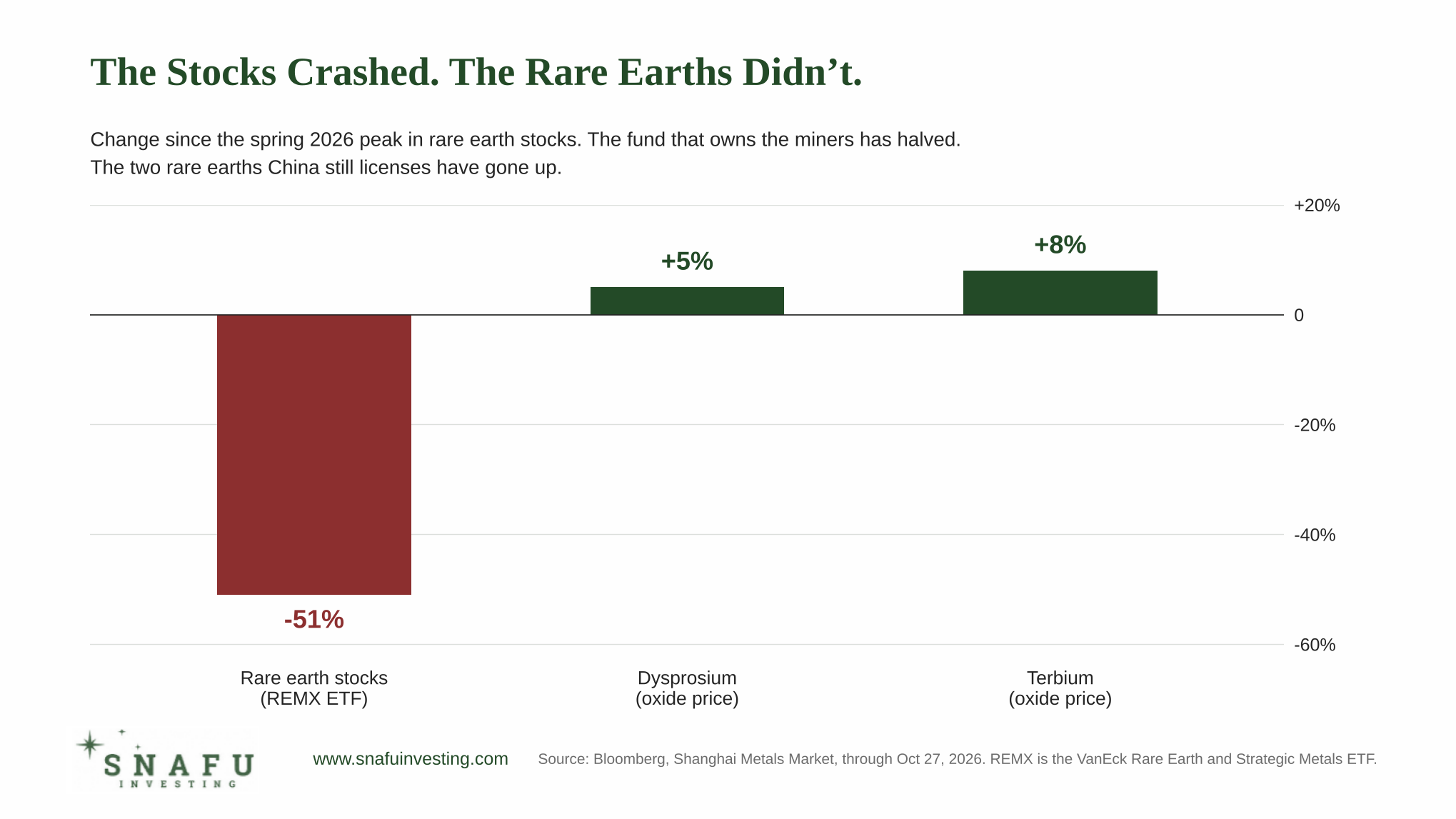
Yes, you’re seeing it right. The companies that produce these metals have lost half their value, while the metals themselves have gone up: dysprosium by about 5% since the stocks peaked, terbium by about 8%. That’s a massive disconnect.
If this sounds vaguely familiar, it’s because I’ve written about this kind of gap before, at my former shop. About two years ago it was gold: the metal was making new all-time highs, while the gold miners were still trading at about half of where they’d been at their 2011 peak.
You may remember what happened next. The gold miners didn’t just catch up with the metal. They ran right past it.
I think we’re looking at the same kind of setup in rare earths today.
Because here’s the thing. Even if a deal gets done at the next Trump-Xi meeting (there are two more scheduled before the current truce runs out in January), that won’t be the end of it. That’s because on January 1, a new Pentagon rule takes effect: the U.S. military won’t be able to buy anything with a rare earth magnet in it if Chinese material went into that magnet at any stage, from the mine to the finished part. That’s U.S. law, not a bargaining chip. It would take an act of Congress to undo, and I don’t see that happening. If anything, the Congress that comes out of next week’s midterms will be even less inclined to do China any favors than this one.
Now, the U.S. government knows what’s coming. That’s why it has spent the past year taking equity stakes in mining companies, launching a US$12 billion strategic stockpile, and lending hundreds of millions to the handful of companies that can process these materials on American soil.
I’ll get to how all this relates to our companies in a second. But first, lest you think this is a rare earth story, take a look at the chart below.
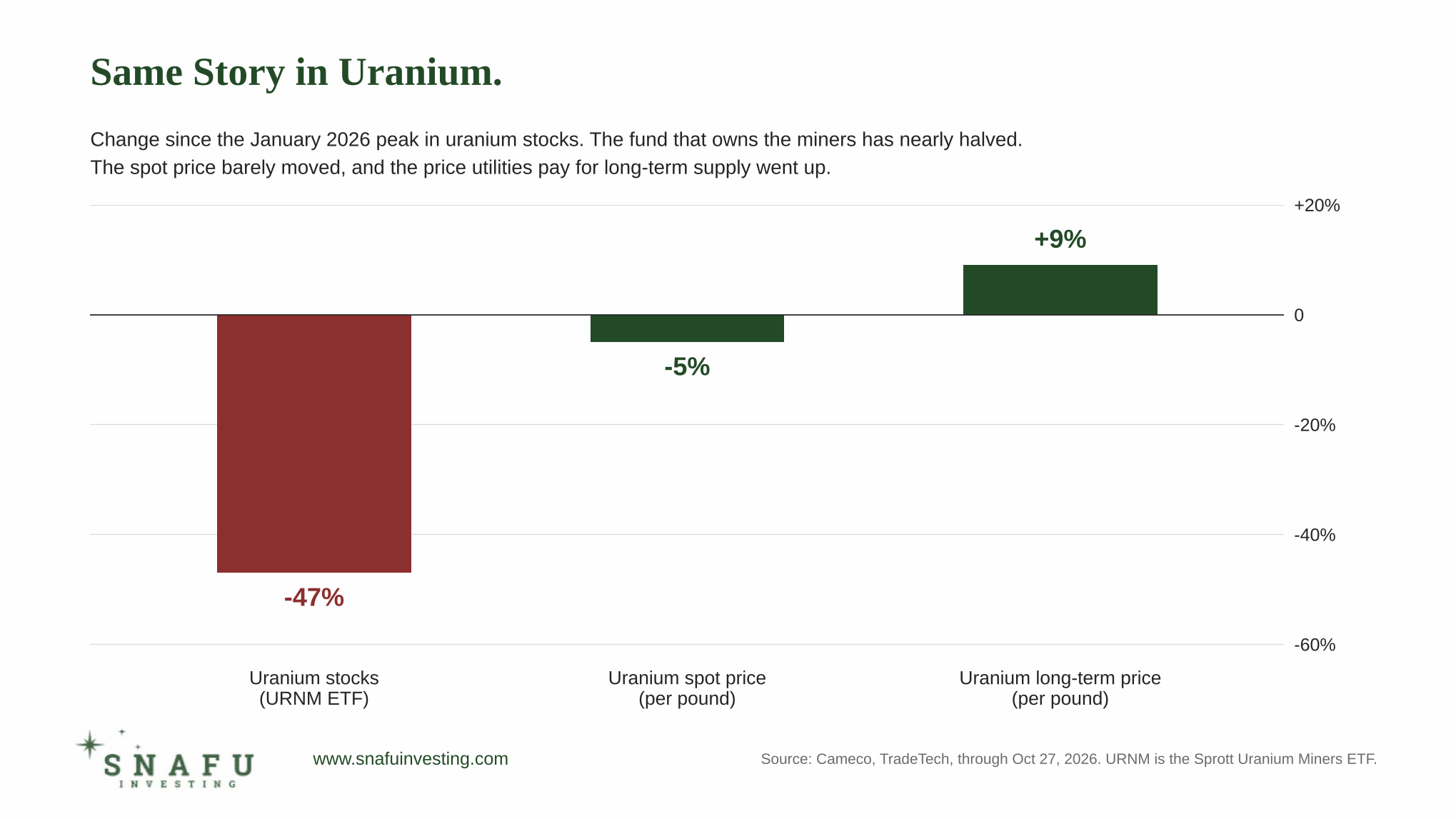
What you’re looking at is URNM, the fund that owns the uranium miners, down 47% from its January high, next to the price of uranium itself, which is down about 5% over the same stretch, and the long-term contract price, the one utilities actually sign at when they lock in supply for years, which is up 9%. It’s the same disconnect you just saw in rare earths, in a different metal.
So what happened there?
Well, the uranium miners got bundled into the AI trade this year, on the back of nuclear power for data centers, and when that trade cooled over the past few weeks, they went down with it.
Now, for what it’s worth, we didn’t buy any of these near the top. Our rare earth pick was already down 60% from its high when I recommended it in September, and I said so in the writeup. Our uranium producer was down even more when we started buying it in July. We came in after most of the fast money had already left.
Which brings me to our portfolio.
Some of our positions are in these two sectors, and they went down with everything else. I’m not going to pretend that was pleasant to watch. But here’s the thing: very little of it was about the companies themselves.
And more importantly, it turned out to be an opportunity rather than a problem. That’s because of the way we buy.
You see, we never buy a position all at once. We build it in tranches, into weakness, with standing orders waiting at lower prices, the way I laid out back in June in “Why I Never Go All-In on a Stock.”
So the volatility of the past six weeks did exactly what it’s supposed to do for us. It filled those orders: the second tranche on two of our positions, and the third tranche, the stink bid, on another. Every one of those fills pulled our average cost down, which is the whole point.
Then, this week, the good news arrived, and it sent two of those positions higher.
One got a government to put money behind the mine that feeds its mill, and the stock jumped almost 10% in a day. The other got a date for the permit we’ve been waiting on, days after that stink bid filled. I’ll also catch you up on our gold developer.
Below, I name all three, walk through what happened, and tell you where I stand on each. If you’ve been on the fence about joining the paid side, this is a good week to come inside: even after this week’s moves, all three are still trading below our buy-up-to prices, thanks to the selloff I’ve just described.