


You might have missed it amid the Thanksgiving feasts and the Black Friday deals, but something really interesting happened behind the scenes. Just this past Friday, regulators closed United Fidelity Bank in Evansville, Indiana.
And it’s not just any failure. With about $5.9 billion in assets and $5.4 billion in deposits, it’s the biggest U.S. bank failure since 2024.
So what sank it? Bad loans.
You see, almost 90% of its loans went to apartment building owners and developers, and by the end of September, seven in ten of its loans had stopped paying.
The irony is that back in 2020, United Fidelity was on the other side of the table, taking over the deposits of a failed bank in Florida.
As for depositors, they didn’t lose a dime. First Citizens, the same bank that took over what was left of Silicon Valley Bank in 2023 (remember that one? We’ll come back to it), picked up the deposits and the branches.
That said, the FDIC expects this failure to cost its insurance fund $1.83 billion. That’s roughly 31 cents for every dollar of the bank’s assets, which tells you how bad things had gotten inside.
And here’s what you probably didn’t know. That’s the seventh bank failure this year. In 2025, there were two. In 2024, also two. Take a look at the chart below.
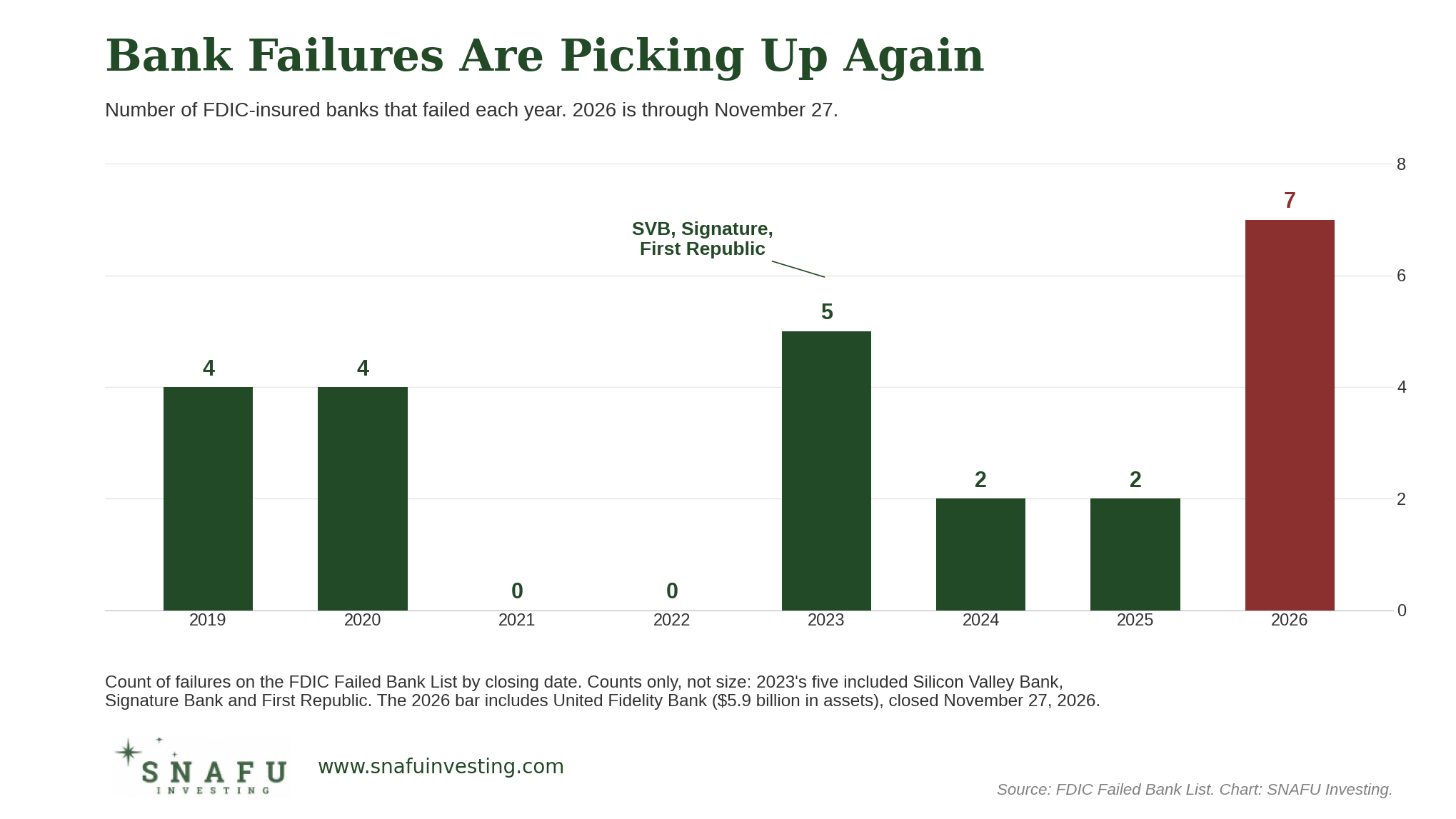
Now, it’s true that most of this year’s failures were small community banks compared with 2023. That year had two fewer failures, but they included Silicon Valley Bank, Signature and First Republic, three of the biggest bank failures in U.S. history.
But the point still stands: more banks have failed this year than in any year since at least 2019, and the year isn’t over yet.
Even the Fed sees the risk. In its stress test this June, the Fed’s worst-case scenario, a severe recession with commercial real estate prices down 39%, projected about $75 billion in losses on commercial real estate loans. That’s close to the highest on record. And keep in mind, this is the Fed, the last institution that wants to spook anyone. In fact, its headline was that the banks would come through just fine. (Tell that to United Fidelity.)
But here’s the thing. The Fed’s stress test only covered 32 of the biggest banks in the country, so it makes sense to look at how the smaller ones are doing. Remember, Silicon Valley Bank and First Republic were regional banks, and they went down in spectacular fashion.
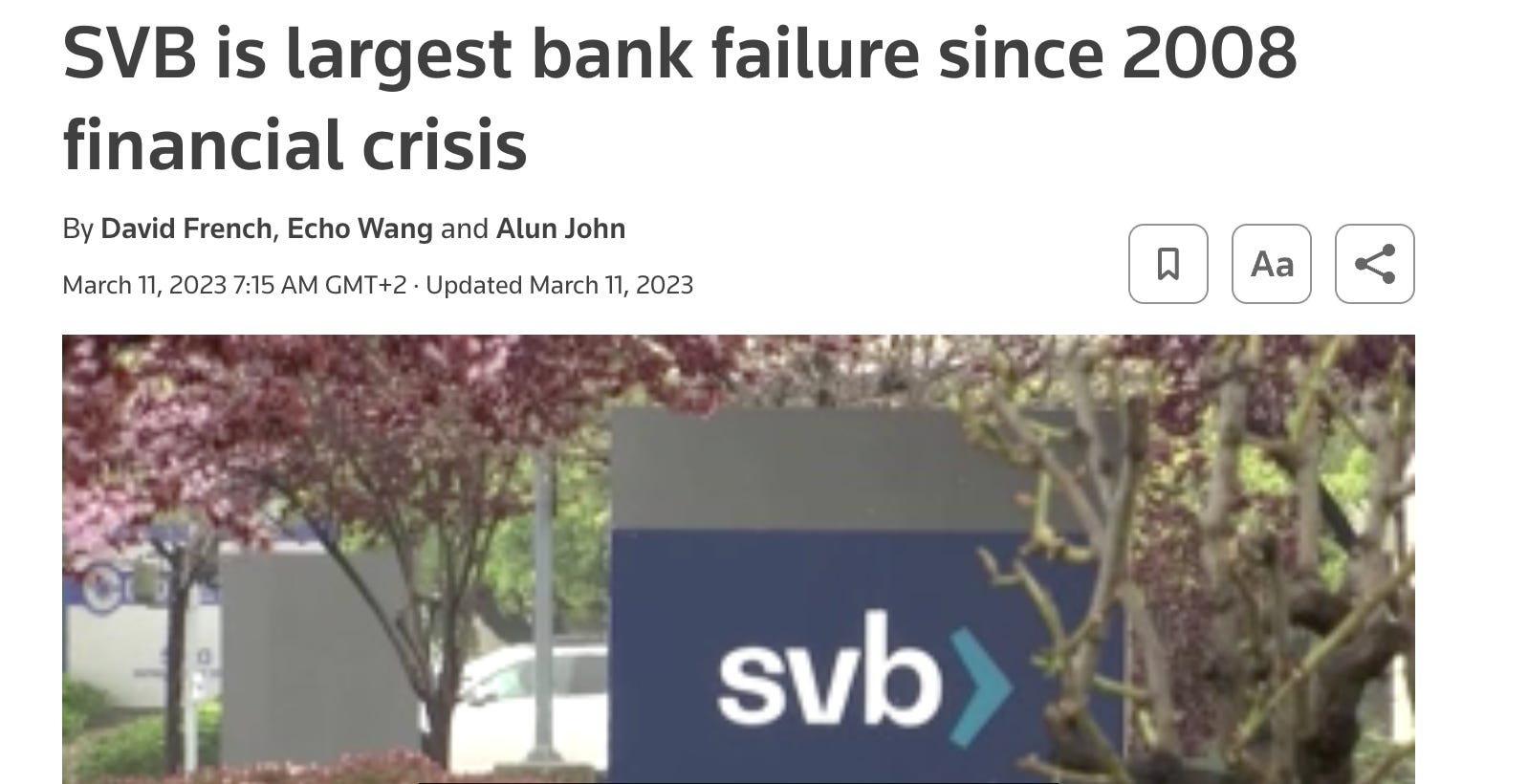
As you may recall, those banks went under because they couldn’t raise enough money by unloading their investment portfolios (which were deeply underwater due to the Fed’s rate hikes) to pay back the depositors who were rushing for the exits.
I couldn’t find a recent study on this, but the most recent one is from 2024. Back then, there was this massive study published from Klaros Group, a consulting firm, and it found that 282 banks, most of them smaller community banks, have both high levels of commercial real estate exposure and large unrealized losses from the rate surge. Chances are, it’s not only these 282 banks that are at risk; there are likely many others not covered by the study.
The Half-Trillion-Dollar Hole
Now, you might wonder why, two years later, any of this still matters.
Well, it matters because banks’ paper losses are right back near where they were when the Klaros study came out. U.S. banks as a group are now sitting on $486 billion in unrealized losses on their securities, according to the FDIC, the most in more than two years. That’s nearly half a trillion dollars. Take a look at the chart below.
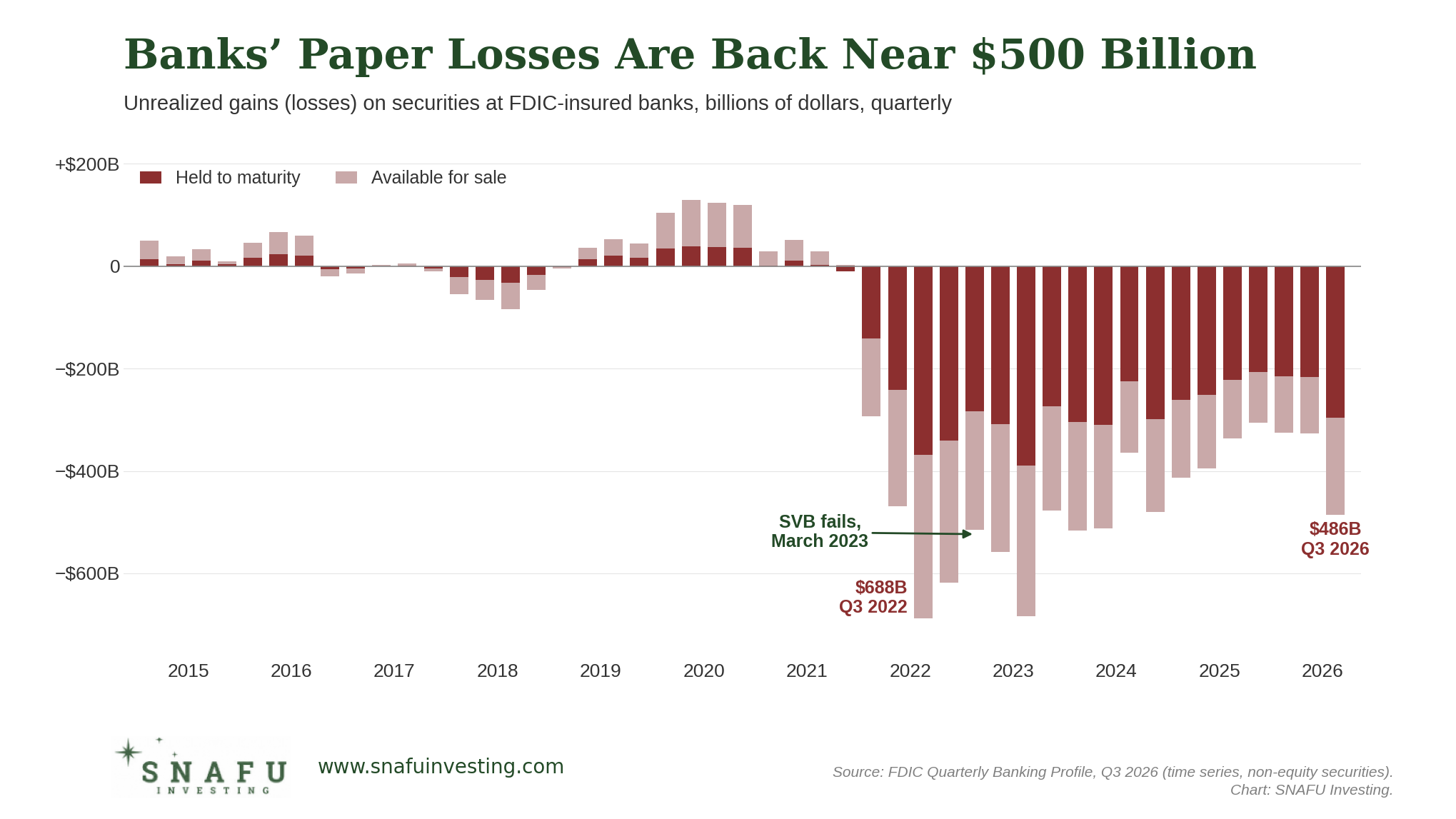
As you can see, the losses shot up sharply from last quarter, when they were $327 billion. That’s a jump of nearly 50% in a single quarter.
Just to remind you how these paper losses happen: Banks loaded up on Treasuries and mortgage bonds when interest rates were near zero. When rates go up, those old low-paying bonds are worth less, because nobody wants a bond paying 1% when a new one pays close to 5%.
Now, this isn’t necessarily a big problem in normal times. Banks have ways of managing cash flow issues, even when dealing with paper losses. And if they hold the bonds to maturity, those losses never materialize (since the bank receives the full face value and all interest payments).
But these times are anything but normal. Inflation is running hot, energy prices are up thanks to the Iran war, real estate is still a mess, and interest rates are rising again. All of this has depositors understandably on edge.
And when a wave of them rushes to withdraw their money at the same time, the banks have to find a way to pay. That often means selling bonds before they mature, which turns those paper losses into real ones, quickly and devastatingly. Again, that’s exactly what took down Silicon Valley Bank and First Republic in 2023.
And actually, it’s the same force that sank United Fidelity, just from the other side of the balance sheet. Higher rates made it harder for its borrowers to pay back their loans, and those same higher rates make the bonds banks hold worth less.
The Smartest Guys in the Room
Take Bank of America (BofA), the second-largest bank in the country, which, as you’ll see, is essentially the poster child for this entire problem.
Back in 2020 and 2021, with the Fed holding rates near zero and deposits pouring in, BofA parked hundreds of billions of dollars in long-term mortgage bonds and Treasuries paying next to nothing.
At the time, they probably thought they were the smartest guys in the room. Interest rates had been near zero for years with no signs of rising. And with the Fed pumping liquidity into the system during the pandemic, BofA likely assumed rates would stay low indefinitely.
Fast forward a few years, and it turns out they weren’t so smart after all. In fact, they misread the economic tea leaves so badly that they ended up making one of the worst financial blunders in modern history.
Why? Because between March 2022 and July 2023, the Fed cranked the federal funds rate from a rock-bottom 0%-0.25% all the way up to 5.25%-5.50%. You know, to fight inflation, the very thing they created in the first place.
Note: The federal funds rate is the interest rate at which banks lend money to each other overnight. When the Fed raises this rate, borrowing costs across the economy rise, pushing up interest rates, including those on government bonds.
When that happened, the value of BofA’s low-yield bonds plunged, and paper losses quickly piled up, decimating their balance sheet.
Back in 2019 and 2020, BofA’s unrealized losses on the bonds it plans to hold to maturity were close to zero, and even in 2021 they were a modest $13 billion. Then, in 2022, they went through the roof, to $109 billion. Take a look at the chart below.
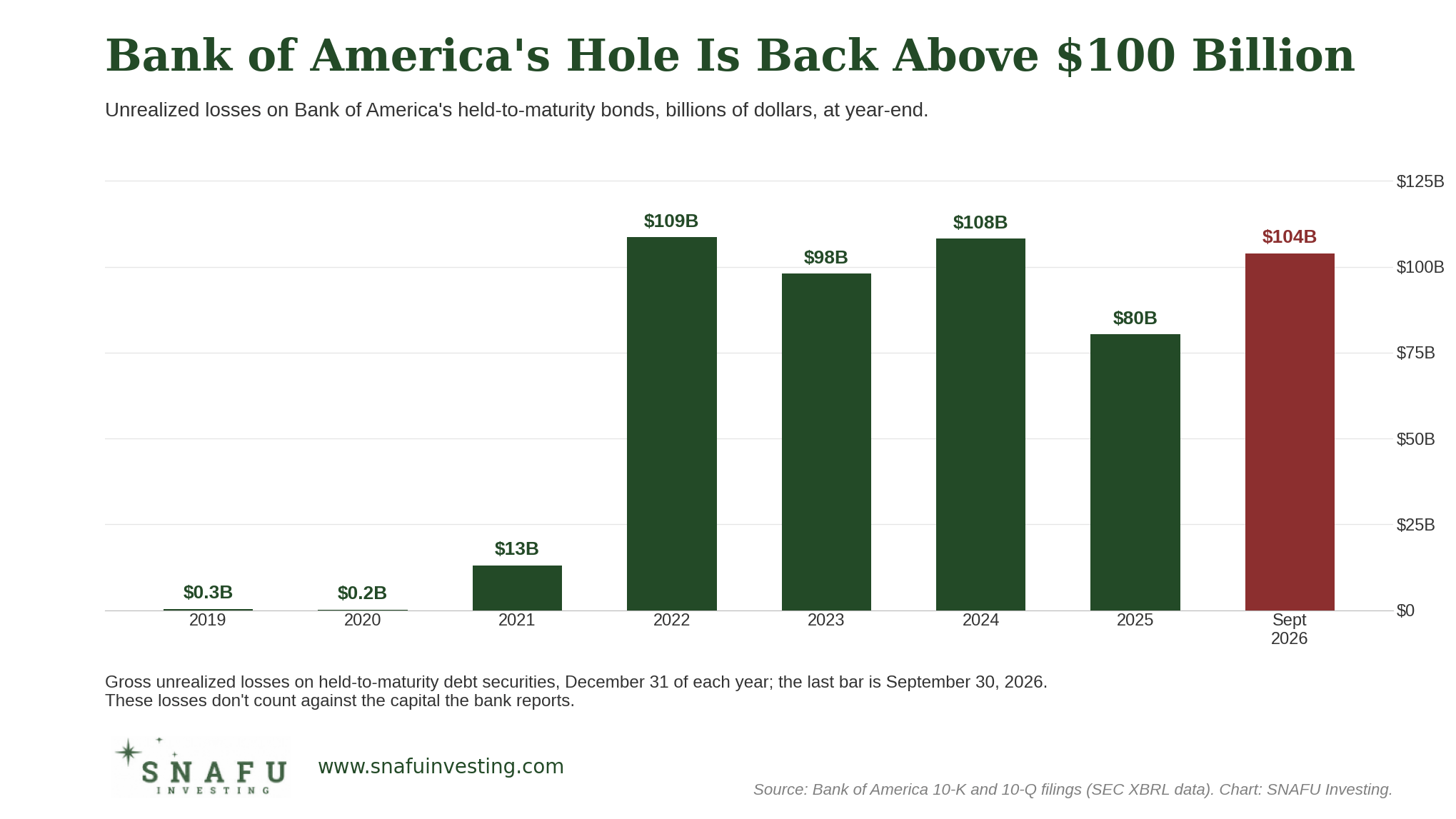
Last year, those losses dropped to $80 billion, and it looked like the hole might finally be closing. Turns out, not really. As of September 30, they were back up to $104 billion, according to BofA’s latest quarterly filing, and the year isn’t even out yet.
This is a huge problem because it’s forcing them to pay depositors a paltry 0.01-0.04% interest, while online banks pay close to 4%.
Offering competitive rates would mean paying depositors far more than those old low-yield bonds bring in, which would gut their profits. And if depositors left anyway, BofA would have to sell those underwater bonds at massive losses, which would completely wreck their balance sheet. So, BofA is stuck between a rock and a hard place, paying meager interest and praying that depositors don’t flee for better yields.
You’d think a run on BofA could happen shockingly fast. It hasn’t, and the reason is simple enough: most people just don’t move their money, even when they could earn hundreds of times more somewhere else. Yes, that inertia is about the only thing holding the whole arrangement together.
But I wouldn’t bank on it if I were BofA, because in our digital age, a few taps on a smartphone can drain a bank’s deposits in a matter of hours. That’s what happened to Silicon Valley Bank.
Why the Fed May Have to Blink
Now, as you probably remember, the Fed raised rates in September for the first time since 2023, and the 10-year Treasury yield has been hovering around 5%.
That means banks are now getting squeezed from both directions at once. On one side, more of their borrowers are falling behind on loans that got harder to pay as rates went up. In fact, the FDIC says late payments on apartment building loans rose across the banking industry last quarter. On the other side, the bonds they hold keep losing value because, again, old low-paying bonds are worth less when new ones pay more.
So if rates keep climbing, that squeeze will only get tighter. And judging by the numbers we just went through, it’s already tightening, so chances are United Fidelity won’t be the last bank to feel it.
But what about the Federal Deposit Insurance Corporation (FDIC)? If you brought this up over Thanksgiving leftovers this weekend, you’d probably hear someone say, “I’m not worried, the FDIC will cover me!”
The reality is more complicated. The FDIC fund only has about $163.5 billion on hand as of September 30. And remember, U.S. banks are sitting on nearly half a trillion dollars in unrealized losses. And that was before United Fidelity took its $1.83 billion bite.
This means the FDIC might need more cash in a major crisis, which, in turn, means the Fed (and the Treasury) will likely have to step in to stabilize the situation, just like they did in 2023, when they guaranteed every deposit at Silicon Valley Bank and Signature, insured or not.
The Fed knows the problem. A string of failures like this could very well bring us right back to that year, when it all ended in a big bailout, with the Fed lending to banks against their underwater bonds as if those bonds had never lost a dime. So I think it’s a fair bet the Fed will instead do what it did in 2024 and 2025: bring rates back down and help the banks dig out of their bond losses.
If, on the other hand, the Fed keeps hiking to “fight inflation,” every bit of that tightening will dig the banks’ hole deeper. And if that leads to bank runs, well, then the Fed has a whole new problem on its hands, because runs can quickly trigger a domino effect of panic that would spill over into the broader economy. That’s to say nothing of the government’s interest bill, which is already running more than $1 trillion a year and only grows as rates go up.
And I doubt either President Trump or the new Congress coming in January wants any of that.
Enjoy the rest of your weekend,
Lau Vegys
P.S. In case you missed it, SNAFU Investing’s latest monthly issue went out to paid subscribers last weekend. In it, I explain what’s really behind gold’s selloff, why I see it as a flush in the middle of a bull market rather than the end of it, and the low-cost miner I’m buying because of it, one that’s on track to double its output without needing a higher gold price. If you’re a paid subscriber, make sure it didn’t get buried under all the Black Friday emails. And if you’re not, the intro is free to everyone.
and you forgot to mention the bank that has the biggest paper loss of all - the fed itself. Hundreds of billions. Fortunate for them they can't be insolvent, by definition.
All the analysis keeps pointing to the "Big Print"
Washington will not allow banks to fail, even if they are insolvent, so they will print.
Washington will not allow government to reduce spending, so they will print.
The American people are addicted to welfare, so the fed will print.
Very well written and instructive analysis of the rocks and hard places squeezing banks, borrowers, federal agencies with valid speculation regarding what the Fed will do with interest rates near term. There are no good answers. All patches cause leaks at other extremes. I think we'll stumble along as individual citizens somewhere in the middle, but everything gets harder for those with less optionality. Nevertheless I hope we all managed some good food and comradery thankfulness over the holidays. Thanks for the update, Lau.