


So earlier this month, the war with Iran officially ended. Four months of fighting. Thousands dead on all sides. The world’s most important oil chokepoint thrown into chaos. Global energy markets rattled. Infrastructure across the Gulf damaged. Lebanon bombed. American service members who will never come home.
It’s over (or so we’re told). And whatever else I say in this essay, I’m glad about that.
But nothing tells you just how pointless this war was quite like the deal Trump was willing to sign to end it.
On June 17, at the G7 in Versailles, Trump signed a 14-point Memorandum of Understanding with Iranian President Masoud Pezeshkian.
On paper, it looks like a remarkable deal… for Iran.
Tehran gets US$300 billion in reconstruction aid (underwritten in part by American taxpayers). All U.S. sanctions lifted. The naval blockade gone. And the right to sell oil freely again.
A Strange Deal
Now, at the risk of stating the obvious, the U.S. government didn't go to war to rebuild Iran. The stated objectives shifted depending on whom you listened to, but they all landed in roughly the same place: destroy Iran's nuclear program, eliminate its ballistic missile arsenal, end its support for proxy groups, and, according to some high-ranking figures in Trump's orbit, topple the regime altogether.
So how many of those objectives made it into the final agreement?
Essentially none.
Under the deal, Iran gets to keep its uranium enrichment program, with only a vague commitment to negotiate the “disposition” of enriched material at some later date. It also keeps its ballistic missiles. So much for eliminating Iran's missile program.
And the regime is still very much in power, just more radicalized after the bombing killed scores of its leaders’ families, including the supreme leader himself, whose own son now rules in his place.
Note: You may recall that when Obama signed the Joint Comprehensive Plan of Action (the “JCPOA”) in 2015, the same deal that Trump pulled out of in 2018 and called “the worst deal ever negotiated,” it didn’t come anywhere close to this kind of price tag. And Iran had to cut its nuclear centrifuges from 19,000 to 6,000, cap enrichment below weapons grade, and accept international inspectors. No missile concessions either.
So what is the U.S. getting?
Beyond the reopening of the Strait of Hormuz — 60 days of free passage, followed by negotiations with Oman over who administers it going forward — not much.
For a man who built his brand on making great deals, this is an awfully strange one.
So — and again, I’m all for peace, something I certainly hope endures this time — but I have to ask: why would Trump, of all people, sign something like this?
Follow the AI
To answer that, you have to understand a new reality, which is that the entire U.S. economy is being carried by one thing right now: artificial intelligence. The chip companies, the cloud platforms, the data center builders. Strip AI out of the picture and there’s almost no growth.
Don’t just take my word for it. Harvard economist Jason Furman recently calculated that without investment in data centers and information processing technology, U.S. GDP growth in the first half of 2025 would have been about 0.1% on an annualized basis. Effectively zero.
We also know that in the first quarter of 2026, AI-related investment accounted for more than half of all U.S. GDP growth. For context, even at the peak of the dot-com boom in 2000, tech contributed about 28% of GDP growth. AI’s share today is nearly double that.
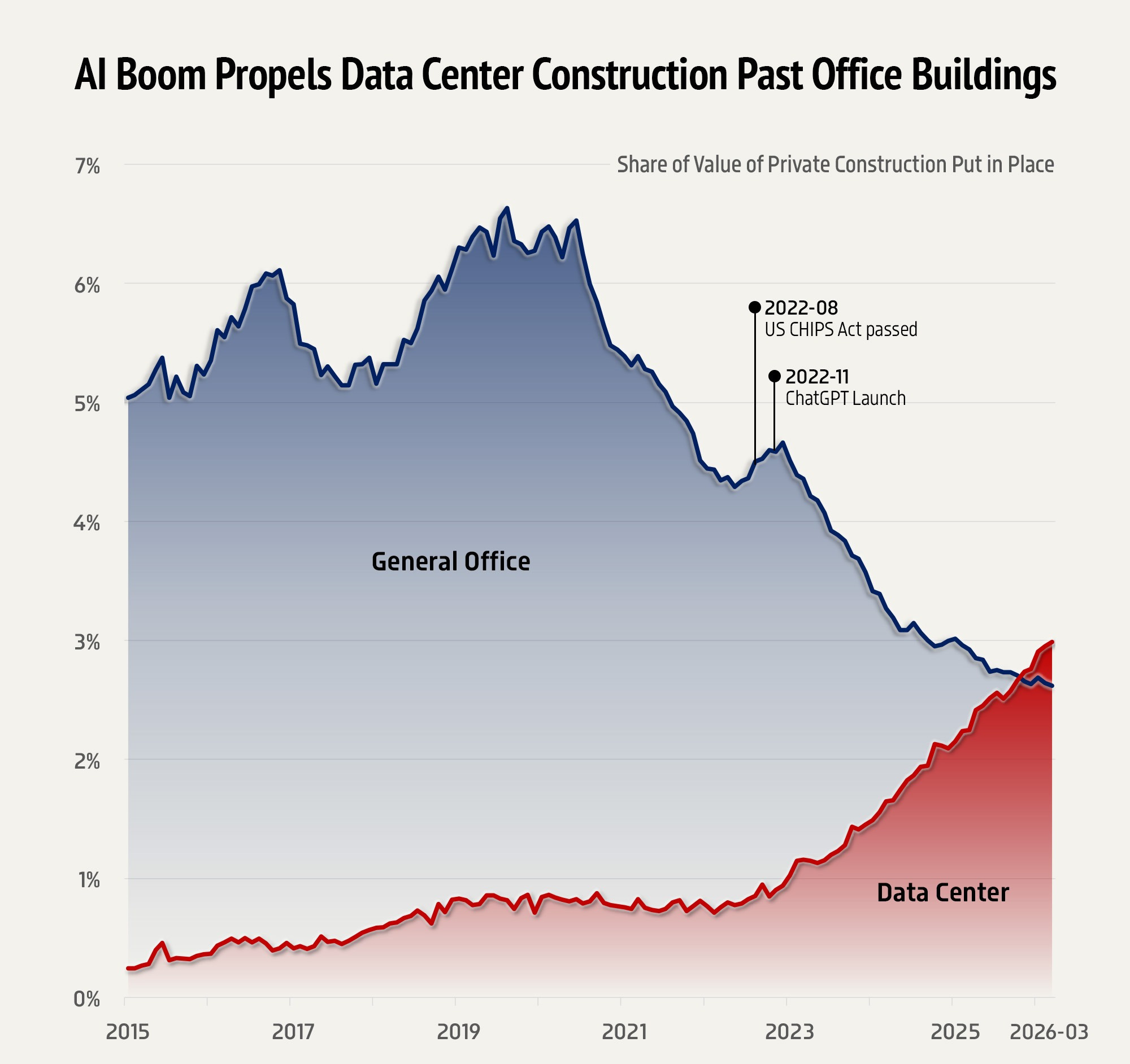
That’s the reason you don’t even see a whole lot of office buildings going up anymore. It’s all data centers. The data confirms it too. Last quarter was the first time in U.S. history when the country spent more on data centers than on building office buildings.
There are now nearly 4,200 data centers in the United States. That’s roughly eight times more than either Germany or the United Kingdom, the next-closest countries by data center count. And there are going to be many more, since the big four alone (Alphabet, Amazon, Meta, Microsoft) are spending over US$650 billion on AI infrastructure this year.
In short, the American economy is physically rebuilding itself around data centers.
The problem, of course, is that data centers run on two things: cheap electricity and cheap debt. Remove either one and the AI momentum disappears.
And U.S. and Israel’s useless war with Iran put a big monkey wrench into both.
For starters, it sent oil prices soaring. Brent crude, which had been sitting around US$80, surged past US$120 a barrel. It wobbled after that, rising and falling depending on whether Trump sounded conciliatory or was rattling the saber on a given day. But we do know from the Fed’s own projections that a two-quarter closure would push oil to US$115 a barrel. Three quarters, US$132. And so on and so forth.
Now, you have to understand that oil at those levels doesn’t just mean expensive gasoline. It feeds into shipping costs, manufacturing costs, food prices, heating bills. And that matters for the AI story, because rising consumer prices make it politically difficult for the Fed to cut interest rates. If rates stay high, the borrowed money financing the entire AI build-out gets more expensive with every passing month.
Take Trump’s own Stargate project, the plan to build a massive network of AI data centers across the country. The headline number was US$500 billion.
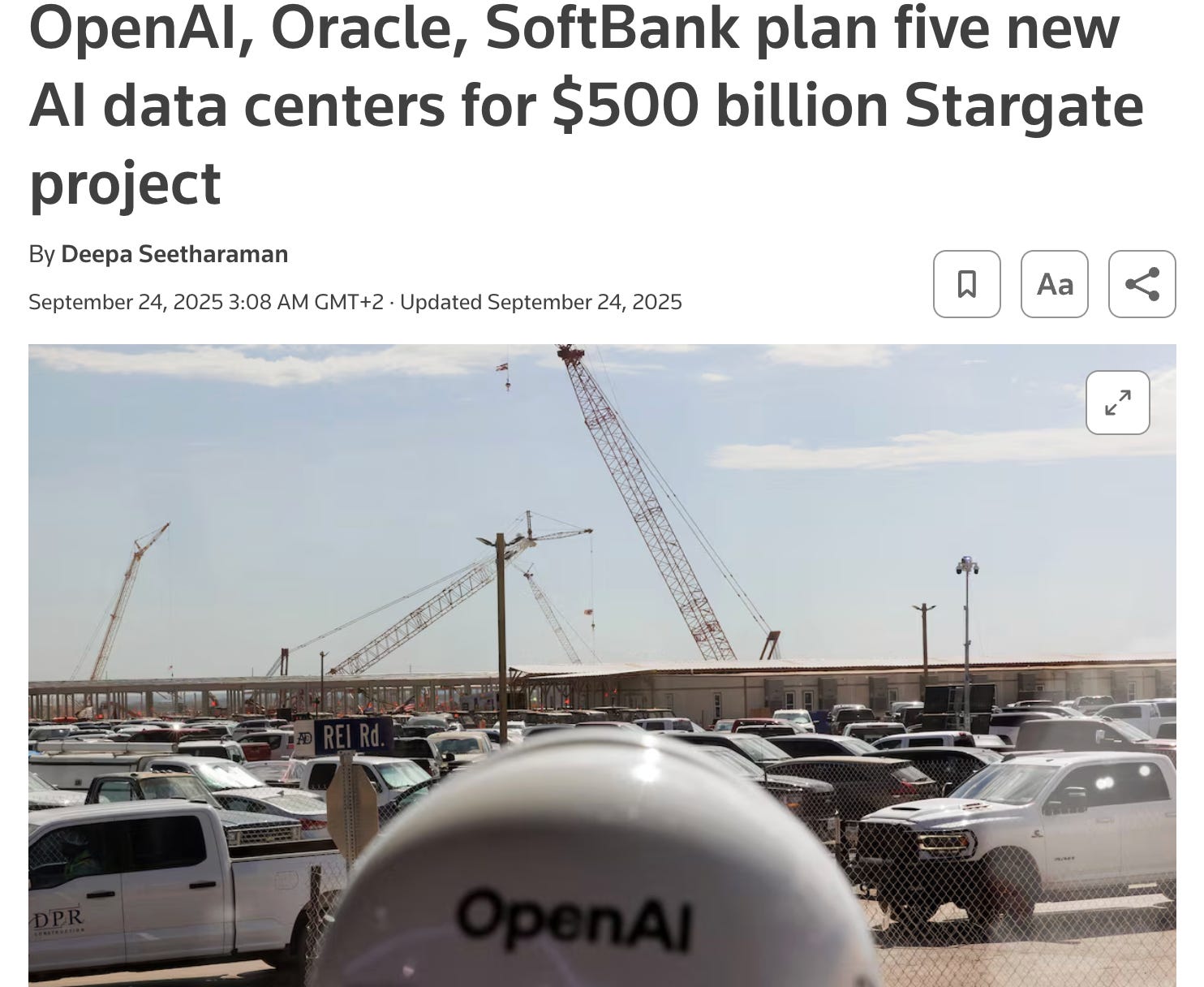
What most people don’t know is that only US$52 billion of that is actual equity. The rest, US$448 billion, was supposed to come from debt financing that hasn’t been secured. Every additional percentage point on that debt costs roughly US$4.5 billion a year in interest. The difference between financing at 5% and financing at 8% is about US$13.5 billion a year, on one project alone. For reference, that’s nearly what OpenAI is on track to lose in all of 2026.
The 41% Problem
Now layer on soaring electricity prices, and it's not hard to see why the administration is so desperate to keep the Strait of Hormuz open.
The connection is pretty straightforward. Natural gas prices tend to follow oil, and natural gas generates roughly 40% of all U.S. electricity. More expensive gas means more expensive electricity. More expensive electricity means more expensive AI.
That's becoming a real headache for the industry.
As I write this, roughly half of all planned U.S. data center projects have already been delayed or scrapped. Another 75 projects, worth a combined US$130 billion, are stuck in limbo because the electricity to run them isn't there. And of the 12 gigawatts of new capacity expected to come online this year, only about a third is actually under construction.
In other words, the AI build-out is beginning to stall.
And that’s a much bigger problem than it sounds.
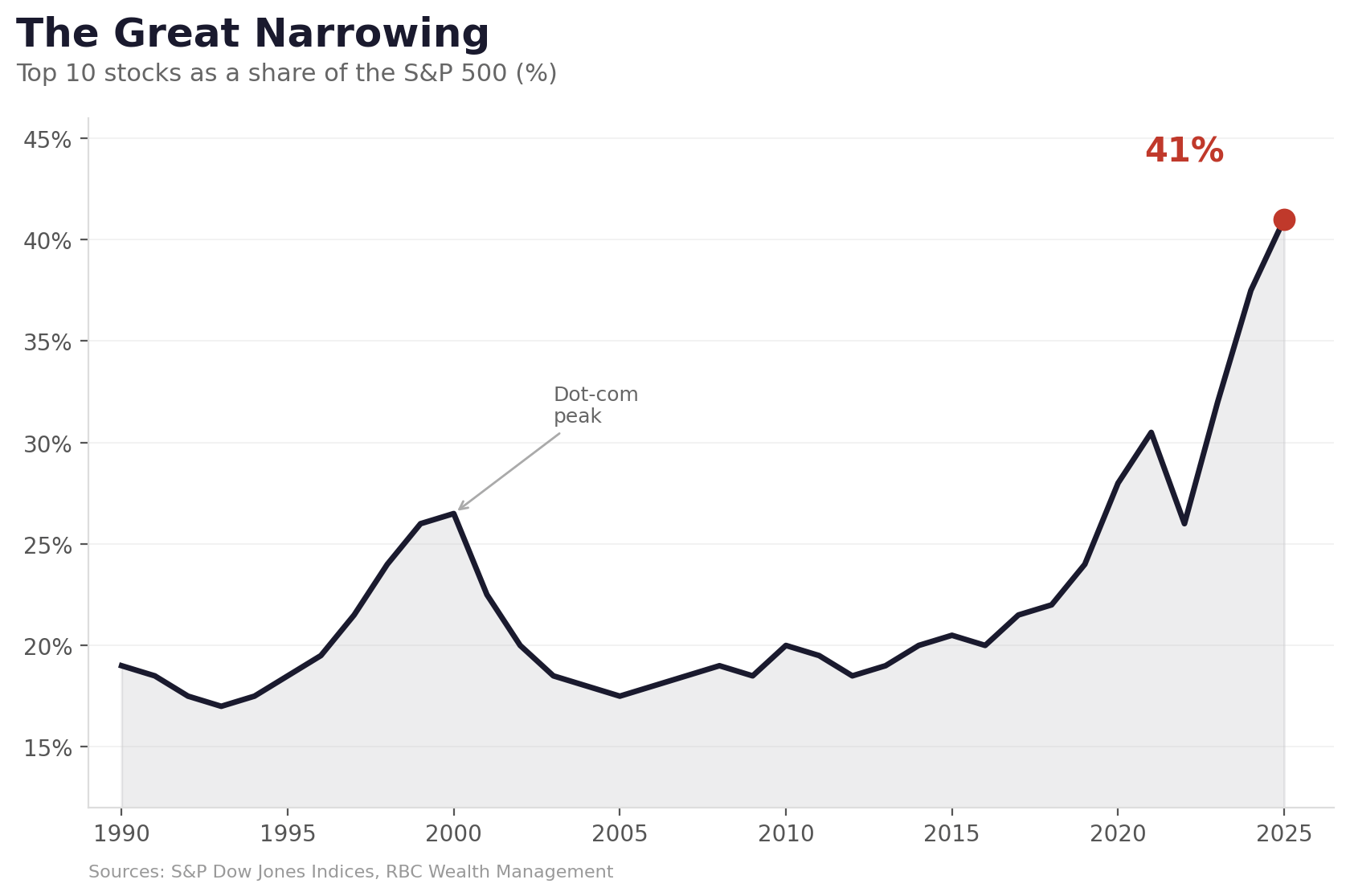
You see, the AI boom isn’t just another hot investment theme. It’s the only thing holding the stock market together. Take a look at the chart below. The top 10 stocks in the S&P 500, most of them AI plays, now make up 41% of the entire index. That's more than double what it was 10 years ago, and considerably more than it was during the dot-com bubble.
Now think about what the stock market actually means to the average American. For most people, their retirement account is the closest thing they have to wealth. And those accounts are now heavily exposed to AI stocks. When those stocks rise, people feel richer and spend more. When they fall, they don’t.
Consumer confidence, in other words, is increasingly tied to whether the AI story keeps working. And consumer confidence is one of the few things standing between the U.S. economy and a recession arriving just in time for the midterms.
Needless to say, the last few presidents who went into the midterms with a sputtering economy didn't enjoy the experience. Obama, for instance, lost 63 House seats in 2010 when the recovery felt too slow. Biden lost the House in 2022 with grocery prices doing his talking for him.
That’s why no price is too high to reopen Hormuz.
Now, none of this is to say the U.S. will necessarily honor every term of this agreement (or that the Hormuz disruption has fully worked its way through the global economy). It may simply be buying time… rebuilding weapons stockpiles, refilling strategic petroleum reserves, and waiting for a more favorable moment. That’s certainly possible.
But with the midterms approaching, the AI sector still needing cheap energy and cheap money to prove it can turn a profit, and Iran now knowing full well that Hormuz is a card no one can answer, the incentives overwhelmingly point the other way.
Position accordingly.
Regards,
Lau Vegys
P.S. I've been on the road and couldn't get to all the comments on last week's essay, but I've read every one. I'll be honest, I'm a little overwhelmed by the response. Thank you. I'll do my best to get to them as soon as I can. And for those of you who've been asking what I'm building here, you'll hear from me on that next week.
The Rothchilds are running the show, and Trump is a puppet, just like all the other Presidents. He who has the gold makes the rules. The Fed is the problem, and the old man who has been running it is one of the biggest problems. NOW, he just will not go away. Still there hovering. It will be interesting to see what the new guy does. The housing market is a mess, but regulations and high interest has kept it there. Free housing for illegals (millions) have stalled the ability to sell commercial hotels, buildings, and re-do offices. Covid did not help either. Blackrock picking up small properties that should go FHA adds to it. More than IRAN, we are still funding Zelensky, and every other nation with it’s hand out. Obamacare has crippled Americans more than oil, and we cannot get rid of that eternal problem that gets worse every year.
Trump can be a bombastic bully, but if we hand this nation over to socialism (Biden, Obama) again; it will be the end, for sure. The Coasts of the US are lost to Communists, and Hucksters. Difficult times.
Thanks, Lau, for the good article.
That’s a nasty picture of what the US stock market, with ripples through the economy, is facing. Too many eggs in one basket. Watch out below. Important warning, Lau. Thanks.