


Freedom, liberty, opportunity, self-reliance, and independence...
These are some of the ideas at the heart of the American Dream, the belief that anyone who works hard and is determined can achieve success and move up in life.
And, of course, it’s been a core tenet of American society for generations.
But increasingly, it seems the glitter of the American Dream is fading for most Americans. Earlier this year, YouGov asked Americans whether they had achieved the American Dream, or ever expected to.
The results were pretty disheartening, to say the least...
31% said they never will. Another 22% didn’t know. Only 26% said they had already made it.
Break it down by age and the picture gets even bleaker.
Among Americans 65 and older, 55% say they’ve achieved the American Dream.
Among Americans under 30?
Just 5%.
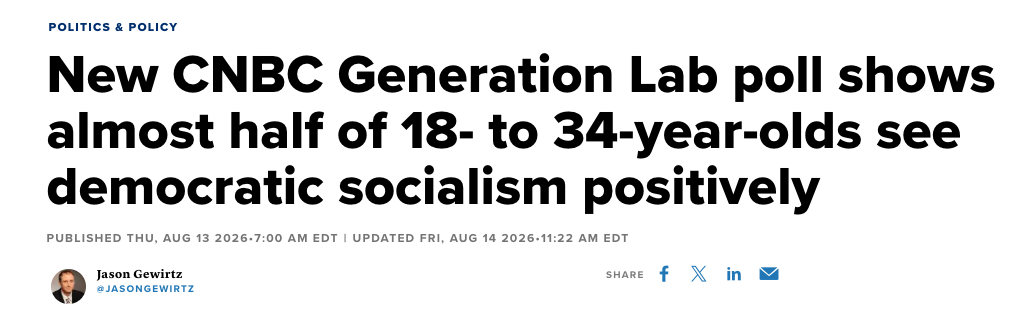
Jeez... with numbers like that, no wonder (democratic) socialism is suddenly finding an increasingly receptive audience.
But when you look at what the American Dream actually costs these days, those numbers start to make more sense.
According to a recent study by Investopedia, living the “American Dream” could set you back just over $5 million over your lifetime. When I last wrote about this, about two years ago, the figure was $3.4 million.
Meanwhile, the average American with a degree is projected to earn just over $2.8 million over a typical career.
You may already see the problem.
Grandpa's America
But what is the American Dream anyway?
If you’re picturing the classic scene of a man and woman with two kids, a white picket fence, a suburban house, and a car straight out of the 1960s, then you’re not far off.
At its core, the American Dream is about being middle class.
Now, I’m a fan of the middle class. It’s made up of people who want to work hard, create and run businesses, take care of their families, and move up in life.
And for a long time, America was perhaps the best place in the world for people like that to prosper.
The decades after World War II were the golden age of the American middle class. Inflation was relatively low, wages were rising, and millions of ordinary families were enjoying a standard of living their parents could only have dreamed of.
Now, I didn’t witness it firsthand, but my grandpa got a glimpse of that America when he visited the U.S. for a track and field competition back in the 1960s.
He’d reminisce about the vibrant American streets, bustling businesses, and those classic American cars that left a lasting impression on him, a Soviet citizen. Every time he shared those stories, he’d proudly gesture to an old Zenith portable transistor radio he brought back from the trip.

Unfortunately, as I found out decades later, that golden age didn’t last.
Through the 1970s, 80s, 90s, and into the 21st century, the middle class’s share of total U.S. household income kept getting smaller and smaller.
As you can see in the chart below, it went from 62% in 1970 to below 50% in the 1990s, and today sits at around 40%.
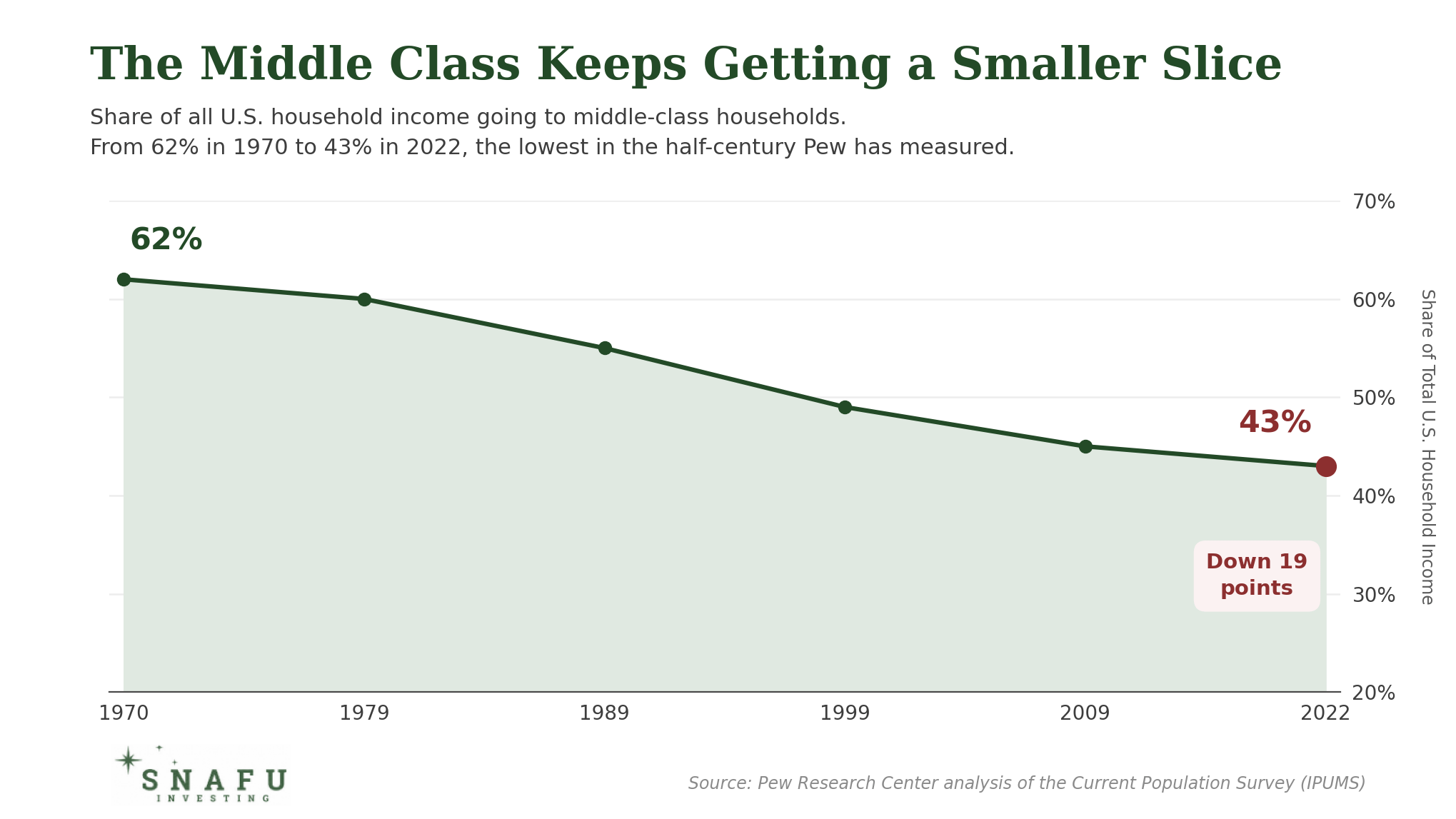
As I write this, the American middle class is 51% of the adult population. In 1971, it was 61%.
In other words, the middle class has shrunk by about a sixth since 1971. And it has lost nearly a third of its share of the income.
Not great.
The Biggest Expense of Your Life
If I had to point to one thing that’s put the most pressure on America’s middle class over the years, it would be housing.
Owning a home has always been a cornerstone of the American Dream. It’s also the biggest expense most families will ever take on. I’m sure you’ll agree on both counts.
Below is a look at just how dramatic the decline in home affordability has been.
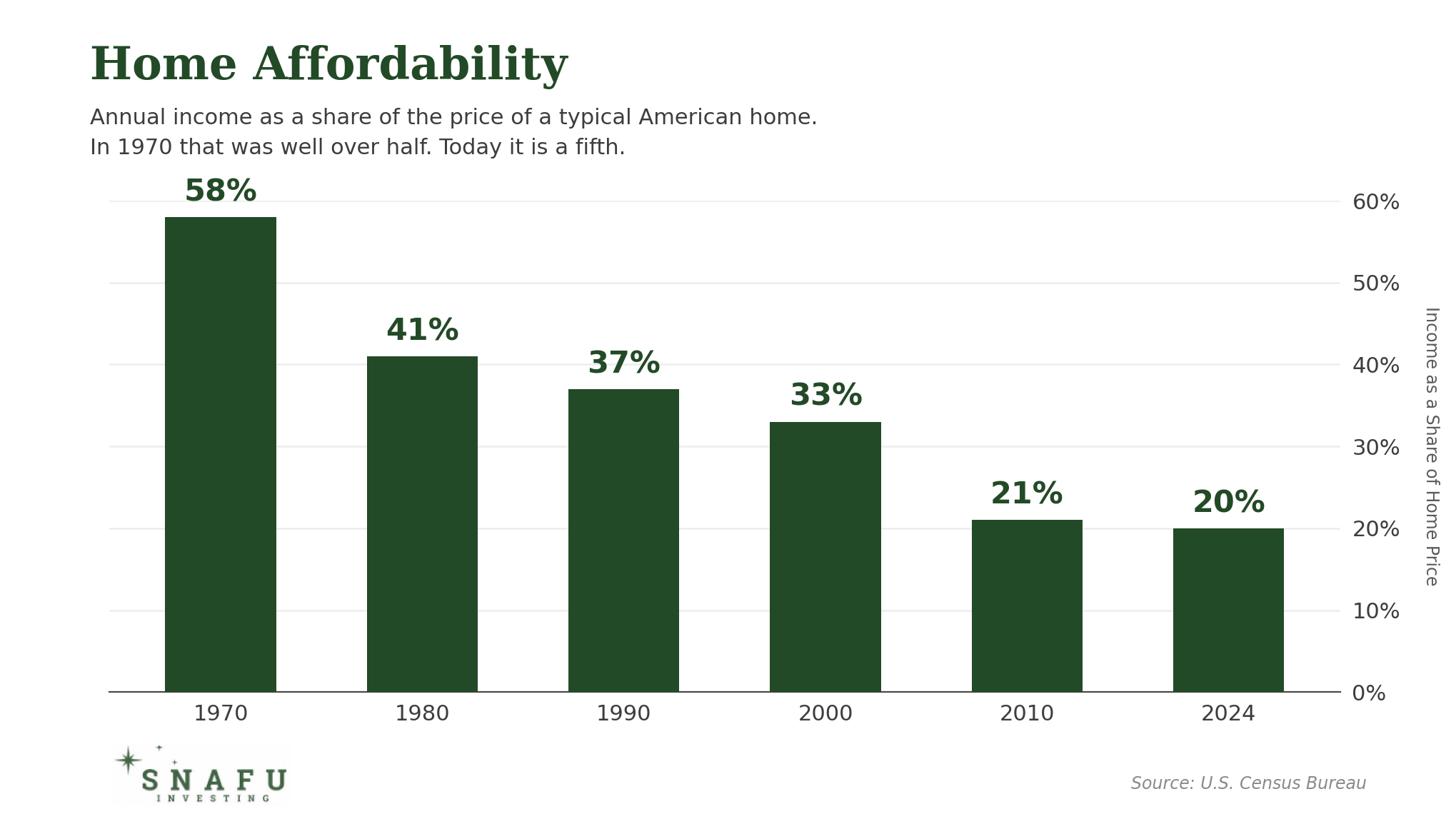
Now, we all know home prices have risen dramatically since the middle of the last century. That’s not the problem. The problem is that, over time, they’ve risen much faster than incomes.
As you can see in the chart above, the income-to-home-price ratio today stands at 20%. In 1970, it was 58%.
To put some flesh on those numbers, in 1970 the median American family earned $9,870 a year, according to the Census Bureau. The median home was worth $17,000. So a single year’s income covered well over half the price of a middle-class house.
In 2024, the median home sold for about $419,000. To match that 1970 ratio, the typical American household would need to be earning just over $240,000.
They aren’t, of course. Not even close. Median household income in 2024 was $83,730 — enough to cover 20% of the price of a house.
In other words, it now takes the combined income of nearly three households to buy what one family could buy in 1970.
To me, the collapse in home affordability is the clearest illustration of just how badly the American standard of living has taken it on the chin.
What the Middle Class Is For
But why should we care, dear reader?
Well, aside from the fact that you and I are, in all likelihood, both members of said middle class, the middle class has historically been one of the great stabilizing forces in American society. Any society, really.
The reason is simple enough to understand: it gives masses of people a stake in the system, something to work for, something to protect, and, perhaps most importantly, a reason to believe they can move up.
Hollow that out and you end up with two Americas: a relatively small group at the top and a much larger group struggling below. That’s fertile ground for resentment, political radicalism, and eventually the kind of class divisions that can turn into outright class war.
We may agree or disagree on the finer points of this argument, but my larger point is this:
When a country doesn’t have a strong middle class, it’s in trouble.
Perhaps the growing embrace of socialism among young Americans is simply an early symptom of that process already underway.

And here’s something else you have to consider. Almost everything we’ve looked at so far happened before another disruptive force entered the picture (one that could only accelerate the whole trend).
AI.
As I’ve been writing for some time now, AI is coming directly for many of the white-collar jobs that have traditionally supported the American middle class. Estimates vary, but we’re talking about tens of millions of American jobs exposed to some degree of AI-driven automation or displacement.
In other words, a middle class that has already been shrinking for half a century may be about to face its biggest squeeze yet.
Where this ultimately leads, I’m not sure. But we’re heading toward a real socioeconomic crisis.
I wonder what Grandpa would make of it all now.
Regards,
Lau Vegys
I was not taught how to be an American in school. I started in 1954. I learned to read and add. The rest I picked up by osmosis: work, Scouts, the people around me. Nobody sat me down and explained what a politician is for, what a vote costs, or how a household budget keeps a free country standing.
I still worked my way into the American Dream. House, family, a living. I thought that was the job. I also thought the schools were teaching my children what the country is, why it is worth keeping, and how you keep it. I was wrong. I was busy earning the life and I missed the dulling.
Then came the children after the dulling. My grandchildren do not think capitalism is bad. They believe it. That is different. A thought you can argue with. A belief they inherited from a classroom that never showed them a ledger, a title deed, or a parent who made payroll. They have been told that my generation did nothing for them. That is a professor’s sentence. We built the roads, the power, the food, the campuses they sit in. We also stopped explaining the machine while we were running it. Both are true.
If the middle class shrinks, a house becomes a prize you wait to be handed, and school teaches ownership as the original sin, young people will not vote to preserve a system they were never taught to run. They will vote for someone who promises to assign the prizes.
I am not asking anyone to apologize to their kids. I am asking one reader to sit down with one child or grandchild and do the thing the school did not do: explain what a free country actually costs, what a house actually is, and why “they gave me nothing” is a lie that feels true when nobody ever showed them the books.
If that conversation happens once, this note did its job. Passing on how a free country works is the first job of a free citizen. The rest follows from that, or it does not follow at all.
It has always been fairly obvious to me that leftist politicians go out of their way to enact legislation that helps eliminate more of the middle class, and for this very reason. As the state grows, the people shrink in stature, prosperity, and independence. Green theocracy is a magnificent catalyst in doing so. If anyone wants proof, for example, try building your own house and navigate the regulatory impediments and costs involved.