


For decades, the petrodollar system quietly underpinned American economic power. Most people never thought about it. They didn’t need to.
Now the cracks are getting harder to ignore.
The recent U.S.-Israeli war with Iran was supposed to weaken Tehran. Instead, it reminded the world of a simple reality: Iran controls one side of the Strait of Hormuz. After disrupting traffic through the chokepoint, Tehran is now charging yuan-denominated transit tolls on tankers that pass through. China is building alternative payment rails. BRICS keeps expanding. And the dollar’s share of global foreign-exchange reserves has fallen to its lowest level in decades.
Now, this doesn’t mean the dollar is about to disappear. But it does mean the system that financed Washington's deficits and projected U.S. government power around the world is coming apart at the seams.
America's ruling elites see the same thing.
And contrary to what many people assume, they aren’t sitting back and hoping for the best. They have a plan to replace the demand that’s slowly disappearing from the old system.
It’s a clever plan. It might even work.
The question is whether preserving the dollar’s dominance is worth the price Americans may end up paying for it.
Before we get to the solution, we need to understand the problem.
The Sponge That’s Drying Up
For fifty years, virtually every barrel of oil traded anywhere in the world had to be paid for in dollars. Every nation that bought oil needed dollar reserves. Every nation with dollar reserves parked them in U.S. Treasuries.
That meant foreign central banks were essentially forced, by the mechanics of the global oil trade, to absorb whatever the U.S. government wanted to borrow. New deficit? Somebody overseas had to buy the debt… because they had accumulated dollars and needed somewhere to park them.
That was the sponge.
It’s also why the U.S. could keep printing dollars for fifty years without getting the inflation that should have followed. This is the thing most people get wrong about so-called “Modern Monetary Theory” — the idea that a sovereign government printing its own currency doesn’t really need to worry about deficits. But MMT only “works” if someone else is absorbing the new money. For the U.S., that someone else was every Saudi or Chinese or German central bank that needed dollars to stay in the global oil game. Without the sponge, MMT is just printing. With it, MMT looked like a free lunch.
Take the sponge away and the math changes immediately. The same dollars that used to disappear into a Saudi central bank’s reserve account now have to find a buyer at home. The same Treasuries that the Gulf used to soak up now have to clear at whatever yield American pension funds and money market funds are willing to accept.
Which is why the 30-year just cracked 5%. It’s not random. It’s not “the bond vigilantes are back.” It’s the visible price of the sponge drying up. And that price gets paid by every American with a mortgage, a credit card, a car loan, or a small business credit line.
So how do you keep funding a government that runs a $2 trillion-plus annual deficit when the foreign sponge is drying up?
Well, you build a new one.
Building a New Sponge
The new sponge isn’t a foreign central bank. It’s a handful of private American fintech companies — Tether, Circle, and whoever else gets licensed under the recently passed GENIUS Act.
That’s the new sponge. Same mechanism. Different infrastructure.
Treasury Secretary Scott Bessent has been telling everyone, in plain sight, exactly what they’re doing. Here’s how he put it in the official statement marking the GENIUS Act’s enactment:
Stablecoins represent a revolution in digital finance. The dollar now has an internet-native payment rail that is fast, frictionless, and free of middlemen. This groundbreaking technology will buttress the dollar’s status as the global reserve currency, expand access to the dollar economy for billions across the globe, and lead to a surge in demand for US Treasuries, which back stablecoins.
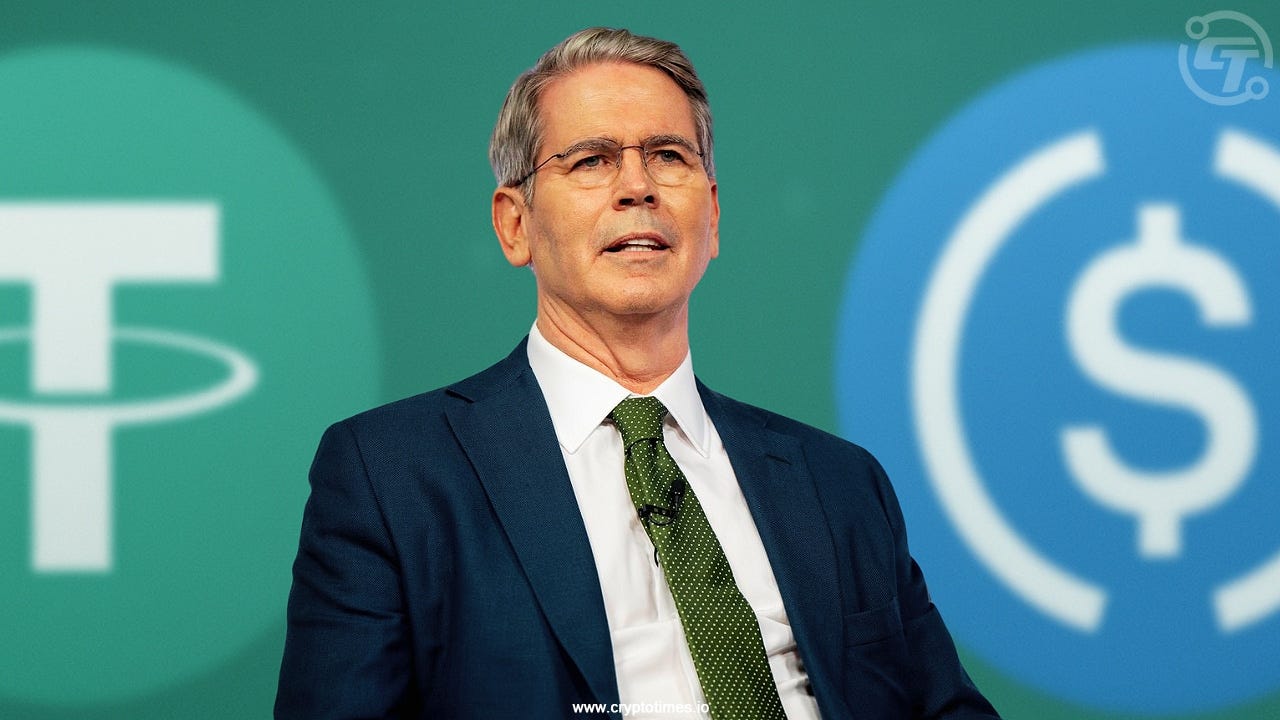
Notice what he says there: “… expand access to the dollar economy for billions across the globe.” That’s the master plan. The dollar is going global — again.
Take a look at some of the numbers. USDT alone has more than 550 million active users worldwide, with user growth running near 30 million per quarter through late 2025 and into early 2026. Total USDT in circulation is about $190 billion as of April this year, up from $118 billion at the start of 2025. In 2025, USDT processed $13.3 trillion in transaction volume. Total stablecoin transaction volume across the whole sector hit roughly $33 trillion. That’s more than Visa and Mastercard combined.
And interestingly, the adoption is taking off exactly where you’d suspect. Argentina, where annual inflation has exceeded 200% in recent years. Turkey. Lebanon. Nigeria. Venezuela. Across Africa and Latin America, USDT now accounts for roughly 85% of stablecoin payment volume. Tens of millions of ordinary people, holding what they think of as “digital dollars.” Not because they love America, but because their own currency is on fire.
Doug Casey has long called the U.S. dollar "the prettiest mare at the slaughterhouse." If ever there was a real-world illustration of that idea, this is it.
What It Means for You
But there’s a catch.
The petrodollar sponge absorbed trillions of dollars over decades. The stablecoin sponge currently holds roughly $200 billion in Treasuries. To replace what’s drying up, stablecoins need to scale ten or twenty times from here. That’s why Washington is pushing global adoption so hard. They need the new sponge to grow fast, while the old one is still functional enough to bridge the gap.
Now, you might think this is fine. The dollar survives. Reserve status holds. Deficits keep getting funded. What’s the problem for regular Americans?
Well, aside from continuing to fund Washington's war machine and ever-growing deficits, the real problem is the mechanism.
Unlike cash, stablecoins leave a record. Unlike cash, they can be frozen, transactions reversed, and access restricted.
Every dollar ultimately depends on intermediaries complying with government rules. They aren’t anonymous. And they aren’t fully yours to use without permission.
That’s not a bug. It’s the feature.
As I wrote in a recent essay, there probably won’t be a formal federal CBDC before 2030. But Washington isn’t waiting around. The replacement is being assembled right now—by the private sector, on government-approved rails, under government rules.
The cost of preserving dollar dominance may ultimately be paid by every American who once had the option of cash, privacy, and opting out. Those options are slowly being engineered away in the same legislation designed to preserve the dollar’s reserve-currency status.
Bottom line: If the dollar is going to survive de-dollarization, American financial freedom may not survive with it.
Regards,
Lau Vegys
Lau's writing is truly lucid, importantly instructive and helpful to understanding historical context for currency development, use, weaponization, and exchange. I am a bear of little brain but curious and
fairly patient. 'MMT only “works” if someone else is absorbing the new money' beautifullysums up so much. But by that point in this piece I sensed Lau was heading toward analysis of what Scott Bessant has been explaining in plain English regarding substitution of stable coin for the petrodollar regime. I recognize that Bessant is an extremely able architect of currency trading and assume that he has Trump's full confidence. I further assume he sincerely believes this pivot will allow the US to continue magical money shenanigans in a way that is better than embracing hyperinflation in order to monetize the debt. I don't know what the best way forward might be, but I fear that doing nothing will eventually collapse our economy in a manner that would ruin most people. Of course in either case Family Trump and most ultra wealthy people will find a way, a plan B, etc., to stay financially secure, with self determination and privacy intact. American financial freedom might not survive this new means of maintaining reserve status, if it comes to this. I do think Lau's made a very good case for that prediction. And obviously it would mean American politicians and the puppeteers behind them will still play big power politics and monetize war, on and on. I'm against all that. But normal Americans may well prefer more of the same than totally crashing against the wall of unsustainable deficit spending. Of course, Yes, slowly but surely the normal Americans are withering on the vine of so-called democratic capitalism and the gap between wealthy and poor is pitifully unsustainable. We have to change, somehow, for the better. So, Lau, can you suggest some reforms that might happen organically and peacefully that would help replace these unacceptable predictions in favor of a real sharing of the natural wealth and abundance that is more than sufficient for we people on this planet? I bet you can. Hope so.
You say BRICS keeps expanding. I haven’t heard any news to that effect. Do you have any details?