


I’m not sure if you saw, but our inaugural recommendation just a few days ago was a Western uranium company.
And the reason is simple: I’m extremely bullish on uranium.
Nuclear power is enjoying a revival across much of the world. That part is no longer exactly a secret.
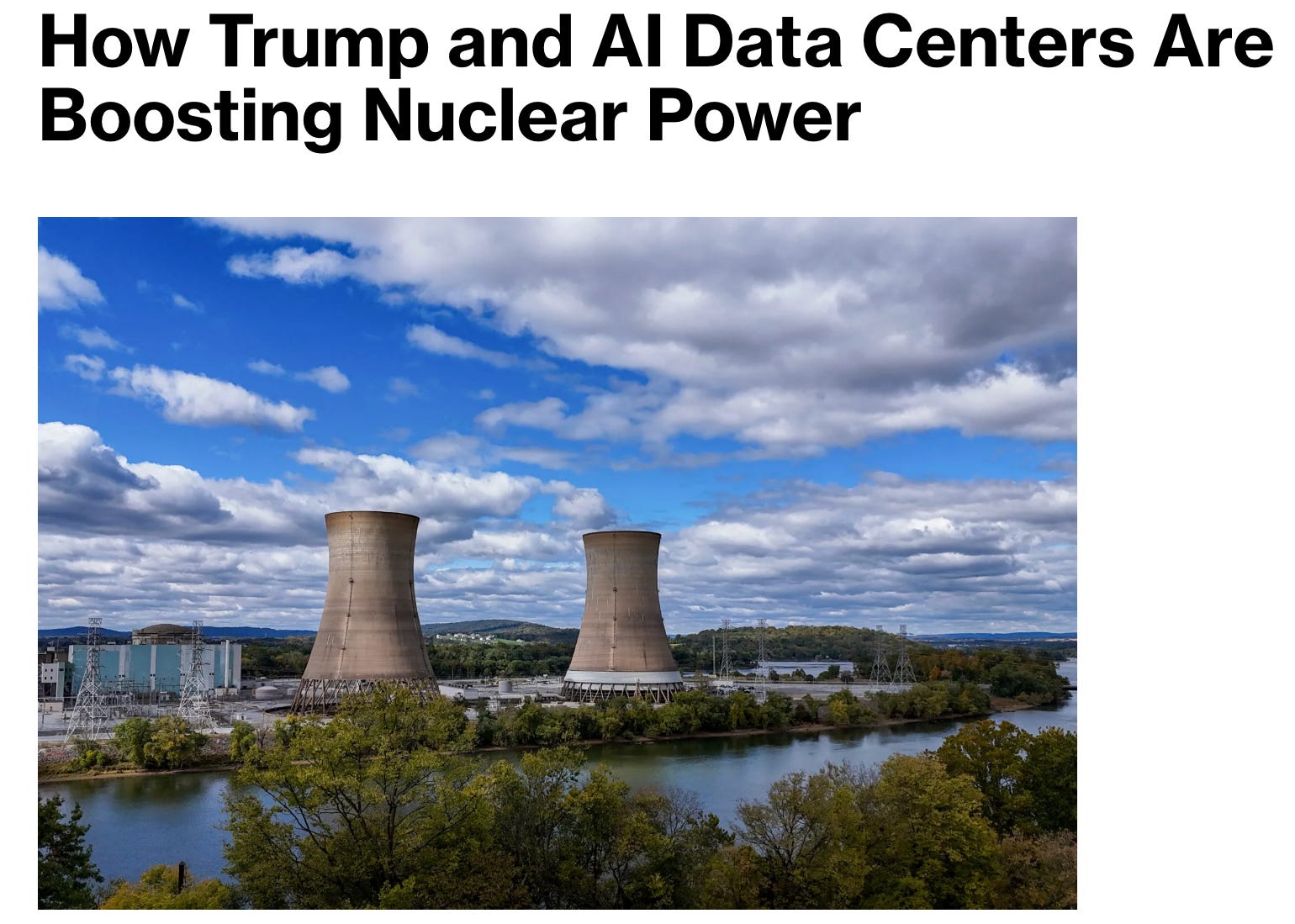
What’s less widely understood is that the real turn is happening in Asia. If you’ve been reading my recent essays, you’ve probably already seen a case in point: Japan and South Korea signed an agreement with the United States to jointly deploy small modular reactors, or SMRs, across Asia and beyond.
One of the things giving that push fresh urgency is the Strait of Hormuz. The recent fighting showed how quickly the oil and gas Asia depends on can be stranded at a single chokepoint.
And that deal is only one piece of a much larger Asian nuclear renaissance: Japan is restarting the reactors it shut down after Fukushima, South Korea is expanding its fleet, and China is building more nuclear capacity than any other country on earth.
More nuclear power, of course, means more uranium demand.
Pretty straightforward.
The Problem
But here comes the big caveat.
Being bullish on uranium doesn’t mean every uranium company deserves your money.
Strangely enough, the reason also goes back to Hormuz.
If you’ve been watching the markets lately, you’ve probably noticed uranium stocks selling off pretty much across the board, caught up in the broader market swings around every new development in the Strait.
At first glance, that doesn’t make much sense.
Uranium doesn’t sail through Hormuz. And a disruption there would, if anything, be good for the uranium price: less supply, the same growing demand, higher prices.
So why would uranium stocks fall because of it?
Because while uranium doesn’t pass through Hormuz, a critical input in producing it does.
And that’s where the opportunity comes in — because not every uranium company depends on it. I’ll get to that in a moment. But first, a little backstory.
You see, many of the world’s uranium mines use what’s called in-situ recovery, or ISR. Instead of digging an enormous open pit, miners inject a solution underground that dissolves the uranium from the surrounding rock. They then pump the uranium-bearing solution back to the surface and process it.
Some — and I emphasize some — use sulfuric acid.
As the name implies, sulfur is the main ingredient used to make sulfuric acid — and it’s the critical input I referred to earlier. Because sulfur is largely a byproduct of processing oil and natural gas, much of the world’s supply comes from the Persian Gulf and sails through the Strait of Hormuz.
In fact, roughly half of the world’s seaborne sulfur trade normally passes through the Strait.
So when the Strait turned into a shooting gallery this spring — and, by all reports, still is — those shipments largely stopped moving. As the Strait seized up, sulfur prices climbed roughly 70%.
Needless to say, that’s a big problem for a lot of industries, not just uranium. Fertilizer producers need sulfuric acid. Copper miners need it. Nickel and cobalt operations need it. And so they’ve all been competing for what’s left.
But then China made the situation even worse.
On April 10, Chinese authorities reportedly instructed producers to halt most sulfuric acid exports beginning May 1.
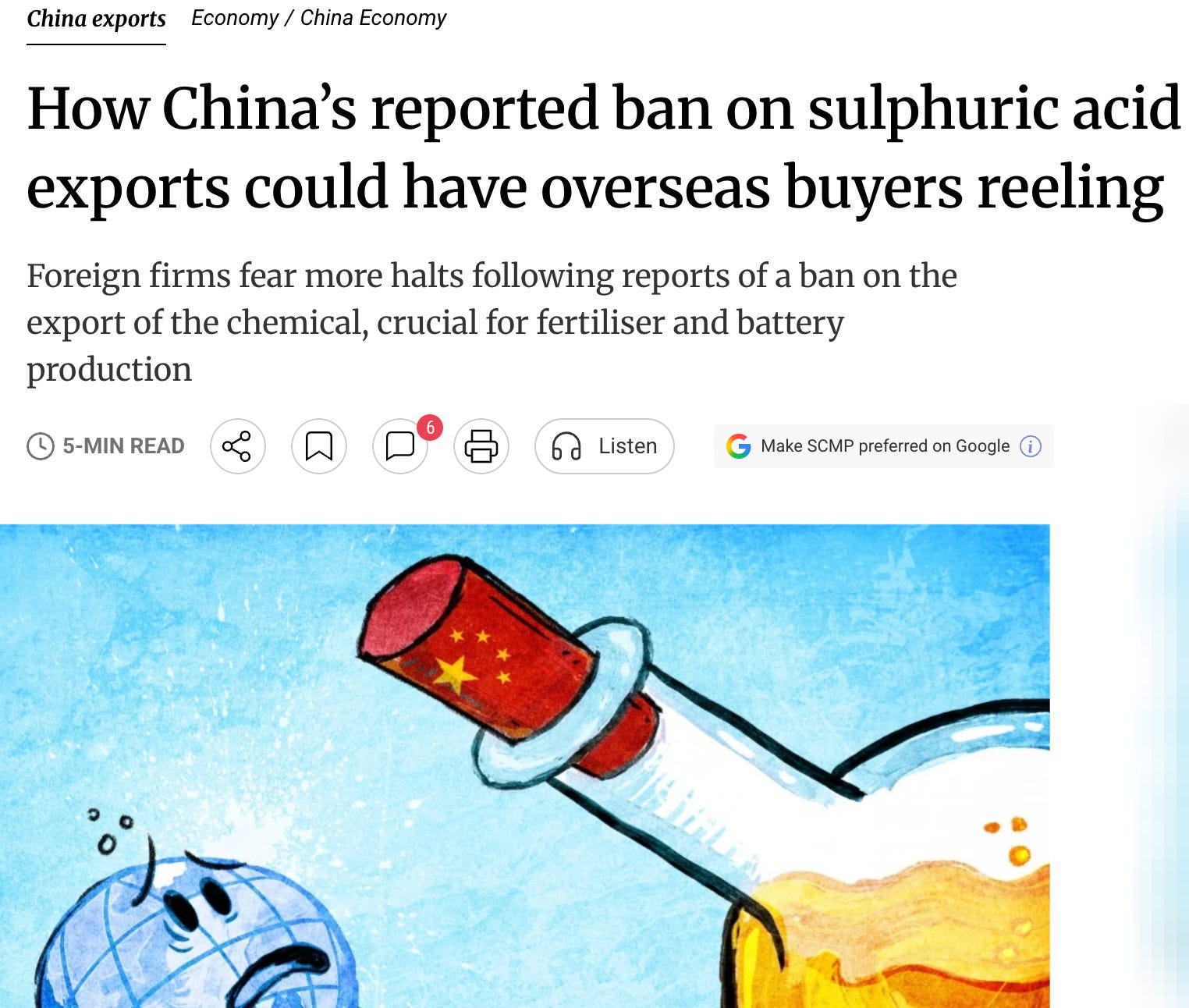
China, mind you, is the world’s largest sulfuric acid exporter, so the restrictions removed one of the market’s largest remaining sources of flexible supply almost overnight.
Incidentally, Russia has also restricted sulfur exports.
Countries don’t normally give up export revenue unless they’re worried about supplies at home.
Russia and China clearly are.
Bad for Some Companies. Great for Others.
Now, remember what I said about uranium producers not being equal — and the opportunity buried inside this crisis?
Well, that’s because not all uranium producers have a sulfur problem.
Some in-situ recovery operations use an entirely different chemistry: groundwater mixed with oxygen and sodium bicarbonate.
Baking soda, essentially.
The solution is injected into the uranium-bearing formation, where it dissolves the uranium underground. The uranium-bearing water is then pumped back to the surface, processed, and recirculated.
No sulfuric acid needed.
My point is that, as long as you’re looking at the right companies, a sulfuric acid shortage isn’t bearish for uranium.
It’s bullish.
And not only because some producers can use a different input to get uranium out of the ground.
It’s also because the biggest producer of all can’t.
That producer is Kazakhstan.
The former Soviet republic — which I’ve visited several times — isn’t some marginal player in the uranium market.
It’s the Saudi Arabia of uranium, producing about 40% of the world’s mined supply.
Most of that uranium comes from Kazatomprom, Kazakhstan’s state-controlled uranium company and the largest uranium producer in the world.
And its mines consume enormous quantities of sulfuric acid.
Interestingly, that was already becoming a serious problem before the latest fighting around Hormuz.
So what happens when you don’t have enough of the input needed to get uranium out of the ground?
You mine less of it.
In 2025, Kazatomprom produced roughly 5,000 metric tons less uranium than originally planned — a shortfall of about 17%. Sulfuric acid shortages were one of the main reasons.
To put that in perspective, that’s roughly 13 million pounds of U₃O₈ (yellowcake, the concentrated form of uranium produced by mines) — more than many publicly traded developers hope to produce over several years.
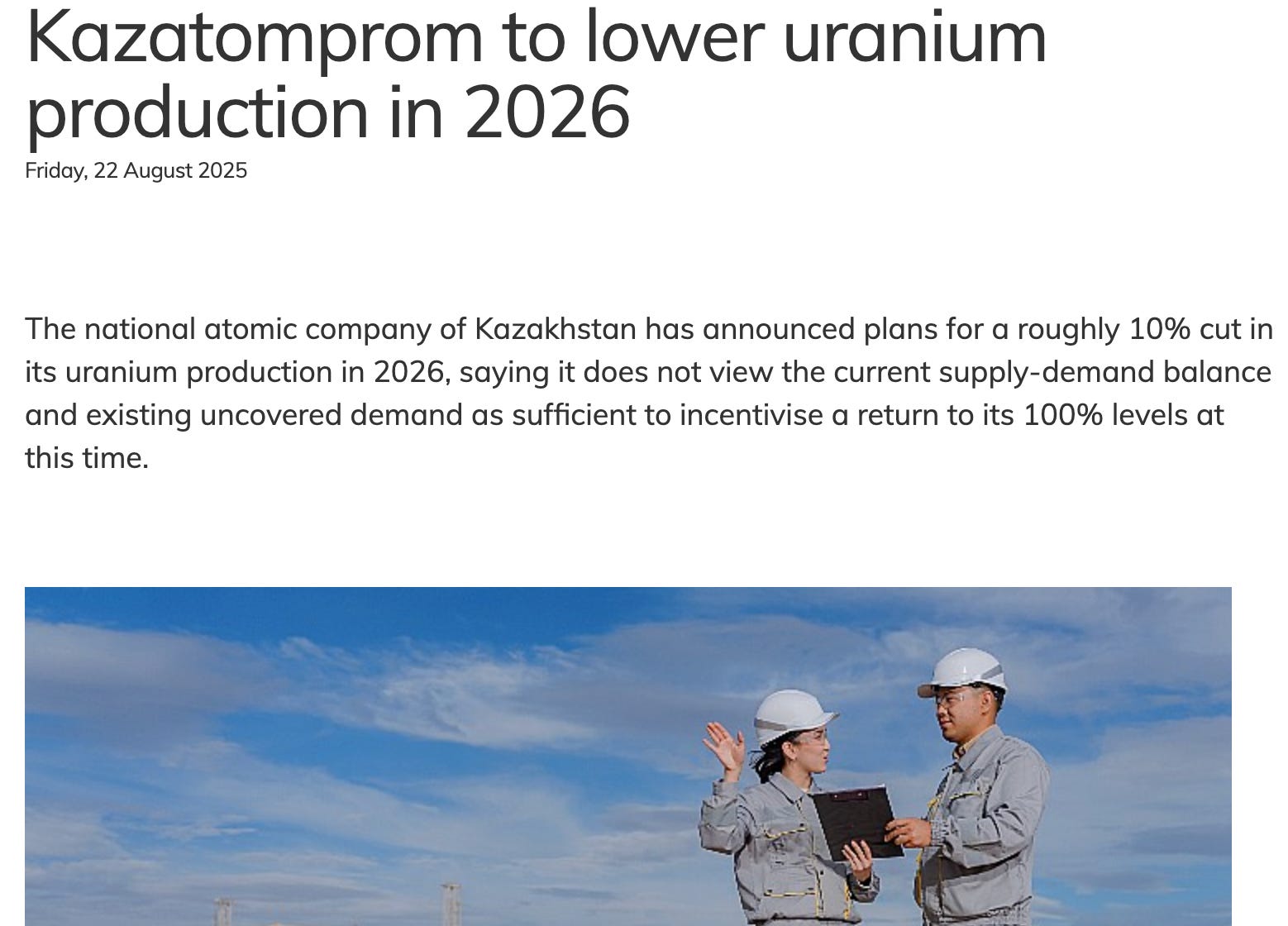
And lest you think that’s old news, Kazatomprom also cut its planned 2026 production by another 10%.
Less supply. More demand. Higher prices.
Economics 101.
And remember, all of this was already happening before Hormuz became a shooting gallery.
The Opportunity
All of this brings me back to SNAFU Investing’s first recommendation.
Last week, I recommended a producing uranium company on exactly the right side of the input divide I described above. Its operations run entirely on groundwater, oxygen, and sodium bicarbonate.
It doesn’t use a drop of sulfuric acid.
That wasn’t the only reason. The company is already producing and selling uranium today — and doing it in the West, just as Western utilities are scrambling for alternative supply. Remember, Russian enriched uranium is now effectively banned in the U.S.
But the sulfuric acid angle was an important part of the thesis.
Because the best uranium companies won’t merely benefit from higher uranium prices. They’ll benefit from the exact problems preventing their competitors from producing more.
Better still — and this is in the writeup too — the stock continues to trade at depressed levels, dragged down along with the rest of the sector.
The business has not suddenly become more dependent on Hormuz. If anything, the disruption has made one of its most overlooked advantages considerably more valuable.
The market can overlook that distinction in the short term. But in my experience, the economics eventually make it impossible to ignore.
The name, the numbers, and the buy-up-to price are all in the full writeup — the first recommendation in the SNAFU portfolio — for paid subscribers. (My broader uranium thesis is free, though, so you can see exactly why I’m this bullish.)
If you saw the launch a few days ago but you’re still on the fence, here’s your nudge. This is launch week, and launch week gets launch terms: $199 for the first year, instead of the standing $349. The offer closes Friday, July 17, at midnight New York time, and it only works through this link: www.snafuinvesting.com/launchweek. (Substack asks for your email first; the $199 shows up on the next screen. Outside the U.S., you’ll see the equivalent in your local currency.) When it closes, it’s gone.
Situation normal. Position accordingly.
Regards,
Lau Vegys
Thanks. I think baking soda is better for the environment than sulfuric acid too
Another thing that is manipulated with the same scenario is tungsten. BTW there's a company that mines fertilizer from the bottom of the ocean. So - let's not wastetoo much of our time on the Chinese sulfur...😁