



As I write this, the last U.S. midterm ballots are still being counted, but from the looks of it, the Democrats have taken both houses of Congress. So I figured this is a fitting moment to talk about another election result, one that came in last week a few thousand miles south, because it probably has more to do with your money than you might think.
Especially since about a month ago I ran a piece by my friend Joel Bowman, who writes Notes from the End of the World from Buenos Aires, on the Liberty Spring sweeping South America. Brazil, the continent’s biggest economy, looked like it would be next. In the first round, Flávio Bolsonaro, the conservative senator and son of former president Jair Bolsonaro, beat Lula, the incumbent socialist president, outright, and his party became the largest in both houses of Congress.
Well, Joel has an update on that now. And it’s not a good one.
How it happened is his story, and he tells it below. Long story short: Bolsonaro was declared the loser, was ordered to hand over his passports, and ended up on the next flight out, over the border into Argentina and on to Miami.
Fittingly, Joel opens his piece with a quote from Stalin that goes right to the heart of what happened there. As someone who was born in the USSR, I can confirm: the votes were never the important part of an election.
Anyway, this is where we get to why an investor should care. Brazil is not just another emerging market with messy politics. It is one of the handful of countries that physically supply the metals and energy the world runs on. Take a look at the chart below, which shows Brazil’s share of world output across the metals and energy that matter, along with where it ranks.
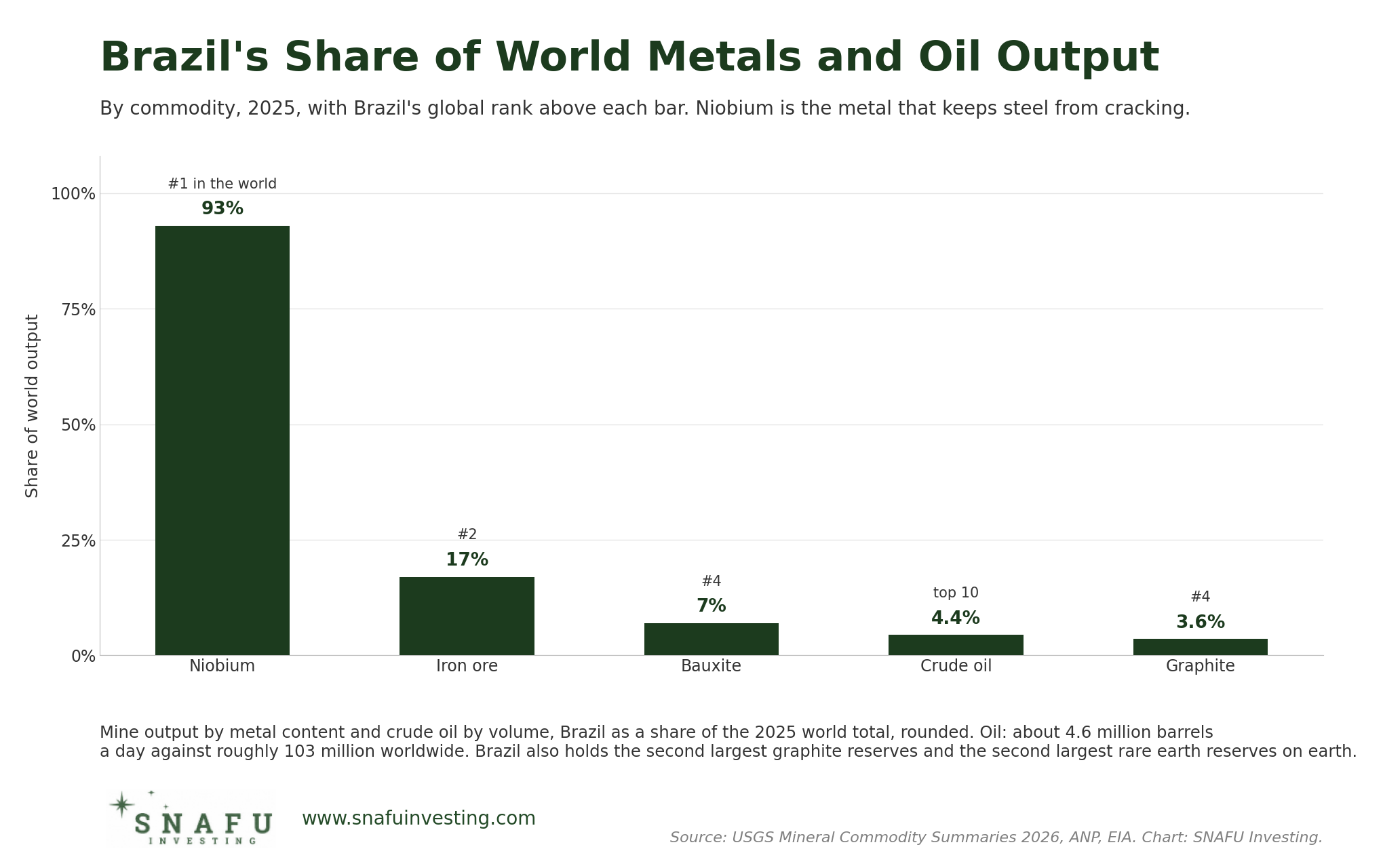
As you can see, Brazil has an impressive résumé:
The second-largest iron ore producer on earth (Vale, Brazil’s mining giant, ships more of it than any company outside Australia).
A top-ten oil producer (the offshore pre-salt fields pump more than 4.5 million barrels a day, well ahead of Kuwait).
Top five in bauxite, the ore you make aluminum from, and in graphite, which goes into every lithium-ion battery.
More than 90% of the world’s niobium (the metal you add to steel so it doesn’t crack in a pipeline or a jet engine).
Underneath all that, the second-largest graphite and rare earth reserves in the world.
Long story short, if you own stocks, Brazil is probably already in your life, directly or through the price of the steel, aluminum, and oil that everything else is built on.
Which is why what just happened is a tragedy, and not only for Brazilians.
The socialists are back for four more years, and they came back the way socialists usually do: with the courts, the police, and the electoral authority all pulling in the same direction. A country that should be one of the great resource investments of this century is, as far as I’m concerned, largely uninvestable for the foreseeable future.
I say largely because there are always exceptions. Specific assets, specific operators, cash flows hard enough to survive almost anything. But these are exceptions rather than the rule. And in Brazil, you now know exactly who still makes the rules.
Capital had already started voting with its feet. Equinox Gold, a Canadian mid-tier gold miner, sold its entire Brazilian gold business recently to China’s CMOC, for over a billion dollars, so it could concentrate on North America. Anglo American, one of the world’s biggest mining houses, let its Barro Alto nickel mine go to China Minmetals.
I could go on, but I’ve kept you from Joel long enough.
Enjoy the piece, and be sure to check out more of his writing over at Notes from the End of the World.
Counting the Votes
By Joel Bowman, editor of Notes from the End of the World
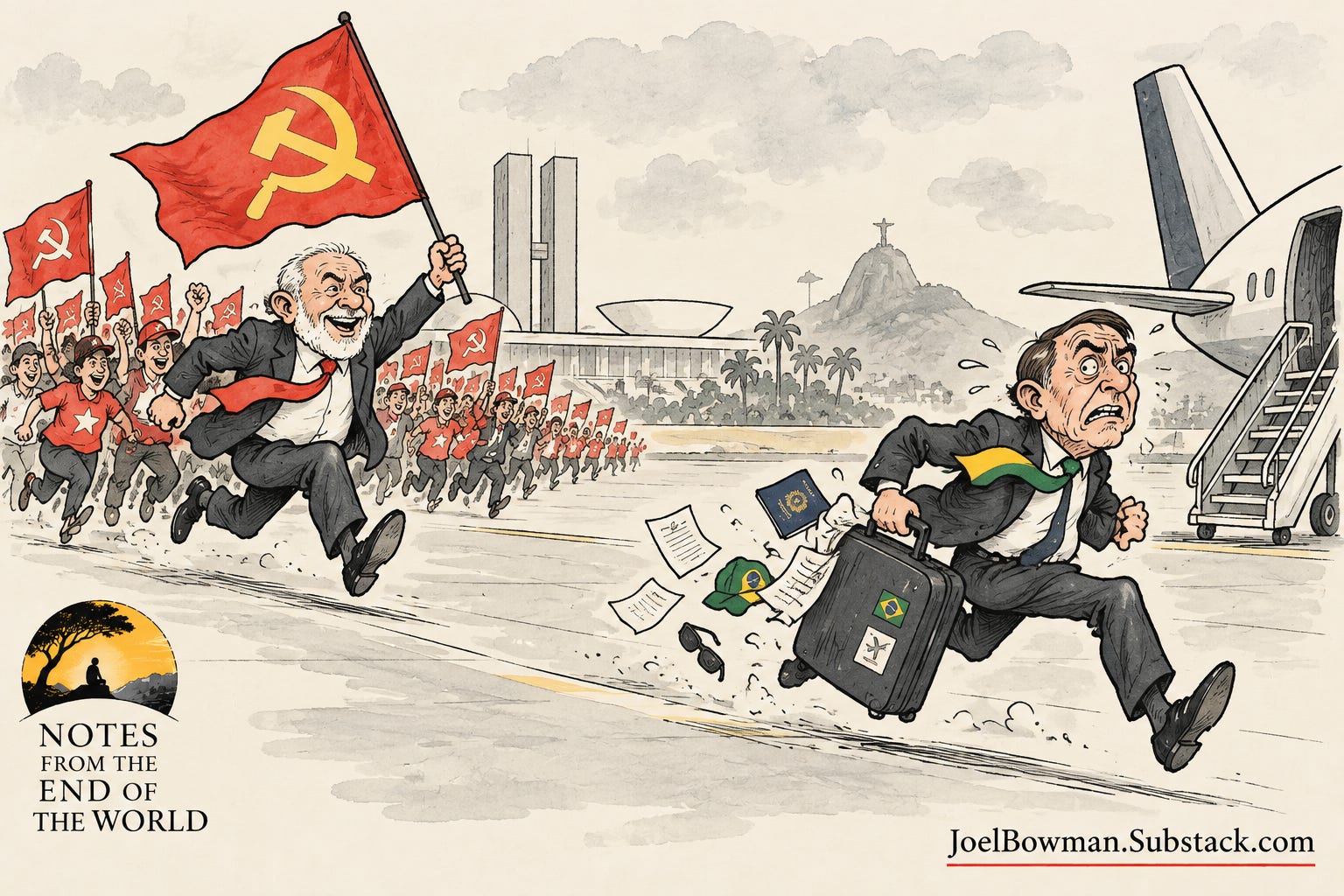
“It’s not the votes that count, but who counts the votes.”
~ Joseph Stalin
Joel Bowman with today’s Note From the End of the World: Buenos Aires, Argentina...
Palhaçada. (Pah-lyah-SAH-dah)
That’s the Brazilian slang for “clown show,” a helpful noun for those trying to make sense of the election shenanigans in South America’s largest economy this past week.
To briefly recap: Three weeks ago, Flavio Bolsonaro’s conservative (PL) party pulled off a surprise win over Luiz Inácio Lula da Silva’s incumbent socialist (PT) party at the polls. The conservatives won both the house and the senate, in which they maintain strong majorities... for the moment.
But neither presidential candidate crossed the requisite 50% mark to secure victory outright, thus sending voters back to the polls to choose between the two leading candidates this past weekend.
Bolsonaro and his voters were understandably optimistic, having won with 56.1 million votes to Lula’s 53.9 million. Plus, most of the independent candidates (who were eliminated in the first round), were “right” or “center-right” leaning, and threw in against Lula, a career socialist. They carried around 9 million votes between them, most of which were expected to fall to Bolsonaro... or simply stay home.
Betting markets, like Polymarket, had Bolsonaro Jr. the favorite to win by as much as 95-5%.
Then came election day.
He Who Counts
Midway through Sunday’s vote, Supreme Federal Court (STF) Justice Cristiano Zanin granted Lula’s request for a two-hour extension. Zanin, readers will be shocked (shocked!) to learn, served as Lula’s longtime personal defense lawyer.
The final count:
Lula: 64.1 million votes (+10.2M)
Bolsonaro: 59.8 million votes (+3.7M)
In other words, Lula apparently found – somewhere beneath the country’s couch cushions, no doubt – over a million more votes than every single independent candidate received in the first round... combined.
Skeptical?
According to an analysis by Paris Group published by Folha:
Flávio Bolsonaro received zero votes in 106 precincts where Lula garnered 14,860. Furthermore, in 3,042 precincts, Flávio reached a maximum of 10 votes, while Lula reached 400,000. Polling experts consider it “statistically impossible.”
After Lula’s unlikely – some would argue, legitimately impossible – victory, Bolsonaro, was ordered to surrender his passports to the federal police.
The order, handed down by Lula’s henchman Alexandre de Moraes, came just seven (7) minutes after the results of the election were officially called, and seemed to make good on a thinly-veiled threat Lula made during a televised debate just days before the event.


“You think you’ve already won the election?” Lula turned to his opponent, before looking directly into the camera to address the viewers. “You prepare. You prepare because on the 25th [election day], you’ll lose your immunity. You’d better prepare yourself. You’ll lose your immunity and you’re going to be in trouble.”
Flight to Safety
Flavio must have felt like it was déjà vu all over again. His father, Jair, had his passports confiscated after he lost to Lula in the last election. He is now serving a 27-year sentence for “plotting a coup to remain in power after losing Brazil’s 2022 presidential election to Lula.”
South American politics as usual, in other words…
That said, having one’s travel documents seized without even being charged (never mind convicted) of a crime does appear somewhat at odds with the kind of basic political freedoms for which many in the west still hold a candle.
None too keen on sharing his father’s fate, Bolsonaro skipped over the land border to neighboring Argentina, where he boarded a plane bound for the United States. He disembarked in Miami, with his family, on the morning of October 28.
Back in the Amazon of Democracy, meanwhile, Lula’s lackeys wasted no time going after his political opponents, rallying the federales and issuing more threats. Here’s PT congressman Jilmar Tatto, saying the quiet part out loud on the House floor on October 28.
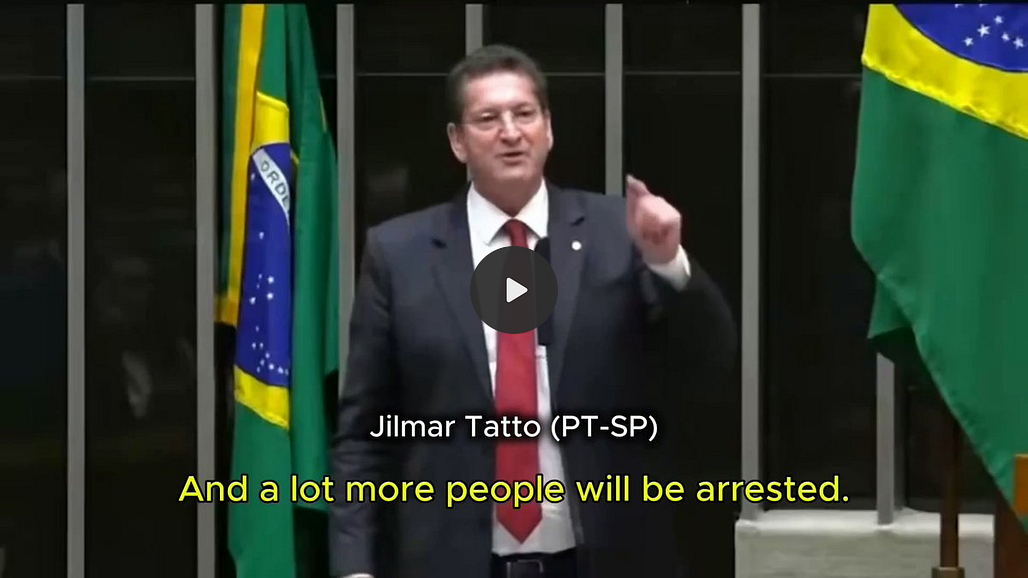
“I have information from the Federal Police that they’re going to arrest many Bolsonaro supporters.”
And right on cue, federal deputy-elect Pedro Rousseff (great-nephew of former president and card-carrying Lula apparatchik, Dilma Rousseff), has called for the detention of Congressman Nikolas Ferreira’s passport, citing “an alleged insult against President Luiz Inácio Lula da Silva (PT), in July 2024.”
Comrades-in-Arms
Now, how might you expect such actions to be met by our brave democracy defenders around the world, those ardent champions of voter’s rights and a political process free and fair of corruption and intimidation? Might they have a “tut-tut” in their windy bag of remonstrations, a “tsk-tsk” for their naughty comrade-in-arms? Don’t hold your breath…
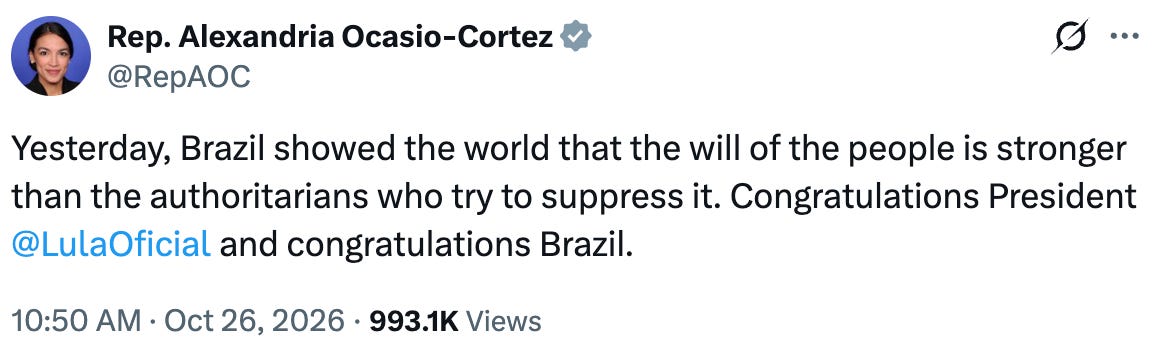
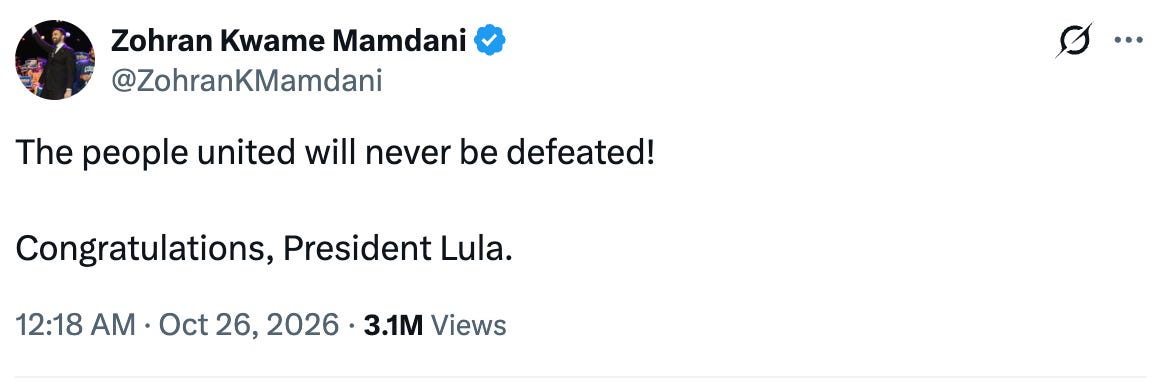
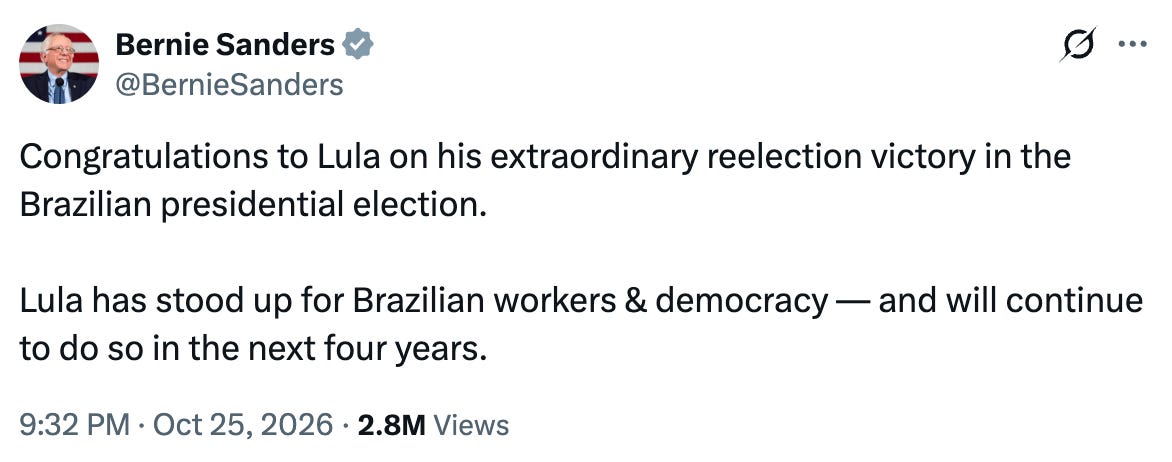
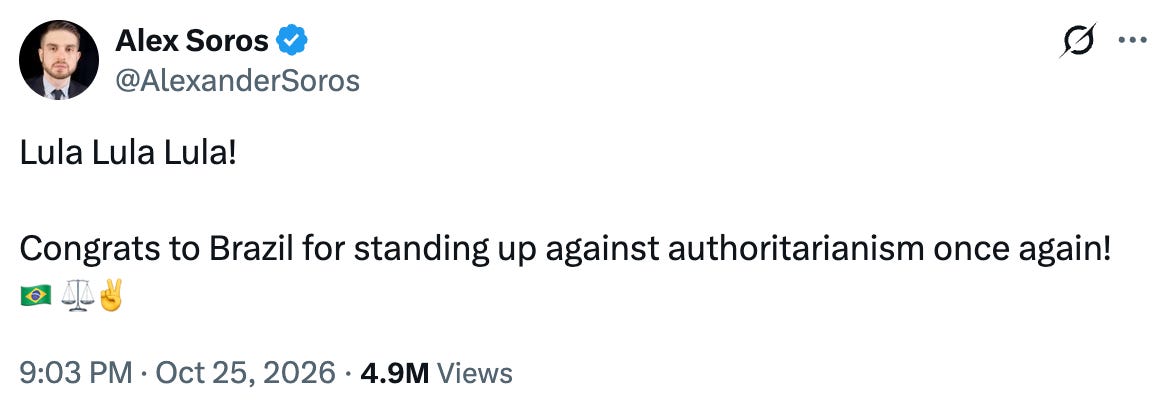
Apparently, the authoritarian is not the one in charge of the nation’s security forces, its jails and police, its kangaroo courts, its electoral system, and the state-subsidized media...
It’s not the one whose former personal lawyer changes the rules of the election on the day... or who orders travel bans on his political opponents minutes after the election results are declared...
It’s the guy fleeing the country... his father under lock and key... their party members, who stand to get it in the neck next... and the voters themselves, who are already facing calls for mass media censorship to combat the age-old nemesis of actual authoritarians everywhere: “Misinformation.”
For those vanishing few voters around the world still blissfully unaccustomed to election fraud, intimidation tactics, lawfare, retributive justice, etc. the events of the past few days may come as a shock.
For the rest of us, it’s politics as usual.
Stay tuned for more Notes From the End of the World...
Cheers,
Joel Bowman
Lau’s Note: Interested in more of Joel’s writing? Be sure to head over to Notes from the End of the World.

Pretty sad. I've traveled to Brasil and Argentina extensively. 25 years ago, the two countries had a healthy rivalry on the surface but we're headed in opposite directions.
Argentina had elected Nestor Kirchner and the Argentine Peso was about 3:1 against the dollar. He (and subsequently his wife) imposed coniscatory taxes, largely on farmers. They seized pensions, nationalized several industries, defaulted several times on the country's debt, and likely assassinated several political opponents. The country was in a funk. The Peso utterly collapsed.
Brasil was the opposite, full of optimism. Having emerged from years of military dictatorship and political instability, the citizenry were guarded against government overreach. True, Lula served two terms, but he was largely kept in check and had to govern closer to the center even if he campaigned from the Left.
Today, the roles are somewhat reversed. Argentina isn't thriving, but it's on a much better path than it had been under years of Kirchner corruption. Brasil? Spiraling down. When Lula returned through a stolen election four years ago, it appears he vowed never to let the voters make another mistake of electing a non-left leader. The optimism from decades ago is gone. It appears the country will need to learn the painful lessons the Kirchner taught the Argentines. Pity.
I appreciate your viewpoint and historical perspective and have in the past enjoyed Joel's writing, but I did a quick AI check about the legitimacy of the Brazilian election. The results flatly contradict Joel's article. What am I missing? Here's the Gemini response to my query:
Prominent independent political analysts, international observers, and judicial bodies widely view the October 25, 2026, re-election of leftist President Luiz Inácio Lula da Silva as highly accurate, clean, and transparent.
While the defeated right-wing candidate, Senator Flávio Bolsonaro, fled to the United States and alleged "electoral fraud", independent experts and institutional bodies have overwhelmingly rejected these claims.
Broad Institutional and Expert Consensus
• Independent and International Observers: Organizations monitoring the election, such as experts aligned with historical observation frameworks like the Carter Center, reported no evidence of systemic or significant fraud. Academic experts in Brazilian studies have re-verified that the country's electronic voting and counting systems remain secure and trustworthy.
• The Brazilian Judiciary: The president of Brazil's Superior Court of Justice officially characterized the runoff as a "clean and transparent" election, explicitly dismissing any grounds for a fraud investigation.
• Bolsonaro’s Own Coalition: In a significant blow to the fraud narrative, key figures within Flávio Bolsonaro’s political camp have accepted the results. The head of his own Liberal Party (PL), Valdemar Costa Neto, as well as his campaign manager, Rogério Marinho, publicly stated there is no evidence to support claims of a stolen election. Prominent right-wing allies, such as São Paulo Governor Tarcísio de Freitas, also stated that the election results must be respected.
Analysis of the "Surprise" Turnaround
Political analysts from outlets like CounterPunch and independent labor researchers point out that while Lula’s victory was a historic comeback—overcoming a 2-million-vote deficit from the first round—the mechanism behind it was structurally sound and traceable to specific campaign shifts rather than irregularities:
• The Leftist Coalition: Lula assembled a massive "Brazil Ready for More" alliance that brought together a polarized spectrum ranging from the radical left and the Brazilian Socialist Party to center-right figures like Vice President Geraldo Alckmin.
• Aggressive Ground Game and Digital Overhaul: Independent analysts highlight that the three weeks between the rounds saw a massive surge in youth turnout, highly organized grassroots student demonstrations, and a revamped digital strategy designed to actively combat far-right misinformation networks.
• Incumbent Social Spending: Analysts note that the Lula administration utilized public policy to secure poorer demographics, implementing a 15% increase in Bolsa Família welfare payments and fuel subsidies shortly before the runoff.
Ultimately, autonomous political data and independent watchdogs conclude that the razor-thin margin (51.79% to 48.21%) accurately reflects a deeply polarized electorate rather than any operational manipulation of the vote.