

Last week was one of those weeks. SpaceX went public on Friday in what was the largest IPO in history. At one point during its debut trading session, the company briefly touched a market value north of $2.25 trillion, and by the closing bell Elon Musk had become — on paper, at least — the world’s first trillionaire.
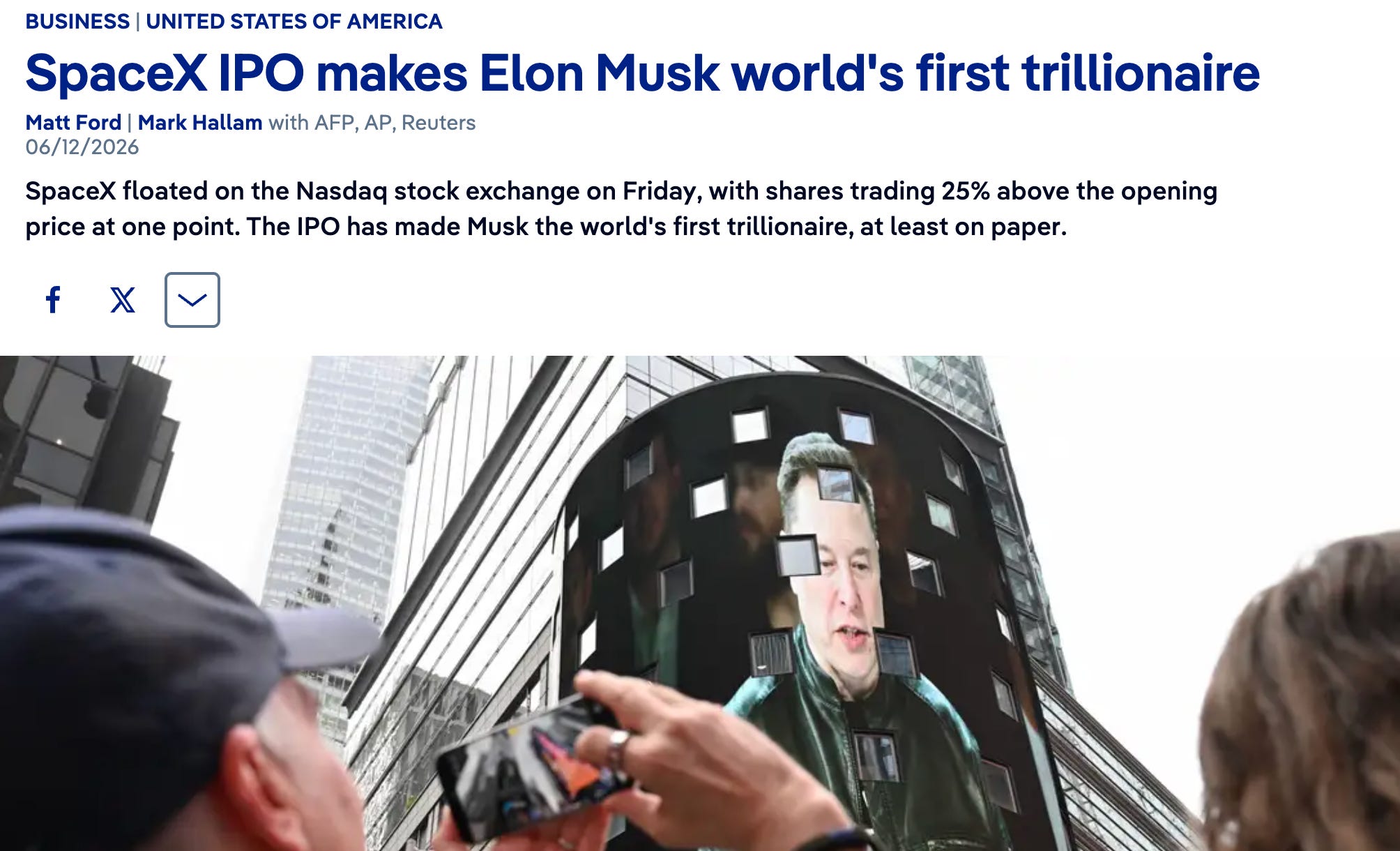
Interestingly, at the press conference, Musk himself was pretty candid about his doubts. “We’re probably gonna fail,” he said, “but we should give it a try because if we don’t, we will never be a truly space faring civilization.” Look, I appreciate the vision. Few people have done more to lift our eyes back up at the stars. But not at this valuation, and not on my dime. In fact, I’ll go further: I think SpaceX will trade meaningfully lower a year from now, and quite possibly before year-end. The forced index buying I wrote about last week can paper over the math for a while — but only for a while. This is a company losing roughly $6 billion a year, with an entire money-losing division — the newly combined xAI/X business — having nothing to do with rockets at all.
On that note, here's a clip of how I think this one's likely to go. (Trajectory only — you'll see what I mean.)
On a somewhat related note, I also have to remind you that earlier this month, Comrade Bernie Sanders formally rolled out his AI Sovereign Wealth Fund Act. It's a simple idea, really: the U.S. government takes a 50% stake in every major AI company by force, holds it in a sovereign wealth fund, and pays out the proceeds to every American as a dividend.
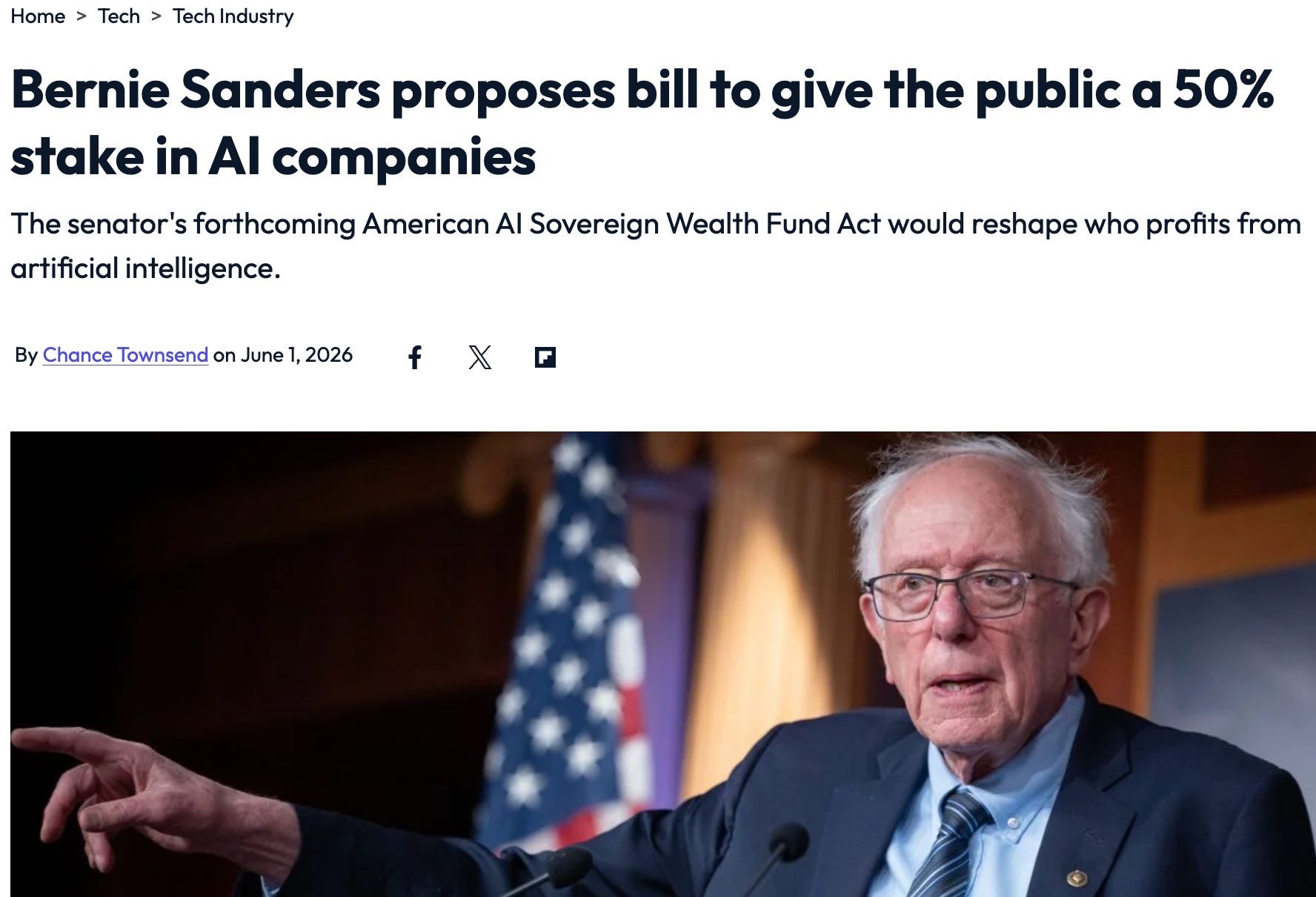
Now, Bernie’s diagnosis isn't entirely wrong — power is concentrating in a small AI cartel, on a scale we haven't seen in a century. But his solution is completely bonkers. On one hand, it's basically a bailout — every one of these companies is bleeding money (OpenAI on track to lose $14 billion this year, xAI burning a billion a month, as I wrote about recently). And that dividend check the whole scheme is supposed to fund? Years away at best. That's assuming these companies ever turn a profit at all. On the other, it's full state-corporate fusion — which, at its actual structural definition (the merger of state and corporate power), is starting to look an awful lot like fascism. I'll probably have more to say on this in the coming days.
Meanwhile, the May jobs report dropped this week and caught everyone flat-footed. 172,000 jobs added against a consensus of 85,000, unemployment steady at 4.3%. Sounds like good news. In practice, it's the opposite — at least from the market's perspective. That’s because a print this hot tells the Fed it's unlikely to cut rates anytime soon.
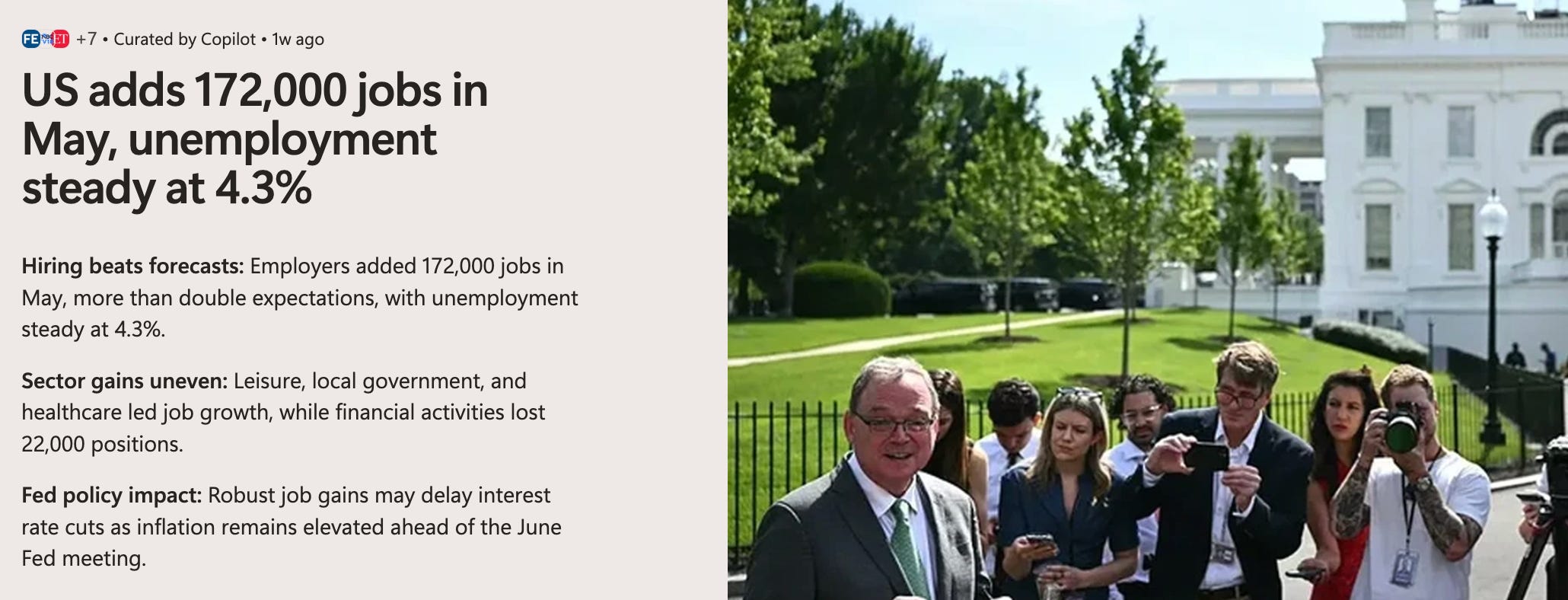
By Friday, futures had flipped from pricing in a cut later this year to pricing in a 70% chance of an actual rate hike before year-end. The market did not love it: Nasdaq -4% on Friday alone (worst session since April 2025), S&P -2.55% on the week. It’ll be interesting to see how this digests over the next few sessions, especially on top of last week’s action.
Over in the metals corner, gold is still sitting at roughly $4,340 as I write this, well off its January peak near $5,600. And that’s despite central banks continuing to buy in size — they added another 244 tonnes in Q1 alone, and China has been buying for eighteen straight months. The financial press still treats gold as last year’s story. The central bankers apparently don’t.
And now for the latest pieces…


From the Comments
One of the things I’ve come to appreciate most about writing here is the conversation that happens in the comments. The thinking that shows up there often sharpens my own, and adds dimensions I’d never have thought to include. With that in mind, here are five reader observations from last week that stuck with me:


Thanks again to everyone who left a comment last week. I read all of them, even the ones I don’t get a chance to reply to individually. Over the coming days, I’ll try to catch up on the questions and the longer threads.
See you in the comments this week.
Regards,
Lau Vegys
All of the government investing in companies will end not well for the public at large. The government is not a bastion of smarts. This is a bad ending written all over it.
Bernie Sanders … I’m amazed.